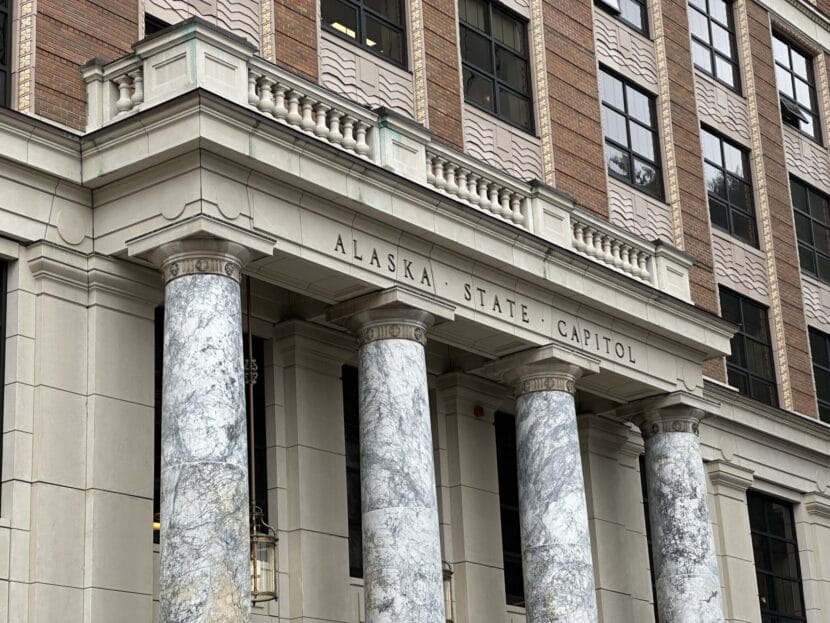
The Alaska State Capitol on March 25, 2024. (Eric Stone/Alaska Public Media)
Alaska’s state government is increasingly failing to keep up with requirements in state and federal law, the state’s nonpartisan auditor told a group of lawmakers on Wednesday.
Legislative Auditor Kris Curtis said she identified dozens of accounting and compliance issues in her agency’s most recent audit. Those range from the Department of Corrections overspending its budget to the Division of Public Assistance failing to process SNAP and Medicaid applications on time.
“What we’re seeing is vacancies, we’re seeing turnover, we’re seeing poor training, we’re seeing a lack of written procedures,” Curtis said in an interview.
Employee turnover and hiring have been areas of particular interest for legislators seeking to reinstitute a pension system for state employees.
Among the issues Curtis spotlighted are errors in the state’s procurement process. She said her team pulled samples of state purchases across various departments and found that roughly a third failed to comply with state rules. That means they either didn’t follow state law, or didn’t maintain the documentation backing up those purchases, Curtis said.
“I think one of the biggest concerns is making sure the state is obtaining the best possible price,” she said.
Curtis found the state also failed to bill the federal government for nearly $280 million in pandemic-era federal aid funding in a timely manner — and that means the state lost out on more than $9 million worth of interest it could have earned in the meantime.
Gov. Mike Dunleavy’s administration disputes some of the auditor’s findings, chalking them up to differences in interpreting state and federal law. Curtis says the report is meant to help state agencies improve and spotlight areas that lawmakers can help them do so.
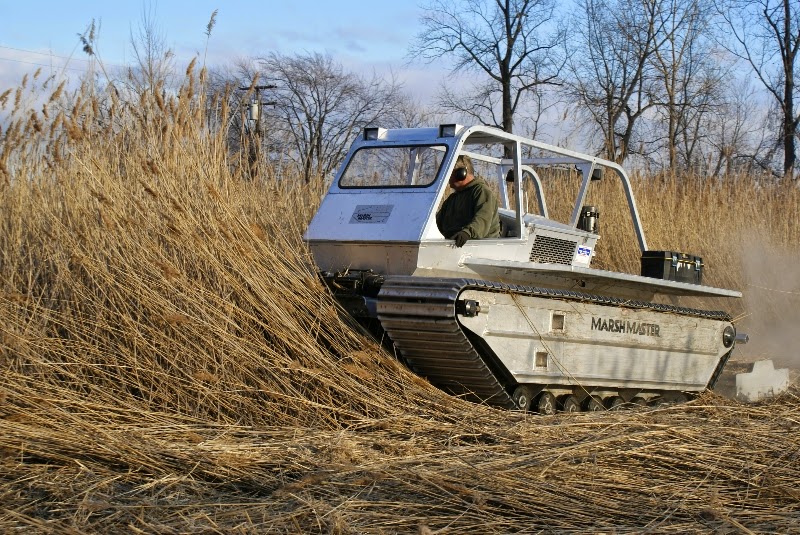
A Marsh Master vehicle drives off-road in a field. (Coast Machinery LLC)
Earlier this week, the Juneau Assembly approved spending $320,200 in mostly federal grant funding to purchase an amphibious wetland rescue vehicle for the Juneau International Airport.
The vehicle is called the Marsh Master MM-2MX. At the Assembly meeting on Monday, City Manager Katie Koester said emergency responders would use the vehicle to rescue people who get stranded in wetland areas surrounding the airport.
“The reason that this response vehicle is necessary is if there were to be an accident, an airplane crash in that area, we would need to allow emergency responders to respond quickly and in large volume to that event,” she said.
The approved purchase includes a $300,200 grant from the Federal Aviation Administration and $20,000 from the airport budget in local matching funds. Airport Manager Andres Delgado said the vehicle can be used in a variety of emergency situations.
“As far as its water capabilities, it does float, and it can traverse ice and muskeg and really harsh terrain as well,” he said.
The airport’s board of directors approved the purchase last month. The Assembly approval came this week, despite Mayor Beth Weldon and Assembly member Neil Steininger voting against it. Weldon served as a division chief at Capital City Fire/Rescue for two decades. She said she didn’t think the amphibious vehicle was necessary.
“I appreciate us trying to get a specialized piece of equipment, but as people know, I come from the fire department. I have seen these, and I just don’t see it as something that we need right now,” she said.
CCFR Chief Rich Etheridge said the department typically responds to three to four incidents a year in the wetlands. People sometimes get trapped there when the tides come in behind them. The ongoing maintenance of the vehicle will be paid for out of the airport’s budget.
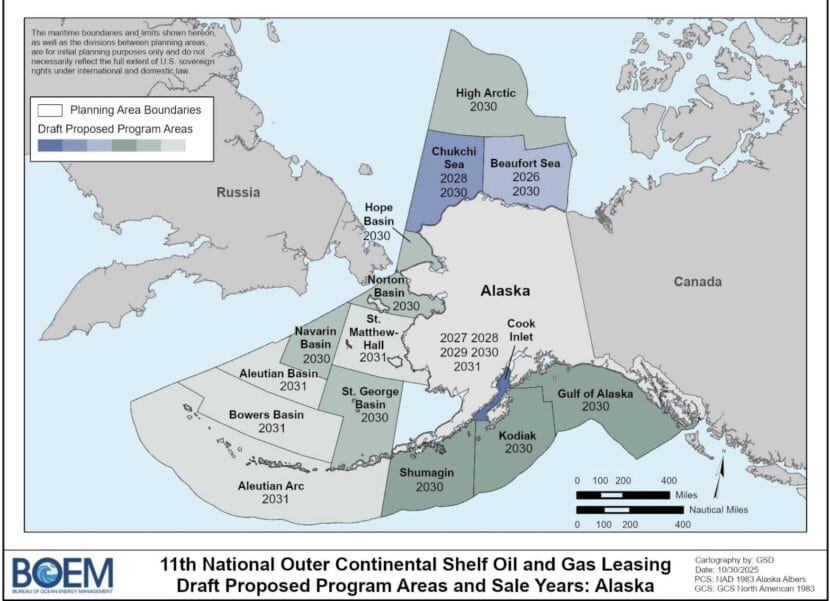
This map shows offshore areas the Trump administration wants to open for potential oil and gas leases. (Bureau of Ocean Energy Management)
WASHINGTON — The Trump administration proposes to open nearly all of the oceans off Alaska to potential oil and gas drilling.
The draft offshore leasing plan includes the Bering Sea, the Gulf of Alaska and other areas important to the fishing industry. It’s part of a national proposal that includes the entire coast of California, where drilling is fiercely unpopular.
“By moving forward with the development of a robust, forward-thinking leasing plan, we are ensuring that America’s offshore industry stays strong, our workers stay employed, and our nation remains energy dominant for decades to come,” Interior Secretary Doug Burgum said in an emailed announcement.
The top Democrat on the U.S. House Natural Resources Committee, Rep. Jared Huffman of California, pledged to fight, in court and in Congress. Huffman said it doesn’t make sense for Alaska either.
“I just think it’s incredibly reckless,” he said. “I mean, we know what the seafood economy means to the state of Alaska.”
The plan goes beyond what Alaska advocates of offshore development have favored in the past. In 2018, Alaska’s all-Republican delegation to Congress praised an offshore plan that included lease sales in Cook Inlet and the Chukchi and Beaufort seas. But they asked the first Trump administration to remove the Bering Sea and the Gulf from consideration.
The plan released Thursday is a “first analysis,” with two more planned before final approval. If it survives, the first lease sale would be in the Beaufort.
It’s not clear oil companies would be interested. Shell spent 10 years and $7 billion trying to drill there before giving up on offshore Arctic exploration.
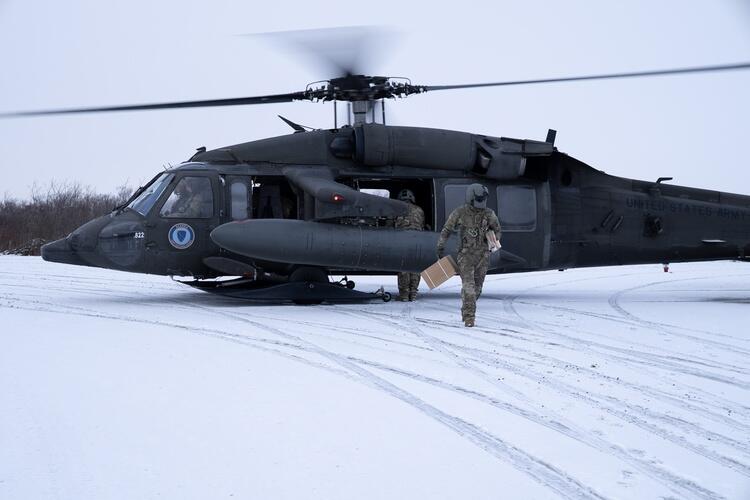
U.S. Army National Guard UH-60L Black Hawk aviators, assigned to the 207th Aviation Troop Command, transport supplies to Napakiak, Alaska, Nov. 19, 2025, while supporting Operation Halong Response efforts. (Tech. Sgt. Daniel Robles/U.S. Air National Guard)
Officials with the Alaska National Guard said they are preparing and training a response force of 100 service members to deploy to Washington D.C. and support civil authorities, as directed by the Pentagon and Gov. Mike Dunleavy.
The update on Tuesday from Maj. Gen. Torrence Saxe, Adjutant General of the Alaska National Guard and Commissioner of the Alaska Department of Military and Veterans Affairs, was in response to a letter from state legislators on the Alaska Joint Armed Services Committee. The lawmakers raised concerns around the implications of a Pentagon directive to Alaska to prepare 350 National Guard personnel for rapid deployment for “civil disturbance operations.”
In his letter, Saxe said Gov. Mike Dunleavy requested that the force be deployed to Washington D.C. to join a joint federal task force in March of 2026.
A spokesperson with the governor’s office confirmed Thursday the request came from the U.S. Secretary of the Army and Dunleavy approved it.
“Governor Dunleavy approved the request because he wants to help the Trump Administration restore public trust and improve the quality of life in the nation’s capital,” said Jeff Turner, the governor’s director of communications, by email.
But the request may turn out to be moot, after a federal judge temporarily blocked the deployments to Washington D.C. on Thursday, declaring the use of troops is likely unlawful. There is a pause on the order until Dec. 11, which gives the Trump administration time to appeal.
Turner declined to comment on the federal ruling.
Saxe said in the letter that 100 Alaska service members are being trained to align with “national level requirements.”
“The team will consist of Alaska Army and Air National Guard personnel trained in mission sets that may include site security, roadblocks and checkpoints, civil disturbance control, critical infrastructure protection, and personnel security,” Saxe wrote. “All training activities are integrated into existing unit schedules and do not alter the organization’s operational commitments.”
The Alaska National Guard is currently active in the disaster relief effort after Typhoon Halong devastated communities of Western Alaska, with an estimated 200 service members deployed there, officials said.
Saxe repeated that the development of this “quick response force” is not new for the National Guard, and it will be structured to “respond quickly to protect lives, property, and critical infrastructure.”
“At the request of Alaska Gov. Mike Dunleavy, members of the Alaska NGRF (National Guard Response Force) will activate to Washington, D.C., in March 2026 to support Joint Task Force–District of Columbia, a federally coordinated effort that brings together National Guard elements, civic leaders, and partner agencies to enhance safety, stewardship, and community engagement,” he wrote.
Officials with the National Guard declined interview requests on Wednesday and Thursday.
In August, officials with the governor’s office said there were “no plans” to deploy the Alaska National Guard to Washington D.C., as reported by the Anchorage Daily News.
The Trump administration’s deployment of National Guard troops to primarily Democratic-led cities has been challenged and repeatedly blocked as illegal in federal courts. On Monday, a Tennessee judge barred the National Guard deployment to Memphis, and said it was only allowable if there was a rebellion or invasion. On Thursday, a federal judge temporarily ordered an end to the monthslong deployment of National Guard to Washington D.C. to tackle crime, declaring the use of troops as likely unlawful.
Rep. Andrew Gray, D-Anchorage and co-chair of the Alaska Joint Armed Services Committee, said he was grateful for the commissioner’s response and additional information on the specialized force, but remains concerned about the capacity and purpose of such a mission.
“It’s important to note that the American taxpayer will be paying their salary while they’re on this mission. They’ll be paying for their room and board,” he said. “So when the National Guard does a mission like this, we just don’t have unlimited money. So we are redirecting money away from training and work here in Alaska.”
Gray said while the Trump administration may have the authority to call the National Guard to Washington, a federal district, he remains concerned at military service members being deployed against civilians and used for police or immigration enforcement.
“Are these police departments saying that they’re overrun, that they’re unable to perform their law enforcement mission, that they need to have their force doubled, tripled, quadrupled in numbers?” he said. “Because that’s what’s happening.”
There are currently 2,866 National Guard service members enlisted in the state, with 1,676 in the Alaska Air National Guard and 1,190 in the Alaska Army National Guard.
Gray, a veteran of the Alaska National Guard who deployed to Kosovo in 2019, said he also worries about the erosion of trust and regard for the military doing these kinds of missions, and deploying against civilians.
“I love the U.S. military. I am proud of my service in the Alaska Army National Guard,” he said. “I think this is going to hurt the military’s standing in the public’s mind. I think that this is going to cause folks to lose some of the admiration that has been so foundational in our country for the military. Our country has long admired, respected and praised its military, and the moves that we are seeing, directed by Secretary Pete Hegseth and the President of the United States are going to lose our military’s standing, not only internationally, but domestically as well.”
Gray said he has requested a meeting with Saxe, and is asking for continued public communication and transparency as the quick response force is developed.
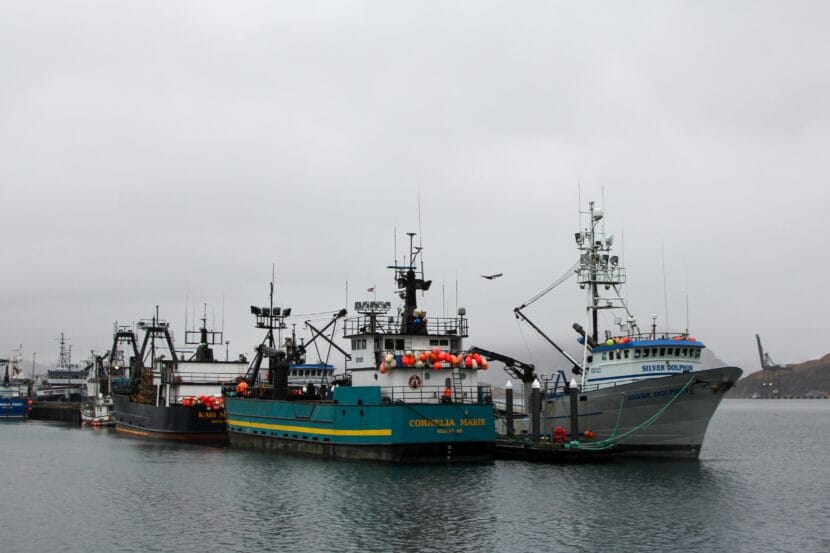
The trade group Alaska Bering Sea Crabbers coordinated with harvesters, processors and communities to ask Gov. Mike Dunleavy to request a federal disaster declaration, which the U.S. Secretary of Commerce approved in May 2023.
Relief money started going out earlier this year, first for community members and seafood processors, and now for captains and crewmembers. But Jamie Goen, the executive director of Alaska Bering Sea Crabbers, says fishermen should not have to wait years for relief.
“It needs to be within six months so that it’s useful for these families that are trying to make monthly payments,” Goen said. “Waiting four-to-six years to get your paycheck, that just doesn’t work for most families.”
Crab stocks have been recovering from the crashes a few years ago. The season that opened last month looks promising, but the rebound has been slow.
Dunleavy submitted another, separate disaster declaration for last season, which saw only minimal improvement from the previous year. But Goen says the goal isn’t more relief — it’s a stable fishery.
“We want to be fishing,” Goen said. “We don’t want to be asking for fisheries disasters.”
Eligible captains and crew have until the end of the year to apply for aid. Applications and information are available online.
Phil Gouvey checks out groceries at Foodland IGA on Wednesday, Nov. 19, 2025. (Photo by Clarise Larson/KTOO)
Before Thursday, when you would grab some groceries or pay your utility bill, Juneau’s city government taxed most residents at 5%. But now, that tax has dropped to zero percent for everyone, regardless of their income or age.
Phil Gouveia was buying groceries at Foodland IGA on Wednesday afternoon. He said he’s excited for the changes and to see some extra cash back in his pocket.
“Yeah, it’s gonna help me. I’m 70 years old. I’m on a pension, so groceries keep going up, but my pension doesn’t,” he said.
The exemptions officially take effect on Thursday, 30 days after the fall election results were certified. The proposition passed with nearly 70% of voter approval.
Deputy City Manager Robert Barr said the roll out of the exemptions should be pretty hands-off for most residents. He said the city is working with businesses on implementing it, but it may take some time before all retailers are under the new system.
“Our goal was to implement this in a way that was as easy for residents as possible, so most residents shouldn’t have to do much, if anything,” he said.
The exemptions apply to the same food items that qualify under the Supplemental Nutrition Assistance Program, also known as SNAP or food stamps. That includes foods like fruits and vegetables, meat and dairy, bread and cereals — and cookies and ice cream. But it doesn’t cover hot food — like a rotisserie chicken — or meals from restaurants.
“What qualifies as food is largely groceries, things that you would buy from the grocery store and prepare at home, or things that are intended to be consumed off-site,” he said.
The utilities exemptions apply to residential electricity, heating oil or propane, water and sewer and garbage and recycling.
Alec Mesdag is the CEO of Alaska Electric Light & Power, or AEL&P, Juneau’s sole electricity provider. It serves more than 16,000 customers. Mesdag said the logistics of rolling out the exemptions are challenging and complex due to AEL&P’s large number of customers and having to verify which accounts are for residential use versus commercial.
Despite that, he said the company is actively working with customers to ensure those who are eligible receive the exemption as soon as possible.
“What we intend to do is go through our list and apply the exemption as broadly as possible, but excluding certain accounts that appear to us to be highly likely to be not eligible to receive the exemption,” he said.
Mesdag said AEL&P is sending out letters to customers to inform them which accounts have received the tax exemption and which have not.
While the exemptions are expected to put some extra cash back into residents’ wallets, it in turn means the city is expected to face a $6.4 million hole in its budget this fiscal year. And, each year moving forward, the city will face an estimated $12 million revenue loss from both the tax exemption on food and utilities and the separate cap on the city’s property tax rate that voters also passed.
City officials and the Juneau Assembly will be grappling with potential service cuts in the coming months.
Close
Update notification options
Subscribe to notifications
Subscribe
Get notifications about news related to the topics you care about. You can unsubscribe anytime.