Government

Johnson will lead Alaska House minority after a shakeup that has conservatives crying foul

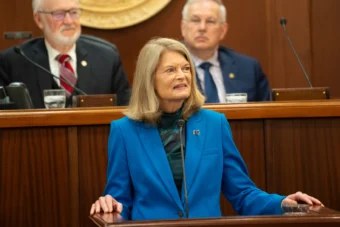
Woman in committee room
Rep. DeLena Johnson, R-Palmer, speaks during a House Finance Committee meeting on March 28, 2024. (Eric Stone/Alaska Public Media)

Republicans in the Alaska House have a new leader. Palmer Rep. DeLena Johnson replaced Anchorage Rep. Mia Costello as minority leader on Saturday after a hastily-called vote. And some members of the caucus are crying foul.

Alaska Public Media’s state government reporter, Eric Stone, joined Alaska News Nightly host Casey Grove to break down the transition.

The following transcript has been edited for clarity.

Casey Grove: So, Eric, what happened over the Thanksgiving holiday?

Eric Stone: Well, the story starts a little before that. In mid-November, a couple of Republican lawmakers approached Mia Costello. One of those was DeLena Johnson. She was a little hesitant to tell me exactly how that meeting went, but she told me she did not go into it looking to force Costello out.

Shortly after that, Costello stepped down as minority leader. Here’s what she told me about why.

Mia Costello: I stepped aside because it was clear that I was not able to unite the caucus, and I felt that it was time for somebody else to give it a shot that everyone could unite behind

ES: That, of course, left the House minority caucus without a leader. And it’s a big task to unite a pretty ideologically diverse Republican caucus that has struggled with internal divisions. Some are staunch allies of Gov. Mike Dunleavy, and some have voted on several occasions to override the governor’s vetoes.

But into that vacuum stepped DeLena Johnson. On Saturday, she called a caucus meeting over Zoom, basically just to talk about the way forward. By the end of it, there was a vote, and Johnson won.

Johnson says she wasn’t planning to call a vote. But she says the subject came up organically, so the caucus went ahead and voted. Here’s how she put it.

DeLena Johnson: I’m looking at it thinking, “Well, if the votes don’t change, and they’re not going to change, well, let’s just take the vote now, and then we can just start moving along.”

ES: But here’s the thing: not everybody was there. In fact, six Republicans were absent — basically, the most conservative members. Folks like Big Lake Rep. Kevin McCabe, Homer Rep. Sarah Vance, Anchorage Rep. Jamie Allard and Fairbanks Rep. Frank Tomaszewski.

CG: Not to mention two districts that don’t have any representatives at all.

ES: That’s right — after Reps. Cathy Tilton and George Rauscher got kicked across the Capitol to the Senate to replace Sens. Mike Shower and Shelley Hughes, two districts don’t have anyone in the House, at least not yet. And all of that is a major sticking point for conservatives like McCabe — not least because he’d like to be minority leader himself.

Kevin McCabe: If I had been there — I was also in the running, there were some folks that were supporting me — we could have maybe at least had a debate instead of just a coronation.

ES: Of course, it might not have changed the outcome of the vote. It does not sound to me like McCabe had the votes to lead the House Republicans. But he says the decision to hold the vote — without telling the caucus it was coming — robbed him and other conservatives of a chance to make their case and possibly change some minds.

Johnson says she wanted to have the vote sooner rather than later, actually in part because of those two vacancies.

DeLena Johnson: There’s some desire to have some leadership as we move through the next month, because we have two new members that we’re going to have to interview, and then we will have to go through a mini-reorganization process for our new members, shuffling around committees and assigning committees.

ES: Gov. Mike Dunleavy appoints the replacement representatives, but they are subject to a confirmation vote by House Republicans. And Tilton’s elevation to the Senate along with Costello’s stepping aside left the caucus without any leadership — Tilton was the minority whip, the number two in the caucus.

In any case, Johnson says she’d be happy to hold more discussions and votes about caucus leadership.

CG: So the Republican caucus has a new leader. What does that mean for how the legislative session will go this year?

ES: That’s a little harder to say. If you ask McCabe, he says the leadership transition is a move towards the center for the Republican minority.

Kevin McCabe: There is a push from inside our caucus to do that, mainly because they think it will allow them the ability to elect representatives — more moderate representatives that are least Republican in name — from Anchorage. I think that’s a mistake. But yes, there is a push to to drive us to a more centrist position

ES: Johnson rejects that view — she does not see it as a move towards the center. And she says she’s excited about the work ahead. She calls this a “rough patch” but says she’s hoping the House minority can push some Republican priorities forward this session.

DeLena Johnson: There’s a lot of different things out there. We’ve got the movement on the gas line on the national front — we have a lot of eyes on Alaska. And I hope, and I want our house minority, our Republican minority (to have) the opportunity to really be a part of a solution on a number of those things.

ES: But this might not be over. I asked McCabe whether the move has him considering whether to leave the minority caucus. Here’s what he said.

Kevin McCabe: You just never know what’s going to happen in in the legislature

CG: I’ve got to say, that doesn’t sound like a no.

ES: It does not. So there might be some more turbulence ahead.

Juneau revives task force to tackle big tourism questions

Cruise ship passengers walk down the docks in downtown Juneau on Wednesday, July 9, 2025. (Photo by Clarise Larson/KTOO)

With major cruise tourism developments on the horizon in the capital city, the City and Borough of Juneau is resurrecting a task force to look at whether its current approach to managing tourism is working.  

At a Juneau Assembly committee meeting Monday night, members approved the relaunch of the Visitor Industry Task Force and its members. Mayor Beth Weldon said the task force will be crucial in informing the direction the city takes to guide any future growth. 

“There is some issues that need to be addressed, and our tourism director relies heavily on these recommendations on how to move forward with her job,” she said. 

Juneau saw another record-breaking cruise ship tourism season this past summer, with more than 1.7 million passengers coming off ships and into town. 

The task force launches as Goldbelt Incorporated is planning a new $500 million cruise ship port on the backside of Douglas Island. And, that plan coincides with another dock development by Huna Totem Corp., an Alaska Native village corporation based in Hoonah. The Assembly approved the corporation’s plan to build a new cruise ship dock in downtown Juneau this spring. 

Weldon said she wants the task force to make big picture recommendations, like a 10-year tourism plan for Juneau. She also wants them to tackle more specific issues like addressing crowding and congestion in Auke Bay, regulating the whale watching industry and reducing ship emissions.  

Juneau Assembly member Ella Adkison will chair the committee, along with eight members that Weldon handpicked. They are Kirby Day, Kirsa Hughes-Skandijs, Sarah Lowell, Matt Catterson, Meilani Schijvens, Adrienne Scott, Shem Sooter and Jeremy Timothy.

Some members are returning from the previous task force, which originally sunsetted in 2020. Weldon said they represent a wide range of perspectives on tourism’s future. 

“I would say this community is no longer deadly against — as a community as a whole — deadly against tourism,” she said. “Nor are we a community that’s opening our gates wide for tourism.”

The task force has until the end of June to submit its recommendations to the Assembly. The first ship of the 2026 cruise season is slated to arrive in late April. 

Ten years after Alaska-B.C. mining agreement, environmental group says state is falling short

Acid drainage from the Tulsequah Chief Mine, discolors a leaking containment pond next to the Tulsequah River in British Columbia in 2013. (Photo courtesy Chris Miller/Trout Unlimited)

Ten years ago, the state of Alaska signed an agreement with British Columbia that sought to give Alaskans a say in the development of mines upstream of Southeast Alaska. Environmental advocates say Gov. Mike Dunleavy’s administration has walked away from key pillars of that agreement — but state officials say they remain committed to keeping cross-border rivers clean.

It’s a boom time for mines in British Columbia. There are a few reasons for that — the rise of renewable energy and the growing importance of microchips, and, of course, President Trump’s trade war. Provincial leaders have fast-tracked a variety of resource development projects — including some proposed mines upstream of communities in Southeast Alaska.

“The majority of this region is staked with mining claims,” said Breanna Walker with the group Salmon Beyond Borders, which has campaigned for stricter limits on mines near rivers that cross into Southeast Alaska.

Ten years ago, Gov. Bill Walker signed an agreement with the premier of British Columbia that he said would give Alaskans a greater voice in the future of B.C. mines. It led to the creation of a working group where senior officials from Alaska and B.C. would meet twice a year to discuss mining and the environment.

Breanna Walker says that was a reason for optimism — but she says in the years since, the Dunleavy administration has failed to live up to its commitments.

She pointed to a variety of issues, including the Dunleavy administration’s decision to discontinue water quality monitoring on cross-border rivers in 2021. Walker said she’d also like to see the meetings between provincial and state leaders include other stakeholders, like Alaska tribes and fishermen.

Additionally, Walker said the Dunleavy administration has failed to keep up the pressure on B.C. to clean up the Tulsequah Chief Mine upstream of Juneau that’s been polluting the Taku River for decades. And she said the state has failed to keep Alaskans informed about other mining activity and pollution upstream of Southeast — despite a portion of the agreement that says Alaskans should be notified.

Walker points in particular to pollution at a mine near Hyder, at the state’s southeastern tip.

“Alaskans learned about that pollution through the media. They did not learn about that from the state or from the province of British Columbia,” she said. “That’s a clear example, in my opinion, of how the state is abdicating the responsibility that they have to Alaskans.”

The Dunleavy administration disagrees. State officials point to webpages maintained by the state and B.C. detailing the ongoing work between the two governments. And they say the water quality monitoring that ended in 2021 duplicated similar efforts at the federal level.

Sam Dapcevich of the state Department of Environmental Conservation said the state has continued to advocate for Alaskans’ interests at working group meetings.

“DEC is fully engaged and working with our B.C. counterparts on activity awareness and status of projects,” he said.

Just last month, at the most recent cross-border meeting, Dapcevich said the Alaska delegation asked for an update on the cleanup of the Tulsequah Chief Mine. And in response, the company working on cleanup is planning to hold a public webinar on Wednesday.

“I just want people to understand that our agencies are deeply involved between the two governments, advocating for cleanup, and we’re using shared science to protect these rivers,” he said.

Dapcevich said the state remains committed to ensuring Alaskans’ voices aren’t lost in the process.

Pebble Mine, halted by EPA order, gets support from national development groups

Kaskanak Creek in the Bristol Bay’s Kvichak watershed is seen from the air on Sept. 27, 2011. The Kvichak watershed would be damaged by the Pebble mine project, the Environmental Protection Agency has determined.
(Environmental Protection Agency)

Developers’ efforts to overturn the cancellation of a vast gold and copper mine planned for southwest Alaska are getting a boost from national mining and pro-business groups, including the U.S. Chamber of Commerce.

On Nov. 24 and Nov. 25, the Chamber and the National Mining Association filed separate friend-of-the-court briefs in the lawsuit brought by the developers of the proposed Pebble Mine against the Environmental Protection Agency, which vetoed the mine.

Neither group has intervened in the case against the EPA, but the briefs represent the groups’ support for the proposed mine and offer legal arguments that Judge Sharon Gleason could consider as she debates whether to move the project forward.

In 2023, the EPA invoked a rarely used “veto” clause of the Clean Water Act to say that there was no way that the proposed Pebble Mine could be developed without significant harm to the environment. The large mineral deposit is located at the headwaters of Bristol Bay, the most abundant sockeye salmon fishery in the world.

The administration of Gov. Mike Dunleavy, which supports the project, and the proposed mine’s developers, filed separate lawsuits in federal court to overturn the rejection, as did two Native corporations that work as contractors for the developers. Those cases have since been combined.

The U.S. Supreme Court declined to hear the case directly, which has left the issue in front of Judge Sharon Gleason in the U.S. District Court for the District of Alaska.

Another lawsuit filed by the state claims that if the veto is upheld, the federal government will owe Alaska $700 billion, the state’s estimate for the value of the mine if built as planned. That case has been put on hold until the District Court rules.

In July, the administration of President Donald Trump indicated that it might try to settle the suit and withdraw the veto. If that occurs, it could come before Jan. 2, when the EPA is slated to file a written response to the plaintiffs’ motions for summary judgment.

If the EPA continues to fight the case, the last written arguments are scheduled to be finished by the end of February. Any oral argument would take place afterward.

If the federal government drops the case, it doesn’t mean a free path for Pebble: Several environmental organizations, fishing groups, tribal organizations and Bristol Bay locals have also intervened in the case and intend to fight in court.

The Alaska Legislature is also expected to consider a bill that would block both Pebble and any successor projects that might emerge.

In its brief, the National Mining Association — joined by the American Exploration and Mining Association and the Alaska Miners Association — call the EPA’s veto “overly broad” and say that if it is upheld, the act “will almost certainly chill investment in domestic mining activities” because other proposed mines could also be subject to a veto.

The Chamber of Commerce, which has backed the Pebble Mine project since at least 2022, said that if the veto is upheld, it has the potential of encouraging other vetoes, which would “disrupt important industries in which many of the Chamber’s members participate.”

Dunleavy appoints Rauscher and Tilton to Alaska Senate, opening two House vacancies

Speaker of the House Cathy Tilton, R-Wasilla, talks to fellow lawmakers about rules for debate on House Bill 183 on Saturday, May 11, 2024. (Photo by James Brooks/Alaska Beacon)

Gov. Mike Dunleavy has appointed state Reps. George Rauscher, R-Sutton, and Cathy Tilton, R-Wasilla, to two vacancies in the Alaska Senate.

Each nomination will become effective if at least five of the Senate’s nine other Republicans approve them. Senate President Gary Stevens, R-Kodiak, said the votes will take place by secret ballot at 10 a.m. Saturday in Anchorage.

“Honestly, I think both of them are excellent candidates,” Stevens said on Wednesday, adding that he expects both to be confirmed.

If Rauscher and Tilton are confirmed, their House seats would become vacant, and Dunleavy would be required to appoint replacements within 30 days of their resignations.

The two Senate seats became vacant after Sen. Mike Shower, R-Wasilla, resigned to run for lieutenant governor and Sen. Shelley Hughes, R-Palmer, resigned to run for governor.

The office of former Sen. Mike Shower, R-Wasilla, is seen in the Alaska state Capitol on Tuesday, Nov. 25, 2025. Shower’s nameplate has been removed from beside the door, but a sticker commemorating Shower’s time as an F-22 fighter pilot remains on the door. (Photo by James Brooks/Alaska Beacon)

Dunleavy’s picks were due no more than 30 days after their resignations, but he acted earlier, which will allow the replacement legislators to take office before the regular legislative session convenes in January.

“I can’t think of two Alaskans more qualified and committed to public service to serve in the Alaska Senate than Representatives Rauscher and Tilton,” Dunleavy said in a statement announcing the selections. “I have known and worked with both for as long as I have been in public office and I look forward to working collaboratively with them as senators. I also want to thank the local Republican district committees for taking the time to meet, deliberate, and send forward names for these seats. This process works best when the people closest to the communities are involved.”

Tilton, first elected to the House in 2014, was Speaker of the House from 2023 through 2024. Reached by phone on Wednesday in the middle of Thanksgiving shopping, she referred to a statement on her Facebook page.

“I look forward to collaborating with my Senate colleagues to advance sensible policy solutions, foster an energy renaissance, and usher in an era of renewed prosperity for all Alaskans,” the statement said in part.

Rep. George Rauscher, R-Sutton, speaks in favor of the creation of an Alaska Department of Agriculture by executive order on Wednesday, March 19, 2025. (Photo by James Brooks/Alaska Beacon)

Rauscher said he’s already at work on a letter thanking Dunleavy for his appointment, but he declined to say what he thinks his confirmation chances are.

“It’s an honor,” Rauscher said of the appointment, “and I feel like it was quite the undertaking — the process — and to have it this close to seeing what the final outcome is, is always a relief in some ways, but it’s also very exciting that I am this close. So I appreciate the fact that the governor did consider me and thought highly enough of me to appoint me.”

Several senators said they expect Rauscher and Tilton to be confirmed, but each declined to say how he or she will vote, citing the need to work with them regardless.

Of the nine Republican senators who will be voting on this weekend’s confirmations, five are members of the Senate’s bipartisan majority caucus, and four are members of the Senate’s all-Republican minority.

Shower and Hughes were members of the House minority, and their replacements are expected to be as well.

Stevens said he’s conducting the confirmation vote by secret ballot in order to avoid the possibility of hurt feelings.

“I don’t want to have anybody have bad feelings when we start working together in January,” he said.

Stevens said he wants to give the House’s replacement process as much time as possible, since that will involve the appointment of two people new to the Legislature who will need to hire staff and uproot their lives in order to arrive in Juneau in January and be ready to work.

“I just want to make sure the House has all the time they need,” he said.

Murkowski defends Democrats Trump accuses of ‘seditious behavior’

A woman in a blue shirt attends a press briefing.
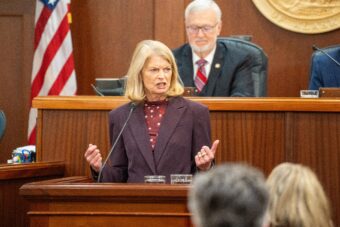
Sen. Lisa Murkowski in Anchorage on Aug. 5, 2025. (Matt Faubion/Alaska Public Media)

WASHINGTON — Sen. Lisa Murkowski is sticking up for six Democratic members of Congress whom President Trump has called traitors for a video they made aimed at military members.

On the video the Democrats face the camera and tell servicemembers they can or should refuse orders that are illegal.

The Pentagon now says it’s investigating one of the six, Sen. Mark Kelly of Arizona, a retired military officer. Nearly all Republicans in Congress have stood by the president, or stayed quiet, as Trump accused the six of “SEDITIOUS BEHAVIOR, punishable by DEATH!”

Murkowski, though, bucked the partisan norm with a social media post Tuesday that defends Kelly and the other Democrats and says their message is accurate.

“Senator Kelly valiantly served our country as an aviator in the U.S. Navy before later completing four space shuttle missions as a NASA astronaut. To accuse him and other lawmakers of treason and sedition for rightfully pointing out that servicemembers can refuse illegal orders is reckless and flat-out wrong,” her post reads. “The Department of Defense and FBI surely have more important priorities than this frivolous investigation.”

Sen. John Curtis, R-Utah, also issued a statement that, while less specific, praises Kelly’s public service.

House members who filmed the video say they’ve been told the FBI is investigating them.

Trump said Friday he was not threatening the six Democrats with death but said they’re in serious trouble.

Site notifications
Update notification options
Subscribe to notifications