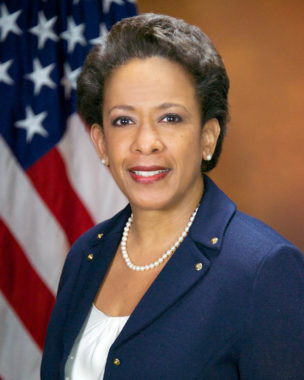
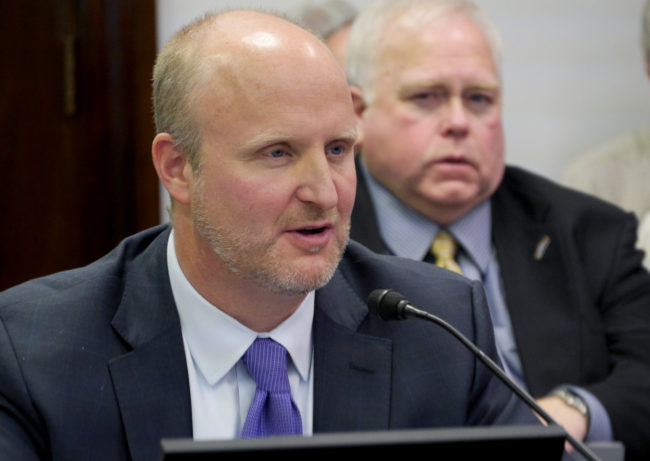
U.S. Attorney General Loretta Lynch has declined to let the Alaska Department of Law act as federal prosecutors to pursue former VECO CEO Bill Allen.
Lynch, in a letter to her state counterpart, said the Department of Justice spent two years investigating Allen for allegedly exploiting an Alaska teen before it decided it couldn’t bring charges. She also said the feds had no immunity deal with Allen. Rather, Lynch said the Justice Department declined to prosecute due to the weakness of admissible evidence.
Allen was once a powerful figure in Alaska business and politics, and he was the key witness in the public corruption case against U.S. Sen. Ted Stevens. Defenders of the late senator allege Allen lied on the stand in Stevens’ trial to avoid federal charges of child exploitation.
Because the feds decided the child exploitation case did not meet their standards for prosecution, Lynch said it would be inappropriate to let the state prosecute the same case on its behalf.
U.S. Sen. Dan Sullivan called that circular reasoning.
Sen. Dan Sullivan
Sullivan pursued the Allen case when he was state attorney general and now has Stevens’ old Senate seat. He claimed there’s ample evidence against Allen, and he changed federal law to help states act as federal prosecutors in sex trafficking cases. The new law, though, said the Justice Department can refuse the transfer of power if it would undermine the administration of justice, and Lynch cited that language in her denial of Alaska’s request.
An attorney representing Allen has denied the former businessman knowingly had sex with an underage girl or transported girls for sexual purposes.
The state previously decided it lacks evidence to prosecute Allen for child sexual abuse under state law.
Rep. Kurt Olson, a Soldotna Republican, developed a plan to tax Permanent Fund dividends back in February, but he didn’t introduce it at the time because he wanted to see how the debate over plans from Gov. Bill Walker and others unfolded.
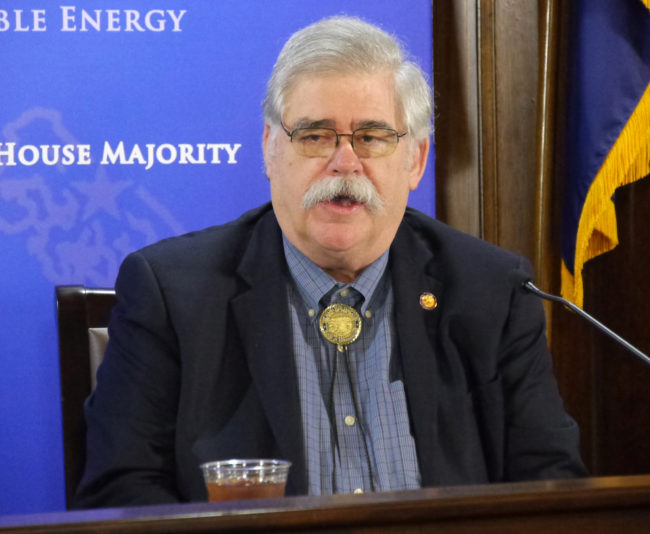
Rep. Kurt Olson, R-Soldotna, at a House Majority press availability in February. (Photo by Skip Gray/360 North)
With less than two weeks left in the session, Olson decided it was time for House Bill 376, which would apply a 35 percent tax to dividends.
“It would have taken pressure off some of the other things had it been out there in February, which is about when we were done with the design and the modeling of it,” Olson said. “It would not been used for what I thought it should be used for, which is something to buy some time without being a permanent fixture.”
The tax would have raised $470 million last year, and Olson estimates it would bring in a similar amount this year. It would sunset after four years. Olson said this will allow the state enough time to find a long-term solution to the state’s budget problems.
Olson said legislative leaders are interested.
“We haven’t really looked for comments but the comments that have been made so far were interested,” he said. “Because it does have a certain, you know, simplicity to it. And it’s finite. I mean, you know what it’s going to be limited to.”
But members of the Democratic minority are giving Olson’s bill a cool response.
Fairbanks Rep. Adam Wool said the state should look for a long-term budget solution this year.
“It’s another kick-the-can bill,” Wool said. “I mean, it’s a quick grab of money out of the Permanent Fund that doesn’t really have any long-term sustainability. It’s a short-term fix, and I think it’s the wrong way to go.”
Olson said it’s important to note that his bill wouldn’t draw directly from the Permanent Fund, but from dividend checks. These checks would remain higher than under proposals by other legislators and by Walker.
The tax “did not come out of the corpus of the fund, it did not come out of the earnings reserve, and it did not come out of the (Constitutional Budget Reserve). It came out of the check as it was issued,” Olson said. “So, from that standpoint, we’re not raiding the Permanent Fund. We’re taking a modest amount of the check.”
The House Labor and Commerce Committee, which Olson chairs, introduced the bill on Monday. It was referred to the House Finance Committee.
Four nominees to replace an outgoing state Supreme Court justice have been submitted to Gov. Bill Walker for review. Walker now has about six weeks to name replacement on the bench.
The nominees are attorneys Susan Carney, Andrew Guidi, Jahna Lindemuth, and Phillip Pallenberg, all of whom have practiced law in Alaska for decades.
The four were selected by the Alaska Judicial Council, a body made up of three attorneys, three non-attorneys, and the state Supreme Court’s Chief Justice, a position currently held by Craig Stowers.
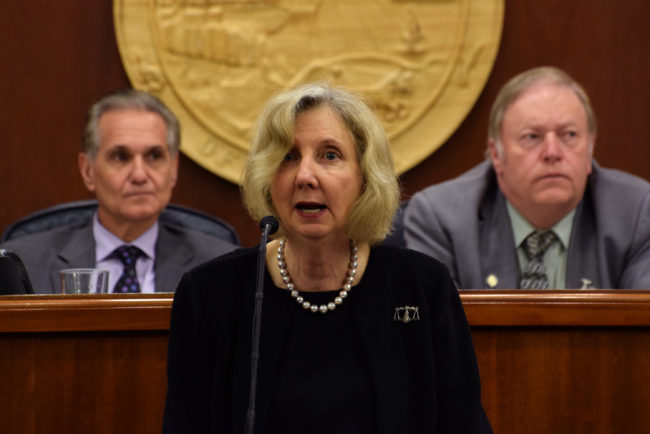
Dana Fabe delivers the 2015 State of the Judiciary Address to a joint session of the 29th Alaska Legislature, Feb. 11, 2015. She’s retiring from the court in May. (Photo by Skip Gray/360 North)
The departing Justice is Dana Fabe, currently the only woman on the state’s highest court. If her vacancy is filled by a man, Alaska will join just two other states, Idaho and Iowa, in having no women on the highest judicial body. Nationwide, women hold just 31 percent of state court judgeships, according to data from the National Association of Women Judges.
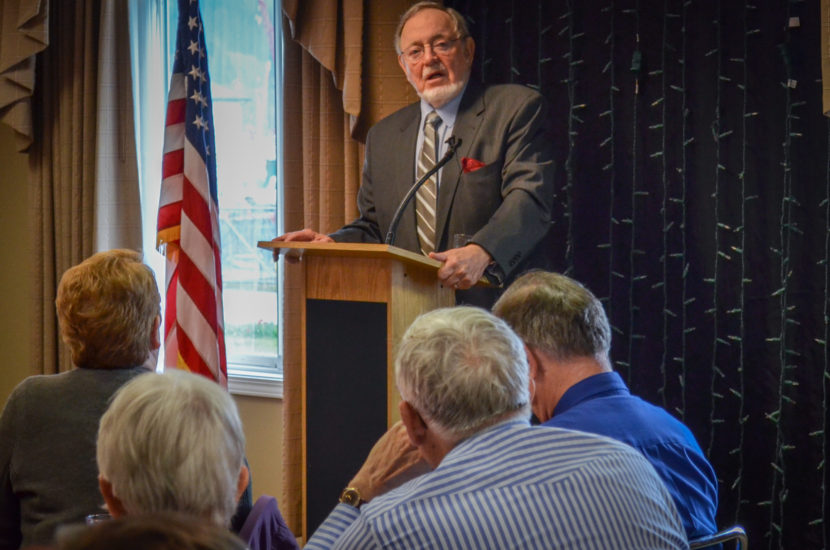
U.S Rep. Don Young speaks to the Capital City Republicans and Capital City Republican Women at the Prospector Hotel. (Photo by Jennifer Canfield/KTOO)
Congressman Don Young called on Juneau Republicans on Monday to support legislative funding for John Sturgeon’s legal fight over operating a hovercraft in a national preserve.
Young also said that while he’s running for re-election, when the time comes for a successor, Alaskans should choose someone who’s young.
Young, 83, told the Capital City Republicans and Capital City Republican Women on Monday that it takes decades to build up seniority and effectiveness.
“Now, that’s something I want you to keep in mind. If you replace me someday, please get a younger person,” Young said. “Not that I have anything against mature citizens. I want you to know that. Just because you have to have someone that serves in the House for more than 25 years. And that’s a big dedication.”
Young said Congress is less effective than it once was. He said that’s because committee chairs have lost power.
“When I was chairman of transportation, I ran the Congress,” Young said. “I’m not braggin’ now, but I had 75 votes. I had Democrat votes, and I had Republican votes. They were loyal to the committee … if the speaker got frisky, and said, ‘You can’t do this, you can’t do that,’ I said, ‘You watch me.’”
Young used colorful language during his speech. He’s a former teacher, and he endorsed corporal punishment and criticized laws that prevent 15-year-olds from working.
“A lot of what we do is (done) incorrectly, as far as education goes. It’s requirements of the federal government to get the federal dollar,” Young said. “We’re hooked on this sugar tit, is really what it is. And we’re not educating our students. I will tell you. I don’t think I could teach today, because I can’t thump somebody.”
Young encouraged the audience to support state funding to back Sturgeon’s lawsuit. The U.S. Supreme Court recently handed Sturgeon a partial victory and sent his case back to the 9th Circuit Court of Appeals.
Young predicted that the federal appeals court won’t change its opinion, and the case will return to the Supreme Court.
The trans-Alaska pipeline system in a zone engineered to cross the Denali Fault. (Public domain photo by USGS)
With less than a month left in the legislative session, one of the biggest questions before Alaska lawmakers is what to do about oil and gas tax credits.
The state’s refundable credit program is unusual – and huge. In recent years, refundable credits have become the third-largest line item in the general fund budget, behind only the departments of Education and Health and Social Services.
Now, Gov. Bill Walker argues the state can no longer afford those kind of subsidies. But some lawmakers worry about unwinding the system too quickly.
This year, the State of Alaska expects to pay out $500 million in credits to oil and gas companies. Next year, that number could be even higher: $825 million, according to estimates from the Department of Revenue. That number includes $200 million the governor vetoed last year, which is still owed to companies.
Meanwhile, the department estimates the state will take in about $2.1 billion in total petroleum revenue – including all taxes and royalties – during that same period.
That means over the next two years, the state will pay out credits amounting to $1.3 billion — more than half the total revenue it expects from the oil and gas industry.
That is pretty unusual, said Tim Bradner, a longtime energy reporter who writes the Alaska Legislative Digest. Nobody else in the world offers a credit program quite like this, Bradner said.
“It started out as a good idea, but incrementally got more and more complicated to the point that it’s difficult to understand, and difficult to control, and way too expensive,” he said. “Even if we had the money, it’s just way too expensive.”
Gov. Bill Walker agrees. With the state facing a deficit of more than $4 billion, Walker proposed cutting some credits and capping others. So far, lawmakers have preferred much smaller cuts.
Origins and evolution of the credits system
But first things first: what areoil and gas tax credits?
The system began as a set of incentives. The state wants existing companies to explore for oil and gas. And it wants new companies to come into Alaska. To encourage that, it instituted a system of credits.
“It was simple in those (early) days,” Bradner said. “The concept was that you could give a company a little bit of a tax break to encourage them to go drill, spend money on exploration that they might not otherwise have spent, and find more oil and gas that way.”
In theory, at least, the state would make more money on the back-end in taxes and royalties than it invested on the front end.
But what if a company doesn’t owe any taxes? For a small company that’s never operated in Alaska, and isn’t producing any oil, a different incentive was needed. Lawmakers wanted to bring smaller companies into the state, in the hopes that they would explore more aggressively, potentially pursuing fields that were too small to interest the big North Slope producers.
So in 2007, the state made some credits refundable. This is basically a check the state writes to reimburse a company for doing things the state likes. You drill a well, and the state will pay part — or even most — of the cost.
“For small companies, it worked pretty well,” Bradner said. “You could make the investment, drill your wells, turn in your tax credit certificates to the state, and get a check from the state, and you could use that to finance your next year’s drilling. So it was very attractive for small companies.”
Only smaller companies are eligible for a refundable credit. The big producers like ConocoPhillips, BP and ExxonMobil can use credits to reduce their taxes, but they don’t get a refund check.
And that $825 million the state expects to pay next year? That’s just in refundable credits.
The system was designed with high oil prices in mind.
“At the time, we had plenty of money,” Bradner said.
And the goal was to take some of what the state was raking in through taxes, mostly from big legacy producers on the North Slope, and reinvest that money in the oil industry, through credits for smaller companies, both on the North Slope and in Cook Inlet.
But now of course, oil revenue has plummeted. Meanwhile, the refundable credits have grown.
“It seems like each year, somebody would have a new idea, and the thing became kind of like a Christmas tree, to the point that it’s very difficult to understand how it all works,” Bradner said.
Companies can also “stack” some credits, to the point that the state might pay more than two thirds of the cost of certain work.
That’s what makes it so unusual, Bradner said
“I think the most unique thing is you can get a check,” he said. “But it’s also the scale of it. And the many different kinds of tax credits that, in some cases, can be layered on top of each other, to the point that 60 to 70 percent of the cost of an exploration well can be covered by these different types of credits.”
Just about anywhere else, Bradner said, if the government is funding 60 or 70 percent of your costs, it would then own part of that well.
Opaque investments
So the big question is, is it a good investment? It’s hard to know, Bradner said.
“One of the problems with this kind of thing is you never really know if the companies would have explored and found the oil anyway,” Bradner said. “That’s the unknowable. The companies … argue that the tax credits have helped them. You’ll never really know if that’s the case, but the fact is, you got wells drilled that may or may not have gotten drilled (otherwise).”
Certainly, many smaller companies have come into Alaska, and explorers like Armstrong Drilling on the North Slope, or BlueCrest Energy in Cook Inlet say the credits were a major draw.
But here’s the catch: the state has spent more than $3 billion on refundable credits since 2007. And neither the public nor the legislature actually know where that money has gone.
For instance, at some point in the last nine years, one company, in one year, received more than $200 million dollars, according to testimony before the House Resources Committee by state Tax Division director Ken Alper.
Tax Director Ken Alper testifies in the House Resources Committee about oil and gas tax credits in February. (Photo by Skip Gray/360 North)
That’s a lot of money – more than half of state spending on the University of Alaska. What was it for?
“We can disclose nothing,” Alper said, in an interview.
That’s because most specifics about credits are protected as confidential taxpayer information.
“We’ve had circumstances, for example, where a company will put in the newspaper how much they’re getting in tax credits, and someone will ask a question, and we can’t even confirm that that company has applied for a tax credit in Alaska,” Alper said.
The governor, and Alper, want to change that. They’d like the state to be able to disclose which companies receive credits, how much they get, and roughly what kind of work they use it for.
“We think it’s important,” Alper said. “It is, frankly, difficult to have a conversation in public, whether it’s in the legislature, the press, or at public meetings … without being able to talk about what we’ve actually done in the past.”
A bill, a governor and a committee walk into the Capitol …
But companies worry that the provision, as written, could reveal too much proprietary information. The measure was stripped out of the bill by the House Resources Committee.
House Speaker Mike Chenaul, R-Nikiski, said he’s not sure there’s a point to more disclosure.
“The state knows who it is, the state knows how much was invested, the state knows all that information,” Chenault said. “And sometimes I just wonder, is that really information that every Alaskan is just dying to know?”
House Resources also scaled back the governor’s cuts. The governor had proposed ending some credits for Cook Inlet immediately, while the committee bill steps down credits over 18 months.
And while the governor’s bill imposed a cap of $25 million in refundable credits per company per year, House Resources raised the cap to $200 million.
The result? Over the next three years, the governor’s bill would save some $905 million, while the committee’s bill would save about $140 million.
Chenault said he worries about yanking the rug out from under companies that have banked on the credits – and threatening future oil production.
“My concern is, if we pull everything away today, how much, if any, investment is going to happen in the next few years?” he said.
The bill has several more stops in the legislature before reaching the House and Senate floors. At this point, Chenault said, his only prediction is that the bill will change.
Five-year-old Courtney Skinner holds up a “Bernie Sanders for President” sign while sitting on Tom Skinner’s shoulders at the Juneau Democratic Caucus, March 26, 2016 at Centennial Hall. Sanders won the majority of Juneau’s votes and those across Alaska. (Creative Commons photo by James Brooks)
Levi Younger, a recent political science graduate from Eagle River, said Bernie Sanders swept the Alaska Democratic caucus, so why is it fair for superdelegate Kim Metcalfe to spend one of Alaska’s few delegate votes on Hillary Clinton?
Metcalfe, of Juneau, is the state party’s national committeewoman. She tells Younger she’s been in the Democratic trenches for 40 years and resents a party newbie telling her what to do. Metcalfe firmly told Younger she’s for Hillary Clinton. And as a superdelegate, she can vote for whomever she wants at the national convention.
They kept it civil, barely, and replayed an internal party struggle that’s gone on for a century.
Younger posted their conversation for the world to see, and it’s become a lightning rod on social media. Thousands of people shared it on social media and joined the fray, mostly on Sanders’ side.
Peter Levine, an associate dean of civics at Tufts University, said the debate illustrates clashing ideas about how a party should select its nominee, and Levine said it’s understandable why the Sanders fans are frustrated.
“They have in mind the model that the party is a vehicle for the public to express its will. It’s the sort of first stage in the election,” Levine said.
By that reasoning, the nomination should be by majority rule, and newcomers should have as much say as established party officers. But Levine said historically, parties have seen themselves as associations that govern themselves, choose their own leaders and set their own agendas. And they like to reward their hardest workers.
“And so on that model, it doesn’t have to be majority rule, and then the party probably wants to have safeguards against being taken over by newcomers,” Levine said. “So it’s two different models, and they really have fought each other for more than 100 years in America.”
Since the 1970s, the parties have largely followed the majority rule model. Still, at this year’s Democratic National convention, about 15 percent of the delegates will be superdelegates who, like Metcalfe, won that status because of their position in the party. In other states, Democratic Congress members and other elected officials get superdelegate status.
The term “superdelegate” dates to the 1980s, and it’s essentially a vestige of the older strong-party model. Superdelegates can choose whatever candidate they like, no matter how their state voted. Sure, it sounds undemocratic, but political scientist Norm Ornstein, a scholar at the conservative American Enterprise Institute, says superdelegates were invented for a reason.
“The party looks to get a broader public grassroots reaction but it also wants to give at least some role for people who are invested in the party, have worked in the party, are concerned about the broader elements of the party’s well-being,” Ornstein says.
Superdelegates, typically chosen in a prior election, serve as a check on insurgencies and passions of the moment. Ornstein said they’re long-timers likely to understand the party’s need to elect Democrats up and down the ticket.
“It’s also the case that people who are connected to the party are going to have maybe a little more sensitivity to making sure you end up with a candidate who can win,” he said.
Sanders is pursuing superdelegates, and Ornstein said it’s no surprise the vast majority are going for Clinton. She has done a lot of joint fundraising, to help the party and other Democratic candidates. Ornstein points out that Sanders, as a senator, rejected the party label and these days is noncommittal about using his fundraising prowess beyond his own campaign.
“He’s got a lot of support. His issues are resonating with very substantial numbers of voters. He has raised a lot of money from small donors. All of that to his great credit,” Ornstein said. “But his attachment to the party whose nomination he’s seeking is a very, very tenuous one.”
Ornstein said that doesn’t play well to superdelegates.
And if you’re wondering about Republican superdelegates, technically there aren’t any, but many in the GOP establishment probably wish there were so they could thwart Donald Trump.
Close
Update notification options
Subscribe to notifications
Subscribe
Get notifications about news related to the topics you care about. You can unsubscribe anytime.