Former state Rep. Bill Thomas greets Juneau Rep. Cathy Muñoz at the first annual Dr. Walter Soboleff Day celebration in 2014. (Photo by Jennifer Canfield/KTOO)
A municipal clerk’s honesty and ethics were called into question over her recommendation in the hiring of former Rep. Bill Thomas as a lobbyist at a Haines Borough Assembly meeting Tuesday.
The meeting was moments from wrapping when Assemblymember George Campbell expressed his concern. His complaint was about the assembly’s vote last month to hire Thomas for $45,000 to lobby for the borough, without going through the proper channels, Campbell said. He said he was troubled by what Julie Cozzi — then-acting manager, now borough clerk — said at a Dec. 29 special meeting. Here’s Cozzi at that meeting:
“The mayor also reviewed the two proposals and the two of us discussed them before I came up with my recommendation. I also, myself, interviewed Mr. Thomas and attempted to call Denali Daniels and was finally successful today and she told me that she had planned to contact me today anyway and withdraw and put her full support behind Mr. Thomas.”
Cozzi said she had “interviewed” Thomas before recommending the assembly hire him.
But when Campbell requested a transcript or interview questions from Cozzi, he was told the interview did not actually happen. On Tuesday, Campbell requested the assembly go into executive session to discuss personnel matters, but the motion failed. So, the discussion around the Cozzi’s interview claim continued.
“Reading our code, one of the things it says for our borough officers, which our then-acting manager and now clerk is, it discusses integrity and it discusses dishonesty, and it discusses trust of the public,” said Campbell on Tuesday. “I think we’ve lost all three of that.”
Campbell said he was concerned that the borough is in violation of state law.
Cozzi said it was an honest miscommunication. She said she did in fact speak with Thomas, but did not a conduct a formal interview. She added that she did nothing out of the ordinary when it comes to the borough soliciting contracts.
“Formal interviews involve specific questions and notes, etc.,” Cozzi said. “I interviewed, which I meant ‘I spoke,’ with Mr. Thomas and Denali Daniels, asking clarifying questions about the proposals. I did nothing different than what staff does anytime we receive bids for construction projects or proposals for any other RFPs.”
Cozzi also reminded the assembly that the decision to hire Thomas was ultimately left up to them, and that they could have delayed the vote. The motion to hire Thomas in December was a tie vote, with Mayor Jan Hill breaking it in favor of the hire.
Assemblymember Mike Case called Campbell’s complaints a witch hunt.
“This is just a silly — no, not silly — a vicious witch hunt and it’s very unprincipled,” said Case.
Campbell replied.
“This is a situation where our decisions are only as good as our information.”
Assemblymember Diana Lapham also defended Cozzi, calling Campbell’s allegations unfounded.
“Every time you have presented Ms. Cozzi with your accusations, your attacks, she has been able to clarify the error, now whether you choose to accept her answers or not is your issue,” Lapham said.
Kathy Friedle, an administrative assistant at the borough spoke on Cozzi’s behalf.
“The comments from Mr. Campbell have been unfounded and are very mean and cruel. If he had worked with Julie the number of years that I have, he would find that she is a very hard worker and goes above and beyond to meet the needs of the community. It’s very sad to have an assembly member such as Mr. Campbell representing our community. I’m ashamed to have him as part of our community.”
Mayor Hill announced that Cozzi will have an annual evaluation this spring, as one has not been performed since 2013. Hill said concerns about Cozzi’s work need to be dealt with through performance evaluations, and put to rest so the assembly and staff can move on.
Earlier in the meeting, Case made a motion to table a resolution on the agenda indefinitely, a resolution he originally requested. It was to increase Cozzi’s salary to$85,000.
A joint House and Senate committee on Thursday quizzed Alaska Department of Environmental Conservation Spill Response Director Kristin Ryan on a new set of regulations that they say could be overly burdensome to companies and people throughout the state.
The department is proposing lowering the allowable amount of certain chemicals that can remain after a spill. The new regulations would cover more than 130 chemicals.
The agency received more than a dozen public comments from individuals and businesses affected by the regulations. Some suggested the proposed changes would drastically increase cleanup costs and be overly burdensome.
The legislative committee can’t force the department to make changes to the new policy. But Ryan says they are continuing to review public comment, and would consider opening it up for further feedback.
Sen. Berta Gardner addresses the Alaska Senate in April 2014. (Photo by Skip Gray/360 North)
Senate Minority Leader Berta Gardner introduced legislation yesterday to create a permanent Ways and Means Committee in the Senate. It’s a companion to a bill introduced by Rep. Sam Kito, a Democrat from Juneau, in the House earlier this week.
I spoke with Gardner as part of a series of conversations with legislative leaders this week. She said the committee would provide a forum where legislators can understand the costs and the benefits of any proposal to address the budget deficit.
GARDNER:Whether they’re new revenue, taxes or cuts, because I think a lot of us lack the information to really make informed votes. And the Finance Committee, where normally this kind of discussion goes, is already overwhelmed. I mean, almost every bill goes through there, and things get bottlenecked and it also — the finance committees are not a forum for all legislators to participate. And we would like to broaden that discussion so that the Ways and Means Committee could focus exclusively on new revenue and cuts, and more people can be actively engaged and asking questions and studying the issues.
TOWNSEND: Well, lawmakers have a lot of work this session in a short amount of time. Is there any concern that adding the committee might make the process more cumbersome?
GARDNER: Well not necessarily because our primary obligation in this session clearly is this issue, and if it means we can’t get to other things in other committees, well, so be it. There is nothing more important, more urgent, in this unprecedented situation in which we find ourselves. We hear people comparing it to what happened in the ’80s. It’s nothing like the ’80s. In the ’80s, all that oil was still in the ground and access to it was right on the horizon. That’s not the case now. It’s a deep, deep, hole and the best we can do in terms of new revenue from our resources is a drop in the bucket, if you’ll pardon that expression, compared to what we need in a three-and-a-half or $4 billion hole that we’re in.
TOWNSEND: Last year’s session was contentious. Are you hopeful that Democrats, Republicans and the governor can have a better working relationship this year?
GARDNER: I am. I think everybody last year learned a lot. The majority of Republicans on the House side, I think, were particularly in a tough place because they weren’t used to having to negotiate with the minority and kinda didn’t know how. We have a new governor who was getting his feet under him, and he had very little history in this building. So things have been a little awkward and inefficient, and people stepped on each others’ toes at times and I don’t think there was any malice or anything intended. But things, you know, we’re all learning how to deal with each other and work with each other.
Beyond that, I am greatly bolstered by the way the special session in October went, and I’ve been through a lot of special sessions, and that is the first time I felt that people came down not locked into place. I mean, it was a really good process and people came together, and in the end it was overwhelming support. So I like that, and it shows me that we can work together and let go of things when we want to, or need to or see a good reason to. And there’s never a better reason than what we’re looking at right now.
TOWNSEND: Will you support tapping the Permanent Fund earnings?
GARDNER: I don’t want to say that I would never do that, but everything has to be part of a package. Under what conditions? You know, this’ll be a discussion that we all have to have. And I understand, according to the Rasmuson Foundation poll, there is broad support for doing that in the public, but doing that to what end? Do we have a sustainable thing? Once we start getting into using the fund itself, it’s almost like a license to keep going, and we have to make other hard decisions.
TOWNSEND: Are there taxes that you would support or could support?
GARDNER: I think that, in the end, if we manage to get to a sustainable plan, we will all be elated and no one will be really happy. And that’s true for all of us, and it’s just gonna be a long process. I think we need to be talking with each other and willing to listen and willing to consider what other people want to.
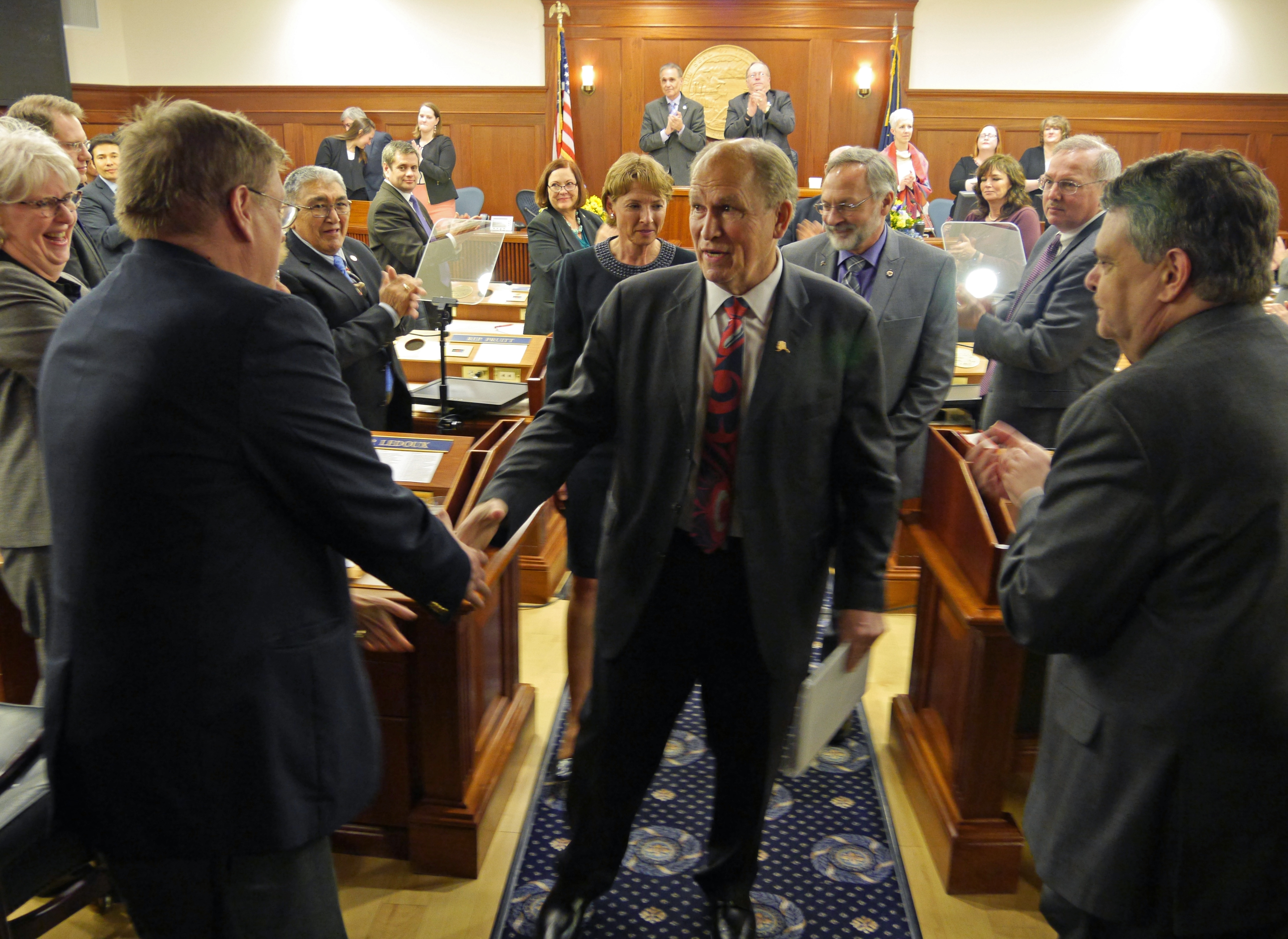
Alaska Gov. Bill Walker exits House Chambers after delivering his annual State of the State address to the legislature. (Photo by Skip Gray/360 North)
Gov. Bill Walker called for the entire legislature to work together with him to close the state’s budget shortfall. His annual State of the State Address on Thursday night reflected the state’s grave budget situation.
Walker said the budget crisis was a long time coming. He said the state has had a hole in what he called its fiscal boat since oil production began to drop in the 1980s.
“As governor, I am flexible on the details of a fiscal plan as long as the outcome meets the basic test of fairness and sustainability. I am not flexible on the need to get there this year,” Walker said. “It’s time to fix the hole in the boat.”
Walker said he was warned some of his proposals would hasten the end of his political life, but that he puts the state’s interests above his own.
He’s proposed reducing the annual Permanent Fund dividend. And he would also introduce a new personal income tax and raise other taxes, while cutting spending.
Walker drew on his own family history for inspiration. The Good Friday earthquake of 1964 destroyed the family construction business in Valdez, among others. He and his father found work as school janitors.
Sen. John Coghill, R-North Pole, responds to Gov. Bill Walker’s annual State of the State Address. (Photo by Skip Gray/360 North)
“We were fortunate to have the work. We struggled right up until the construction of the Trans-Alaska Oil Pipeline System. But we survived by cutting our expenses and developing new sources of revenue. We survived through hard work, and pulling together as a family,” he said. “Today, Alaska’s been struck by an earthquake of a different kind. Oil prices are plummeting and oil production is declining.”
The state is seeking to close a $3.5 billion budget shortfall.
After the address, politicians from both parties expressed a willingness to work with the governor.
Sen. John Coghill, R-North Pole, said fellow Republicans agreed with much of what Walker said. But, his party is looking for deeper spending cuts. And Coghill suggested that while there may be progress, the legislature is unlikely to close the entire shortfall this year.
Rep. Chris Tuck, D-Anchorage, speaks at a press availability. (Photo by Skip Gray/360 North)
“Some of the details that he has put forward are going to be tougher to, uh, to shuffle together than as alluded to in the speech,” Coghill said.
Rep. Chris Tuck, leader of the House Democrats, said he liked Walker’s call for working together. He said the speech reflected the less divisive tone that’s surrounded the start of the legislative session.
“It is going to require all of us to pull together and, uh, Republican, Democrat, doesn’t matter,” Tuck said. “There used to be a time in Alaska’s history where we all pulled together to do what’s best for Alaska, and we’re back in those times now.”
The speech came near the end of the first week of the legislative session. Last year, the legislature ran well past their 90-day deadline to adopt a budget.
An Alaska Permanent Fund Dividend check from 2008. (Creative Commons photo by Travis)
A former appointee to the Alaska Board of Fisheries and former head of the United Cook Inlet Drift Association is being charged with illegally collecting $7,422 in Alaska Permanent Fund dividends between 2009 and 2014.
Roland Maw, who owns a home in Kasilof, was charged Wednesday in Juneau District Court with 17 counts of theft and unsworn falsification on his applications for six years of Permanent Fund dividends and for commercial fishing permits.
According to the charges, Maw left the state for over 90 days during those years, and did not disclose the length of his absences on his applications.
In that time, Maw got resident sport licenses, permits and tags in Montana. He pleaded no contest last year to seven counts of license violations in seeking a Montana resident benefit while still claiming Alaska residency. The court banned him from hunting, fishing and trapping in Montana for 18 months, and he was fined $7,245.
Maw also obtained resident fishing licenses in Alaska between 2008 and 2014, claiming Alaska residency on commercial fishing permits.
Gov. Bill Walker appointed Maw to the Board of Fisheries last January. The appointment proved controversial, especially as the Montana charges came to light, and Maw withdrew his name from consideration last February.
People for and against unions hold up signs Monday in front of the U.S. Supreme Court building in Washington. The court was hearing arguments in Friedrichs v. California Teachers Association. Justices will decide whether California and other states can make nonunion public employees covered by union contracts pay partial dues. Mark Wilson/Getty Images
A landmark Supreme Court decision that’s nearly 40 years old is on life support. The outcome of a case currently before the court could cripple public employee unions in 23 states, and weaken their influence nationwide.
In 1977 the Supreme Court declared that state and local governments can require nonunion public employees to pay partial fees for negotiating union contracts that cover them. Conservative activists and union opponents long have hated the decision, and on Monday a majority of Supreme Court justices seemed poised to reverse it.
Nearly four decades ago the court said that while nobody is required to join a union, nonunion members can be required to pay so-called fair-share fees to cover the costs of negotiating the contract they benefit from. The caveat is that nonmembers do not have to pay for the union’s lobbying and political expenses.
But in the past two years, conservative Supreme Court justices led by Justice Samuel Alito have all but invited a challenge to that 1977 ruling, and on Monday that challenge was finally before the court — a lawsuit brought by 10 California teachers who object to paying the mandatory service fees.
Within moments it was apparent that the court’s four more-liberal members were fighting an uphill battle.
Until the argument, the unions had some reason to hope that conservative Justice Antonin Scalia might side with them; in the past, he has seemed to agree with the view that unions need to collect service fees to prevent “free riders.” But on Monday he was consistently hostile to that position.
“The problem,” he said, “is that everything that is collectively bargained with the government is within the political sphere.”
Kennedy’s Questions
Justice Anthony Kennedy, the member of the court most likely to be open to persuasion on many other issues, is something of a purist when it comes to the First Amendment; he is the author of the court’s 2010 decision striking down many key campaign contribution and spending limits. On Monday, he suggested that service fees — rather than preventing nonunion members from being free riders — create “compelled riders” in support of contract provisions they disagree with.
At the opening of Monday’s argument, Kennedy did wonder why, if public employees could be exempt from paying union service fees, the same would not be true for private sector employees who work in a unionized shop.
The challengers’ lawyer, Michael Carvin, replied that the First Amendment doesn’t apply to the private sector; it applies only to government restrictions on speech.
But, replied Kennedy, if the state authorizes nonmember service fees in the private sector, wouldn’t that be the same kind of “coerced membership and coerced speech you are objecting to?”
Carvin said he did not think so.
But, interjected Justice Elena Kagan, isn’t that the point? She maintained that the court’s public employee cases historically were aimed at ensuring that “when the government acts as an employer,” it is in “the same position as a private employer.” In other words, when it is dealing with the employee workforce generally, the government is no different than a private employer, except that the government is not permitted to use its “leverage” to target individuals to prevent them from expressing their views.
Justice Kennedy observed that if the union has a public relations campaign against merit pay, nonunion member fees are charged for that, even though nonmembers may disagree.
Justice Sonia Sotomayor countered that those members who disagree are not prevented from speaking out or expressing themselves to the legislature.
How Far To Go In Overruling Precedent
Justice Kagan then focused on a larger question — whether the court’s 1977 ruling had proved either so unworkable or untenable that it should be reversed.
You come here “with a heavy burden,” she said to Carvin. “That’s always true in cases where somebody asks us to overrule a decision.” And here there are “tens of thousands of contracts” with these service-fee provisions for nonunion members, contracts that affect as many as 10 million employees. So, she asked, what special justifications are you offering here?
Carvin replied that the 1977 decision was wrong, out of step with other First Amendment cases, and thus should be reversed.
An incredulous Justice Breyer asked whether Carvin thought all of the court’s decisions were correct.
“Maybe Marbury v. Madison was wrong,” Breyer said, referring to one of the most important landmarks of American law. There are people who think it was, he added. As for the 1977 labor law decision, he observed that it was a “compromise” — but stressed that that “was 40 years ago.” If the 1977 decision were overturned, Breyer said, there were at least three other decisions that sprang from it that would have to be overruled as well.
Some things are basic enough that they warrant overruling, Breyer noted — like the 1896 decision upholding racial segregation — but most are not.
If you start overruling things, Breyer continued, “what happens to the country thinking of us as a kind of stability in a world that is tough, because it changes a lot?”
Do Unions Make Managing Easier?
Next up to the lectern was California Solicitor General Edward DuMont, siding with the union in this case. He noted that 90 percent of California’s 325,000 teachers are union members, and that unionization actually has prevented the massive strikes that characterized the state workplace until the court’s 1977 decision.
Chief Justice John Roberts was doubtful. If the employees want this so overwhelmingly, he asked, then isn’t the concern about free riders “insignificant”?
No, replied lawyer DuMont — because suddenly, what you had to pay for before would be free. Minor disagreements among union members and nonmembers alike would be magnified and, as occurred in the 1960s, there would be constant unrest because of disagreements from people who support a rival union.
The problem, interjected Justice Scalia, is that everything a public union negotiates for “involves political questions. Should the government pay higher wages … should it promote based on seniority …”
Chief Justice Roberts, impatient, asked DuMont for his “best example” of something the union negotiates for that is not political.
Mileage reimbursement rates and safety measures, replied California’s lawyer.
But “that’s all money,” replied Roberts. “That’s how much money is going to have to be paid to the teachers.”
DuMont answered, “What is fundamental is that we need to be able to run our workplaces,” and the most efficient way of doing that is by negotiating with a single democratically elected union that has the power to bargain over matters that, of necessity, do involve some public policy issues.
Moments later Justice Kennedy observed caustically that a state is always “more efficient if it can suppress speech.”
It seemed not to matter to the court’s conservatives that the state, the union and the federal government were all on the same page.
David Frederick, representing the union, argued that the court long has given government more leeway when it is acting as an employer dealing with its workforce.
The last to argue was U.S. Solicitor General Donald Verrilli, representing the largest public employer in the country: the federal goverment.
Employee speech does have some First Amendment protection, he said — but in the collective bargaining context, the standard for evaluating it has to be “reasonableness,” not the “exacting scrutiny” we would require if the government acted to regulate speech.
A decision in the case is expected later in the Supreme Court term.
Copyright 2016 NPR. To see more, visit http://www.npr.org/.
Read Original Article – January 11, 2016 4:23 PM ET



9(MDEwMjQ0ODM1MDEzNDk4MTEzNjU3NTRhYg004))