Politics

Public testimony: Keep state hands off of dividends

Update | Feb. 5, 11:04 p.m.

Dozens of people who testified asked lawmakers to cut spending to balance the budget. While spending cuts are popular in general, the public is less certain about which specific programs should be cut.

That’s according to the Rasmuson Foundation’s Plan4Alaska survey.

Foundation President and CEO Diane Kaplan said last month the foundation is making a new online tool. It will allow residents to develop their own version of the state budget.

Kaplan says when when people propose cuts, they’ll learn the potential effect on services.

“When you work to put together your own balanced budget, and you say I want to cut a hundred million, we’re going to list what could be in that as much as we can,” Kaplan said. “So we’re hoping to provide a little bit more detail when people say $500 million, $100 million, $1 billion, what that really means. Because those are big numbers for people and they have a hard time with what that exactly means to them.”

The House Majority launched its own effort to solicit public comment on the budget Friday. Representatives set up a toll free call-in line for residents to weigh in on ways to save the state money. Rep. Charisse Millett encouraged people to call this month.

“Good ideas come from  those that use state government the most. So we’re open to criticisms, we’re open to suggestions, and the next three weeks are critical for Alaskans to get their voices heard,” she said.

The number is 1-844-414-5949.

Original post | Feb. 5, 2:16 a.m.
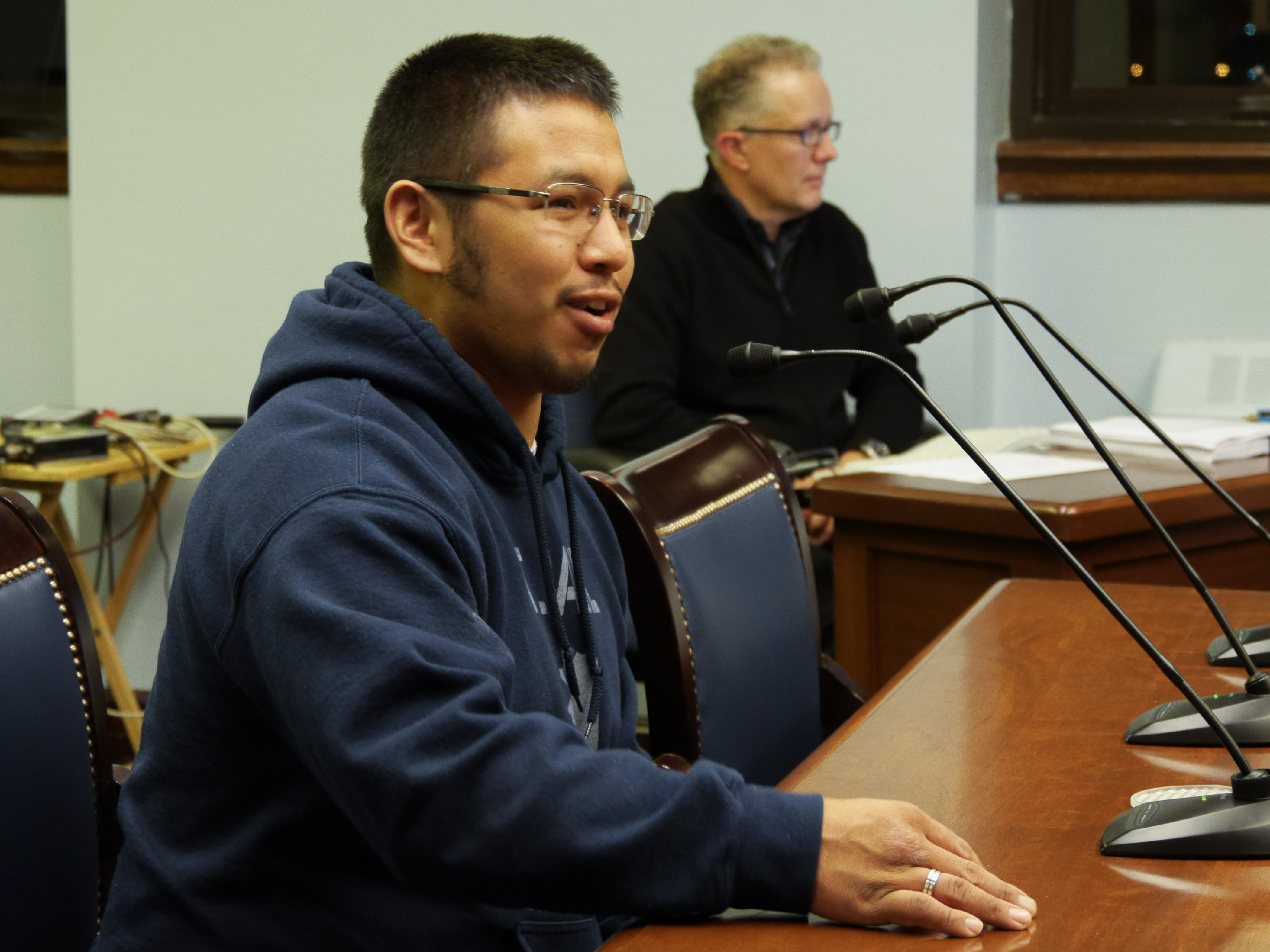
Martin Stepetin Sr.
Martin Stepetin Sr. of Juneau testifies on Senate Bill 128 in the Senate State Affairs Committee. The bill is the governor’s plan for reshaping the Permanent Fund to make state government fiscally sustainable. (Photo by John Kelly/360 North)

Alaskans don’t want to see large cuts to their annual Permanent Fund dividends. At least, that was the message most people delivered Thursday night about Gov. Bill Walker’s plan for the fund.

The Senate State Affairs Committee heard public testimony from across Alaska on Senate Bill 128.

Deering resident Kevin Moto said local businesses allow residents to make payments based on future dividends.

“In rural Alaska, the dividend contributes to the economy,” Moto said. “And I think by reducing the distributions, we’re creating a bigger rural-urban divide.”

Walker proposed using Permanent Fund earnings to pay for much of the state’s budget.

He would draw $3.3 billion  from the fund’s earnings, as well as other state reserves.

The governor has also proposed $100 million in spending cuts.

Under Walker’s plan, the source of dividends would shift to oil and gas royalties. They’re expected to decline.

More than 100 people spoke. Another 200 submitted written comments.

Beth Fread of Palmer asked legislators to balance the budget through spending cuts.

“Some of the cuts you could make would be to eliminate the positions that are currently frozen,” Fread said. “You could utilize the tools that we used in the ‘80s, which was a wage freeze, to which the unions agreed for the good of the state. There are many ways to make cuts.”

Others who oppose cutting Permanent Fund dividends supported drawing new revenue from other sources.

Anchorage resident Tom Lakosh said he would like to spare children from dividend reductions.

“It’s clear to me that the preferred method of revenue generation would be from corporate and/or personal income so that we can spread most of this cost of our state government on those who actually make money in the state,” he said.

A minority of speakers expressed a willingness to see changes to how the state spends Permanent Fund earnings.

Kodiak resident Erin Harrington said it’s imperative that legislators act this year on the budget shortfall.
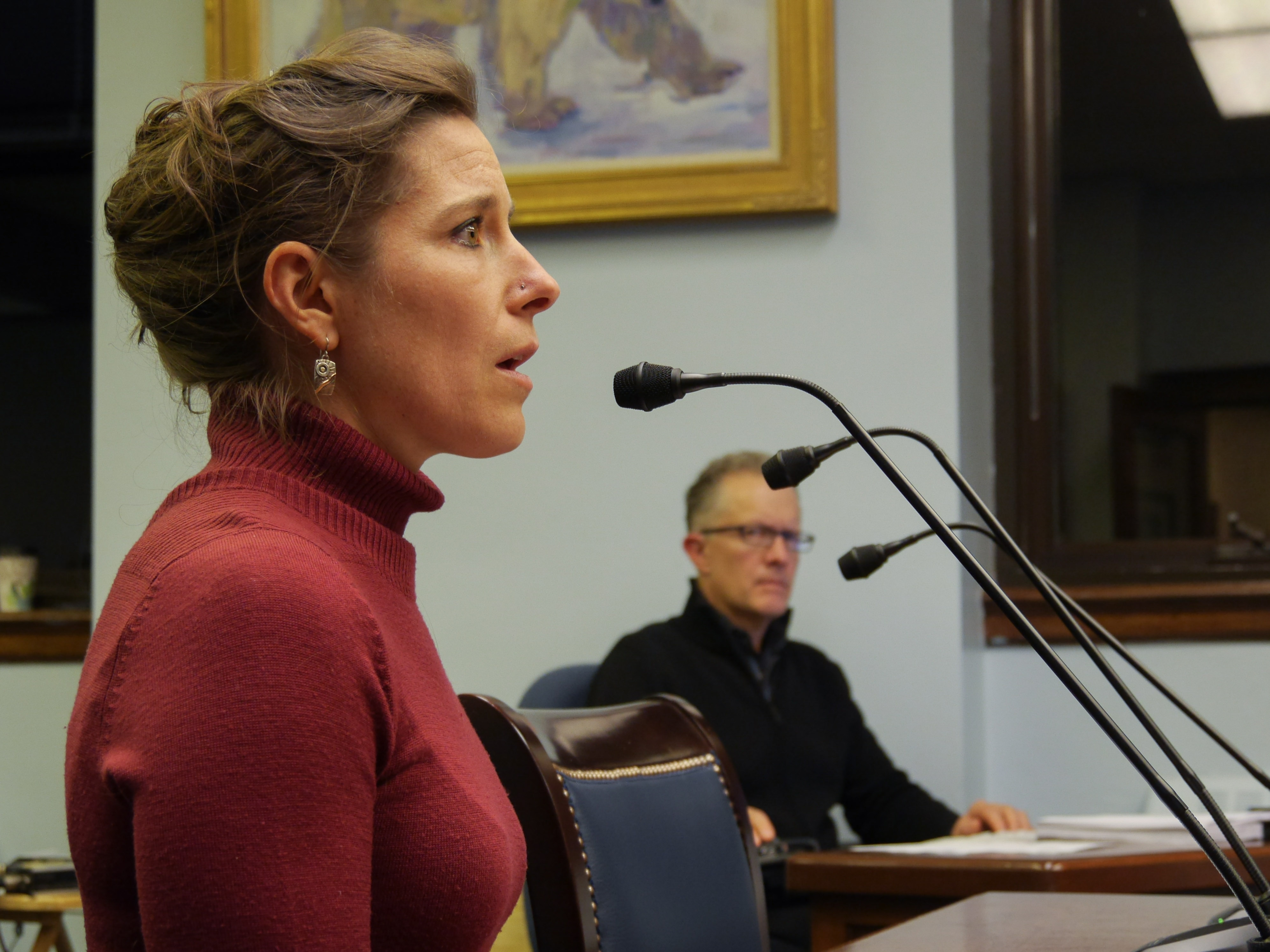
Erin Harrington
Erin Harrington of Kodiak testifies on Senate Bill 128 in the Senate State Affairs Committee. (Photo by John Kelly/360 North)

“I certainly see places for efficiency in government,” Harrington said. “But I believe that first we have to take action to stabilize our revenue sources and I think that using the Permanent Fund and adding new revenue sources is completely reasonable.”

Sen. Bill Stoltze, a Chugiak Republican and the committee chairman, said the committee would take the testimony into account as it considers what to do with the bill.
What does ‘required’ mean? The answer could reverse Medicaid expansion

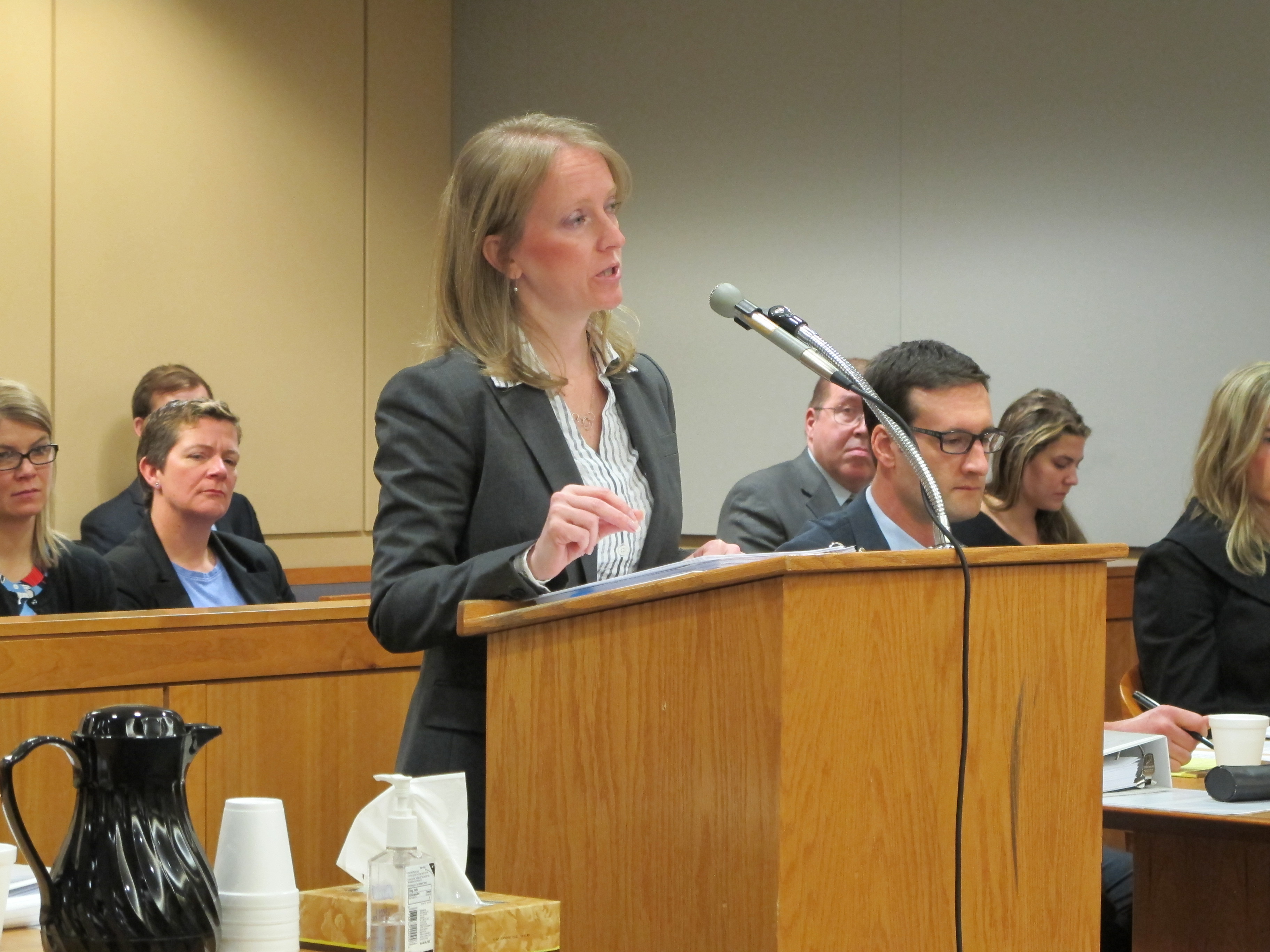
Attorney Erin Murphy
Attorney Erin Murphy argues for the Legislative Council in Anchorage Superior Court, Feb. 5, 2016. (Photo by Annie Feidt/APRN)

The Alaska Legislature’s lawsuit against the Gov. Bill Walker’s expansion of Medicaid hangs on the interpretation of the word “required” in Alaska statute. That’s a point all parties agreed on during oral arguments Thursday in an Anchorage courtroom.

The Legislative Council is suing over the governor’s decision to expand Medicaid without permission from the legislature. Alaska law says legislative approval is necessary to add an optional group to the Medicaid program. Federal statute lists the expansion population in the required category, but the U.S. Supreme Court ruled states can choose whether to expand the program.

Attorney Erin Murphy flew in from Washington, D.C., to present the legislature’s case. She told the judge that given the U.S. Supreme Court decision, the intent of federal law is obvious.

“We think the answer is quite clear that federal law doesn’t require this,” Murphy said. “And I think it’s very hard to come up with any explanation for why the legislature would have intended ‘required’ to mean anything other than what federal law actually requires.”

The state takes a more narrow view of the law.

Dario Borghesan argued the case for the administration. He said Alaska statute tracks the text of the Social Security Act, where the expansion population is listed as required.

“The legislature, when they enacted this statute 40 years ago, clearly wasn’t thinking about this situation today. Our view is the legislature simply wanted HSS, the Department of Health and Social Services, to straightforwardly apply what the instructions of the Social Security Act are,” Borghesan said.

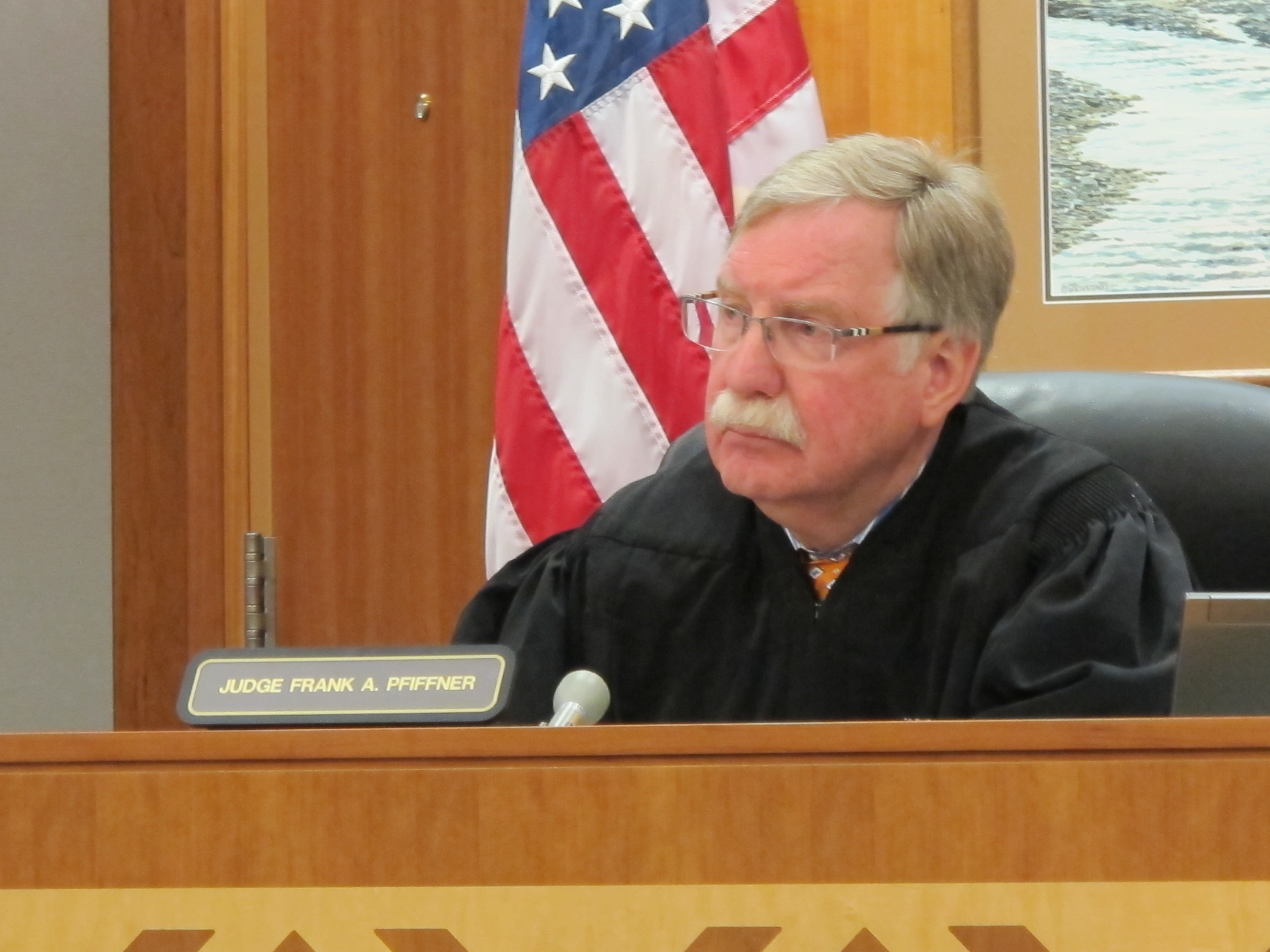
Judge Frank Pfiffner
Judge Frank Pfiffner hears oral arguments in the Medicaid expansion case, Feb. 5, 2016. (Photo by Annie Feidt/APRN)

Judge Frank Pfiffner asked both attorneys to address whether the issue of Medicaid expansion would be better handled by the legislature than the court system. Given scarce judicial resources, he wondered if he should “slow roll” his decision until after the legislative session wraps in the spring.

“Giving the legislature an opportunity to stand up and be counted, so that the voters will know whether they support or don’t support Medicaid expansion,” Pfiffner said.

Pfiffner said he would issue a “lengthy” decision in the case by the end of March at the earliest. He said his decision was likely only a “speed bump” on the way to the state Supreme Court.

About 8,000 low-income Alaskans have enrolled in Medicaid under the expansion. A new report from a consultant hired by the Legislative Budget and Audit Committee calls expansion a “highly attractive policy change financially” for the state.

This story is part of a reporting partnership between APRN, NPR and Kaiser Health News.

Governor, state board oust Alaska education chief

Education Commissioner Mike Hanley 1 20 16
Education Commissioner Mike Hanley speaks to the Joint Education Committees, Jan. 20, 2016. (Photo by Skip Gray/360 North)

Mike Hanley is stepping down as Alaska’s education commissioner. Gov. Bill Walker announced the leadership change in a press release Thursday morning.

Hanley said it was the decision of the governor and the State Board of Education, who said they want to steer the department in a new direction.

“I believe there are some things around the board’s new strategic plan. I worked with them to develop that,” Hanley said. “There’s three primary goals: modernizing education, honoring local control, and recruiting and retaining high-quality teachers. We’ve begun to put some meat on that, and I assume they’ve got somebody else in mind that they would like to help lead in that direction.”

This month marks five years Hanley has been education commissioner. He’s a holdover from former Gov. Sean Parnell’s administration.

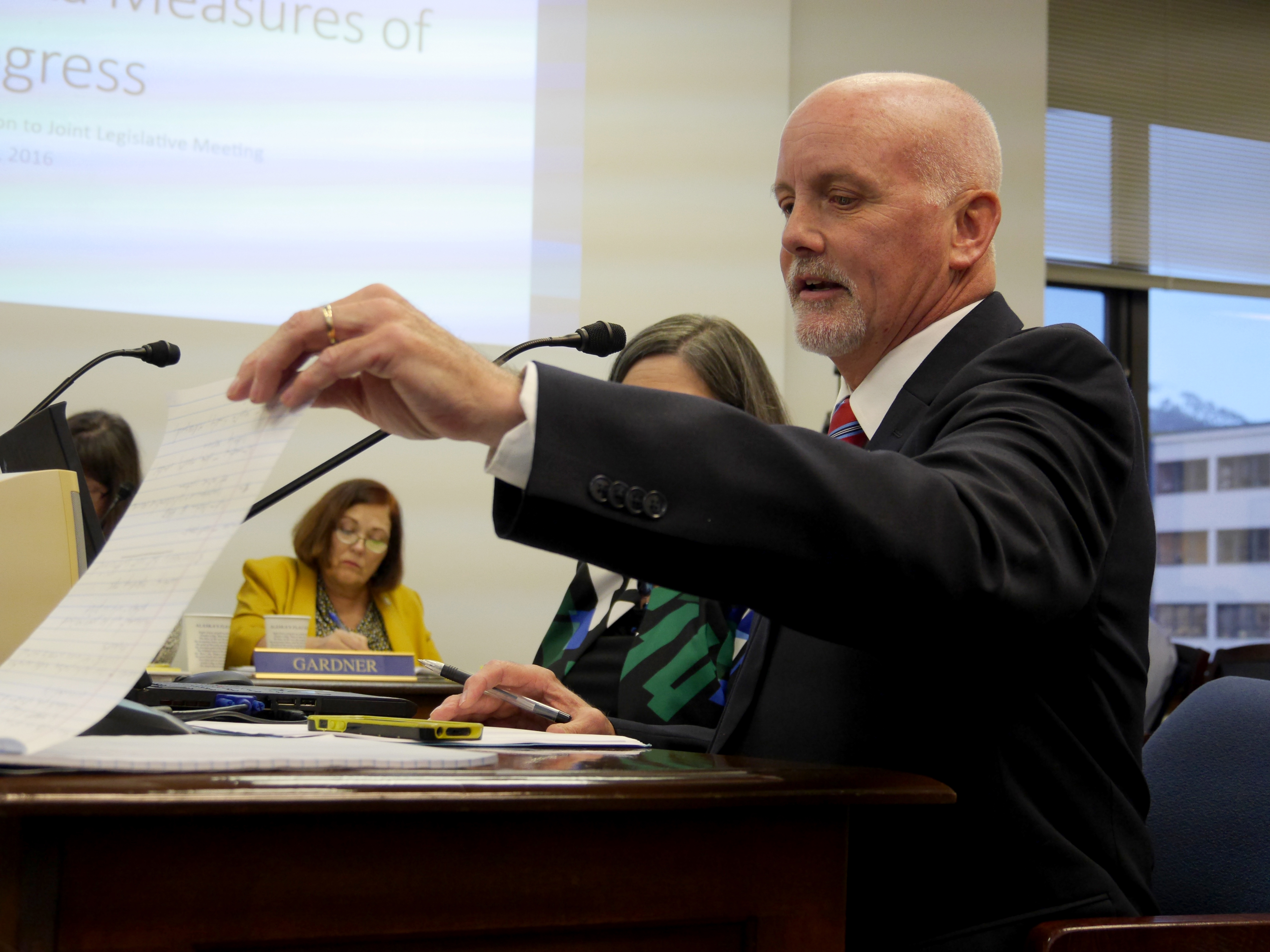
In recent months, Hanley and the department have been criticized for what many see as the failure of the state’s new Alaska Measures of Progress assessment. Hanley said he’d be surprised if that didn’t play some part in the governor and the board’s decision.

“You know, I look back at when we put AMP in place; we went through the procurement process, and things happened with the vendor that basically made it really difficult for them to follow through. And it caused a lot of frustration,” Hanley said. “I don’t know that we could have foreseen any of that. But it happened on my watch, so I own that. There’s a frustration that we all have — some of it’s with AAI, and some people have it with me — so that surely could be a part of the conversation.”

Board of Education Chair James Fields said that Hanley’s resignation has no “direct tie” to the AMP controversy.

Hanley won’t get to oversee the development of a new test, but he said there are areas where he thinks the department made gains during his tenure.

He said he saw to the settlement of two lawsuits, the Kasayulie and Moore cases, that helped ensure equitable state oversight and funding for rural Alaska schools.

“When I came on board, there was a lot of friction and some divide between rural and urban Alaska,” Hanley said. “We had two lawsuits that had been sitting in front of us, one for 8 years and one for 13 years. By settling those two lawsuits, it allowed us to continue conversations, rebuild those bridges and recognize all our students as one body of students, not defined by where they live. That was huge, I think, in helping to break down those conversations.”

Hanley will stay on board until March 1. He said he’s weighing options in both the private and public sectors, possibly looking to work with young people in a more direct capacity.

Susan McCauley
Susan McCauley. (Photo courtesy Alaska Governor’s Office)

Susan McCauley will take over as interim commissioner. She currently leads the department’s Teaching and Learning Support Division. She previously taught in Hooper Bay and was principal and administrator in the Matanuska-Susitna Borough School District.

Summit explores achieving racial equity in Alaska

The First Alaskans Institute hosted a Racial Equity Summit in Anchorage this week. The event’s dialogues focused on what racial equity is and how we can start to achieve it.

Panelists from around the world discuss steps toward achieving racial equity during a recent Anchorage Summit. (Photo by Anne Hillman/KSKA
Panelists from around the world discuss steps toward achieving racial equity during a recent Anchorage Summit. (Photo by Anne Hillman/KSKA)

Racial equity and racial equality are not the same thing. Equality means everyone is treated the same or given the same resources. It assumes that everyone starts at the same point. Equity means making sure everyone can arrive at the same point, no matter where they start.

Gyasi Ross is a member of the Blackfeet Nation and lives in Washington. He speaks on social justice and race issues and presented at the summit. He says to achieve racial equity, communities first need to acknowledge that underlying systems deny people of color equal starting points.

“We think that now we have this quote-unquote colorblind society — which doesn’t exist but even if it did exist, so what? The foundation wasn’t colorblind. The foundation wasn’t equal. And that creates a structure that’s on an unequal playing field, an asymmetrical playing field from the very start.”

He gives the example of land ownership. Black people in the United States couldn’t own land until the late 1800s. As a result, whites currently own about 850 million acres of agricultural land. Blacks — just 7 million. Ross says to change that basic inequality, people with privilege need to be OK with losing some of their privilege. But that’s not an easy thing to talk about.

“The point is that equity as a serious conversation, and there might be uncomfortable conversations and some level of displacement, and we have to be OK with that,” Ross says.

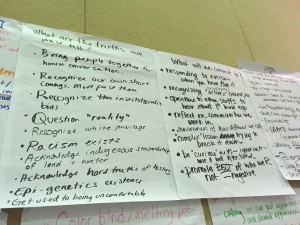
Ideas gathered during the two day racial equity summit in Anchorage. (Photo by Anne Hillman/KSKA)
Sheets of paper hold lists of ideas gathered during a two-day racial equity summit in Anchorage. (Photo by Anne Hillman/KSKA)

So how do we get beyond that discomfort? Summit speaker Jay Smooth, who speaks and writes about race and culture, says we need to change how we frame the conversation.

“We tend to frame each conversation as a referendum on whether I am a good or bad person. And if I’m a good person then I don’t need to consider whether I’m prejudice or have any blind spots toward people or whether I’m part of a system that perpetuates injustice even if I’m not consciously contributing to that.”

Smooth says people need to think beyond good versus bad and be actively looking for our own unconscious biases and the ways we perpetuate racist systems.

But for some Alaskans, like extension officer Kari van Delden from Nome, that means first identifying why the conversation is so hard to have. She’s white and helps host conversations about race in her community with Panganga Pungowiyi, the director of Kawerak’s Wellness Program.

“For a long time I was really uncomfortable talking about anything around racial issues,” van Delden says. “So I had to start trying to figure out why is this an uncomfortable conversation for me. And there were a lot of things like I would find myself feeling like I needed to defend something or feeling like somebody would misunderstand me. So I had to start understanding why I was backing away from the conversations or avoiding them before I could even start having the conversations.”

Pungowiyi says one of the first steps for talking about race is acknowledging the history of external and internalized oppression.

“True history about Alaska Native people is not taught, and when that history is kept from you and you don’t know how your families and your communities have gotten into the situation that they’re in with all these symptoms of historic trauma manifesting, like alcoholism, like abuse, like violence. All of these things. The high suicide rate. When you don’t realize there’s a reason for all these things, you become internally oppressed. You just feel inferior.”

Pungowiyi says it’s a feeling you have to heal from–it’s part of a community-wide healing process. She tries to incorporate conversations about race into all aspects of life in Nome. Because if people can talk about it, they can make systems more equitable for everyone.

The First Alaskans Institute hosted the two-day conference in Anchorage as part of its ongoing work on racial equity.

Governor taps Ruffner for fish board, again

For 40 years, someone from Bristol Bay has sat on the Alaska Board of Fisheries. For the first time next fall, that might not be the case.

Gov. Bill Walker announced five nominations to the state fisheries and game boards on Tuesday. On the list again for a fish board seat is scientist Robert Ruffner of Soldotna, who would replace Fritz Johnson, a commercial fisherman from Dillingham.

That was a surprise for many in Bristol Bay — including long-time drift fisherman Robin Samuelson, a former fish board member himself.

“This is a sad day for Bristol Bay,” Samuelson said shortly after the announcement was made. “Fisheries is everybody’s livelihood in Bristol Bay and I’m very disappointed in the governor’s action.”

Johnson, also a Bristol Bay drifter, wanted to serve a second term on the board. He was appointed to replace Vince Webster, of King Salmon, who replaced Dillingham’s Robert Heyano. As far back as 1975, when the board of fish and game was split into two, someone from Bristol Bay has sat on the board of fish. Dillingham’s Herman Schroeder was the first appointee from the region. Samuelson said he wasn’t expecting the governor to change that pattern.

“I could see him replacing Fritz, but it would seem that with having the biggest herring fishery in the state of Alaska, having the biggest salmon fishery in the world, that we’d be afforded a board of fish member,” Samuelson said.

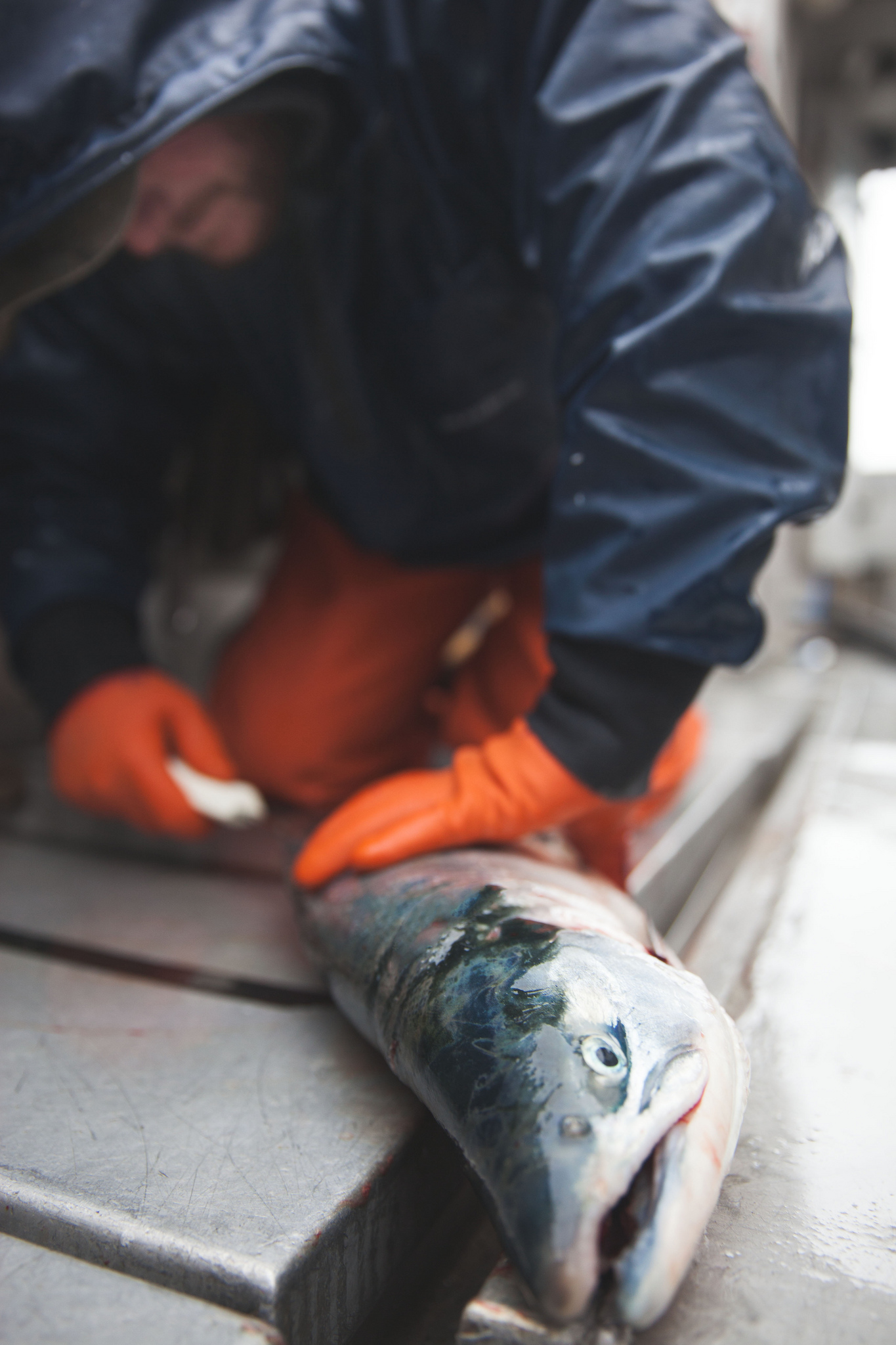
A commercial fisherman and salmon in Bristol Bay, July 2, 2013. (Creative Commons photo by Chris Ford)

Norm Van Vactor, CEO of Bristol Bay Economic Development Association, said the news was a surprise to him as well. Although he’s been a supporter of the governor, he was frustrated by the lack of outreach to Bristol Bay stakeholders before the decision was made.

“And I think that the lack of process that the governor and the commissioner have not gone through is really sad,” he said. “… I think all of us were put in a position of not being able to rally and ask why.”

But Walker said he was ready for something different and didn’t make the decision lightly, knowing it was a big change for the bay.

“I just wanted a little different balance, not necessarily of user groups but a regional balance a little bit for a change,” Walker said. “I certainly wouldn’t look at this as a trend in anyway, but I think that there’s a lot of angst in the Cook Inlet, Peninsula region. … I looked at the individuals, both were obviously quite good. Fritz has been a good board member. And I look at Robert Ruffner, and … what I think he brings to the board, and I just felt I needed to have a little bit of a different, a little bit of a shift, and use Fritz in a different way.”

Although Johnson received a ticket for fishing three minutes after the fishing period closed this summer, Walker said that wasn’t a deciding factor in the decision not to reappoint him. Instead, Walker said he’s hoping Johnson will help with a new advisory group he’s forming to review the board process.

“I know he’d much rather be on the board, but I need somebody from the board to be part of this advisory group,” Walker said. “I want to look at some potential changes to the board process in some way, but I need to put together this advisory group to do that and so, like I said, I’ve asked Fritz to be part of that if he’s willing to.”

Walker said he met with Samuelson and Rep. Bryce Edgmon after the announcement was made.

Johnson’s replacement, Ruffner, is actually a second-time nominee. Last year, the state legislature voted him down after he was selected to replace former board chair Karl Johnstone, citing concerns that his appointment would change the balance. Johnstone was considered a sportfishing representative; Ruffner had a science background, and said he would put the resource first.

Walker later appointed Robert Mumford, a former Alaska wildlife trooper, to Johnstone’s seat after Ruffner wasn’t confirmed. Mumford served for most of the year, but announced in late January he planned to resign in March.

Walker has nominated Anchorage’s Al Cain, another former trooper, to replace him. The governor rounded out his fish board nominees with Israel Payton, a Wasilla resident who has worked as a hunting and fishing guide. He’ll replace Tom Kluberton, who said in December that he didn’t plan to serve another term.

The appointments change the balance on the seven-member board, which makes policy and allocation decisions for the state’s fisheries. Typically, there are three representatives of the sportfishing industry, one subsistence representative and three from commercial fisheries. The most recent round of nominations, if confirmed, will change the balance.

Samuelson said it isn’t just commercial fishing representation he’s worried about.

“Subsistence is the most important fishery in our state, especially in rural Alaska, and who’s gonna carry the torch on that board for us,” he said. “Not only our commercial fishery but our subsistence fishery.”

All of the governor’s nominations are subject to confirmation by the legislature, a process that’s been contentious in the past couple of years. Walker said he expects Ruffner to be confirmed this time around.

“I’ve received, I believe, assurances that it will go significantly differently. Otherwise I would not have put him back up as a nominee,” he said.

Specifically, Walker said individuals from the Kenai Peninsula told him they thought the vote would go differently this spring. But one Kenai Peninsula lawmaker, Republican Rep. Mike Chenault, said it remains to be seen how the confirmation process will go.

“It is contentious,” Chenault said. “I have never seen a board member just kinda sail through unscathed without somebody taking pot shots at ‘em. And you know, why some (people) even would want to be on this board? I have no idea.”

Chenault said the fish board appointees will likely face multiple confirmation hearings before the legislature meets in a joint session to consider the nominees. That hearing is typically occurs toward the end of the session.

In addition to the fish picks, the governor reappointed Nathan Turner for the state Board of Game, and appointed Guy Trimmingham for a first term.

Alaska LNG faces ‘significant economic headwinds’

natural gas stove flame blue
(Public Domain photo)

As if lawmakers don’t have enough on their plates trying to close a $3.5 billion budget hole, this week brought a reminder that the state is also trying to advance a natural gas gigaproject.

That would be Alaska LNG, the effort to build a pipeline from the North Slope to Cook Inlet.

With natural gas prices following oil in an extended plunge, lawmakers heard the project faces “significant economic headwinds.”

Meanwhile, tension between the Walker administration and the state’s three oil company partners once again spilled into the open.

Lawmakers heard a series of updates on the Alaska LNG project this week. The upside? Technical progress is on time and on budget, according to project manager Steve Butt.

The downside? Just about everything else.

Representatives from ExxonMobil, BP and ConocoPhillips, the state’s three partners, testified Wednesday.

In his opening statement, Leo Ehrhard, Vice President for Commercial Assets at ConocoPhillips, said his company is committed to Alaska LNG.

“But we have to be realistic about the project in this current price environment,” he said. “And we have to be realistic about the challenges that sit in front of us.”

Those include oil prices at their lowest levels in over a decade, gas prices at their lowest levels in a decade and a half, and more liquefied natural gas on the market than buyers can absorb. Prices will rise, Ehrhard said, but nobody knows when.

Meanwhile, for the project to move forward, the companies must complete a series of agreements among themselves — and with the state.

In a letter sent to the companies in mid-January, Gov. Bill Walker insisted those agreements must be submitted to the legislature by the end of the current session.

That seems unlikely, Ehrhard said.

“The governor has identified a list of agreements he would like to see completed before the special session,” he said. “This will be a very difficult task to accomplish.”

Representatives from ExxonMobil and BP echoed that point.

If that’s not ominous enough, Ehrhard went on to explain what would happen should ConocoPhillips decide to pull out.

“Should we find an impasse to these agreements, ConocoPhillips will not stand in the way of the project, and will make our gas available to the state.”

If that sounds like Conoco has one foot out the door, a spokesperson reiterated Friday that the company is “committed.”

But key deadlines are looming. The three companies are seeking what they call “fiscal certainty,” meaning, they want to lock in tax rates on the project to avoid the decades of litigation that followed the construction of the Trans-Alaska Pipeline.

That would likely require a constitutional amendment, which in turn requires a vote this November. If the partners miss the deadline for this year’s general election ballot, the next chance is 2018.

Walker said he can’t support an amendment unless the other contracts are signed — including agreements on the governance structure for the project, how the state would access its share of the gas, and, stickiest of all, an agreement among the producers themselves about how to supply the project.

In fact, the governor wrote, if the partners can’t agree, he will have “no other choice but to consider other options for commercializing Alaska’s gas.”

Speaking with reporters on Thursday, Walker was vague about what exactly that might mean.

“Really, it’s just a matter of, I wanted to be clear what my expectations are,” he said.

Meanwhile, Senator Bill Wielechowski, D-Anchorage, asked the question on many Alaskans’ minds.

“How likely is this project to happen at this point, would you say?” he asked.

“I’m hesitant to put a number on it, since I’ve been working on this since 1992,” replied ExxonMobil’s Bill McMahon.

But McMahon ticked off a series of factors in the project’s favor, including the fact that all three leaseholders and the state are working together, and he noted that by the end of this year, the project will have gone further than any previous effort.

In the end, he said, he’s bullish on Alaska gas.

Site notifications
Update notification options
Subscribe to notifications