State Government

Brooks Range Council opposing ‘Road to Resources’ program

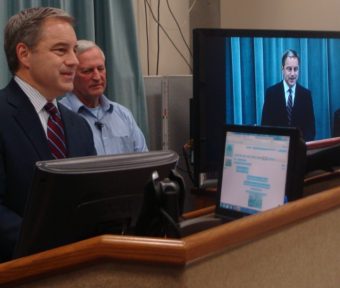
The Brooks Range Council is a grassroots movement opposing Governor Sean Parnell’s plan to develop a road to the Ambler Mining District.

The governor’s office has proposed nearly $29 million next year to advance his “Road to Resources” program, which includes $4 million for the planned road to Ambler. That money will be used for permitting and environmental work on the proposed roads, which the governor says will eventually allow access to resources near Umiat, Tanana and Ambler. The Ambler mining district is the proposed terminus of a 220-mile road from the Dalton Highway.

The governor calls the roads a chance to “grow economic opportunities” in rural Alaska and create jobs. But John Gaedeke, the chairman of the Brooks Range Council, says only industry will benefit from the roads.

The Ambler Mining District holds one of the largest undeveloped copper-zinc deposits in the world. A study commissioned by the Department of Transportation in September of last year estimated the cost of the Ambler road be $430 million, with annual maintenance costs over $8 million. The Brooks Range Council says the true cost could more than double that figure, and that the high-sulfide rock to be mined if the road is built would leech acid into the environment, harming wild fish populations and requiring costly annual cleanup long into the future.

Other critics of the road are also becoming more vocal. The community of Bettles in July passed a resolution officially opposing the road. Gaedeke says any road should be approved by the people who live there.

And to tell the governor “what they want,” the Brooks Range Council is collecting signatures for a petition calling on the governor to abandon the project.

So far, the Brooks Range Council hasn’t received any official response from the governor’s office. If the Ambler road project stays on schedule, DOT hopes to begin the permitting process for the road in October.

Parnell seeking spending restraint

Gov. Sean Parnell is seeking spending restraint for next year’s state budget.

Parnell’s been preaching this since taking office. He recently met with his commissioners to let them know that when they write their budgets, they should do so in the context of the state constitution, Alaska’s economy and the global economy.

Parnell says the state is currently looking at a decline in revenue next year, due to factors including lower oil prices. If that situation holds, he says he will seek less spending.

Parnell’s budget proposal for fiscal year 2014 is due in December.

He is also continuing his call to get more oil in the trans-Alaska pipeline, saying declining production will eventually force “drastic changes” in state spending habits.

Health commish responds to abortion reg concern

Alaska’s health commissioner says his department didn’t intend to restrict the definition of a medically necessary abortion in proposed regulations for abortion payment conditions.

Commissioner Bill Streur was responding to Sen. Hollis French, who said the agency is seeking to reinstate criteria overturned by the Alaska Supreme Court.

The court held the state must fund medically necessary abortions if it funds medically necessary services for others with financial needs.  A legal opinion requested by French said phrasing used in the proposal is narrower than current law, and “reasonably likely” to be found unconstitutional.

While French asked Streur withdraw the proposal, Streur said the department would determine, after reviewing all public comment, whether to make language changes.

Streur said a court would ultimately decide constitutionality if the adopted regulation were challenged.

Thirteen lawyers vying to replace Justice Carpeneti

Three Juneau residents are among the thirteen applicants to replace Justice Walter “Bud” Carpeneti on the Alaska Supreme Court.

Superior Court Judge Philip Pallenberg, Assistant Attorney General Susan Cox and Administrative Law Judge Terry Thurbon have submitted their names to the Alaska Judicial Council for consideration. Ketchikan Superior Court Judge Trevor Stephens is the only other Southeast resident that applied.

The list also includes attorneys Andy Harrington and Peter Maassen, the two finalists to replace Justice Morgan Christen on the Supreme Court. President Obama recently appointed Christen to the federal 9th Circuit Court of Appeals. Governor Sean Parnell has less than 10 days to pick either Maassen or Harrington, taking one of them out of the running for Carpeneti’s seat.

Carpeneti, who lives in Juneau, announced his retirement in June. His last day on the bench will be January 31, 2013.

The Alaska Judicial Council will evaluate all of the applicants for the upcoming vacancy, including public hearings in person interviews. The council will then submit two or more nominees to the governor, who will choose the next Justice.

Opponents of coastal zone measure pick up advertising pace

Opponents of measure 2 on this month’s Alaska primary ballot are using their sizable financial advantage to flood the airwaves.

Thanks largely to donations from resource development groups and companies, the “Vote No on 2” campaign is running TV and radio commercials in addition to print advertising, encouraging voters to say no to the measure restoring Alaska’s Coastal Management Program.

Backers of the citizen’s initiative say they’re not trying to compete with the full on media blitz, but believe their support in coastal communities will help them prevail.

KTOO’s Casey Kelly has more.

If you’re watching the Olympics on TV this week, chances are you’ve seen the ads urging you to vote no on Ballot Measure 2.

The “Vote No on 2” campaign paid for the TV spots with some of the nearly $719,000 in cash it raised since forming just two months ago.

Mike Satre is executive director of the Council of Alaska Producers — a trade group representing large-scale mines and mining projects in the state. It was one of the first groups to give money to “No on 2,” cutting a $25,000 check in June. Satre says the council’s membership supported the state’s previous coastal management program, but is concerned about the version outlined in Measure 2.

“We had some long conversations about where we sat on this program and ultimately decided that because of the uncertainty that this initiative would bring out, the new bureaucracy it would bring about that we simply couldn’t support this initiative,” Satre says.

Other resource development companies and organizations have followed suit. That includes a $150,000 donation from Shell Oil; $120,000 from the Alaska Miners Association; and $75,000 dollars from Hecla Greens Creek Mining Company — Juneau’s largest private employer.

Satre, who’s also donated more than $5,000 of his own staff time as an in-kind contribution, says obviously the money will help to get the message out on multiple platforms between now and Election Day on August 28th.

“We find that most people around the state don’t know what this initiative is, and so it’s very, very important that we spend our time and money on educating voters,” he says.

In contrast to the anti-Measure 2 group, initiative sponsors the Alaska Sea Party raised just under $64,000 during the last reporting period. Juneau Mayor and Sea Party Chairman Bruce Botelho says the group will not be airing TV ads during the Olympics, or at all for that matter.

“Obviously it’s a concern, because we will not be able to match the message that people will be exposed to, perhaps saturated with,” Botelho says.

He says the Sea Party plans to respond with a “grassroots” campaign, including door-to-door canvassing, phone calls, and speeches to civic groups.

In response to industry claims that Measure 2 is too complex and would add another layer of bureaucracy, he says the initiative is really just a framework to set up a coastal management program like the one the state had for more than 30 years.

Botelho says that includes the fundamental feature of coastal management — one-stop permit review for coastal projects by a single state agency. He argues that’s pro-development, especially when the builder is a small company or an individual.

“That person or company has an opportunity to have all the regulatory agencies at the table at the same time, walking through issues that may arise,” he says. “And to make sure that we don’t get in the cycle that is actually starting to occur now, which is if the permit has to be modified with one agency, you basically have to run the gauntlet yet again.”

In addition, coastal management traditionally gives local communities a greater voice in development decisions happening in their backyards. For that reason, Botelho thinks the Sea Party will have an advantage when it comes to support in coastal areas.

“In the rural, coastal communities, there has been a very strong statement of support for coastal management and for the initiative,” he says. “They see the importance of having a viable coastal management program and having a community voice.”

Indeed, the Sea Party’s largest contributor is the North Slope Borough, which has given more than $40,000 since late last year. Other top donors include the Bristol Bay Borough, Bristol Bay Native Corporation, and Anchorage businessman Bob Gillam — a major opponent of the proposed Pebble Mine.

Satre says “Vote No on 2” supporters are not opposed to local input when it comes to development.

“I can see why coastal communities want to get a program back on the table,” he says.

But he still thinks the measure goes too far.

The Alaska Coastal Management Program shut down in 2011 after the multiple failed attempts by the legislature to reauthorize it.

If voters okay the initiative, it would likely take about two years to get federal approval for a new program. Currently, Alaska is the only coastal state without an authorized coastal management program.

Juneau Labor building to undergo more renovation, mold remediation

Labor Building
A contractor will soon begin staging equipment at the Department of Labor building in Juneau for yet another renovation, mold remediation project. The state, which rents the space from a private company, will partially foot the bill for the work. (Photo by Casey Kelly/KTOO)

The State of Alaska will partially foot the bill for yet another renovation project at the Plywood Palace.

The state Department of Labor building in Juneau continues to be plagued by mold and air quality issues, despite several rounds of remediation and remodeling over the past decade.

Labor Commissioner Dianne Blumer last week sent an email to employees, letting them know construction crews would soon begin staging equipment at the building.

The state still has not awarded a new lease to the building’s owners. But when it does, the cost of improvements will be amortized over the first five years of the agreement.

KTOO’s Casey Kelly has more.

It’s not known when the renovations will get underway, or even what will be involved. A spokesperson for the Labor building’s owners, Juneau I, LLC, could not be reached for comment.

State Chief Procurement Officer Vern Jones says Juneau I was planning some work before the state’s recent announcement of a tentative lease agreement, which will require certain repairs.

“They’ve told us previously and included in their offer some replacement of the HVAC system, including the rooftop air handling units, the heating units, ducting,” says Jones. “Remediation of mold — they’re going to basically remove the sheet rock and the inside surfaces of the walls and remediate where necessary there.”

Earlier this year, the state walked away from mediated negotiations for a lease extension, and sought proposals for new office space for the department’s 300-plus Juneau-based employees. Jones says there were only four responses – less than state officials had expected. Juneau I successfully bid to keep about 260 employees at the current facility, while Salmon Creek, LLC won a bid to house 78 workers at the Mendenhall Mall.

Despite the Labor building’s history of problems, Jones says the state was unable to exclude Juneau I from the process.

“Our procurement rules and laws require us to allow free and open competition,” he says. “And just because a facility may have a condition doesn’t mean it can’t be repaired or remediated or fixed somehow. A lot of times a building owner will completely gut a building and by the time they’re done it will be completely different and essentially new.”

Representative Beth Kerttula and the rest of Juneau’s legislative delegation continue to press the Parnell administration for a new state-owned office complex.

“I would rather see a new building altogether,” Kerttula says. “I have my doubts as to whether this building will ever come up mold free.”

Kerttula says the delegation is most concerned about the many state employees who say the Labor building is causing their chronic health problems.

“I am very hopeful that anyone who does have these health issues will be able to be moved out of that building,” she says.

Jones says Juneau I believes the building can be renovated while employees continue to work there.

The state is still negotiating floor plans and logistics with both Juneau I and Salmon Creek, and he expects to issue a final notice of award in the coming weeks.

What’s not being negotiated, he says, are the financial terms of the two leases. In both cases, the state will pay more during the initial five-year term to help the landlords with the cost of renovations and repairs needed to comply with state requirements. For the Labor building that means an extra $1.36 per square foot every month, or nearly $4-million over five years.

Jones says the state is only agreeing to a five-year initial term in order to have more flexibility in the future. In the meantime, he says Administration Commissioner Becky Hultberg is keeping all options for state office space on the table, including a new building.

Site notifications
Update notification options
Subscribe to notifications