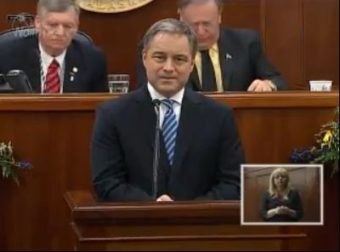
The Alaska Legislature this year set aside July 30th of each year as a day to honor the National Guard and its work.
In Juneau, active and retired Air and Army National Guardsmen and women will celebrate with a picnic at Sandy Beach.
The first National Guard unit in Alaska — Alpha Company, 297th Infantry — was established in Juneau in 1940 under Territorial Governor Ernest Gruening.
Mac Metcalfe is one of three retired guardsmen in Juneau to organize the event. He says there are about 60 active National Guard members in Juneau, and an unknown number of retired members.
Every state has its own National Guard, “controlled by the governor, until the president calls a unit or all units up, then they become part of the regular Army or the regular Air Force,” Metcalfe says. In state, the National Guard “is here primarily to assist in state emergencies. And they have a lot of different tools to help, including helicopters, aircraft that can bring in large amounts of supplies, soldiers that can be deployed for security reasons or to do pick and shovel work, whatever’s needed.”
Monday’s first Alaska National Guard Day picnic in Juneau is from 4:30 to 7:30 p.m. Monday at Sandy Beach.
“We’re serving up some good food and good fellowship here in Juneau.”
That’s how Gov. Sean Parnell characterized the fourth annual Juneau Governor’s picnic in Juneau on Friday.
He and First Lady Sandy Parnell started the evening handing out paper plates. Lt. gov. Mead Treadwell and ten commissioners and several deputy commissioners also served food at the Juneau event.
“I think it’s a great way for the community to see their government serve them and to be able to meet their commissioners and the governor and myself,” Mrs. Parnell said. “It’s nice way for us to be able to serve you.”
The capital city governor’s picnic is one of a series of four in Alaska’s major urban centers. This year a rural Alaska picnic was added in Glennallen, which the governor called the first of the “traveling” picnics.
“We held a traveling picnic in Glennallen and we’re going to do one traveling picnic a year in a different rural community,” he said.
The last two for the year will be held in August in Anchorage and the Mat-Su.
About 2,000 people attended the Juneau picnic, according to Cathie Roemmich, director of the Juneau Chamber of Commerce, which helped organize the event.
As the line for food got shorter, the Parnell’s slipped out of the serving line and mingled with the crowd.
The governor said it’s not all picnic; Alaskans often have hard questions for him.
“Oh, all the time,” he said. “That’s part of the beauty of being out here like this.”
Governor Sean Parnell, Sandy Parnell and Lieutenant Governor Mead Treadwell welcome visitors to the picnic. (Photo by Heather Bryant/KTOO)
People line up for grilled salmon, hot dogs, chips and drinks. (Photo by Heather Bryant/KTOO)
Caleb Friend, 5, waits patiently for his balloons. (Photo by Heather Bryant/KTOO)
Gerry Harmon ran a gold-panning table where picnic guests could try their hand at striking gold. (Photo by Heather Bryant/KTOO)
The picnic featured a variety of activities for children. (Photo by Heather Bryant/KTOO)
Governor Sean Parnell hands out plates to picnic guests. (Photo by Heather Bryant/KTOO)
A nonpartisan group, formed in 1999 to fight an oil merger in the state, is expressing support for the Alaska Senate’s bipartisan coalition.
Leaders of Backbone held a news conference in Anchorage on Thursday, in which they lauded the coalition’s stand against Gov. Sean Parnell’s oil tax-cut plan. Some Republicans, including Parnell, have expressed a desire to break up the current coalition.
The group does not plan to register as an independent expenditure group or to endorse candidates but rather intends to draw attention to the importance of this year’s Senate races
Vince Beltrami, of Backbone, likened the coalition’s efforts in the oil tax fight to keeping the fox out of the henhouse.
Six of the Senate’s 10 Republicans have joined with the chamber’s 10 Democrats to form the coalition.
The Federal Communications Commission says thousands of rural Alaskans will have access to affordable, higher-speed Internet through its “Connect America Fund.”
The fund is intended to connect millions of unserved rural Americans to broadband. And FCC says Alaska Communications accepted nearly $4.2 million to increase broadband access in this state.
FCC says more than 14,000 rural Alaska should benefit once the build-out is completed. Alaska Communications must complete two-thirds of its new broadband commitments within two years, and the remainder by the third year.
Gov. Sean Parnell & First lady Sandy Parnell serve up picnic food at Juneau’s first governor’s picnic in 2009. Photo by Rosemarie Alexander.The capital city’s fourth annual Governor’s picnic is tonight (Friday) from 4:30 to 7 p.m. at Savviko Park in Douglas, also known as Sandy Beach.
Gov. Sean Parnell, First Lady Sandy, and some of Parnell’s cabinet will be on hand to dish up fresh barbequed salmon, hot dogs and other picnic fare.
Juneau Chamber of Commerce Director Cathie Roemmich says the annual picnic has brought Juneau closer to this governor.
“With Gov. Parnell and his wife Sandy they have definitely made themselves a part of our community and it’s obvious to the people of our community,” Roemmich says.
Parnell is not the first governor to be part of the community, but he is the first governor to hold a picnic in the capital city.
It wasn’t noticed much until former Gov. Sarah Palin decided not to live in the Governor’s House, and instead charged the state per diem to live in her Wasilla home and work out of the Anchorage governor’s office, coming to Juneau only when necessary.
Roemmich says some state departments are becoming more involved in this year’s picnic, with informational booths and activities for kids, including a front-end loader from the Transportation Department. She says Kensington Gold Mine will offer gold panning.
A month-long series of hearings on Ballot Measure 2 wrapped up in the Capital City yesterday (Thursday).
Some Juneau residents and public officials were heavily involved in getting the initiative to restore the Alaska Coastal Management Program on the August primary ballot, and are now trying to convince voters to pass it. Other residents have joined efforts opposing the measure.
KTOO’s Casey Kelly has more.
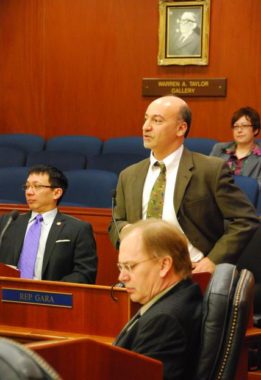
Former DEC Commissioner Kurt Fredriksson (center) makes a point during Thursday’s hearing on Ballot Measure 2 – the coastal management initiative – while Juneau Mayor Bruce Botelho (left) and Lieutenant Governor Mead Treadwell (right) listen. (Photo by Casey Kelly/KTOO)
Juneau Mayor Bruce Botelho says it’s unfortunate that Alaska citizens even have to vote on whether to have a coastal management program. He notes that in 2011, 55 of 60 state lawmakers voted for some form of coastal management, but the legislature still failed to reauthorize it.
“The legislature, left to its own devices, has had three regular sessions and two special sessions to deal with it,” Botelho says. “And it’s failed to do so.”
Botelho chairs the Alaska Sea Party, the group responsible for getting Measure 2 on the ballot. He says coastal management is good for the state, good for developers, and most of all good for local communities.
“Our initiative opts for greater community involvement in the formulation of statewide policy,” says Botelho.
Like previous versions of the Alaska Coastal Management Program, Measure 2 allows communities to develop local standards for coastal development, as long as they conform to statewide regulations.
It also restores a coastal policy board appointed by the governor, and participation by the state Department of Environmental Conservation in the coastal management review process. Both were features of the Alaska Coastal Management Program prior to changes made by the Murkowski administration.
Former DEC Commissioner and Vote No on 2 co-chair Kurt Fredriksson says Measure 2 is a major step backwards.
“Ballot Measure 2 returns Alaska to a time when there was no agreement on who best represents the interests of state and local communities in resource development decisions,” Fredriksson says. “No agreement on how state permits should be coordinated; no agreement on how long it should take to make a coastal permit decision.”
Fredriksson says that uncertainty invites legal challenges.
“That will frustrate the needs of coastal communities and delay or tie up resource development projects in the courts for years,” says Fredriksson.
The coastal management initiative is the first to fall under a 2010 state law requiring eight hearings – at least two in each judicial district – on citizen sponsored legislation up to 30 days before Election Day.
Thursday’s hearing was moderated by Lieutenant Governor Mead Treadwell, whose office oversees state elections. At one point, Treadwell asked Botelho – a former state Attorney General – whether Measure 2, if it passes, could be amended by the legislature and to what extent.
“The answer is yes,” Botelho said. “The legislature has the power to amend at any time.”
The hearing also featured public testimony. Mike Satre Executive Director of the Council of Alaska Producers disputed the contention by Measure 2 supporters that the initiative is pro-development.
“I think we can all agree that coastal zone management is pro-community,” Satre said. “But if this was pro-development why would the Council of Alaska Producers, the Alaska Oil and Gas Association, the Resource Development Council, the Alaska Miners Association, the Alaska Cruise Association, the Association of General Contractors and the Alaska Forest Association all oppose it?”
But Dave Hanna – owner of Alaska Concrete Casting in Juneau – said Measure 2 would have the most benefit for small businesses and individuals.
“For about 32 years now I’ve been the lead person on planning, permitting and developing various small projects in Alaska that went through the coastal zone policy program,” Hanna said. “I think I can speak with some authority on how effective a tool it is for development. For a small developer it’s almost imperative.”
The state-sponsored hearings may be over, but the debate over Measure 2 will continue for the next month. August 28th is primary Election Day, and both sides are sure to ramp up their campaign.
Close
Update notification options
Subscribe to notifications
Subscribe
Get notifications about news related to the topics you care about. You can unsubscribe anytime.