Governor Sean Parnell today (Thursday) signed into law a bill explicitly banning text messaging while driving.
Lawmakers thought they handled the issue four years ago. But last year some judges in the state ruled the law did not cover sending messages over smart phones. The legislature’s legal advisors said it would take at least three years to appeal the decisions. So, legislators decided to make the law more specific.
Haines Republican Bill Thomas was one of six sponsors of the bill.
“It was a public safety issue all along,” Thomas says. “You travel six seconds while you’re texting. It’s about the length of a football field. And you know you could drive off the road, hit another vehicle or something else. The idea is to concentrate on your driving and not texting.”
Anchorage Democrat Les Gara says texting is as dangerous as any other distraction to drivers, and some experts say it compares to driving drunk.
“Actually, while you’re typing a text, there is one study that says it’s more dangerous than drunk driving – your reaction time is slower,” says Gara. “We wanted to make certain that people knew that it was illegal, that it’s not okay even though people think it’s a social thing, it’s very dangerous. You can kill somebody doing this.”
The bill goes into effect Friday. Violators risk being charged with a misdemeanor.
Before the regular session ended, lawmakers appropriated $2.9 Billion for construction and maintenance projects statewide for the next fiscal year, and $450 million in general obligation bonds to be approved by voters next November.
Rosemarie Alexander takes a look at those destined for the capital city.
Juneau’s portion of the new public works budget is more than $100 million.
“And that’s an amazing feat for our delegation,” says Juneau Sen. Dennis Egan. He and Rep. Cathy Munoz and Beth Kerttula call themselves a good team for the capital city.
Part of Juneau’s largesse is $49-million for the so-called SLAM project — the new state library, archives and museum building. Total cost is estimated at more than $126 million, and it’s unclear exactly what work will be done with the current funds. But the project has long been a capital city priority and legislators say it’s a relief to see the money roll in.
Other Juneau projects include work on the downtown State Office Building, first phase of renovation of the Douglas Island office building, and other statewide facilities. City projects range from $7 million dollars for a Mendenhall Valley library to $100,000 for school computers. There’s money for the arts, local non-profits, even dust control for valley streets. Of course, Gov. Sean Parnell can veto any project he chooses.
Munoz is disappointed the legislature did not increase the base student allocation for school districts, but is enthusiastic about the state’s new scholarship fund. Last year lawmakers set up the program endowment; this year, they added structure.
“It’s a $400 million fund with a 7 percent payout. Two-thirds will go for merit based scholarships, and one-third will be for needs-based merit scholarships,” she says. “And those are direct grants that will be available for qualifying students for the entire time that they’re pursuing their degree or their certificate at an Alaskan post-secondary school.”
As a member of the Senate bi-partisan working group, Egan is pleased with progress made on the most controversial legislation, including oil taxes and his bill to reinstate a defined benefit retirement program for public employees.
The legislation would give employees an option of a 401-K style defined contribution, or the guaranteed pension. Juneau legislators have introduced the bill every session since 2007. This year it made it through the Senate.
“It was too late in the session to make it through the House but that’s the most progress that’s been made on anything like that in years, so I felt very happy about that and will attack it again next year,” Egan says.
The special session ended with House Majority Republicans and Gov. Parnell blaming the Senate for derailing the governor’s oil tax cut bill.
Kerttula, the House Democratic Minority Leader, says the Senate methodically and thoughtfully dealt with the contentious issue.
“They exposed the fallacies, they went forward and at the end they even put together a bill that would have helped new fields, which is what we have been told time and again is what would help production,” she says.
Juneau legislators say oil taxes will be back again next year, and they don’t like the finger-pointing that took place at the end of the session. But they’re looking beyond that to those projects that are sure to help heat up the Juneau economy.
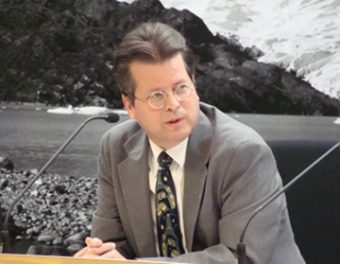
House Finance Committee Co-chairman Bill Thomas waits to speak during a House floor session on the operating budget. Image courtesy Alaska Legislature.
Haines Representative Bill Thomas spent much of this year’s session working on the state’s operating budget. He also got projects into the capital budget for his widespread district, made up of villages and small cities from Metlakatla to Prince William Sound.
Thomas has focused for several years on reducing energy costs.
Angoon’s Thayer Lake hydroproject got a chunk of money this year. But there weren’t many others in the capital budget.
Still, Thomas says one funding measure is a sign of progress.
“The renewable energy bill is critical to all of rural Alaska. It’s $50 million for the next 10 years, if we have the money. As long as we continue to have the money people will continue to retire diesel and hopefully put in wind generation and hydros,” he says.
The Haines Republican also praises a loan program to help build transmission lines and generation projects. That was added in by the Senate.
Other Legislative funding will benefit fishermen and women.
“Working with the governor we put a lot of money into the hatcheries and the harbor program to keep our harbors working. What we call our road to resources starts at the harbor,” he says.
Funded harbor projects are in Sitka, Saxman, Petersburg, Juneau, Haines, Hoonah, Hydaburg, Port Alexander and Skagway.
Thomas also worked to find money for a small veterans’ home in Haines.
“We don’t have a home in Southeast and our veterans have to go elsewhere and typically they end up passing there and then people have to go get them. People want to stay home in Southeast,” he says.
It will house 14 to 20 veterans when completed. The home will be named for Tlingit leader Walter Soboleff and noted Haines veteran Howard McRae.
Thomas was among lawmakers backing other legislation for service-members this session.
The Vietnam veteran sponsored a measure banning picketing and protesting during funerals. Another would have sped up the professional licensing of qualified vets. A third would have set a Welcome Home Vietnam Veterans Day.
They passed the House, but not the Senate.
“I think it was a dishonor for them to hold up honoring Vietnam Veterans Welcome Home Day, but that was their choice on the other side,” he says.
Thomas succeeded in pushing through a bill honoring Cordova vets. Fourteen unnamed bridges will soon recognize individual service-members from World War I and II, as well as Vietnam.
Another span, over the Eyak River will be named after Marie Smith Jones. She was the last fluent speaker of the Eyak language.
The measure also names a Petersburg bridge after Harry Kito, a hometown service-member who died in Vietnam.
“And also the airport in Klawock, they call it Klawock Frank Peratrovich Airport. Frank Peratrovich was the only Alaska Native in the constitutional convention for statehood. He also served in the territorial and state legislatures,” he says.
Thomas has served in the Legislature since 2004, representing a winding district with about 50 communities, many of them quite small.
The most recent reapportionment plan takes away some of those towns and adds Sitka, which will become the largest community in the district. He’s running for re-election in what’s for now called District 34.
The Alaska House of Representatives adjourned sine die just before 5:30 p.m. Monday. It marked the end of a tumultuous special session that seemed doomed from the start.
Lawmakers passed only one of the bills on the special session call, pertaining to human trafficking. The governor pulled oil taxes from the agenda after his bill appeared to be going nowhere. The Senate then adjourned on Thursday, relying on a legal opinion that said if a bill was removed from a special session call while the session was underway, the action, in effect, ends the session. The only bill left on the table would have advanced a natural gas pipeline from the North Slope to Southcentral Alaska.
In a news conference following adjournment, House Speaker Mike Chenault (R-Nikiski) said in-state pipeline supporters had looked at every possible option to get the Senate to act on the project.
“We’re not afraid to continue to work on it,” he said, “but without any input from the other side, we’re not a single-bodied legislature, so we have no option other than to ‘sine die’ and go home.”
The House passed the bill in March, after 14 months of consideration. During that time the Senate expressed concerns about elements of the measure and when they adjourned senators said they were not ready to rush into the subject.
Chenault said the bill had been written to take the Alaska Gasline Development Authority’s project though a successful open season, where gas shippers agree to terms by contracting for shipping space. He said there were only a few “must-have” elements to the bill.
“Specifically, they needed confidentiality, they needed money. Those are probably the two biggest issues out there. Both of those were addressed in two other pieces of legislation that were sent over there a year ago that they (the Senate) failed to take up or consider. And they were also in the bill that went over to them in March,” Chenault said.
A version of the bill generated in the Senate appropriated enough money to the Authority to continue advancing the project; another element gave the Authority the ability to take part in confidential negotiations with oil producers. But those provisions were rejected by House supporters of the measure.
After House adjournment, Gov. Sean Parnell said he stood with the House on its decision to gavel out “after the Senate Majority failed to address the state’s energy needs.”
The Alaska state Senate Thursday adjourned the special legislative session called by Governor Sean Parnell last week. The move followed Parnell’s unprecedented action Wednesday night of removing from consideration his bill to lower oil taxes.
After meeting in private most of the day, Senators explained their adjournment in a floor session by approving a statement called a “Sense of the Senate.” It read in part: “The Senate rejects the governor’s asserted authority to withdraw the subject relating to oil and gas taxes, and SB3001 introduced by the Senate Rules Committee by his request concerning that subject.”
Senate Judiciary Committee Chairman Hollis French – an Anchorage Democrat – referred to a written opinion from the Legislature’s attorney agreeing that Parnell was out of line. The opinion said the governor’s next constitutional duty was to sign or veto the legislation coming from lawmakers. French said that the governor can add items to the agenda, but it isn’t safe to assume the governor can remove them.
“It points out that where one could fairly imply a power to rescind a designation before a legislation assumes jurisdiction over the subject by convening, there is no justification for implying such power once the legislature has convened. Once he submits a bill to us, it is our bill,” said French.
House leaders agreed with the governor asserting his right to withdraw the bill, but were disappointed he chose to do so. However, they were more disappointed in the Senate’s adjournment, which if it stands, also removed the only other item on the agenda – a bill that outlined a complete plan for a natural gas pipeline from the North Slope to Southcentral Alaska. House Speaker Mike Chenault – a Nikiski Republican – said the bill is a high priority for the House. And he hasn’t yet decided how to handle it.
“I can’t tell you what’ll happen next. The House will decide tomorrow what direction we’re going to go,” said Chenault. “We certainly could stay here in session – make the Senate continue to come back. We could gavel out sine die and not take up any of these issues until future legislatures. I think the governor has the ability if he wants to to turn right around, call us back in and put whatever he wants on the call.”
The state Constitution allows the Senate to take three days in adjournment – meaning that if the House is still in session on Monday, the Senate must return. Senate President Gary Stevens acknowledged the mandate, but said he expects the House to adjourn, too, since the Senate has the only piece of legislation to work on.
“So I don’t know what the House would deal with, but to answer your question, if we have to be back within three days – if the House continues and they call us back – then I will be here to have a technical session should that occur,” Stevens said.
The “Technical Session” Stevens referred to requires only a minimum number of people – generally three. No business is dealt with.
The House and Senate have finished one third of the items on the agenda for the special session that began on Wednesday. Members expected fast action on the bill strengthening the state’s laws against Sex Crimes.
The Senate first passed the measure Thursday. The House then concurred with the single five-word change to the bill that they had already passed during the regular session.
That change on the Senate floor made human trafficking illegal within the state. Anchorage Republican Senator Lesil McGuire said the entire bill was directed at protecting children.
“Our most valuable resources are our children,” said McQuire. “And if we don’t protect their souls and their spirits, we don’t have anything.”
The bill recognizes children as victims by not immediately classifying them as prostitutes. It cracks down on forced prostitution and on pornography. It makes having sex with an underage person a felony instead of a misdemeanor.
“We don’t tolerate preying on our most innocent victims,” said McQuire. “If you are out there listening, we’re going to come get ya.”
The bill drew no opposing votes in either the House or the Senate and now goes to the governor for his action.
Close
Update notification options
Subscribe to notifications
Subscribe
Get notifications about news related to the topics you care about. You can unsubscribe anytime.