The Alaska Senate today (Wednesday) unanimously passed a bill giving judges the ability to consider Fetal Alcohol Spectrum Disorders as a mitigating factor in sentencing for non-violent crimes.
FASD is the term used for the range of conditions experienced by children whose mothers drank alcohol while pregnant. Some of the conditions are physical. But Senate Bill 151 sponsor, Anchorage Republican Kevin Meyer, says the one common feature all people with FASD share is some form of cognitive brain damage.
“More jail time for a non-violent offender does not help these particular folks,” Meyer said. “But extended periods of parole, intensive care management, assisted living, there’s a whole host of other mental health programs that will work better for folks who suffer from this disability.”
Meyer’s bill would require defendants to get a clinical diagnosis before FASD can be considered as a mitigating factor.
Eagle River Republican Fred Dyson noted that in twenty years, the state has gone from identifying FASD as a problem, to developing programs designed to treat and eradicate it.
“And now what we’re doing here is completing the kind of last step of dealing with these folks,” Dyson said. “And that is, when they encounter the criminal justice system, for it to be identified that there is an issue going on here, that the person who suffers from it didn’t cause. And it’s a lifelong disability. And it gives a chance to deal with that in these circumstances.”
Senate Bill 151 now heads to the House of Representatives, where companion legislation has already moved through the Health and Social Services Committee.
At a two-day “Crime Summit” in January, lawmakers heard from experts about the need for more flexibility in sentencing for all offenders – not just people with FASD. Alaska Supreme Court Chief Justice Walter Carpeneti echoed that call in his annual address to a joint session of the House and Senate.
A bill that would allow judges to consider FASD as a mitigating factor in criminal sentencing had a hearing in the Senate Finance Committee today (Monday).
FASD stands for Fetal Alcohol Spectrum Disorders. It refers to the range of conditions experienced by children whose mothers drank alcohol while pregnant. Many of the disorders can impair brain function, including how the person with FASD uses judgment and processes information.
Senate Bill 151 gives judges the option of considering FASD as a mitigating factor if it’s clear the defendant’s condition significantly affected their conduct. But Anchorage Republican Kevin Meyer – the bill’s sponsor – says it’s not a get out of jail free card for people with FASD.
“What we see is, a lot of times, the folks who suffer from this, a lot of times we end up throwing them in our corrections system, and then that become their way of life,” says Meyer. “So, what we’re saying is that, hey, maybe a long jail sentence for some of the crimes isn’t the right thing to help these folks.”
Meyer says the bill helps accomplish what Alaska Supreme Court Chief Justice Walter Carpeneti and other legal experts have told lawmakers about the need for more flexibility in the state’s legal system.
The Senate Finance Committee held the bill for another hearing.
A chorus of voices sang the second verse of the Alaska Flag Song on the steps of the Capitol building this afternoon (Friday).
Senate Bill 94 would officially add it to the state song. But like a number of similar bills introduced since 1987, it is currently languishing in the Legislature. Today’s singing rally was to urge lawmakers to move the bill to a vote in the House of Representatives.
The second verse was written by Juneau resident and Alaska Poet Laureate Carol Beery Davis. It pays tribute to Benny Benson – an Aleut boy who designed the state flag, with its eight stars on a background of blue. It also expresses appreciation for Alaska Native cultures.
Juneau Representative Cathy Munoz grew up taking music lessons from Beery Davis, who passed away in 1990. At today’s rally Munoz said the state flag had personal meaning to Beery Davis.
“Her husband Trevor was on the committee that actually selected the winning design. And at one point, he said, ‘During our deliberations we almost voted to select a bear on an ice cake,'” Munoz said with a laugh. “So they really vociferously worked to get the Alaska Flag, Benny Benson’s winning design, selected.”
SB 94 is sponsored by Anchorage Senator Bettye Davis. It passed the Senate last year on an 18-1 vote.
The bill is currently in the House Judiciary Committee. Chairman Carl Gatto requested to have it in his committee, but has not scheduled it for a hearing.
The second verse of the “Alaska Flag Song” as proposed in SB 94:
A native lad chose our dipper’s stars/for Alaska’s flag that there be no bars/among our cultures. Be it known/through years our natives’ past has grown/to share our treasures, hand in hand,/to keep Alaska our Great Land./We love the northern midnight sky,/our mountains, lakes and the streams nearby;/Our Great North Star with its steady light/will guide our cultures clear and bright/with Nature’s flag to Alaskans dear-/The simple flag of the last Frontier.
The Parnell administration has reached a settlement on the Point Thomson gas fields that the governor says will help clear a path to an Alaska natural gas pipeline.
Point Thomson has been dormant or tied up in litigation for the past four decades, but it holds about 25 percent of North Slope natural gas.
Gov. Sean Parnell says the settlement ends the long-running litigation with ExxonMobil and other leaseholders.
“Alaskans’ resources will be produced from Point Thomson rather than remain locked underground,” Parnell said during a news conference Friday with Natural Resources Commissioner Dan Sullivan.
Parnell received a letter Friday, signed by the CEOs of Exxon, BP, and ConocoPhillips, agreeing to work with the Alaska Pipeline Parties (APP), including TransCanada, to get North Slope gas to market within the framework spelled out in the Alaska Gasline Inducement Act, or AGIA.
“This letter states that they are now formally aligned with the APP parties and have begun to undertake work together on the commercialization of North Slope gas with a specific focus on a large-scale LNG project from Southcentral Alaska,” Parnell said.
In the letter, the CEOs say gas development will require the state offer producers competitive and stable fiscal terms.
Sullivan told reporters the companies are “on the clock” and have agreed to firm timelines for gas production. He says without production the state will terminate the producers’ Point Thomson leases.
In the near term, the settlement calls for 10,000 barrels of oil be produced a day from Point Thomson by the winter of 2015 / ’16. Sullivan says the producers will build a 70,000-barrel per day pipeline connecting into the TransAlaska Oil Pipeline. The agreement also provides two windows for the producers to sanction a major gas project off the North Slope, with gas for instate use by 2019.
“Failure to do this work, or indication that this work has been abandoned, will result in automatic return of significant acreage to the state in 2015,” Sullivan said.
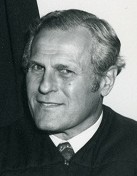
Judge Robert Boochever (Photo courtesy Alaska Court System)
Alaska’s Congressional delegation has introduced legislation to rename Juneau’s federal courthouse facilities in honor of the late Judge Robert Boochever, who passed away in October at the age of 94.
After moving to Juneau in 1946, Boochever served as an assistant U.S. Attorney, and later became the fourth Chief Justice of the Alaska Supreme Court. In 1980, he became the first Alaskan appointed to the federal Ninth Circuit Court of Appeals.
When he wasn’t practicing law, he was involved in several community groups, including the American Red Cross, the Chamber of Commerce, and Juneau Rotary Club.
Legislation to name Juneau’s federal courtroom after Boochever, comes as the U.S. Justice Department is considering closing at least 60 federal courthouses nationwide – including Juneau’s.
The latest district boundaries map for Southeast Alaska. Courtesy Ak Redistricting Board.
The latest reapportionment plan makes no changes to Southeast Alaska election districts. But it alters boundaries elsewhere in the state, which will likely be further changed because of federal requirements protecting minority voting strength.
The Alaska Redistricting Board released the plan Tuesday. And today (Wednesday), it considered a consultant’s report saying it would significantly reduce Alaska Native influence in one Interior House district and one western Senate district.
The plan responds to a recent state Supreme Court ruling saying the board put too much emphasis on protecting Native voting rights. The court said the board should have paid more attention to state constitutional requirements, which call for compact districts made up of similar communities.
Redistricting Board Executive Director Taylor Bickford says the controversy does not include Panhandle communities. (See the Southeast map.)
“There was an influence district that was built in Southeast. But the board never claimed and the court never found that the board’s drawing of an influence district in Southeast led to violations of the Alaska Constitution,” Bickford says.
Petersburg officials hoped for new boundaries closer to its current district, which includes Wrangell and Sitka. Those districts were reworked because of population shifts from Southeast and to Southcentral Alaska.
The new plan combines Petersburg, downtown Juneau, Douglas Island and Skagway. That angers Petersburg Mayor Al Dwyer.
“We don’t think that Juneau is similar in any way to Petersburg or a fishing community. It has a processor there, but it’s not considered a fishing community. It’s a tourist community and a government (community),” Dwyer says.
“I completely understand why people would be unhappy. And I think there are a lot of unhappy people around the state,” says Juneau Democratic Representative Beth Kerttula, who serves in the House district slated to include Petersburg.
“All I can say is wherever the district I’m in is I’d be honored to represent it and work hard to do a good job,” she says.
Petersburg sued to change last year’s reapportionment plan. Mayor Dwyer says the Supreme Court ruling provides another opportunity to challenge the redistricting board.
“We kind of knew that they would propose that again. But we’re against it and we’re going to oppose it,” Dwyer says.
He says Petersburg could return to court, depending on the cost.
Redistricting shrinks the region’s legislative delegation from eight to six. That means four lawmakers – two in the House and two in the Senate – will likely run against each other.
That puts one Southeast Native lawmaker – Angoon Democrat Albert Kookesh – at risk.
Kerttula worries the court-ordered change in the redistricting board’s focus – from voting rights to geography – could further isolate Alaska Natives.
“Whenever you start to redraw the lines you’ve got to have your eye on the fact that under the federal law we can’t dilute Native power,” Kerttula says.
One is a House district made up Interior villages. The other is a Senate district running from Yakutat to Kodiak and from Lime Village to Dillingham and out the Aleutians.
The redistricting board is scheduled to meet through Saturday. Executive Director Bickford says it should finish its work by then.
“We’re really just playing by ear at this point. We’re trying to do our due diligence, build the best plan we can and do it in a timely fashion,” Bickford says.
In Southeast, other district pairings put Sitka in a district with small cities and villages from Haines to Port Alexander. Ketchikan, Wrangell and northern Prince of Wales Island are in one district. And Juneau’s Mendenhall Valley and Auke Bay area remain on their own.
The latest reapportionment plan makes no changes to Southeast Alaska election district boundaries.