Gov. Mike Dunleavy discusses his new proposed omnibus education legislation at a news conference on Jan. 31, 2025. (Photo by Corinne Smith/Alaska Beacon)
Alaska Gov. Mike Dunleavy on Monday vetoed Senate Bill 54, a bill that sought to extend and expand the duties of the State Board of Registration for Architects, Engineers and Land Surveyors, including licensing interior designers.
Sen. Matt Claman, D-Anchorage and the bill’s sponsor, said he learned of the veto Tuesday and said it could come up for a possible override vote in January, when lawmakers convene for the regular session.
As written, SB 54 would have allowed interior designers to register with the board, enabling their work on large, public-use projects to be submitted to permitting agencies without an engineering review.
In his veto message, the governor said the bill does not define “interior design,” and said “there is no public safety rationale for creating a new title and bureaucracy. The expansion increases cost and confusion without a demonstrated benefit.”
Claman said the bill deliberately left the definition of “interior design” to the board as part of a legislative compromise.
The governor also offered two other reasons for his veto, saying that one section could eliminate the state’s ability to select contractors on price, and that another section could require residential wastewater work to be done by licensed professional engineers, increasing costs for housing.
Claman said the governor’s reasoning appears to be based on different legal interpretations than ones he relied upon when drafting the bill.
“Obviously, I was very disappointed,” he said of the governor’s veto. “I can’t say I was expecting it, but I just wasn’t sure where the governor was.”
The governor’s veto of SB 54 is his eighth veto of a policy bill so far this year. Two of those vetoes have been overridden. While the number of vetoes is low in absolute terms, it represents a record-high percentage of vetoed bills.
Lawmakers passed 33 bills through both House and Senate this year, meaning the governor has vetoed almost a quarter of all passed bills. No other governor has come close to that veto rate.
One bill remains pending on the governor’s desk. That’s Senate Bill 113, which would boost vocational-technical education and student reading programs with proceeds from a revised state corporate income tax.
The governor has previously expressed skepticism of the bill, and at a news conference in May, he implied he would veto it. That was before lawmakers overrode his veto of a separate bill that allocates funding from SB 113 to education projects.
Dunleavy has until Oct. 1 to decide whether to veto it, sign it, or allow it to become law without signature.
Alaskans file their Permanent Fund dividend applications in downtown Anchorage in March 2016. The Anchorage, Juneau and Fairbanks PFD information offices are closed because of the pandemic, but Alaskans can still get a paper application in the buildings’ lobbies. (Rachel Waldholz/Alaska Public Media)
This year’s Permanent Fund Dividend will be exactly $1,000. Payments to more than 600,000 Alaskans are set to begin Oct. 2.
The Department of Revenue announced the $1,000 figure in a news release Friday afternoon, but it’s not exactly a surprise. Lawmakers approved the amount when they passed the state budget in May.
Gov. Mike Dunleavy proposed dividends of roughly $3,900 in his budget. That would have drained more than half of the state’s main rainy-day fund. Plunging oil revenue and uncertainty about the future led legislators to cut back on both state services and the dividend this spring.
Alaskans have received annual dividends from the Permanent Fund since 1982. The state started drawing down 5% of the fund’s value each year in 2018 to help pay for dividends and other state spending. Today, the fund totals more than $86 billion.
Alaskans who applied electronically and requested direct deposits will be included in the first round of payments. People who filed paper applications or requested a physical check can expect their dividends starting Oct. 23.
Tammy Jablonski Murphy holds a photo of her and her late husband Joseph Murphy on August 9, 2025. (Photo by Yvonne Krumrey/KTOO)
Tammy Jablonski Murphy said she had given up on the prospect of finding love before her first date with Joseph Murphy in the late 1990s.
“But he kissed me, and it was like, ‘I’ll marry you right now.’ I mean, that’s how I felt in my heart,” she said. “I thought, ‘I can see me with you for the rest of my natural life.’”
Instead, their years together were cut short.
Listen:
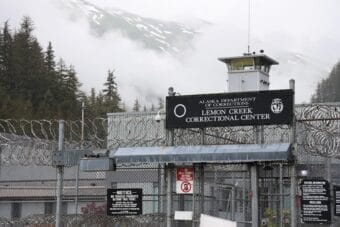
Joseph Murphy died of a heart attack on Aug. 14, 2015 in Juneau’s Lemon Creek Correctional Center after guards refused him care. He was there on a protective custody hold — a type of hold intended to prevent someone from harming themselves or others while intoxicated. He wasn’t charged with a crime.
Jablonski Murphy said her late husband had a heart condition, but it was treatable, and that he may not have died if he’d had access to his medications or medical care. She and Murphy’s family sued the state for wrongful death and settled out of court.
It’s been 10 years, and Jablonski Murphy is still mourning. She wants to know if the state has changed its policies to prevent deaths like this in the future.
“I want to know what’s changed,” she said. “Because if nothing has changed, I’m not laying my banner down, kid. I’m not.”
A KTOO investigation shows that the state did make some initial changes and the number of in-custody deaths decreased for a couple of years.
But those changes were undone under Gov. Mike Dunleavy. The state has seen some of its highest number of deaths in custody per year under his administration – peaking at 18 deaths in 2022.
Leading up to Joseph Murphy’s death, his widow said he had relapsed into drinking after years of sobriety. He had quit drinking after leaving military service in Iraq a decade before. She says he was becoming progressively more suicidal.
Jablonski Murphy helped him try to seek care at Bartlett Regional Hospital and other treatment facilities without success, and it culminated in the sequence of events leading to his death under a protective custody hold in prison.
“He went to treatment. He was at the hospital. They sent him to the jail,” she said. “It just kept going, and I was watching him fall through every crack you can imagine.”
Then, one night in August a few days before Jablonski Murphy’s birthday, he told her she would be better off without him. She was afraid that if she fell asleep, he would hurt himself. So, she took him to Bartlett Regional Hospital.
Staff there said he had to go to Lemon Creek Correctional Center. He wasn’t being charged with a crime. He was held on a “protective hold” intended to prevent people who are intoxicated from harming themselves or others.
Jablonski Murphy said she tried to insist the officers let Murphy take his heart medication with him, but they didn’t allow it. Instead, the officers said they would call 911 if anything happened.
Murphy died the next morning.
Tammy Jablonski Murphy holds a photo of her and her late husband Joseph Murphy on August 9, 2025. (Photo by Yvonne Krumrey/KTOO)
Investigation and aftermath
By the time Murphy died, 25 people had died in Alaska Department of Corrections facilities in the preceding years. Then-Gov. Bill Walker had already ordered an investigation of the department prior to Murphy’s death. The investigation’s findings were released in a report in November of that year, and they were scathing. The report included an analysis of how Murphy died.
The report said that video footage from the prison showed guards dismissing Murphy’s repeated calls for help. The video did not have any audio.
One staff member said he was in the bathroom when he overheard Murphy saying he needed his heart medication. Another staff member responded, telling him, “I don’t care, you could die right now and I don’t care.”
Emergency medical services were called when a different staff member found him unresponsive on the floor. By then it was too late. Murphy had died of a heart attack.
Dean Williams, who was special assistant to the Governor at the time, spearheaded the investigation.
He said the law that allows for protective custody increased the danger Murphy faced in prison.
“Mr. Murphy was not there under any criminal allegation, but under a statute that was designed to protect him,” Williams said. “And unfortunately, the statute that was designed to protect him contributed to his death.”
Williams said the staff of Lemon Creek misinterpreted the law — it says people can be held until they are sober, or up to 12 hours. Williams said the staff involved with Murphy’s death believed he had to be held for at least 12 hours, The state’s report said Murphy appeared sober in the hours leading up to his heart attack and could have been released.
Williams said staff also exhibited a blatant lack of concern for Murphy’s well-being.
“They handled Mr. Murphy in a horrible way, in a cruel and callous way,” Williams said. “The man was having a heart attack in front of everyone, and nobody called 911.”
Williams later served as DOC Commissioner from 2016 to 2018. He created an internal investigations system for Alaska’s Department of Corrections – a change to prevent more deaths like Murphy’s, he said.
“The death of Mr. Murphy shocks our conscience, and it should, right?” Williams said. “But that was not the only one.”
Williams said internal affairs units can thoroughly investigate deaths and find ways the system failed and can improve, instead of sweeping custody deaths under the rug.
“That’s why you have internal affairs,” he said. “It’s not a luxury, it’s an essential component, which is why every other state has it.”
But Alaska’s next DOC Commissioner Nancy Dahlstrom, under Gov. Dunleavy, dismantled the internal investigations unit in 2018. Legislators said the cut would save the state money. Dahlstrom could not be reached for comment.
Alaska DOC hasn’t had internal investigations since. The department’s spokesperson said there are no plans to resurrect it.
KTOO could confirm only that most states have internal affairs units. But Michele Deitch, director of the Prison and Jail Innovation Lab in Texas, said Williams was right — Alaska is the only state she knows of that doesn’t have internal investigation mechanisms.
Some policy documents reference internal investigations, but Department of Corrections Spokesperson Betsy Holley said the department only conducts reviews, not investigations. She said the investigations are conducted by Alaska State Troopers “ensuring neutrality and objectivity.”
In recent years, deaths in Department of Corrections custody have garnered public outcry, and multiple lawsuits from the American Civil Liberties Union.
There were 110 inmate deaths in DOC custody between 2015 and 2024. Two-thirds were reported as “natural” deaths, including Joseph Murphy’s.
A photo of Tammy Jablonski Murphy and her late husband Joseph Murphy. (Courtesy of Tammy Jablonski Murphy)
Juneau’s health care safety net
While changes in the state’s corrections department were relatively short-lived, Juneau health care services have changed in ways that could reduce the chances that someone in Joseph Murphy’s condition would end up in a state corrections facility at all.
Many people in crisis may now get help before they end up in a protective custody hold at Lemon Creek. Jodie Totten is the medical director of Bartlett Regional Hospital’s emergency department. She wasn’t working at Bartlett in 2015, but she said in the several years she’s been with the hospital, she’s seen changes to the landscape of care for people suffering from mental health and substance use conditions.
Now, Totten said, Bartlett’s emergency services staff rarely sends patients to Lemon Creek Correctional Center.
“I mean, we’re always trying to avoid having to have people go to Lemon Creek,” she said. “And there are a lot of other great options in the city that I think we should all be really proud of.”
Some facilities like Rainforest Recovery, a residential substance use treatment facility at Bartlett Regional Hospital, have closed in the meantime, limiting care options.
But Juneau’s CARES teams —Community Assistance Response and Emergency Services – were formed in 2019. Those teams are staffed by medical providers and emergency responders that help provide crisis care and follow up with patients who have long-term needs.
CARES also offers a sobering center, where people can recover from intoxication under medical supervision.
With these programs, when someone is experiencing suicidal ideation, loved ones can request providers come to their home and offer support or intervention.
And the support network may not be improving just in Juneau. Across the state, the numbers of protective holds halved in 2020. The decrease only continued, from 1,301 holds in 2015, to 379 in 2024.
Murphy’s widow
Tammy Jablonski Murphy said the pain of losing her husband is still with her. She’s 66 years old, and she still works as a social worker. She helps people recovering from addiction and people reentering the community after incarceration. She said her work is a tribute to Murphy.
“If I can help one person crawl through this fractured, broken system and come out the other end and be able to claim their life back and start over – get their families back, whatever they need to do – then that honors my Joe, and that’s what I’m all about,” she said. “That’s what I’m all about.”
She doesn’t plan to retire anytime soon. And she doesn’t plan to let go of the memory of her husband, no matter how many years it’s been.
The produce section at Foodland IGA in Juneau. (Photo by Tasha Elizarde/KTOO)
Lawyers are trading arguments in a case challenging the state’s failure to process applications for the Supplemental Nutrition Assistance Program on time.
The case dates back to 2023. The number of Alaskans caught in the SNAP backlog has dropped by roughly 75% since plaintiffs filed the class action lawsuit, but the backlog still hovers around 4,000 as the state’s struggle to process applications on time has continued.
Saima Akhtar with the National Center for Law and Economic Justice, an attorney for the plaintiffs, said her team is asking the court to rule that Alaska’s SNAP system violates low-income Alaskans’ rights.
“The first step is essentially the court assessing whether or not the facts as they are laid out in the record constitute a legal violation,” she said. “And then after that, the question would be, what’s the fix?”
Lawsuits like this have helped in other states, Akhtar said.
“There are a number of states where there has been litigation and there has been a resolution that led to processing improvements,” she said in a phone interview.
Akhtar and her team obtained a preliminary injunction in the case last year requiring the state to report on its progress as it works to catch up on the backlog. It’s possible that could be converted to a permanent injunction.
State attorneys have filed a variety of arguments asking the court to decide the case in their favor. In one filing, state attorneys say that a recent U.S. Supreme Court case means that private individuals shouldn’t have a right to sue over the state’s failure to meet deadlines in federal law. In others, state attorneys say many of the issues highlighted in the suit have been resolved.
A Department of Law spokesperson said attorneys are reviewing the recent filings.
A decision isn’t expected for months. In the meantime, Akhtar says people struggling to access SNAP or other benefits can contact Alaska Legal Services for help.
Alaska Attorney General Treg Taylor speaks to reporters in Anchorage on July 17, 2024. (Wesley Early/Alaska Public Media)
Former Alaska Attorney General Treg Taylor filed to join the 2026 race for governor on Wednesday. Taylor is the 10th Republican to enter the race to replace his former boss, Gov. Mike Dunleavy, who is term-limited.
Taylor was Dunleavy’s attorney general for more than four years and, in an interview, he said he could hit the ground running.
“I know what the issues are that we face,” he said. “We definitely need to get the economy moving again. We need to create good-paying jobs. We need affordable, reliable sources of energy and to get the cost of living down, and we need to get Juneau working again and not be politics as usual.”
Taylor touted his work challenging the Biden administration, especially on resource development, and his collaboration with the Trump administration. He said he worked with Trump’s team on the president’s Day 1 executive order seeking to ease drilling, mining and logging in the state.
Taylor also cited significant declines in violent crime and sexual assault in the state during his tenure as attorney general.
He said that if elected, he’d seek to attract data centers and other new businesses to the state, echoing a priority of Dunleavy.
“I think that the overall theme from me is going to be not taxing your tax base more, but growing your tax base,” he said.
Taylor also echoed Dunleavy’s approach to improving the state’s education system, saying he would focus on improving students’ performance, rather than seeking to boost funding for public schools. He pointed to “some distinction in the sort of the focus of what elements I would like to see in education, on the accountability side, on the option side” compared to Dunleavy’s approach but said he was still developing the specifics.
As the state continues to face a budget crunch, Taylor said he’d like to take a “serious look” at the state’s spending. He said he’d also like to scrutinize federal spending that flows to the state.
“What you know some people might call free money, well, it’s not free. It comes with purse strings, one, and two, it’s paid for by taxpayers like you and I,” he said. “We need to look and see what the cost of that money is to the state, and whether those programs and those things are worth (it) to the state.”
Taylor and his wife recently asked state campaign regulators for an exemption from a requirement to disclose the names of tenants paying rent at properties they own in Anchorage, saying disclosure would open the tenants up to harassment. The Alaska Public Offices Commission has yet to decide whether to grant the request.
Taylor joins nine other Republican candidates and one Democrat seeking to succeed Dunleavy.
The top four vote-getters in the August 2026 primary will advance to the general election in November.
Gov. Mike Dunleavy discusses his new proposed omnibus education legislation at a news conference on Jan. 31, 2025. (Photo by Corinne Smith/Alaska Beacon)
Alaska’s governor will not withdraw an executive order proposing to create a new state Department of Agriculture, he said in a letter sent Monday to the leaders of the state House and Senate.
Gov. Mike Dunleavy’s letter comes days after a joint House-Senate panel voted to spend up to $100,000 on a lawsuit against the governor if he goes ahead with his proposal to create the department unilaterally.
Alaska is one of only two states without a cabinet-level state Department of Agriculture, and legislators have spoken favorably about the idea of creating one, but a majority of the House and Senate want to authorize that new department through law, not by the governor’s executive order.
In March, the Legislature voted 32-28 to reject an administrative order that would have created the Department of Agriculture by splitting off part of the Department of Natural Resources, the agency that currently oversees agriculture.
Shortly before the vote, lawmakers in the House and Senate introduced new legislation to create the department. Neither the House bill nor the Senate bill advanced to a final vote, and either could be taken up during the next regular legislative session, which begins in January.
When Dunleavy called lawmakers into special session in August, he reissued the executive order, but the leaders of the state House and Senate declined to accept the order as valid, saying that the Alaska Constitution does not grant the governor the power to issue an order during a special session.
Lawmakers also say they believe that it isn’t legal to reintroduce a previously rejected order.
“There clearly exists a disagreement between the executive and legislative branch as to the governor’s ability to introduce an executive order in a special session,” the governor wrote in Monday’s letter. “When such a dispute exists, it is appropriate to seek clarification from the courts.”
The governor’s letter notes that lawmakers could have met during the special session to vote down his executive order. Legislators have previously said they did not wish to do so, because taking the vote would have been the equivalent of acknowledging that the governor has the power to issue an executive order during a special session.
Rep. Sara Hannan, D-Juneau, is chair of the Legislative Council, the joint House-Senate committee that authorized the lawsuit against the governor.
By phone on Tuesday, she said she isn’t sure when the suit will be filed, but she expects it to move quickly.
The executive branch is preparing to launch the new department by Jan. 1, and legislators want to stop it before then.
“We have two prime legal issues that we think need to be addressed by a court, because the executive branch is interpreting them completely different,” she said.
Hannan said she expects that once a trial judge decides the issue, the losing party in the case will rapidly appeal to the Alaska Supreme Court for a final determination.
Regardless of who wins the case, Hannan said the state may still end up with a Department of Agriculture by June because legislators are advancing bills that would create the department.
“The 34th Legislature still may create a Department of Agriculture, but the executive order action of creating that and attempting to do it in a special session and after an executive order has been rejected, those are the legal questions that we need addressed,” she said.
Close
Update notification options
Subscribe to notifications
Subscribe
Get notifications about news related to the topics you care about. You can unsubscribe anytime.