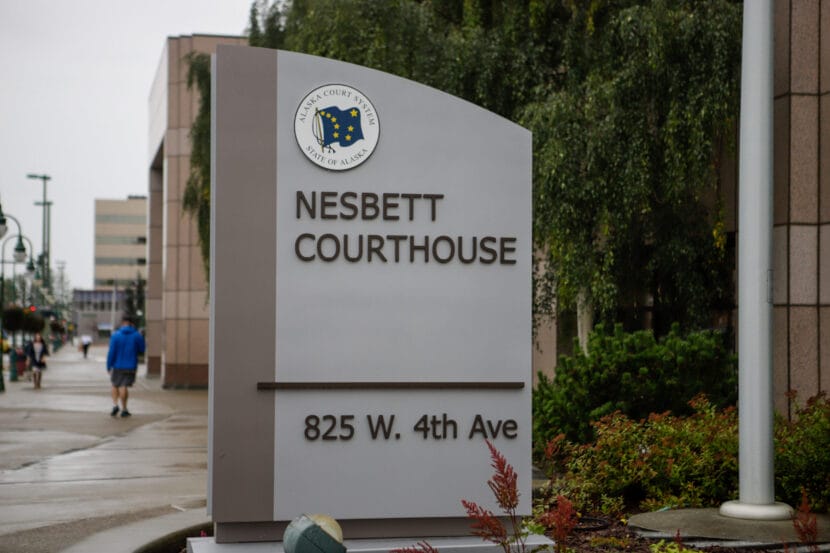
Pedestrians pass the Nesbett Courthouse, located in downtown Anchorage on August 31, 2022. (Valerie Kern/ Alaska Public Media)
A high-profile lawsuit challenging a key part of Alaska’s homeschool system moved ahead this week after an Anchorage judge denied a motion to dismiss the case.
The lawsuit centers on what are known as correspondence school allotments, cash payments to families who homeschool their kids in the state’s public correspondence school system. They’re meant to pay for things like lessons and supplies, and some parents use them to pay for private school tuition.
A group of parents sued the state in 2023, saying the use of allotments on private school tuition violates the state Constitution. Article 7 bars state spending “for the direct benefit of any religious or other private educational institution.”
Then, earlier this year, a group of correspondence school parents represented by the legal nonprofit Institute for Justice asked the lower court judge to dismiss the case. They argued allotments are a direct benefit to correspondence school families, not private schools, and that the use of allotments for private school tuition is protected by the U.S. Constitution.
“The reality is that the Alaska Legislature has provided parents with funds to ensure that they can choose the education that fits their families’ needs, regardless of each family’s income,” they wrote. “That is a fully constitutional objective and the Program is a fully constitutional way to pursue that goal.”
But in an eight-page order on Monday, Superior Court Judge Laura Hartz disagreed. She said the Supreme Court’s decision requires a review of how allotments are actually spent in practice. The plaintiffs, the state and the school districts added to the case following the Supreme Court ruling all argued against dismissing the case and said a final ruling would require more evidence.
“Litigation of this case requires a factual record establishing actual authorized allotment expenditures,” Hartz wrote.
The ruling moves the case into the discovery phase, where attorneys for the parties will exchange evidence as they build a case for a possible trial.
Sun shines on the Peninsula Clarion’s since-dismantled Goss Suburban printing press on Saturday, Oct. 22, 2022 in Kenai, Alaska. (Ashlyn O’Hara/KDLL)
Most of the staff running three Alaska newspapers in Homer, Kenai-Soldotna and Juneau resigned in protest Monday. The decision came after the corporate owner of the Homer News, Kenai Peninsula Clarion and Juneau Empire forced revisions to a story after pressure from a Republican state lawmaker.
The four journalists — Regional Editor Erin Thompson, Clarion Sports and Features Editor Jeff Helminiak, Clarion Senior Reporter Jake Dye and Homer News Reporter Chloe Pleznac — signed a joint resignation letter castigating Alabama-based Carpenter Media Group for its decision to modify the story without consulting the reporter or editor responsible, saying it “gravely undermined” their ability to do their jobs.
“Though this decision is extremely painful for us, it is not difficult,” they wrote. “We cannot do our jobs knowing that pressure from an elected official can mean our stories are edited without prior consultation with us.”
Last Wednesday, Homer Republican Rep. Sarah Vance posted a letter on state letterhead to her official Facebook page objecting to a Homer News article about a memorial for the slain activist Charlie Kirk. She highlighted a paragraph that identified Kirk as a “far-right” activist with “racist and controversial views.” Vance accused the paper of bias and said she was “aware of” a campaign to boycott Homer News advertising.
In an interview, Dye said his resignation was a long time coming. He’s repeatedly complained about mismanagement since Carpenter Media bought the paper out of insolvency last year, he said. But capitulating to pressure from a state lawmaker, going over the editor’s and reporter’s heads, Dye said, was a step too far.
A day later, the story was removed, edited, stripped of a byline and reposted — without, Dye said, any consultation with the newsroom. Vance subsequently thanked Carpenter Media in a Facebook post for responding to her concerns after a discussion with the paper’s publisher.
“Sarah Vance sent one letter on a Wednesday night — she probably didn’t even put a ton of thought into it — and got our story changed,” he said. “What stops her from doing that the next time? What stops anybody?”
Vance and Carpenter Media did not respond to interview requests.
Dye hasn’t gotten answers on what Vance asked for, and what Carpenter agreed to, he said.
“I feel like I should be able to trust Carpenter Media,” he said. “That’s just not what happened in this case.”
The mass resignations leave the three papers with just two reporters: one for the Homer News and another with the Juneau Empire, Dye said.
Veteran Alaska journalist and University of Alaska Fairbanks professor Paula Dobbyn said she was shocked by the episode — not just by Vance’s pressure campaign, but Carpenter’s decision to give in.
“We pride ourselves as Americans on having freedom of the press,” she said. “For an ownership group to just go ahead and alter a news story based on a complaint by a politician without consulting the editor or the reporter, I just think was appalling, and I fully support the staff for not putting up with it.”
It’s especially alarming given the fragile state of journalism in Alaska, she said. It’s not clear what’ll happen to the papers with most of the editorial staff gone, and Dobbyn said she’s concerned the exodus will leave Kenai Peninsula communities less informed.
“I certainly hope that the Kenai is not going to become another news desert, because, you know, people have the right to be informed,” she said. “There’s a lot that’s happening down there, and we certainly need coverage of it.”
Dobbyn said she hoped another news source would fill the void. She pointed to the Juneau Independent, a nonprofit online outlet founded by the former editor of another Carpenter paper, the Juneau Empire, who also resigned over disagreements with management.
As much as he loves journalism, Dye said he’s not planning to follow a similar path.
“I don’t think the others are really interested in that. We certainly don’t have the money for that,” he said. “I, unfortunately, kind of think this is it.”
Dye hopes Carpenter Media will invest in its Alaska papers, he said, but he’s not optimistic. He said management told the newsroom that the Clarion was losing money, but had not outlined plans to turn the struggling outlet around.
“Until this last week, they (didn’t) really interact with us,” he said. “I keep asking them what the plan is, and I don’t ever get a satisfying answer.”
On Tuesday, Dye said he planned to head to the local job center for a typing test so he could apply for a job as a 911 dispatcher.
“I really think that’s going to be less stressful than what I’m doing now,” he said.
Editor’s note: Former Homer News reporter Chloe Pleznac previously worked at KTOO as a Morning Edition host from 2022 to 2024.
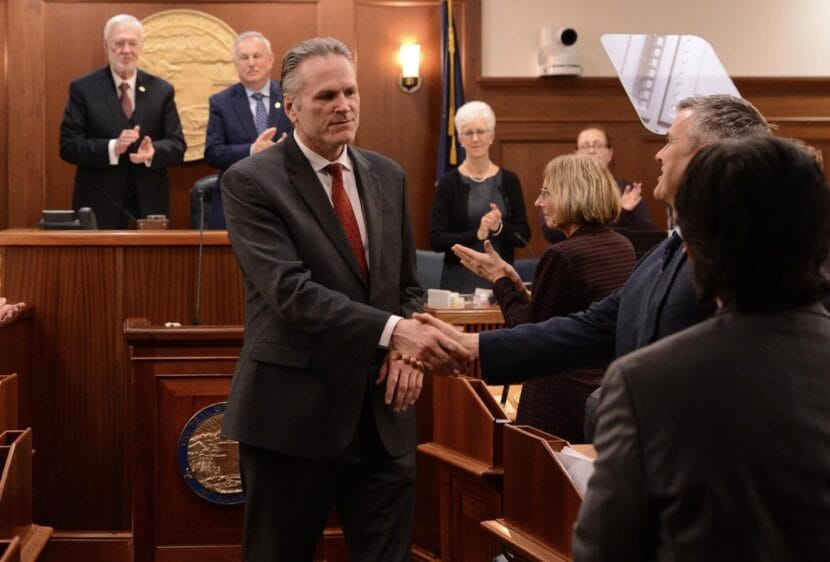
Alaska Gov. Mike Dunleavy shakes hands with Rep. Andrew Gray, D-Anchorage, following the annual State of the State address on Tuesday, Jan. 28, 2025, in the Alaska Capitol. (James Brooks/Alaska Beacon)
Senate Bill 113, passed by the Alaska House and Senate in May by a combined vote of 42-18, would have required internet companies to pay corporate income taxes based on the location of their sales, not the location of their server farms or offices.
That shift, already enacted by 36 other states, would have required companies like Netflix and Hulu, which do not have any in-state business presence, to pay corporate taxes based on sales to Alaskans. That shift was expected to generate between $25 million and $65 million per year for the state treasury once fully implemented.
In House Bill 57, which increased the state’s per-student public school funding formula, lawmakers included provisions that directed much of that money to vocational and technical instruction, as well as grants intended to help elementary school students improve their reading.
Without SB 113, those programs will not receive additional money.
In 2022, Dunleavy and the Legislature collaborated on the Alaska Reads Act, legislation intended to boost the reading skills of young Alaskans. Initial results have shown some benefits, and funding in SB 113 was intended to expand upon that effort.
But in a message accompanying Monday’s veto, Dunleavy said he will not approve any tax measures unless they are part of a larger plan intended to bring state income and expenses into line over the long term.
Dunleavy said he wants to see a “truly durable fiscal plan” that includes “not only revenues but also clear guardrails: spending limits, statutory and regulatory reviews, and policies that make Alaska the most competitive state in the nation for investment and new business growth.”
Dunleavy called SB 113 “a simple tax bill that does not consider the comprehensive fiscal approach outlined above.”
The Legislature could override Dunleavy’s veto of SB 113, which would require 45 votes when lawmakers reconvene for the regular session in January, but that’s a level of support larger than the bill received when it originally passed.
Sen. Robert Yundt, R-Wasilla, sponsored the amendment that would have diverted SB 113 funding to education. He did not answer a phone call seeking comment on Monday afternoon.
Sen. Bill Wielechowski, D-Anchorage, sponsored SB 113 in the Senate and lambasted the governor’s decision in a written statement.
“SB 113 was a common-sense, bipartisan solution to help close our revenue gap without costing Alaskans or Alaska businesses a penny,” Wielechowski said. “The Governor had the opportunity to stand with Alaska families, students, and communities – but instead, he chose to side with tech corporations that profit from Alaskans and utilize our infrastructure, while paying nothing back to our state.”
Wielechowski said that the bill would have modernized Alaska’s corporate tax structure using reforms already adopted by other states.
“Every Alaskan knows Alaska is facing a revenue crisis, and that our education system needs critical resources. This bill would have been a step towards closing those gaps without taxing Alaskans while asking these corporations to contribute to the state that they use for their business ventures,” Wielechowski said. “The Governor’s veto sends the message that outside corporations come before Alaska’s schools, Alaska’s workforce, and Alaska’s future.”
Asked whether the governor had a comment about the veto’s effects on education funding, his communications director responded by email.
“Governor Dunleavy continues to encourage lawmakers, as he has done for the past several years, to work with him on a durable and comprehensive fiscal plan,” said Jeff Turner, the communications director. “Passing more taxes without spending limits and policies that give existing businesses the confidence they need to expand and new businesses the confidence they need to invest in Alaska will make our state less competitive.”
SB 113 was the last bill awaiting gubernatorial action this year. Of 33 bills passed by the House and Senate this year, Dunleavy vetoed nine, or 27%, the highest proportion since statehood. Legislators overrode two of Dunleavy’s vetoes during a special session in August.
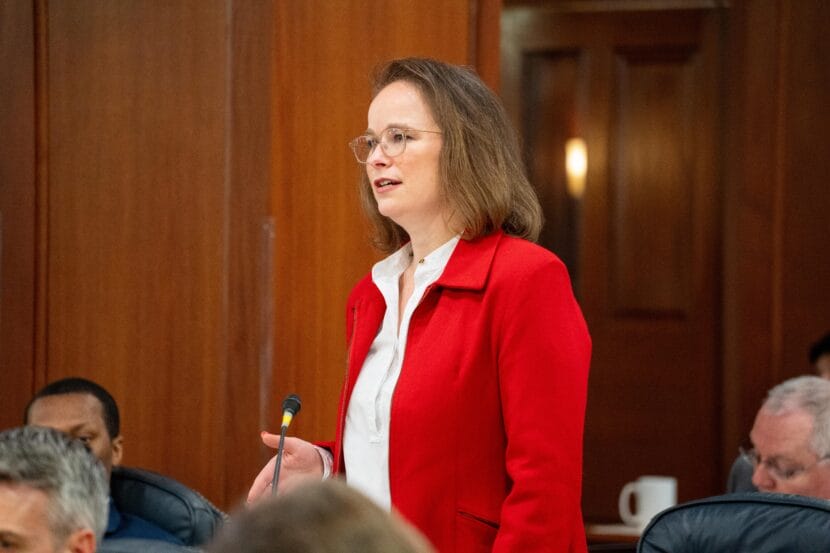
Rep. Sarah Vance, R-Homer, speaks on the House floor on April 24, 2024. (Eric Stone/Alaska Public Media)
A Homer Republican state representative declared victory on Friday after successfully pressuring the local newspaper to revise a story about a vigil honoring Charlie Kirk.
Rep. Sarah Vance, who helped organize the vigil, took issue with the newspaper’s description of Kirk’s views.
Vance highlighted the story’s second paragraph, which identified Kirk as a “far-right activist” and an icon among Christian nationalists. It described some of his views as “racist and controversial” and said Kirk perpetuated “conspiracy theories.” The story, by Homer News reporter Chloe Pleznac, didn’t include concrete examples, but did link to an 1,100 word article in the New York Times with many.
“This piece is not journalism, but rather it is hate-baiting at its worst,” Vance said in a letter to the newspaper’s owners, Carpenter Media Group, on her Alaska State Legislature letterhead. She accused the paper of bias.
“I urge you to take immediate corrective action,” she wrote.
The newspaper’s owners later removed, edited and reposted the story, a move that Vance welcomed in a post on social media. But a former editor of the newspaper said Vance took it “a step too far for an elected representative.”
“That’s government intimidation of a free press, and, you know, the First Amendment says the government shall not do that,” said Michael Armstrong who worked for the paper for more than two decades. “It’s right there up front, and I think she’s crossed that line.”
Vance and Carpenter Media executives did not respond to interview requests for this story.
Armstrong said it’s fair game for government officials, or anyone else, to criticize a news outlet’s coverage. But he said a passage from Vance’s letter saying she was “aware of a growing movement to boycott Homer News advertising” crossed the line into intimidation.
“If you want to have a civil dialogue with the newspaper, with the editors, with the publishers, that’s appropriate,” he said.
At the Homer vigil, a week after Kirk was assassinated in Utah, Vance had extolled the value of the type of open debate Kirk and his group, Turning Point USA, were famous for.
“Remember that the people who were spreading hate and vitriol are our neighbors,” she said in a short speech at the vigil. “We need to do like Charlie and engage with them in open dialogue that’s respectful, that leads them to the truth.”
In an interview, Pleznac defended her work, saying her coverage of the vigil was part of a larger effort to ensure Homer conservatives saw themselves reflected in the newspaper’s coverage.
“I thought it was important to document them honoring Charlie Kirk’s legacy,” she said. “I went, I took photos, and I took video, and I thought that that was something that would honestly make them happy.”
Pleznac said she wrote the description Vance objected to after reviewing other news coverage of Kirk’s assassination in an effort to provide context backed by evidence.
“Vance said I should have published the original article as an opinion piece because of the language I used to report the opinions that Kirk regularly, proudly espoused,” Pleznac said. “My reporting of those opinions is not a reflection of my bias but rather a reflection of my research.”
Armstrong said the episode echoes another recent Kirk-related controversy — ABC’s decision to temporarily take Jimmy Kimmel off the air following threats from the chair of the Federal Communications Commission after Kimmel made comments about Kirk’s assassination
“I think that (has) set a tone, obviously, for his administration, but also for a lot of other conservative Republicans,” Armstrong said. “It’s making it harder for the press to do their job.”
Pleznac, too, said Vance’s pressure campaign amounts to state censorship.
“It is the antithesis of what I believe ethical journalism stands for,” she said.
Armstrong said Vance should be held accountable, and that government officials more broadly should respect the role that reporters play in American democracy.
“I don’t think newspapers should be intimidated by their government. I think the government should be intimidated by the newspapers,” he said.
If government officials don’t like what they see in the newspaper, Armstrong said, the right approach isn’t intimidation — it’s open dialogue.
KBBI’s Simon Lopez in Homer contributed reporting to this story.
Editor’s note: Homer News reporter Chloe Pleznac previously worked at KTOO as a Morning Edition host from 2022 to 2024.
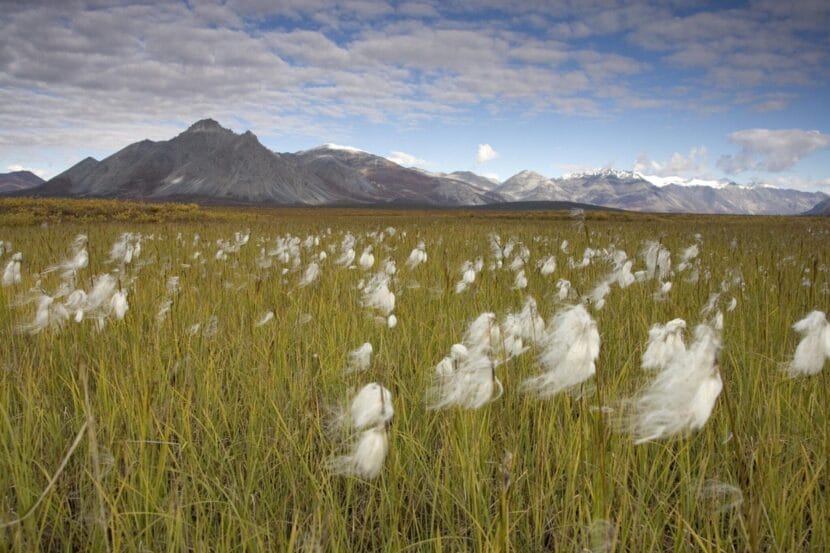
Cottongrass wafts over the tundra in the Arctic National Wildlife Refuge on Sept. 2, 2006. (Steve Hillebrand/U.S. Fish and Wildlife Service)
A U.S. District Court judge in Anchorage has ruled against the state of Alaska in an 11-year-old legal dispute that has significant implications for the Arctic National Wildlife Refuge and state finances.
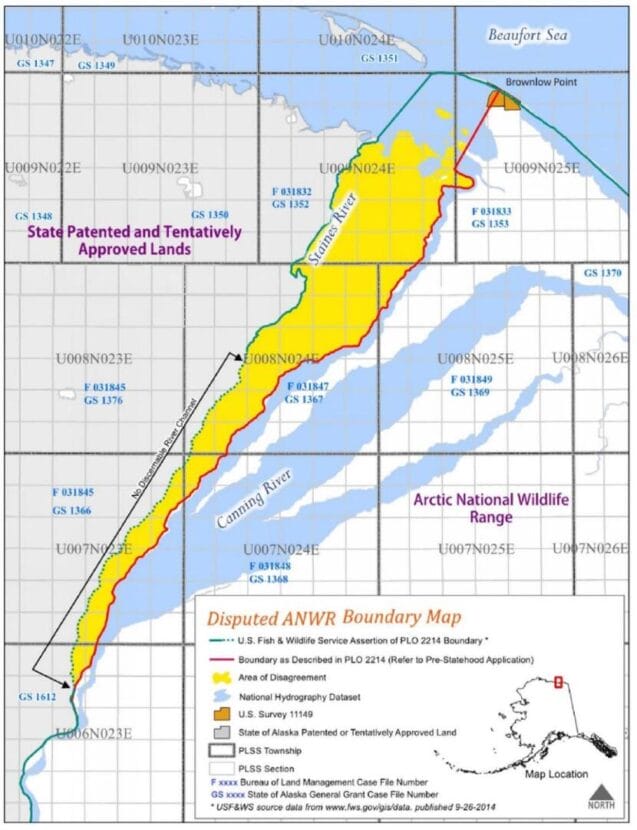
There are 20,000 acres of potentially oil-rich land between the two waterways, and the state of Alaska had sought ownership of the area — sited just to the east of the Prudhoe Bay oil field — for oil and gas drilling.
This map, published by the Alaska Department of Law as part of its summary judgment motion, shows the area contested between the state of Alaska and the federal government. (Screenshot from Alaska Department of Law)
While the federal government is now advancing plans for oil and gas leasing in the disputed area, the decision to keep it under federal control means that if oil and gas are discovered there, the state of Alaska would receive far less revenue than it would if it were state-owned land.
“The state of Alaska is disappointed that the court failed to recognize the state’s ownership of this disputed area on the border of the Arctic National Wildlife Refuge,” said Patty Sullivan, communications director for the Alaska Department of Law, which brought the case against the federal government.
“This land may hold significant resource potential for the future of energy for Alaska and the United States and would likely be thoroughly explored and developed under state management. We will evaluate our options and are glad to, at least, have a federal administration currently in place that recognizes the importance of responsible resource development in this area,” she said.
Attorneys for the U.S. Department of the Interior and the U.S. Department of Justice did not return messages seeking comment.
The state’s dispute with the federal government revolves around whether federal mapmakers viewed the Staines River as a separate river from the Canning, or simply a “distributary,” a different channel of the same river, in 1957.
The Bureau of Land Management used the boundary drawn that year to create the Arctic National Wildlife Range in 1960, and it became the refuge in 1980. Maps published at that time show the border running along the Staines River.
As Gleason explained in her 74-page order, “If the Staines River was considered to be part of the Canning, then the extreme west bank would follow the west bank of the Staines distributary of the Canning River. But if the Staines and the Canning were considered to be two separate rivers, then the boundary would follow the west bank of western-most channel of the main Canning River.”
The dispute also included a marker designating the northwest, seaward boundary of the refuge, but the main issue was about the river-defined border.
In 2014, the Alaska Department of Natural Resources requested ownership “of certain lands west of” the Arctic National Wildlife Refuge.
In 2016, the U.S. Bureau of Land Management responded to the state’s request, saying the state had already selected all available land in the area. The state protested, saying that federal officials were drawing ANWR’s border west of where it should have been because they were relying on the Staines River, not the Canning.
The state appealed to the U.S. Interior Board of Land Appeals, which ruled in favor of the BLM. The state sued over the issue in 2022 and won an early victory when Judge Gleason ruled the following year that the land appeals board failed to consider a 1951 map that showed the Staines as a separate river from the Canning.
But in 2024, the land appeals board again ruled against the state, which promptly renewed its case in the U.S. District Court and requested summary judgment, a request that was answered Wednesday.
Explaining her order, Gleason noted a 1906 U.S. Geological Survey dictionary that labeled the Staines and the Canning as the same river, but “on the other hand, some contemporaneous maps label the two rivers separately, indicating that the Staines and the Canning may have been considered to be two separate rivers. And yet other contemporaneous maps do not label the Staines or do not separately label the Canning River at the mouth,” she wrote.
While that might have favored the state’s position, Gleason concluded that the land appeals board’s interpretation of the border was reasonable, not arbitrary, was supported by substantial evidence and wasn’t contrary to law, meaning that the state doesn’t have grounds to overturn it.
Gleason concluded, “the court upholds the IBLA’s finding that the northwest boundary of the refuge follows the Staines River, a distributary of the Canning River.”
If the state chooses to appeal Gleason’s decision, it will have 30 days after final judgment.
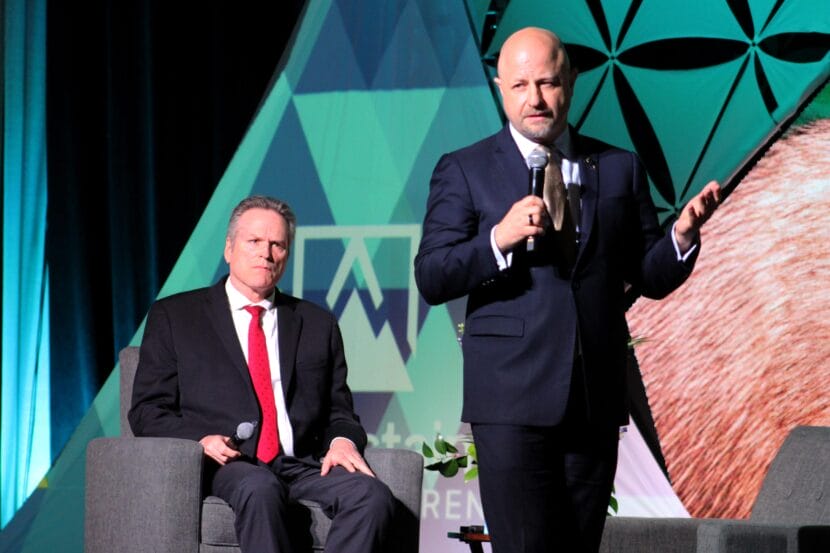
Gov. Mike Dunleavy (left) listens to Glenfarne CEO Brendan Duval (right) talk about the Alaska LNG Project during a panel on Thursday, June 5, 2025 in Anchorage, Alaska. (Ashlyn O’Hara/KDLL)
The Alaska LNG Project netted two more agreements earlier this month during an energy conference in Italy. Both agreements are nonbinding, but proponents say it’s proof of ongoing positive momentum. The developments come as the company behind the project aims to decide whether to move forward with development, or not, by the end of the year.
Adam Prestidge remains optimistic about the Alaskan LNG Project’s commercial viability. He’s the project president under Glenfarne Group, which assumed majority ownership earlier this year.
“We think it is a fantastic project from an infrastructure fundamental standpoint,” he said. “Its commercial attributes, we think, make it a really attractive project, and put it in a really advanced state.”
The idea of a natural gas pipeline between the North Slope and Southcentral has been tossed around for decades.
If it’s built, the three phase project would extract and treat natural gas on the North Slope, move it through an 800-mile long pipeline to Southcentral and then liquefy it in Nikiski for export overseas. The project already has the necessary land and permits. What it needs now are customers – and, of course, to be built.
Since taking over, Glenfarne’s secured five nonbinding agreements with potential project customers. Two of those were signed at the Gastech Conference earlier this month in Italy.
One agreement is with JERA Co. – Japan’s largest power generation company – to purchase a set amount of liquefied natural gas from the project over two decades.
The other agreement outlines a “strategic partnership” with POSCO International. The company is the sales representative of POSCO Group, Korea’s largest steel producer, and also imports liquefied natural gas.
Prestidge says he’s aware of the skepticism around nonbinding contracts. But he says the scale and scope often require a drawn out negotiation process – sometimes up to one or two years.
“They’re enormous contracts, and they don’t just turn into binding agreements overnight,” he said.
Glenfarne Communications Director Tim Fitzpatrick says four of the agreements are at the first in a three-step process to get to a binding agreement.
The agreements come as project owners prepare to make a final decision whether to move forward with development – a decision expected by the end of the year.
Glenfarne enlisted another firm to update the project’s current cost estimate. Prestidge says Glenfarne does not expect construction costs to be “significantly more expensive” than previous estimates, but they’re keeping the final construction price tag secret.
“You wouldn’t normally be publishing publishing costs for a project – for a private project, kind of on a recurring – rolling updates,” he said. “And so the ultimate cost to complete is going to be something that is most likely not going to be made public.”
Glenfarne says construction costs are only one part of the equation. Prestidge says steel tariffs and the cost of liquefied natural gas will ultimately dictate final project costs, and Glenfarne thinks its commercially viable.
Larry Persily is a former state revenue commissioner and Federal Coordinator of the Alaska Natural Gas Transportation Projects. He suspects Glenfarne’s decision won’t sit well with Alaskans.
“I think keeping it secret, which is another way to say private, will just increase the skepticism among Alaskans who think this thing has been a multi-million dollar wasted effort over the years,” he said.
And Persily is doubtful project costs will come in at previous estimates, around $44 billion, pointing to rising labor costs and project overruns in other parts of the country. In the mid-2010s, the total estimates were between $45 billion and $65 billion. In 2020, the estimate dropped $37.5 billion, but then came back up, in part, due to inflation.
“It’s really hard to believe that is going to come in at that [Alaska Gasline Development Corporation] estimate,” he said. “Mega-projects like this are notorious for going over budget.”
Prestidge says Glenfarne’s team is up to the challenge.
“We’re very appreciative of the reception that we’ve gotten from Alaskans,” he said. “We know, we know that we’re new in the state, and we’re going to continue working, working really hard to deliver this fantastic project for the state.”
Glenfarne and the Alaska Gasline Development Corporation will hold an open house Oct. 8 at the Nikiski Community Recreation Center from 5:30 to 7:30 p.m. to share project updates and meet with residents.
Close
Update notification options
Subscribe to notifications
Subscribe
Get notifications about news related to the topics you care about. You can unsubscribe anytime.