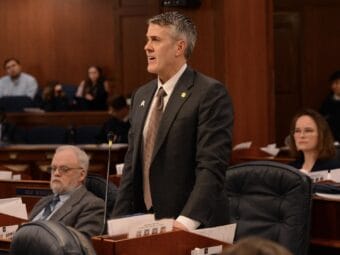
Sen. Scott Kawasaki, D-Fairbanks, speaks Friday, Feb. 7, 2025, on the floor of the Alaska Senate. (James Brooks/Alaska Beacon)
Democratic Fairbanks Sen. Scott Kawasaki violated ethics law by holding constituent events too close to the 2024 state primary, a panel of the Alaska Legislature concluded in a report published Friday.
The report was published by the Senate subcommittee of the Legislature’s Select Committee on Legislative Ethics, which recommended no penalty.
Under the Legislative Ethics Act, a legislator in a campaign cannot use state funds “to print or distribute a political mass mailing to individuals eligible to vote for the candidate” if the mailing takes place during a period that begins 60 days before the primary election and ends one day after the general election.
According to the report, Kawasaki e-mailed constituents a newsletter, distributed informational flyers and held a “Picnic in the Park” event to observe the opening of his office in Fairbanks.
Kawasaki, who defeated Republican Leslie Hajdukovich in the November general election, faced only Hajdukovich in the primary, making the race uncontested. In Alaska, the top four vote-getters advance from the primary election to the general election. Kawasaki and Hajdukovich were the only two registered candidates.
Kawasaki was first elected to the Alaska State House of Representatives in 2007, and to the Senate in 2019. He ran for re-election in 2024 to represent Senate District P.
Reached by phone on Friday, Kawasaki said that “it’s just sort of disappointing to have this be said and politicized, and then it becomes a potential issue in the future campaign.”
“It was a technical violation,” he said, “and I think it was unfairly weaponized against us just because of who we were running against.”
Students walk past a school bus outside Juneau-Doublas High School: Yadaa.at Kalé on Aug. 15, 2025. (Photo by Jamie Diep)
The Alaska Board of Education unanimously voted to send a proposed regulation change that would have limited how much money local governments can give to schools back to the state education department on Thursday. It comes after public outcry and a change in stance from the department.
The Department of Education and Early Development, or DEED, backtracked on its initial recommendation to the board to change the state regulation that defines what counts as local contribution. That’s school funding that comes from municipalities. State law restricts the amount of funding local governments can give to their districts.
Instead, DEED recommended the board take no action on the change. DEED Commissioner Deena Bishop said the department has been working with district leaders since August to clarify their intentions with the proposal.
“I think just the stress about school funding, a lot of trust isn’t there,” Bishop said. “The department wants to earn that trust back and continue with the work.”
Many district leaders voiced concerns about how it would affect out-of-cap spending. That’s money that local governments give to districts outside of the maximum legal amount. It’s for non-instructional purposes, like transportation, child care and extracurriculars. Many, like the Anchorage and Sitka School Districts, also worried about how in-kind services would be impacted.
The proposal spurred hundreds of written public comments against the change last summer. Several Alaska district officials and parents testified when the regulation was considered in June and again at Thursday’s meeting.
Part of the initial reason for bringing this forward was something called the disparity test — that allows the state to use federal impact aid as part of its contribution to districts, which can save the state money. The state failed the test this year and in fiscal year 2022. It’s currently appealing the decision. Bishop said during a work session on Wednesday that the department is moving through the appeals process.
But she also said that the focus on the regulation is to make sure districts are following state law.
“We’re not reacting to the federal government,” she said. “What we are, is trying to meet the state statute that calls for that equitable funding.”
In a memo for the regulation when it was introduced in June, Bishop wrote that one of the reasons for bringing the regulation change forward was to make sure it was in line with the federal disparity test.
In his public testimony, Juneau School District Superintendent Frank Hauser referenced a letter from DEED appealing the results of the federal disparity test. The state claimed it would pass the test through a different calculation method, and does not mention local contribution. Hauser said he wants the department to drop this regulation change.
“I am terrified of version 3.0 of this regulation,” he said. “Each subsequent attempt at this regulation change has had exponentially more negative impacts, impacts beyond what the department realizes, even to REAAs, homeschool and correspondent students.”
Juneau officials estimated the district would have lost $8 million in funding if the regulation had gone through. In an email to KTOO after the decision, Hauser said he appreciates the board bringing the regulation back to the department to get more input, but “that action begs the question why stakeholder input was not sought in the first place.”
Several testifiers, including Valdez City Schools Director of Technology Megan Gunderson, also mentioned a back-and-forth between the Anchorage School District and the department. The department posted on social media, calling the information from the district inaccurate.
“When the agency responsible for leading and supporting Alaska schools uses public mockery and personal targeting, that is not communication,” Gunderson said. “It is the breakdown of an essential partnership.”
State Board of Education member Lt. Col. James Fowley only had an advisory vote on the issue, but he said he wanted to ensure the department would come back with a list of districts it engaged with and recommendations.
“In my learning on it, it is going to be incredibly complex, and it’s probably going to vary between every single one of the districts,” Fowley said. “And so for the department, I think you’re going to have to sharpen that pencil and really nug down through this.
In the meantime, the department said it will work with local stakeholders like district leaders and officials to gather more information.
Adam Crum, then the commissioner of the Alaska Department of Revenue, applauds during Gov. Mike Dunleavy’s State of the State Address at the Alaska State Capitol in Juneau on Jan. 30, 2024. (Eric Stone/Alaska Public Media)
Former Revenue Commissioner Adam Crum defended his decision to invest $50 million from the state’s main savings account in an outside private equity fund in an interview Thursday. The investment with the infrastructure firm DigitalBridge has raised concerns among lawmakers, who have asked their auditor to investigate it.
The investment also raised eyebrows within the Department of Revenue.
Crum’s successor, acting Revenue Commissioner Janelle Earls, expressed concern over the process that led to the investment, a spokesperson said. In response, Gov. Mike Dunleavy ordered an independent third-party review of the investment to determine “whether there were in fact any violations of policy and make process recommendations as appropriate,” Department of Revenue spokesperson Aimee Bushnell said by email Wednesday. Bushnell said DigitalBridge was cooperating with the review but that the contract Crum executed could not be canceled.
The scrutiny was a surprise, Crum said.
Crum, who is a Republican candidate in the 2026 race for governor, said in an interview that the investment was an effort to boost the state’s investment returns. It represents about 1.7% of the roughly $3 billion in the state’s Constitutional Budget Reserve.
“The idea behind this was to put it into things that we know that there’s going to be more of,” Crum said by phone. “These are companies that own cell phone towers, digital assets, AI data centers, and as the world’s growing that direction, (it) seemed like an opportunity to actually get the state to invest in that.”
Crum had been working on the investment for more than a year and delayed his planned resignation to complete it, he said. The state committed the $50 million on July 28, three days after Crum announced that he would resign.
Crum said he’d followed state policy and procedure throughout the process.
“There was Department of Law sign-off, governor’s office sign-off, all of that was there throughout,” he said. “This was not something that was done by fiat.”
Bushnell, with the Department of Revenue, said Crum had approached the governor’s office with the idea, but she said Dunleavy’s staff “cautioned that any investments made needed to be in accordance with established investment policies and procedures.” The Department of Law did not respond to a request for comment.
The vast majority of the reserve is invested in low-risk products like short-term U.S. Treasury bills, which can be easily and quickly sold when the state needs to access the money. That’s been the case since July 2020, when an analysis showed that the fund could be depleted within 12 to 18 months.
“For a budget reserve account that needs to fund the day-to-day operations of government in the event that the price of oil declines, you really need to be holding your investments in cash or Treasury bills or some similar asset that you can turn into cash quickly when you need it,” former Deputy Revenue Commissioner Brian Fechter said in a phone interview.
State law does, however, allow a portion of the Constitutional Budget Reserve known as the “subaccount” to be invested to yield higher returns. Lawmakers created the subaccount in 2000 in pursuit of higher returns but emptied it in 2015 to reduce risk.
Alaska is no stranger to private equity investments, which allow the state to invest in companies not listed on public stock exchanges. The state’s retirement funds hold more than $5 billion in private equity, and the Alaska Permanent Fund nearly $15 billion, according to public documents. Permanent Fund managers have said private equity and other alternative investments are a major driver of growth.
Private equity investments typically come with lock-up periods that make the assets difficult to access on short notice. The industry standard is five to 15 years, Crum said.
Senate President Gary Stevens, a Kodiak Republican and House Speaker Bryce Edgmon, a Dillingham independent, said in a joint statement earlier this month that their risk and inaccessibility makes them an inappropriate choice for the state’s rainy-day fund.
“The (Constitutional Budget Reserve) was created to provide stability during times of deficit and emergency, ensuring that schools, public safety, and essential services remain funded when state revenues fall short,” they wrote. “Placing tens of millions of dollars into an illiquid, high-risk investment undermines that purpose and raises serious concerns about accountability, transparency, and fiscal responsibility.”
The state has drawn on the account repeatedly in recent years to fill gaps in its budget, and lawmakers have said they’re concerned uncertainty around oil revenue and federal spending could require more spending from the Constitutional Budget Reserve in the coming years.
It’s unclear how much of the $50 million committed to the private equity investment would be available in an emergency. Crum said he believed the contract with DigitalBridge included “fire sale” provisions that would allow the state to withdraw its money at a steep discount. To make its money back and see some additional return would take “probably five years,” Crum said.
Crum, though, said it was unlikely the state would need to access the money before then. He said the Legislature’s scrutiny was “amusing” and chalked up the governor’s review to an effort to build a better relationship with state lawmakers.
“If we are actually at the point to where we’re arguing over our last $50 million as a state, then we are already completely done,” he said.
About 50 people packed into the Haines Public Library in early October for an open house-style meeting about the Chilkat Connector Feasibility Study. (Avery Ellfeldt/KHNS)
On a dreary evening late last week, dozens of people packed into the back of the Haines Public Library. Before long, two attendees broke into a chant.
“No road! No road! No road!” they shouted.
Their words captured the tenor of the gathering, which centered around a controversial effort by the state of Alaska to study what it would take to build a road that would – at least in theory – better connect Juneau, Haines and Skagway.
The Department of Transportation and Public Facilities announced the study last spring, indicating that the plan was to assess options for the route along the west side of the Lynn Canal.
The agency organized last week’s open house-style event to provide information to the community and get feedback.
“We’re trying to show people what this project looks like, what potential benefits there are. We also want to understand everybody’s concerns,” said Greg Lockwood, DOT’s Southcoast region project manager.
Some locals have expressed support for the idea, noting that the state ferry system is unreliable and that a road could open up access for recreation and other purposes. But others are opposed, for a long list of reasons.
Attendee Shannon Donahue, who initiated the “no road” chant, is among them. In an interview, she said that as she sees it, it’s clear the state’s central goal is to “create roads to resources.”
“It’s unlikely that this whole thing is going to come to fruition,” Donahue said. “Pieces may come to fruition. Roads to logging, roads to mines, and you know, that can do a lot of damage.”
Others at the open house raised the same concern, particularly given that state officials recently unveiled plans to remove longstanding logging restrictions in the Haines State Forest and open up the entire area to logging. The potential west-side road would run through that forest and could provide better access for timber sales.
In a phone interview following the open house, DOT’s Lockwood said finding ways to partner with and benefit industry is an important part of the process. He added that the potential project “is just not purely a ferry terminal, and road to a ferry terminal.”
“If we can find added value, a freight dock, if we can find a way for mining trucks coming from the Yukon to use [a west side road] and stay out of town, or if there’s timber to be harvested, that would all be value added that would help support this roadway,” Lockwood said.
Critics of the idea have also raised concerns including the rugged terrain along the canal, which would complicate building a road and maintaining it, particularly during winter.
Other worries include implications for people traveling by ferry without a vehicle – and potential environmental impacts of the road itself.
“The Marine Highway is an excellent alternative,” said Sky Skiles, another attendee. “I think putting money into that to keep it in good shape is a better alternative than to cause so much damage to our environment.”
A new ferry terminal, route options
The idea of building a road between Juneau and Haines has been around for decades. But it’s never come to fruition, despite a smattering of earlier feasibility studies. This time around, the study will cost at least $1 million and is being carried out by DOWL LLC, a Washington-based consulting firm.
Gov. Mike Dunleavy’s administration says a road would create more cost-effective and efficient transportation for the region. That idea is that the road in Haines would reduce the length of ferry service between the two locations.
The contractor is studying two main route possibilities, which were illustrated in detail on maps set up during the event last week. Both rely on a yet-to-be-built ferry terminal at Cascade Point, about 30 miles north of Juneau.
The state signed an initial contract for that project this summer, a move that sparked criticism in the upper Lynn Canal but was welcomed by a mining company planning an ore shipping facility in the same location.
Under the first route option, travelers starting in Juneau would need first to travel from town to Cascade Point. From there, they would take a ferry across the canal to William Henry Bay, at which point they would drive north until they hit a bridge back into Haines.
In the second option, travelers would still need to get to Cascade Point and board a ferry. But the ferry would take them further north to Pyramid Harbor, near Haines. From there, they’d drive a much shorter distance to a bridge and then cross back into Haines.
Notably, neither option, as illustrated on maps, indicates how people would get to Skagway.
Lockwood, of DOT, emphasized that it’s still early days, and the agency is still purely gathering information.
“People need to understand this, this isn’t a done deal.” he said. “We haven’t made any decisions.”
The agency plans to have a draft report in December and a final version in January, which will be used to inform next steps. The public can ask for more information and provide feedback by emailing ChilkatConnector@dowl.com.
Senate President Gary Stevens, R-Kodiak, greets Gov. Mike Dunleavy while standing alongside House Speaker Bryce Edgmon, I-Dillingham, in the House chamber at the Alaska State Capitol in Juneau on Jan. 28, 2025. (Eric Stone/Alaska Public Media)
Top state lawmakers say they’re investigating why $50 million from the state’s primary savings account was invested in an outside private equity fund.
Former Revenue Commissioner Adam Crum committed to investing $50 million in state dollars in the fund shortly before his resignation took effect, according to his successor. The political website Alaska Landmine first reported the news and identified the outside fund as DigitalBridge, a digital infrastructure investment firm. Crum, who is running for governor, did not respond to a request for comment on Monday.
Senate President Gary Stevens, a Kodiak Republican, said in an interview that he and House Speaker Bryce Edgmon, a Dillingham independent, learned about the investment on a call with Gov. Mike Dunleavy on Sept. 30. They’ve asked the legislative auditor to look into it, he said.
“We’re not accusing anybody of anything. We’re trying to find the truth right now,” he said. “We’re in an investigative stage right now, as is the governor. I mean, he was very forthright in talking to us about this.”
Stevens and Edgmon issued a joint statement on Friday saying state officials should not make similar “high-risk investments” in the future without involving the Legislature.
“Regardless of whether the action was technically permissible under statute, decisions of this magnitude must not occur outside the view of the Legislature or the public,” the pair wrote.
Dunleavy’s office and the Department of Revenue did not respond to a series of questions seeking more information on the investment and whether it’s consistent with the state’s investment policies.
The money for the investment comes from the state’s main rainy-day fund, the roughly $3 billion Constitutional Budget Reserve. Unlike the Permanent Fund, the reserve is typically invested in safe, cash-equivalent assets that are easy to sell quickly, like short-term U.S. Treasury bills. Lawmakers have repeatedly drawn from the account in recent years to fill gaps in the state budget.
But private equity investments tend to be far less liquid — and Stevens said that undermines the purpose of the savings account.
“We’re concerned (about) what we’ve heard, whether it’s a proper investment, whether we are tying up monies that we shouldn’t be tying up,” Stevens said. “We just have limited savings these days, and we need to be very careful about protecting those savings.”
Stevens says he expects lawmakers will hold hearings on the issue.
Former Anchorage Mayor Dave Bronson speaks at a campaign launch event at the Sullivan Arena in Anchorage on Friday, Oct. 3, 2025. (Matt Faubion/Alaska Public Media)
Former Anchorage Mayor Dave Bronson is joining the race for governor. He announced his candidacy Thursday as he kicked off a two-day series of events in Fairbanks, Wasilla, Anchorage and Soldotna.
“I’ve tackled crime, I’ve taken on homelessness, I brought record investment to our city and I’ve shown that when you put the people first, government can work in the way it was intended,” Bronson said at the Anchorage event Friday morning. “That’s why I’m running for governor. To put Anchorage first, to put Alaska first, and to fight for a smarter, stronger government that serves the people, not the other way around.”
Bronson is running as a Republican and said in a news release that he plans to focus on economic growth, infrastructure, affordable housing, education and “protecting the Permanent Fund Dividend.”
In a crowded field that includes 12 Republicans, Bronson said he shared many of his competitors’ values and policy priorities, but he said his experience as mayor sets him apart.
“I’m the only one that’s had that executive experience,” he said. “Others have legislative experience, and that is important, don’t get me wrong, and others had some small business experience, but at the end of the day, chief executive experience within the government realm is fairly unique.”
Bronson rode a wave of pandemic-induced frustration to be elected to lead the state’s largest city, serving as Anchorage mayor from 2021 to 2024. He frequently clashed with the left-leaning Anchorage Assembly over the city’s approach to COVID-19 and homelessness, and faced accusations of creating a hostile work environment, resulting in numerouswrongfultermination lawsuits and high amounts of staff turnover across departments.
He lost a bid for reelection to former Assembly chair Suzanne LaFrance last year.
Bronson said he expected to work closely with Republican caucuses in the state Legislature if elected.
“I’ve worked with the Legislature as mayor, many of the same folks in Juneau, and they’re far more reasonable and rational than the Assembly was,” he said. “I think it’ll be easier. It’ll be tough, but it won’t be irrational.”
Gov. Mike Dunleavy appointed Bronson head of the Anchorage International Airport in January. He left the role in September.
Dunleavy is term-limited and cannot seek reelection. Candidates have until June 1 to join the race.
Close
Update notification options
Subscribe to notifications
Subscribe
Get notifications about news related to the topics you care about. You can unsubscribe anytime.