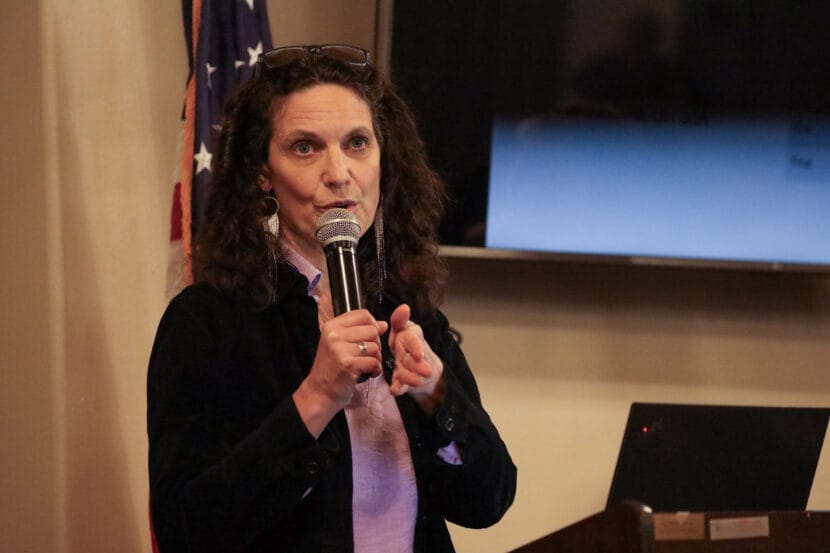
Rebecca Braun speaks in favor of ranked-choice voting at a Juneau Chamber of Commerce Luncheon on Thursday, Oct. 30, 2025. (Photo by Clarise Larson/KTOO)
Though Alaskans approved ranked choice voting nearly five years ago, the debate about whether it actually benefits voters persists. At a Juneau Chamber of Commerce Luncheon on Thursday, two speakers shared what they think of the system.
Alaska uses a ranked choice voting system for statewide elections. Voters approved it in 2020 and used it for the first time in 2022, though there have been attempts to repeal it. The system allows voters to rank candidates by preference.
Rebecca Braun is on the board of Alaskans for Better Elections and spoke in favor of the system. Braun argued that ranked choice voting encourages voter participation and reduces political polarization.
“It might not be perfect, but I think that it’s better,” she said. “I don’t think there’s any voting system that like has no distortions. Mathematicians study this, and there’s almost nothing where you have 100% perfect outcomes. But this seems like to me a better system.”
Alaska is one of only two states that use ranked choice voting. Ten Republican-led states have banned it. Murray Walsh spoke against the system at the forum. He’s a retired land use consultant and is a part of a statewide campaign to repeal ranked choice voting.
Walsh argued it makes voting unnecessarily complicated and unfairly gives Democrats an advantage. The Alaska Republican Party has consistently opposed ranked choice voting.
“Anytime you take something that people do understand and make it more complicated so that they don’t understand it, and then you’re alienating the voter,” he said.
According to data from the state’s Division of Elections, Juneau voters appear to support ranked choice voting. The capital city overwhelmingly voted against an effort to repeal the statewide system last year, which only very narrowly failed statewide.
Though the discussion on Thursday centered around ranked choice voting in state elections, the City and Borough of Juneau could soon be the first major Alaska city to adopt the system. Larger cities in the U.S. like New York, San Francisco and Minneapolis already use ranked choice voting in local elections.
Earlier this summer, Juneau Assembly member Ella Adkison proposed an ordinance to adopt the system locally. She said the change will help build community consensus. The Assembly chose to delay voting on the ordinance until after this fall’s local election. Members are expected to take the topic back up in the coming weeks.
Correction: A previous version of this story used the wrong title for Rebecca Braun.
Alaska Organized Militia members remove debris while supporting storm recovery operations at Kotzebue, Alaska, Oct. 15, 2025. (Photo courtesy of the Alaska National Guard)
It’s been nearly three weeks since a storm caused major flooding and erosion damage in Kotzebue and other Northwest Arctic communities. That was before the remnants of Typhoon Halong made their way through the region.
After assessing the damage in multiple communities, officials said the region is moving quickly to make repairs as winter sets in.
Kelly Hamilton is the emergency manager for the Northwest Arctic Borough. He says more than 150 homes in Kotzebue have already been assessed for damage after the Oct. 8 flood and the remnants of Typhoon Halong a few days later.
The region saw similar flooding last year, too. Hamilton said many of the homes that needed repairs last year will have to go through the same process again, tearing out and replacing damaged flooring and insulation.
This year, he said the borough had a better game plan to start that work immediately.
“If at all possible, help the residents de-water, dehumidify, dry out their house, and then help them to the extent the borough can and get things buttoned up for winter,” Hamilton said.
Temperatures in Kotzebue are already in the low teens and 20s this week, making repairs more challenging.
“The residents need a dry place to live, and winter is on the way,” Hamilton said. Otherwise, they’re just living on an ice block.”
According to Hamilton, a coordinated response between the borough and multiple local, state and even national agencies — including Maniilaq, NANA and the City of Kotzebue— helped assess the damage.
Hamilton said the borough’s Village Public Safety Program also helped, but now about a dozen of the borough’s VPSOs are deployed in the Yukon-Kuskokwim Delta to help with emergency response efforts there.
Damage in Kivalina and Deering
Kotzebue wasn’t the only community in the Northwest Arctic to experience damage.
In the community of Kivalina, over 280 residents sheltered at the school during the night of the Oct. 8 storm. Several returned home to flood damage.
The Alaska Organized Militia, including Alaska National Guard members, deployed eight people to Kivalina for repairs and assessments, according to Jeremy Zidek, a public information officer with the Alaska Division of Homeland Security.
Emergency officials said Kivalina also received help from the nearby Red Dog Mine, which was able to transport water, non-perishable food items and diapers to the community via helicopter. Many Kivalina residents have already applied to the state’s individual assistance program for financial help.
Zidek said the community of Deering had erosion near their health clinic.
Erosion in Kotzebue
Zidek also said emergency officials are working with Alaska Native Tribal Health Consortium on Kotzebue’s sewage lagoon, which had just undergone repairs.
“Those repairs were just completed about a week before the storm from last year’s storm,” Zidek said.
Representatives from the Alaska Department of Transportation and Public Facilities said there was significant slope erosion in Kotzebue, especially along Ted Stevens Way. The road is closed because of the severity of the erosion, and repairs are ongoing.
“We’re working on the repairs between the bridges, and we’re working as fast as we can,” said Angelica Stabs, a public information officer with the division. “We just saw a lot of erosion.”
Kotzebue resident Matt Bergan said his home experienced damage from the flooding. He spoke at a recent Kotzebue City Council meeting. Bergan said he thinks there should be more of an effort for long-term planning.
“It seems like there’s plenty of money to respond to emergencies and fix things like we’re doing now, but it seems harder to get the money for preventive measures before disasters happen,” Bergan said.
Residents have until Dec. 9 to apply for state individual assistance and can apply for federal individual assitance until Dec. 22.
State of Alaska Individual Assistance (IA) – Deadline is December 9, 2025
To register for State of Alaska Individual Assistance:
Call 1-844-445-7131, Monday – Friday, 8 a.m. – 4 p.m.
Or apply online https://ready.alaska.gov/Recovery/IA
FEMA Individual Assistance (IA) – Deadline is December 22, 2025
To register for FEMA Individual Assistance:
Call the FEMA dedicated Alaska Center at (866) 342-1699
Or apply online at https://disasterassistance.gov Red Cross Assistance
To Register for assistance through the American Red Cross:
Call 1-800-RED-CROSS
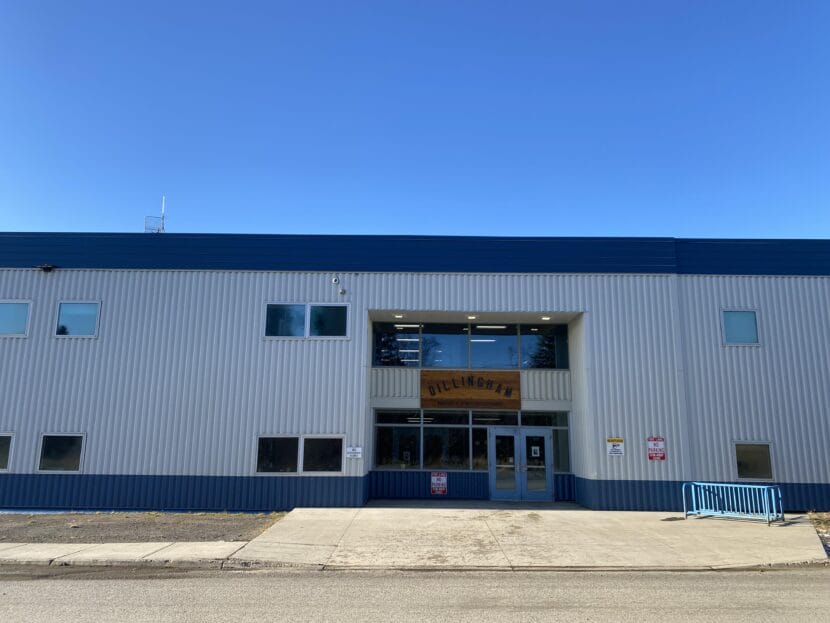
Dillingham City School District Middle/High School building. (Margaret Sutherland/KDLG)
The City of Dillingham and the Lake and Peninsula Borough government are two of 17 Alaska municipalities and school districts that are trying to close budget shortfalls after the state cut its payments for school construction and renovation projects by roughly 25-30% this year.
The payments are part of the state’s School Bond Debt Reimbursement Program, which startedin the 1970s. Local governments borrowed money to pay for new or improved school facilities, and the state committed to help repay the debt over time.
The proposed reduction to the bond reimbursement program originated in theSenate Finance Committee last session. Bristol Bay Representative and House Speaker Bryce Edgmon says the Legislature had to cut costs for several projects to balance the budget and avoid dipping into the state’s savings account, the Constitutional Budget Reserve.
The cost for the state to fully fund projects under the program would have been roughly $47 million a year. The reduction cut roughly $12 million of that.
“When you start looking at the finances of a small, first-class community like the city of Dillingham, that reduction is quite meaningful to their bottom line,” Edgmon said. “I would also point out it signifies how tight the budget really is getting down in Juneau, with costs increasing at every turn.”
‘A huge chunk of money’ from Dillingham’s budget
In 2015, the Alaska Legislature paused funding of new projects for 10 years, a moratorium that expired on July 1. But the state kept paying for pre-moratorium debt, like for a $15 million bond Dillingham voters approved in 2008 to pay for repairs to Dillingham school facilities.
“The state said, ‘Listen, we’ll help support you, you go out and get the bond. We are going to reimburse you for 70% of that bond,'” said Anita Fuller, finance director for the City of Dillingham.
Fuller said that in normal years, the city paid the remaining 30%, primarily with local tax revenue. But this year, the state cut its help with the debt by $231,000, roughly 30% of its commitment to Dillingham’s schools.
“That’s a huge chunk of money because that’s $231,000 that we just lost,” Fuller said. “Somebody’s paying that school bond. If the state’s not, then that means we are.”
All 17 districts and municipalities in the program face the same roughly 30% cut. In the Lake and Peninsula Borough, district officials say that amounts to a roughly $250,000 cut — about 8.5% of the borough’s total education budget for the year.
Lake and Peninsula Borough officials say they will have to shift money from other commitments or drain their reserves to close the gap.
Meanwhile, Dillingham’s city council introduced a revised budget at a special meeting earlier this month to make up for the lost funding.
Various departments are facing cuts, though Fuller says they can’t all be attributed to the loss in bond reimbursement because there were other budget changes to account for.
But she says the cut pulls from the finite amount of money available for all departments.
“All of that money comes from our general fund,” Fuller said. “So money that was going in there to help us with the library or the senior center or the school, all that comes from our general fund.”
Other changes to the budget include a $200,000 increase to the estimated FY26 income tax revenue and a $111,000 annual lease-to-own payment for a new grader.
Fuller said the librarian and senior center director positions were consolidated into one position, and the two full-time staff members at the senior center have been reduced to part-time.
After the moratorium, questions about the program remain
This isn’t the first time lawmakers haveshorted the reimbursement program. In 2019, the governor cut the program and left districts to shoulder the majority of thedebt payment from 2020 through 2022. Then, in 2023, they back-paid districts and municipalities for those three years.
Edgmon says that it is possible that will happen with this reduction as well. He says funding next year and possible retroactive payments depend on state revenue, especially the price of oil. Alaska’s oil prices arecurrently lower than what lawmakers budgeted for.
“That makes me a little nervous in terms of what our budget situation is going to look like next year,” said Edgmon. “My hope is next year we can come back and fully fund the bond debt reimbursement program and really maintain our commitment to municipalities and school districts.”
The reduction in funding coincides with the expiration of the 10-year moratorium on the program. Organizations have been calling for the state to lift the moratorium and reopen the bond debt reimbursement program for years.
“There’s this pent-up need for money to build school infrastructure or repair school infrastructure that hasn’t been addressed since the moratorium,” said Carole Triem, government affairs manager for the Alaska Municipal League.
On the other hand, Triem said the fluctuation in state funding makes the program risky for communities.
“It’s hard for them to say, ‘I feel confident that if we go out and bond for a new school building or fixing a school building, that the state will honor its obligation to repay that debt,'” she said.
But Triem said the need may be great enough for districts to take that risk.
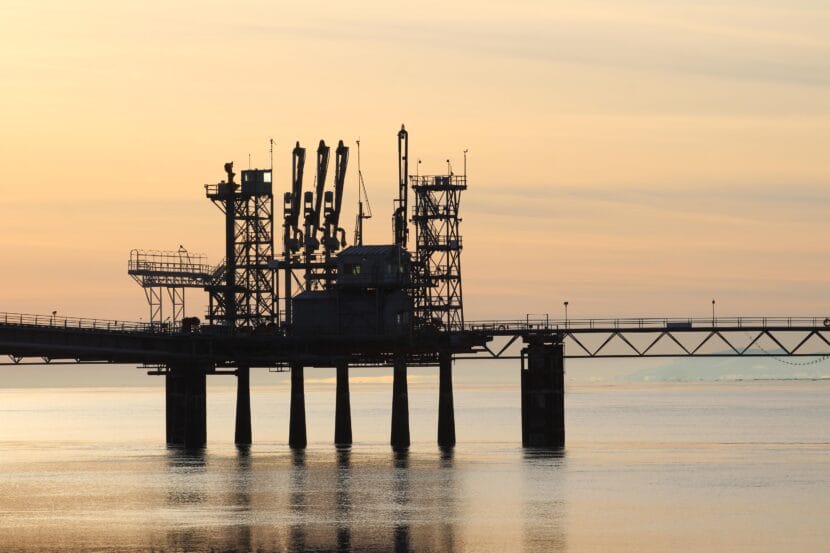
The sun sets behind Marathon Petroleum Corportation’s Kenai LNG Terminal on Thursday, Feb. 6, 2025 in Nikiski, Alaska. (Ashlyn O’Hara/KDLL)
The proposed Alaska natural gas pipeline project picked up another nonbinding agreement last week. This time, the letter of support comes from Tokyo Gas Company, one of Japan’s largest energy utilities. It’s the fifth acquired for the project since Glenfarne, a private energy asset developer, took over majority project ownership earlier this year.
If it’s built, the Alaska LNG Project will move natural gas from the North Slope through a roughly 800-mile pipeline to Nikiski to be liquefied and shipped overseas.
Adam Prestidge is the project president with Glenfarne. He told KDLL last month that preliminary agreements, though nonbinding, are a necessary first step toward agreements that are binding. But he says that can take a while.
“Typically, an LNG contract like this, can take, you know, 12, 18, 24 months to go from initial concept to being a binding agreement,” he said.
Glenfarne celebrated the preliminary Tokyo Gas agreement in a press release for pushing the project over the halfway mark of its LNG export capacity.
Glenfarne Communications Director Tim Fitzpatrick said the project’s annual capacity boils down to two separate numbers.
The first is the natural gas capacity of the pipeline, measured as a volume in billion cubic feet. The second is the liquid volume of natural gas for export, measured as a weight in million tons.
Fitzpatrick says the pipeline has an estimated capacity of 3.3 billion cubic feet of natural gas per day. Of that, 15.2%, or 500 million cubic feet, is earmarked for in-state use by Alaska residents as natural gas. According to a report commissioned by the Alaska Gasline Development Corporation, that’s roughly double what Alaskans in the Anchorage, Matanuska-Susitna and Kenai Peninsula regions actually use each year – between 180 and 200 million cubic feet.
The remaining project output will be converted to 20 million tons of liquefied natural gas for export, Fitzpatrick said. Of that, 11 million tons already have tentative customers through the handful of preliminary agreements reached this year.
Glenfarne estimates it needs binding commitments for five million more tons of liquified natural gas to fund the full $44 billion project.
This week, the head of the International Energy Agency predicted a forthcoming increase in liquefied natural gas supply could change global markets. Reuters reports the shift is creating a buyer’s market, pushing prices down for importers in places like Asia.
Glenfarne is eyeing the end of this year to decide whether to move forward with project development or not.
Correction: A previous version of this story incorrectly stated the annual natural gas capacity of the pipeline.
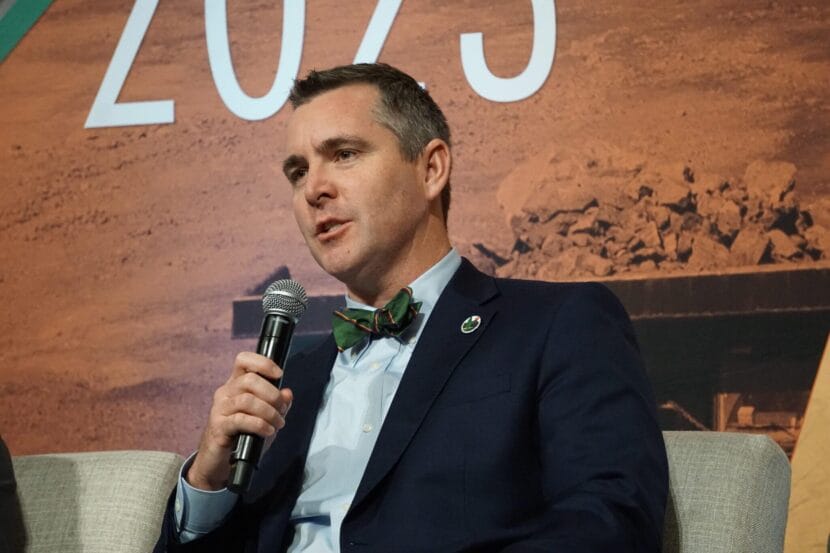
John Boyle, commissioner of the Alaska Department of Natural Resources, speaks on Nov. 15, 2023, at the Resource Development for Alaska annual conference in Anchorage. (Yereth Rosen/Alaska Beacon)
John Boyle, commissioner of the Alaska Department of Natural Resources, abruptly resigned his position on Friday.
Gov. Mike Dunleavy announced the appointment of his deputy, John Crowther, as acting head of the agency that regulates Alaska’s agriculture, mining, oil and gas.
The governor’s office declined Monday to answer questions about the resignation, which had not been previously announced.
Dunleavy is term-limited and will leave office in December 2026. Boyle’s departure follows those of Revenue Commissioner Adam Crum and Attorney General Treg Taylor.
The resignations of both of those men — who are now Republican candidates for governor in next year’s elections — were announced in advance, unlike Boyle’s departure.
Boyle could not be reached for comment on Monday.
The departing commissioner has extensive experience in the oil industry. Before joining Dunleavy’s cabinet in 2023, he was a lobbyist for BP and Oil Search.
Crowther, who will replace Boyle on an interim basis, has been with the Department of Natural Resources since 2012, the governor’s office said.
He previously worked as director of the governor’s Washington, D.C. office and served on the staff of the U.S. Senate’s Energy and Natural Resources Committee. He holds a law degree from Georgetown University.
“The Department of Natural Resources is at the forefront of protecting and developing Alaska’s precious land and waters. Mr. Crowther’s legal background and experience as a deputy commissioner make him a great choice to advance the responsible development, and maximum use, of Alaska’s natural resources consistent with the public interest as mandated by Alaska’s Constitution,” the governor said in a prepared statement released on Friday.
Correction: This story originally had the wrong byline.
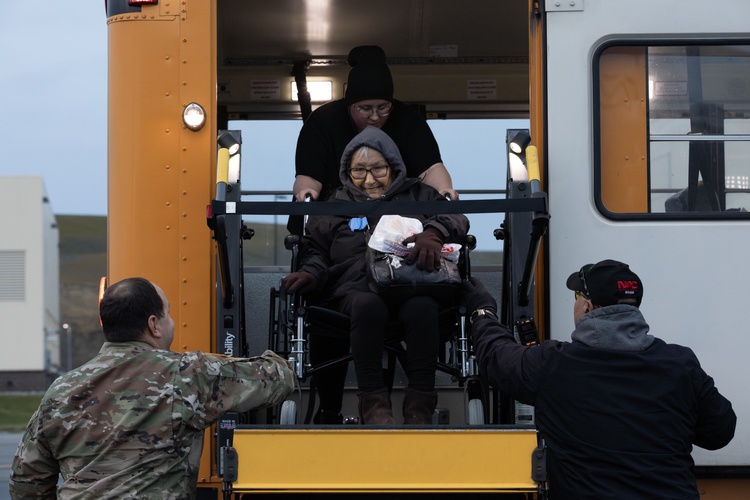
Alaska Air National Guard C-17 Globemaster III aircrew, assigned to the 176th Wing, arrive at Joint Base Elmendorf-Richardson, Alaska, with 62 evacuated residents from western Alaska, Oct. 17, 2025. (Alaska National Guard photo by Alejandro Peña)
The State of Alaska has begun distributing disaster relief payments, totaling over $217,000 as of Friday, to residents of western Alaska impacted by storm damage from ex-Typhoon Halong.
The state has received more than 940 applications for state individual assistance, according to a statement from the Alaska Division of Homeland Security and Emergency Management. Applications are open on the state’s website, through Dec. 9.
As many storm evacuees left or lost identification or essential documents, the Alaska Department of Motor Vehicles and the Department of Health have booths at emergency evacuation shelters in Anchorage to assist with replacements. The Association of Village Council Presidents is offering tribal IDs in the shelters. State caseworkers and a Yup’ik speaking public notary are helping with documentation, the state update said.
Residents must prove they are from the designated disaster area, and provide proof of identification and a mailing address where checks can be mailed.
As of Thursday night, there were 302 evacuees staying in emergency shelters in Anchorage, with 178 at the Egan Center and 124 at the Alaska Airlines Center.
The state’s assistance program provides financial assistance for storm damage to homes, vehicles, essential personal property and medical, dental or funeral needs directly related to the disaster. Applicants will be eligible for $21,250 in home repairs and another $21,250 for “other needs.”
The state’s individual assistance program also includes a housing assistance program that provides renters with up to three months and homeowners with 18 months of financial assistance, according to the state’s website.
Gov. Mike Dunleavy announced Friday that he amended the state’s disaster declaration to waive state fees associated with replacing documents, including licenses and registrations. It also waives late fees for state-administered loan and payment programs.”
Federal disaster assistance approved
On Wednesday, the Trump administration authorized a federal disaster declaration for the Western Alaska storm. The president said that he has authorized an immediate $25 million in federal aid for the state to cover costs as the recovery effort is underway.
Trump also approved the state’s request for federal assistance, including federal individual assistance, public assistance and the hazard mitigation grant program.
Residents can apply on the Federal Emergency Management Agency’s website at DisasterAssistance.gov or on the FEMA app. Applicants must file a claim and are required to go through a FEMA inspection to qualify.
The U.S. Small Business Administration is also offering low interest loans to small businesses, non-profits and individuals impacted by the storm, to help pay for losses not covered by insurance. Applications can be submitted on their federal website.
Financial donations pour in for Western Alaska communities
Individual and business donations have come pouring in for the families and communities devastated by ex-Typhoon Halong, including food, supplies, and financial assistance.
The state has a list of resources and links to assistance on its website.
The Western Alaska Disaster Relief Fund has raised $2.5 million to date, said Ashley Ellingson, director of communications with the Alaska Community Foundation, with mostly corporate donors pledging an additional $1.5 million more. She said an advisory committee of regional and state leaders meets at least weekly to consider requests and how to best allocate funding.
The Alaska Community Foundation has already distributed roughly $575,000 to five organizations: the Association of Village Council Presidents, the Maniilaq Association, the tribal councils of Kipnuk and Kwigillingok — the communities hardest-hit by the storm — and the Alaska Native Heritage Center. Ellingson said that is to ensure funding goes to immediate needs.
“Local organizations can distribute to individuals and families affected the most,” she said.
Correction: The application for state disaster assistance is open until Dec. 9, 2025.
Close
Update notification options
Subscribe to notifications
Subscribe
Get notifications about news related to the topics you care about. You can unsubscribe anytime.