State Government

Alaska’s public schools serve as emergency shelters. Those buildings are also in crisis

Emergency supplies fill the lobby of the Chief Paul Memorial School in Kipnuk, Alaska. Nearly 700 people sheltered there for two days after ex-typhoon Halong.
Emergency supplies fill the lobby of the Chief Paul Memorial School in Kipnuk, Alaska. Nearly 700 people sheltered there for two days after ex-typhoon Halong. (Eric Stone/Alaska Public Media)

On a Sunday morning last month, James Taq’ac Amik was huddled on a small bridge with his girlfriend. At 4 a.m., they had scrambled into an 18-foot aluminum motor boat, fleeing floodwaters from a massive storm surge that inundated Kipnuk, a village of 700 in the heart of western Alaska’s sprawling Kuskokwim River delta.

“I couldn’t make it up. I tried, but the wind was too strong to try and go by boat, so we ended up staying on the bridge for five hours,” Amik said. Things only grew more dramatic. “The houses started drifting away around 5:30 a.m.,” Amik said. “There was still lights in them; there was people in them.”

When they set out, the couple were heading to Kipnuk’s public school, the largest building in the Alaska Native Yup’ik village. At least that building, they hoped at the time, would be secure.

The storm that hit Alaska’s west coast in mid-October was the remnants of Typhoon Halong, which picked up momentum in a warmer-than-normal Pacific Ocean. After the wind died down and the floodwaters receded, the village lay in ruins. But while the school still stood relatively unscathed on its steel pilings more than 20 feet above the muck and wreckage, there were other problems inside. District staff had been working on much-needed upgrades to its main generator. Then the school’s backup generator sputtered. Everyone in the community, including Amik and his girlfriend, stayed for two days until local leaders decided the storm had done too much damage and organized a mass evacuation.

James Taq’ac Amik, his girlfriend, and his daughter fled to the school in Kipnuk before evacuating to an Anchorage hotel more than 480 miles away two days later. (Gabby Hiestand Salgado/KYUK)

When disaster strikes, public school buildings are integral as safe havens in hundreds of predominantly Indigenous villages scattered across Alaska’s vast landscape. In many remote communities, schools are some of the only buildings with flush toilets and their own generators. Schools are often the only buildings that stand on pilings — important amid the rising waters of climate change — and also the only buildings large enough to house dozens, if not hundreds, of people for days at a time.

“It is a known fact that if you need to evacuate, you evacuate to the elementary school,” said Alaska state Sen. Löki Tobin, a Democrat and chair of the Senate Education Committee, who grew up in Nome but now represents Anchorage.

“Those are lifeboats,” said Alaska’s emergency management director, Bryan Fisher. “They’re the last place of refuge.”

Gov. Mike Dunleavy, a Republican and former educator, has declared more than a dozen disasters since August 2024, and in at least half of those cases, public schools were used as emergency shelters. The state reported damage in 52 communities in October, and the impacts forced hundreds of residents to sleep in gymnasiums and on classroom floors in rural public schools. Since 1998, Alaska has seen more than 140 state-declared disasters, and dozens of those required schools to function as shelters.

But Alaska’s rural schools have been neglected for decades. Earlier this year, ProPublica, KYUK Public Media, and NPR documented a health and safety crisis inside many rural school buildings across Alaska. In some cases, the buildings that function as safe havens in times of emergency are becoming emergencies themselves.

The state is required by law to fund construction and maintenance projects in rural school districts because they serve unincorporated communities where there is no tax revenue to help fund education. In the last 28 years, Alaska’s rural school districts have made close to 1,800 requests to the state for money to maintain and repair deteriorating schools, but only 14% of those requests have been approved. And as the backlog of major maintenance projects continues to grow, the state budget has been shrinking.

“Just the maintenance that goes in every day to keep up a building, that’s really where the flaw is,” said Alaska Education Commissioner Deena Bishop. For years, her department has struggled to meet the growing need for dollars to maintain school facilities, including more than 60 owned by the state. “The crux of the situation,” she said during an interview in Juneau last year, is that “we get to an emergency because we didn’t take care of it.”

The main generator that provides power to the school in Kipnuk was not working before hundreds of residents fled there during ex-typhoon Halong. Lower Kuskokwim School District Superintendent Andrew “Hannibal” Anderson said the generator “was working well enough to provide what it needed for the school.” But it was quickly overwhelmed by the sudden increase in demand for power once the school became Kipnuk’s primary emergency shelter. A smaller backup generator also couldn’t meet that demand to charge cellphones and keep the building heated after the community’s residents piled in.

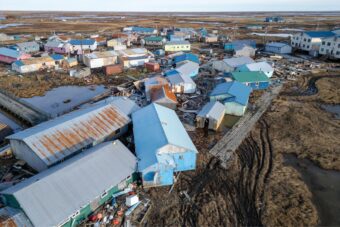
Houses and other buildings sit jumbled and surrounded by debris in Kipnuk on Sunday, Oct. 19, a week after the remnants of Typhoon Halong brought record flooding and high winds. (Eric Stone/Alaska Public Media)

The school district waited 14 years for the state to approve funding to do a major renovation in 2015, but it has not asked for funding since then. Every year, the applications school districts submit for construction and maintenance funds are ranked. Data analysis and interviews with superintendents across the state indicate that submitting an application that ranks high enough to win funding is cumbersome, and they feel pressure to include professional inspections and surveys, which can be expensive. Anderson explained that although the generator required maintenance, he believed Kipnuk’s needs wouldn’t be considered urgent enough to receive funding. “Kipnuk is a relatively new school,” he said.

In Kotlik, a village of just over 650 residents almost 220 miles north of Kipnuk, 70 people spent two nights at the school. “We have a church and a community building, but those are seldom used in evacuations,” explained Principal Cassius Brown. “That’s because the school is situated higher and it’s not as close to the river.”

Since 2018, the Lower Yukon School District has made annual requests ranging from $2 million to more than $5 million to the state’s education department to make extensive repairs to the school in Kotlik and another in a nearby village. That work remains unfunded.

In Chevak, where about 950 Alaska Native Cup’ik people live less than a dozen miles from the Bering Sea coast, school Principal Lillian Olson said 65 people spent a few nights on the gymnasium floor. “Our community is kind of dependent on the school for shelter,” Olson said. “One time, two years ago, we had an electric outage in one part of town that lasted for like a week, and because the houses didn’t have electricity and no heat, we housed them.”

Olson said a test of the building’s fire sprinklers failed in September. In a phone call last spring, Kashunamiut School District Superintendent Jeanne Campbell described a host of problems related to the Chevak school’s boiler and broken water pipes that impacted the fire sprinkler system. “And that’s just inside the building,” Campbell said.

In 2024, the Kashunamiut School District made its first request to the state’s education department since 2001, asking for $32 million to update and renovate the school. The proposal was one among 114 for fiscal year 2025. The state allocated enough money for only 17 of those projects. Work at the Chevak school was not one of them.

Just over a dozen miles west, in Hooper Bay, Mayor Charlene Nukusuk said between 50 and 60 people sheltered for two nights in that community’s public school. The village’s location makes it extremely vulnerable. Over the last few decades, fall coastal storms have devoured several rows of sand dunes that used to protect the community of 1,375 people. Now, the black and frigid Bering Sea laps at the beach only a few hundred feet from the far corner of the local airport runway. Nukusuk said that the school is one of the safest buildings.

Hooper Bay’s school was rebuilt after it was destroyed by fire in 2006. Since then, the district has made 29 funding requests totaling more than $8.4 million in needed repairs to the state for a range of projects on the school including roofing, emergency lighting, and siding. In 2024, the district received money for one of those — just under $2.3 million for “exterior repairs,” according to state data. The superintendent did not respond to questions about specific needs in Hooper Bay.

Alaska’s emergency management division does not have formal agreements with the state’s education department designating schools as emergency shelters, and neither agency has funding to help maintain schools specifically as emergency shelters. However, a division spokesperson said there are some state grants that schools could access for emergency preparedness.

“Schools are built for educational purposes — other uses are incidental or secondary to design,” education department spokesperson Bryan Zadalis wrote in an email. He said no one from the education department visits schools “to ascertain whether a facility is in condition to serve as an emergency shelter.”

“I don’t know if people necessarily correlated together that if you’re going to use schools as multipurpose facilities, that you also have to maintain them for those purposes,” said Tobin, the state senator. “They’re not just institutions of learning. They’re also institutions of after-school activities, of community gatherings, and of evacuation facilities and disaster preparedness support infrastructure,” she said.

@georgebrightsrThis shows that no matter what hardship this village is going through they have a gathering of praise to our Lord Jesus♬ original sound – George

In February 2024, Tobin, who also sits on the state senate’s Military and Veterans Affairs finance subcommittee, put the question of funding schools for emergencies to Craig Christenson, deputy commissioner of the Alaska Department of Military and Veterans Affairs, during a budget meeting.

Alaska’s emergency management division falls under Christenson’s department. “From my understanding,” Tobin said to him, “if the school wasn’t available in some of these very small, rural, remote areas, we would be paying to evacuate people, versus using an asset that we have already put resources into but have already failed to maintain. Is that accurate?”

“I can’t comment on failing to maintain them,” Christenson responded. “Our department does not maintain schools.” (The deputy commissioner declined to comment further on last year’s meeting.)

“But you do utilize them?” Tobin asked.

“We do,” Christenson said.

This article was produced for ProPublica’s Local Reporting Network.

Emily Schwing reported this story while participating in the University of Southern California Annenberg Center for Health Journalism’s National Fellowship. She also received support from the Center’s Fund for Reporting on Child Well-being and its Dennis A. Hunt Fund for Health Journalism.

Alaska aims to regulate its own hazardous waste

Dead batteries are common household hazardous waste items that are accepted at Juneau’s hazardous waste facility. (Photo by Rosemarie Alexander/KTOO)

Alaska might soon regulate its own hazardous waste if the U.S. Environmental Protection Agency authorizes the Alaska Department of Environmental Conservation’s new hazardous waste program.

Alaska is one of only two U.S. states without an authorized program, the other being Iowa. That means the EPA regulates the generation, storage and disposal of the state’s hazardous waste. 

Lori Aldrich, the manager of the state’s new hazardous waste program, said the team consists of six DEC employees, including her, who have been training to take on the responsibility for the past three years. If the program gets federal approval, she said the team will take the lead on permitting, inspections and clean-ups instead of the EPA. 

“Honestly, for Alaska, it doesn’t mean that much change, except that you’re going to have somebody at ADEC here to call,” Aldrich said.

The state Legislature adopted new hazardous waste regulations in 2023 that went into effect this summer. For the most part, the state’s rules now mirror the federal rules under the Resource Conservation and Recovery Act.

According to the most recent EPA data, 2,729 tons of hazardous waste were generated in Alaska in 2023. The three largest producers were the Petro Star Valdez Refinery, Eielson Air Force Base — a Superfund site in Fairbanks — and a company that handles hazardous waste and spills. Together, they were responsible for 57% of the hazardous waste generated in Alaska that year.

Aldrich said Alaska’s generation rate is quite low compared to most other states, and one reason is that petroleum, on its own, is not categorized as hazardous waste. 

She said businesses commonly toss things like cleaning solvents, paint and oil contaminated with other chemicals, which are hazardous wastes. Some things are hazardous due to their toxicity, while others are hazardous because of how they react. 

For instance, “cylinder gas is a hazardous waste if you’re throwing it away, because it could blow up,” Aldrich said.

She said that if the program gets approved, her team will start with a lot of outreach to educate Alaskans about what counts as hazardous waste. 

“Getting people to manage it properly and to make sure that it’s not impacting health or environment here in Alaska is what’s the most important part of our job,” she said.

Aldrich said that almost all of the hazardous waste in Alaska is shipped to disposal facilities in the Lower 48, and that her team would only be in charge of the waste when it’s within state boundaries. 

The public comment period on the state’s application to the EPA is open until December 8.

Alaska will use state funds to fill SNAP cards and help food banks amid federal delays

A shopper passes by a sign welcoming SNAP recipients at a Fred Meyer store in Anchorage on Monday, Nov. 3, 2025.
A shopper passes by a sign welcoming SNAP recipients at a Fred Meyer store in Anchorage on Monday, Nov. 3, 2025. (Matt Faubion/Alaska Public Media)

People who rely on food assistance from SNAP, the Supplemental Nutrition Assistance Program, could have their electronic benefits cards refilled as soon as this week. Gov. Mike Dunleavy issued a state disaster declaration Monday in an effort to free up state funds to make up for federal money delayed by the Trump administration amid the government shutdown.

“The interruption of these benefits would create an immediate threat of food insecurity and hardship, jeopardize the health and well-being of a substantial population within the state, and a direct threat to public health,” Dunleavy wrote in the disaster declaration.

The roughly 66,000 Alaskans who participate in the federally funded, state-run SNAP program did not have their cards refilled on Saturday as scheduled. Until this weekend, the Trump administration said that funding for the program would run out Nov. 1.

On Friday, two federal judges ordered the administration to tap a contingency fund to at least partially fund SNAP benefits. But the Trump administration says it’ll take time for that money to be distributed, and the administration says it only has enough money to fund half of SNAP recipients’ typical benefits.

Dunleavy’s disaster declaration allows the state to refill benefit cards with state funds quickly and offer money to food banks around the state already stressed by the response to ex-Typhoon Halong and the federal government shutdown.

State House Speaker Bryce Edgmon, an Independent from Dillingham, said in a phone interview it was clear the state needed to act to help Alaskans struggling to put food on the table.

“Compelling stories all around the state of single families and elderly people and others not being able to get food because their cards had run out, you know, were already beginning to come to light, so we knew we had to act quickly,” he said. “I’m really pleased working with the governor and Senate President (Gary) Stevens, that we were able to put our heads together and make this happen.”

Dunleavy previously said it would likely take weeks for any state money to flow to beneficiaries. But on Sunday, Edgmon said, the contractor that handles SNAP cards told the state that recipients’ debit cards could be reloaded much sooner.

As of Monday afternoon, a Department of Health spokesperson, Shirley Sakaye, estimated cards could be refilled by Friday, Nov. 7.

Edgmon said the disaster declaration eliminates the need for a special legislative session to address the issue. Lawmakers and the governor had floated a special session as a possibility as they considered ways to ensure food assistance continued to flow.

Stevens, the Senate president, said the money would likely come from already-appropriated but unused funds in the Division of Public Assistance. Stevens said lawmakers would seek to replace the money with a new appropriation when lawmakers return to Juneau in January. He said he hoped the federal government would reimburse the state at a later date.

The solution is temporary, Stevens said, and likely not sustainable in the long term if the federal government remains closed. The program costs around $8 million per week, he said.

“It would be problematic for us to fill that amount of money on an ongoing basis,” Stevens said.

Democrats and Republicans in Congress have yet to come to an agreement to restore funding for the federal government in a dispute over expiring federal health insurance subsidies. How long the shutdown will last remains an open question.

Haines and Skagway both oppose Cascade Point ferry terminal. Juneau hasn’t taken a stance.

This is a concept design drawing of a new ferry terminal facility in Juneau at Cascade Point. (Alaska Department of Transportation and Public Facilities)

The Juneau Assembly doesn’t plan to take a stance on whether it’s in favor of the state’s proposed Cascade Point Ferry Terminal north of Juneau. That’s despite Haines and Skagway openly opposing the project.

The new ferry terminal would be located beyond where the road ends in Juneau on land owned by Goldbelt Incorporated, a local Alaska Native Corporation. The project is slated to cost tens of millions of dollars. 

Juneau already has a ferry terminal in Auke Bay. The new terminal would be about 30 miles north of the Auke Bay terminal. The state has been pushing for the new terminal for several years, saying it would benefit travelers by reducing operating costs and travel time between Juneau, Haines and Skagway. 

But in an interview, Juneau Mayor Beth Weldon said that the Assembly has other priorities to focus on right now. 

“I don’t think we ever took a stance on it because we just had other, more pressing issues, like the flood,” she said. “We’ve been dealing with that for three years now, and now we’re dealing with budget cuts and everything else, so I don’t see it coming back on our plate for quite some time.”

Multiple Assembly members declined to share where they stood on the topic. Member Paul Kelly said he is “not yet convinced that this is the best solution to help Juneau and other communities in Southeast Alaska improve our interconnectivity.”

The state department of transportation has already signed a $28 million contract for the project’s first phase in July and construction could begin next summer. 

An economic analysis released earlier this month by the department weighed the financial merits. Overall, it portrayed it as having more pros than cons. That’s despite its high price tag and criticism from regional officials and members of the Alaska Marine Highway Oversight Board.

The analysis concluded the project would allow for flexible travel in the region and would play a key role in bringing a proposed new gold mine in Juneau to fruition. Canadian mining company Grande Portage wants to develop an off-site ore terminal at the new ferry dock in partnership with Goldbelt. 

The state began soliciting public comment on the first phase of the project last week. The comment period runs through Nov. 28.

State analysis of Cascade Point ferry terminal draws fire from advisory board, Haines mayor

An Alaska state ferry in front of a steep mountain on a cloudy day
The Alaska Marine Highway System ferry Hubbard approaches the dock in Skagway on July 28, 2024. (Eric Stone/Alaska Public Media)

A state plan to build a new ferry terminal north of Juneau is hard to justify on its financial merits but could pose long-term benefits, including more flexible regional travel and a boost to the mining industry.

That’s the conclusion of an economic analysis released by the Alaska Department of Transportation in mid-October. It weighs the agency’s plan to shorten the ferry route between Juneau, Haines and Skagway by routing passengers through a new terminal located 40 miles outside the capital city.

For months, local officials and members of a key advisory board have called on the state to provide an economic analysis or feasibility study of how the project might help – or hurt – travelers. At least so far, they’re unimpressed with the resulting document.

“It’s not convincing me,” said Haines Mayor Tom Morphet. “And it’s certainly not, even in their own words, a slam dunk.”

Bob Horchover of the Alaska Marine Highway Oversight Board echoed that point during a meeting last week. He said the analysis, which was first reported by the Juneau Independent, read “like a timeshare brochure.”

“I don’t think it was realistic, and I’m not sure where they got some of their numbers,” he said.

Report calls proposed terminal “a strategic investment”

At issue is the so-called Cascade Point ferry terminal project. The state says it’s been working on the idea for several years. But DOT recently kickstarted the effort by signing a $28 million contract for the first phase of the project.

The site is located on land owned by Goldbelt, Inc., a Juneau-based Alaska Native Corporation. News of the initial contract was welcomed by Canadian mining company Grande Portage, which plans to develop an ore terminal at the site – in partnership with Goldbelt.

DOT, for its part, argues the project would reduce operating costs and ease passenger travel by moving the ferry terminal significantly closer to Haines and Skagway, shortening the ferry route.

The new economic analysis assesses those claims plus concerns raised by critics. It was written by a contractor, Ed King, who formerly served as chief economist and economic advisor for the state of Alaska.

On the whole, the report acknowledges that the project’s “extensive capital costs” are “difficult to justify based on savings alone.” Still, it paints a picture of the so-called Cascade Point ferry terminal as a project with more pros than cons – especially in the long term.

“In conclusion, although the Cascade Point Ferry Terminal presents challenges as an independent initiative,” the report reads, “it may prove valuable as a strategic investment that facilitates resource development and improves access to the Capital.”

A skeptical ferry board 

That framing drew sharp criticism from members of the Alaska Marine Highway Oversight Board during a meeting last week.

Board Chair Wanetta Ayers said it seems like the analysis aims to “build a case for Cascade Point,” as opposed to evaluating it against alternative options.

“I don’t believe it makes a strong case, certainly from a customer service standpoint, and very marginally from an economic standpoint, that the project is justifiable,” Ayers added in a follow-up interview.

That’s concerning, she said, given that dollars are already being allocated to it — and that there’s a long list of other ferry-related projects in desperate need of funding. The nearly 45-page report explores potential impacts from the terminal, which would shorten the ferry ride between Juneau, Haines and Skagway.

The analysis acknowledges that the terminal would create new infrastructure and maintenance responsibilities for the state. It also finds that “construction costs are unlikely to be recovered in a meaningful timeline without additional changes.”

Another con is that passengers would have to make up for the shorter ferry route by traveling 28 more miles outside Juneau. That would make regional travel more expensive, given extra gas, vehicle wear and tear, and ferry fares that would stay the same.

Goldbelt has committed to running a bus service to transport passengers between Cascade Point and Juneau. But uncertainty remains about the reliability and cost of that shuttle for those traveling without a vehicle – and about what the longer drive would mean for those who do bring a car.

“My guess – and obviously, I’m not an economist – is that for the average user, it’s not a clear cut win, to put it most lightly,” said Morphet, the Haines mayor. “And certainly, to a lot of people, I think would be a loss” of access.

DOT spokesperson Danielle Tessen did not directly address those concerns during an interview Wednesday morning. She said shortening the ferry route ultimately comes down to saving money for the chronically underfunded ferry system.

“That is what we’re focused on, is creating these shortened ferry distances, because that’s how we’re able to continue reducing the cost of operations,” Tessen said.

Cascade Point “not an on-its-own project,” DOT says 

The analysis concludes that the new terminal would reduce planet-warming emissions and operating costs. Shorter ferry runs would result in “modest reliability gains” and an estimated 5% bump in ridership, it says.

But the real value comes from other long-term factors.

“Cascade Point, and this terminal, it’s not an on-its-own project,” said Tessen, of DOT. “And what I mean by that is, there is a bigger plan.”

That bigger plan has two main prongs. The first is another DOT effort, known as the Chilkat Connector Feasibility Study, which has also faced fierce opposition in the Upper Lynn Canal.

The agency is assessing what it would take to build a road aimed at easing travel between Skagway, Haines and Juneau. Cascade Point, the analysis notes, would be a “foundational” component of that effort.

The second prong is regional economic development by way of mining. The analysis says the new terminal would serve as a major boon for Grande Portage Resources’ proposed New Amalga Gold Project, which would likely use Cascade Point as its logistical base.

Morphet took issue with that logic.

“It’s kind of based on this trickle-down view of the economy, that if there’s commercial or industrial development at Cascade Point, there’s a greater benefit to the public,” he said.

“But is there a greater benefit to the traveling public?” he added. “That’s what this question is about: transportation.”

Horchover, the operations board member, echoed that point.

“I don’t know exactly what the motivation is, but it sure isn’t for the good of the Alaska Marine Highway service,” he said. “That’s my two cents.”

The board has previously raised concerns that the Cascade Point planning process deviated from the ferry system’s long-range planning process. During last week’s meeting, the board voted to write a so-called “corrective action” letter to the agency and state legislature saying as much.

The state announced on Wednesday that it is soliciting public comment on phase one of the project through Nov. 28.

Wasilla Sen. Mike Shower says he’ll resign to campaign for lieutenant governor

Man speaking in legislative chamber
Sen. Mike Shower, R-Wasilla, speaks in the Alaska Senate on March 25, 2024. (Eric Stone/Alaska Public Media)

Alaska Senate Minority Leader Mike Shower plans to resign to focus on his campaign for lieutenant governor alongside gubernatorial candidate Bernadette Wilson.

In an interview, Shower said he was concerned his duties as a legislator would create roadblocks in the campaign. For instance, state law prohibits sitting lawmakers from fundraising during legislative sessions.

“Going to the Legislature and being sequestered for four months in Juneau, and then maybe a special session or two next year, would limit my ability to fundraise and campaign,” he said. “You can violate the law if you’re not careful, right? You can really make a mistake there.”

The Wasilla Republican represents a large chunk of the Matanuska-Susitna Borough and some other communities, including Talkeetna, Willow, Sutton and Valdez. He leads the all-Republican minority that makes up about a third of the state Senate. He’s been in the Senate since 2018.

Once Shower’s resignation takes effect on Nov. 3, Gov. Mike Dunleavy will have 30 days to appoint a new Republican to serve until the 2026 election.

Shower declined to say who Dunleavy should appoint to replace him, and the governor’s office didn’t immediately respond to questions on the subject. But he said he’d like it to be someone who shares his conservative views.

“What I think is important is that that person represents the values of my district,” he said. “My district is very conservative. It’s one of the most conservative, politically, in the state.”

Since Shower is a Republican, state law requires Dunleavy to appoint a Republican to replace him. The appointment is subject to confirmation by other Senate Republicans.

Sutton Republican Rep. George Rauscher has registered as a candidate for Shower’s seat. Big Lake Republican Rep. Kevin McCabe, who also lives in Shower’s district, has also filed campaign paperwork that would allow him to run for Shower’s seat, as has former Alaska Wildlife Troopers head Doug Massie.

Site notifications
Update notification options
Subscribe to notifications