State Government

Between vows against taxes and using savings, the 2025 PFD and Alaska state services are in a vise

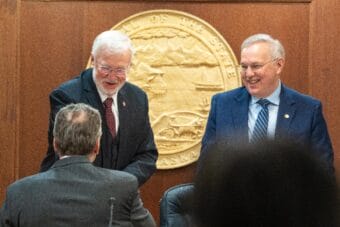
A man listens while sitting before a committee
Sen. Bert Stedman, R-Sitka, listens to a presentation on the proposed amendment to the Alaska Constitution on Thursday, April 24, 2025. (Photo by James Brooks/Alaska Beacon)

As Alaska lawmakers confront a major budget deficit, legislators’ opposing views on possible solutions appear likely to lead to a lower Permanent Fund dividend and cuts to services, including public schools.

In public statements, members of the Alaska Senate’s majority caucus have said they oppose spending from savings to balance the budget and want to see new revenue bills instead.

Meanwhile, members of the state House and Gov. Mike Dunleavy have said they oppose new revenue bills and would prefer to spend from savings.

Those different positions leave only budget cuts — to public services and the dividend — as the way to balance the budget.

“It’s still a very dynamic conversation right now. … We can clearly see we don’t have enough funds to pay for everything,” said Rep. Bill Elam, R-Nikiski.

“In the absence of revenue, the PFD is going to go away. An affordable PFD this year is like $500,” said Rep. Zack Fields, D-Anchorage.

As it prepares its draft of the state’s operating budget, the Alaska Senate’s finance committee has already stripped out all spending increases proposed by the state House in its draft budget, and it has nixed most of the increases requested by Dunleavy.

Even after cutting more than $200 million from a budget draft approved by the House, the Senate Finance draft budget has a deficit of at least $70 million — and possibly much more, depending on the results of ongoing labor negotiations and other factors.

Next on the chopping block is the dividend, set at $1,400 per recipient by the House.

“I believe, because of the tightness of this year’s budget, we are looking at reducing that further, but no further than $1,000,” said Sen. Lyman Hoffman, D-Bethel and co-chair of the Senate Finance Committee.

That reduction would save close to $420 million, he told reporters on Tuesday, but the size of the reduction hasn’t been finalized.

While legislators have not agreed on a new formula to set the dividend, the amounts each of the past two years were based on 25% of the annual draws from the Permanent Fund, a share supported by some senators since at least 2017. Reducing the dividend below $1,400 would end that practice.

With three weeks left in the Legislature’s regular session, the Senate has passed one revenue bill — modifying the state’s corporate income tax for big Internet companies like Amazon — and two others remain in committee.

On Tuesday, Senate Majority Leader Cathy Giessel, R-Anchorage, confirmed that the Senate will not pass the biggest revenue proposal this year: a reduction in the per-barrel tax credit given to oil companies as part of the state’s oil tax system.

That leaves only a change to the taxation of privately held companies like Hilcorp, the North Slope oil firm, on the Senate’s docket.

Even if both bills were to pass the Legislature and gain Dunleavy’s approval, the combined gain to the state treasury would be the equivalent of less than $200 for the Permanent Fund dividend.

On top of that, the odds of the House passing and the governor allowing both revenue bills appear low.

In a March opinion column published by the Anchorage Daily News, House Majority Leader Chuck Kopp, R-Anchorage, joined 15 members of the Republican House minority in opposing two of the three Senate bills.

Asked why Alaskans should endure a PFD cut to avoid higher taxes on those companies, Kopp said on April 8, “Right now, our oil and gas industry is recovering from the COVID-19 setback and we are currently on the verge of a renaissance in the energy industry. … I don’t want to kill an energy renaissance when it is just forming, coming online and showing tremendous promise.”

The House’s majority caucus has only 21 members, meaning that Kopp’s opposition would require the majority to have the support of at least one member of the House’s Republican minority in order to advance one of the oil-related bills.

But even if a bill were to pass the House and Senate, Dunleavy would still have to OK it.

“I told legislative leadership, I’m not interested in new taxes. I’m not interested in a program that taxes and spends, taxes and spends,” the governor told reporters during a news conference earlier this month.

As an alternative to cutting the dividend and services, the Legislature could unlock the Constitutional Budget Reserve, a $2.8 billion savings account. Lawmakers are already planning to do so in order to cover a $200 million shortfall in the current year’s budget.

But on Tuesday, members of the Senate’s majority caucus reiterated their opposition to that idea.

As bad as the state’s budget situation is this year, it’s likely to be worse next year, said Sen. Bert Stedman, R-Sitka and co-chair of the Senate Finance Committee.

“We’re very concerned (about) any access to the CBR this year … because the concern is next year, it’s highly likely we’re going to need it,” he said.

Between federal budget cuts and depressed oil prices, the problems that the state is facing now will be repeated next year, both Stedman and Hoffman said. That’s when the Legislature will debate the budget to cover the fiscal year from July 2026 to June 2027.

“That is also an integral part of what we’re having dialogue on — positioning the state for the FY27 budget a year from now, so we’re not … halfway down a cliff, heading for a final stop,” Stedman said.

Alaska House votes down restrictions and disclosure rules for ‘dark money’ campaign cash

The Alaska and American flags fly in front of the Alaska State Capitol on Tuesday, April 22, 2025.
The Alaska and American flags fly in front of the Alaska State Capitol on Tuesday, April 22, 2025. (Photo by James Brooks/Alaska Beacon)

Ahead of its vote on a bill to restrict political donations in state elections, members of the House’s multipartisan majority rejected a series of amendments that would have expanded the bill.

Among the rejected proposals were ideas to require greater disclosure of donations funneled through so-called dark money groups enabled by the 2010 U.S. Supreme Court decision known as Citizens United.

The rejected amendments, from Rep. Kevin McCabe, R-Big Lake, would have required prompt disclosure of donations to independent expenditure groups, required advertising disclosures, and sought to limit out-of-state contributions to groups backing ballot measures. Federal courts have struck down Alaska’s limits on out-of-state contributions to candidates.

Previous bills dealing with independent expenditures haven’t advanced to a floor vote, making the rejected amendments significant.

Inverting the usual pattern, Republican lawmakers proposed the restrictions, and they were defeated by the votes of independents and Democrats.

Speaking on the House floor, McCabe called the lack of disclosure rules for third-party groups “a critical loophole” in state law.

Traditionally in Alaska, Republicans have supported actions to reduce limits on campaign contributions. The Republican Governors Association has repeatedly challenged disclosure rules imposed by voters in a 2020 ballot measure, and a Republican-backed lawsuit led to the elimination of Alaska’s campaign finance limits in 2022.

A ballot measure scheduled for Alaska’s 2026 elections would reimpose some limits, but if House Bill 16 becomes law, those limits would come into effect ahead of the election.

McCabe argued that HB 16 should be extended to cover independent expenditures, not just direct donations.

“Independent expenditure groups have become a big part of our political campaigns,” he said, speaking on one of his amendments.

Other lawmakers noted that most of the political mailers that filled Alaskans’ mailboxes last year were from independent expenditure groups, not politicians’ campaigns.

“Voters deserve to know who is funding the message,” McCabe said.

Rep. Calvin Schrage, I-Anchorage and a sponsor of the ballot measure and HB 16, was among the lawmakers who voted against the dark-money amendments.

“I think there is concern amongst the Alaskan public around both contribution limits and independent expenditure spending. However, the dire concern is really around the hole around campaign finance, and so to the maximum extent possible, my efforts were to try and keep the bill constrained to what was approved through the ballot measure, and to address the campaign finance portion of this,” Schrage said.

Under the Alaska Constitution, a law can replace a ballot measure only if the underlying bill is “substantially similar” to the ballot measure.

In addition to the dark-money amendments, the House rejected a proposal to exempt most municipal elections from campaign-finance reporting requirements, and an amendment that would have prevented the recipients of state contracts — and their family members — from donating to political campaigns.

That amendment was almost identical to a bill rejected by Hawaii’s Legislature on the same day that the Alaska House turned down the idea. Several states, including New Jersey, have so-called “pay for play” disclosure rules; the amendment proposed by Rep. Sarah Vance, R-Homer, would have gone further by actually restricting donations.

Schrage said it went too far.

“With that specific amendment, I think my biggest concern was around the fact that family members would be prohibited from making donations to political campaigns,” Schrage said. “The courts have been pretty clear that we need to be careful about limiting people’s free speech, and thanks to Citizens United, political spending is considered free speech.”

In 2010, the U.S. Supreme Court ruling in Citizens United v. Federal Election Commission eliminated restrictions on spending by political groups unaffiliated with a particular politician. Since then, the amount of money spent by independent groups has significantly increased. So has the role of dark money contributions — money funneled through independent groups in order to conceal the identity of the donor.

A ballot measure approved by Alaska voters in 2020 requires independent groups to disclose the “true source” of their contributions, but that measure has exemptions: It doesn’t cover ballot measure groups, for example.

Schrage said some of the rejected ideas could show up in separate legislation, but he wanted to keep HB 16 confined to the ballot measure that’s ready for a vote in 2026.

“There’s always this question of, how much do you try to do, and how much can you fit into a bill before it becomes too heavy and too controversial to make it through the process. There is a very strong desire from Alaskans to address our campaign contribution limits, and we have a very clear proposal before us. I wanted to move forward,” he said.

Juneau families rally to support child care funding as Legislature teeters on fiscal cliff

Rally attendees carry signs and babies on the steps of the Alaska State Capitol in Juneau on April 29, 2025. (Photo by Jamie Diep/KTOO)

Listen here:

More than 100 parents, children, lawmakers and advocates carried signs and babies outside the Alaska State Capitol on Tuesday. They were asking the Legislature to prioritize child care funding.

The rally comes after the Alaska Senate cut more than $13.8 million in child care funding from the budget.

Hannah Weed is raising two children and runs Tumbleweeds, a licensed child care facility in Juneau. She said the only way she could afford taking care of her younger child was to start a business providing child care to others at the same time.

“I can’t actually afford to stay home with him, but I don’t have anywhere to send him,” Weed said. “So thankfully, I have experience working with children, and that route worked for me. But it doesn’t work for everybody.”

Child care is part of a long list of cuts as the Senate works on drafting their version of a budget that balances a nearly $2 billion deficit. Advocates also pushed for supporting several bills to bolster several early childhood education and development programs.

Blue Shibler is the executive director for the Southeast Alaska Association for the Education of Young Children. She’s advocated for child care support for years. She said it’s legislators’ job to look for ways to make money to fund child care, like through taxes.

“Parents are tired of having to, like, sing for their supper,” Shibler said. “We shouldn’t have to beg and plead for these things. They’re just basic things that every family needs to thrive in a state.”

At a Senate Majority press conference after the rally, Fairbanks Republican Sen. Cathy Giessel said she agrees with rally-goers on the importance of child care, but the state can’t afford to fund it.

“The problem is we don’t have any money. We’ve had to make serious cuts. And child care funding is one of them,” she said.

Giessel added that advocates shouldn’t give up as the Senate finds other ways to drum up revenue for the state.

“We’re not at a fiscal cliff anymore. We’re actually falling over the cliff,” she said. “And so what we’re trying to do is be creative, to find new ways and yet not place burdensome taxes on Alaskans that are struggling and businesses that are struggling.”

The Legislature is required to pass a balanced budget by the end of the session or face a state government shutdown. The last day of session this year is May 21.

Alaska becomes first state to require warnings about alcohol link to colon, breast cancers

Bottles of wine are displayed on June 29, 2022, at an Anchorage liquor store. Alaska is the first U.S. state to require that businesses post signs warning that alcohol consumption raises cancer risks. (Photo by Yereth Rosen/Alaska Beacon)

Alaska bars and liquor stores will be required to post signs warning of alcohol’s link to cancer, under a bill that became law on Friday.

The new sign mandate, to go into effect on Aug. 1, makes Alaska the first U.S. state to require such health warnings specifically related to colon and breast cancers.

The warnings about the alcohol-cancer relationship will be added to already mandated warnings about the dangers that pregnant women’s consumption can lead to birth defects.

The requirement is part of a measure, Senate Bill 15, that allows employees under 21 to serve alcohol at restaurants and breweries. Lawmakers last year passed a similar bill, with the same combined provisions, but House members gave their final approval just minutes after the midnight adjournment deadline. It was one of five bills that Dunleavy vetoed because of passage after that deadline.

Rep. Andrew Gray, D-Anchorage, was the leading proponent of the new signage. He sponsored a stand-alone measure, House Bill 37, that became combined with the alcohol-server measure; the same process was used last year, though passage of that bill was after the adjournment deadline.

This time, the combined bill on alcohol servers and cancer warnings was approved by lawmakers well before they adjourned. It won final passage with a unanimous vote in the Senate on April 4. Dunleavy allowed the measure to become law without his signature.

Alcohol consumption has been shown to increase risks of certain types of cancer, including breast and colon cancer.

Gray said the relationship has gained more attention in recent years, and he some gave credit to former U.S. Surgeon General Vivek Murthy. In January, Murthy issued an advisory report describing how alcohol consumption, even at moderate levels, increases risks of at least seven types of cancer. “Alcohol consumption is the third leading preventable cause of cancer in the United States, after tobacco and obesity,” said the report.

Murthy recommended that the label on packaging for alcoholic drinks be updated to include the cancer-risk link.

Currently, South Korea is the only nation that requires warning labels about alcohol consumption increasing cancer risks. A similar warning is set to go into effect in Ireland next year.

The newly passed bill includes a provision, originally part of a stand-alone bill sponsored by Rep. Andrew Gray, D-Anchorage, that requires warnings to be posted about alcohol use’s link to cancer. The currently requried sign is on the left; the new sign required starting on Aug. 1, 2025, is on the right. (Graphic provided by Alaska Legislature)

Alaska Senate passes compromise bill including $700 school funding boost with broad support

Senators smile ahead of a final vote on House Bill 57 on Monday, April 28, 2025.
Senators smile ahead of a final vote on House Bill 57 on Monday, April 28, 2025. (Eric Stone/Alaska Public Media)

The Alaska Senate passed a second attempt at an education funding bill on Monday, setting up an up-or-down vote in the House that could send the bill to Gov. Mike Dunleavy.

House Bill 57 would boost the basic input into the state’s public school funding formula, the base student allocation, by $700. It comes less than a week after lawmakers failed to override Dunleavy’s veto of a $1,000 boost to basic funding. The bill passed 19-1 with five members of the all-Republican minority caucus crossing over in support. Sen. Robb Myers, R-Fairbanks, was the only no vote.

School administrators, parents, businesspeople and community leaders have pleaded with lawmakers to boost education funding for years, and there’s broad agreement that the state’s public schools are underfunded. But lawmakers have failed to come to terms with each other and the governor on a long-term increase, instead offering one-time cash infusions the last two years.

“While the bill before you isn’t the final answer to adequately funding our schools, it will get the much-needed financial resources our schools desperately need to retain high quality educators, reduce class sizes, keep beloved extracurricular activities and support our struggling students,” Senate Education Committee Chair Löki Tobin, D-Anchorage, said.

It’s an attempt at compromise. Dunleavy has called for any school funding boosts to be tied to policy items that he says would boost student performance. Those include changes to state law aimed at boosting charter schools and correspondence homeschool, along with grants supporting literacy in elementary schools.

Tobin, who negotiated in closed-door meetings with the governor’s staff on a prior attempt to find common ground on an education funding bill, said the final bill did not represent a deal with the governor.

“I am working with my colleagues here in the Senate and also in the House to ensure that we have a veto-proof majority supporting this legislation,” Tobin said in an interview after the vote. “I’ve been working my ass off, so I’m hopeful.”

The bill that arrived in the Senate Monday morning would, in addition to boosting overall school funding, provide a 10% boost in student transportation funding, require school districts to regulate student cellphone use and simplify the process of creating a new charter school or renewing its contract. It would also set up a task force to study education funding.

After the bill advanced out of committee last week, Dunleavy said he would sign the bill if lawmakers made “a few key edits.” Those included additional provisions aimed at boosting charter schools, an additional funding boost for correspondence homeschool, and an incentive program aimed at improving reading scores for young students.

Senators modified the bill in some important ways during debate on the floor, adding some but not all of the policies Dunleavy requested.

“We believe we’ve struck the most reasonable compromise we’re going to find this year,” Senate Minority Leader Mike Shower, R-Wasilla, said.

One amendment, which passed with unanimous support, added a literacy incentive program proposed by Dunleavy to the bill. The program would pay school districts $450 for each student in kindergarten through sixth grade who reads at grade level or demonstrates improvement.

But, as the state faces a dire budget picture, senators tied the literacy program to passage of a Senate-approved bill that would boost state revenue. Senate Bill 113 would require companies who do business in the state via the internet to pay Alaska state income taxes. Senators have described the tax bill as a “unicorn” and said it would not increase taxes on Alaskans or companies based within the state. Revenues from the tax change would be allocated to the literacy program, with any money in excess of the cost of the reading program going towards career and technical education.

“I’m just trying to find a way to get what I believe is the most important part of all this to the finish line,” said Sen. Robert Yundt, R-Wasilla and a member of the all-Republican minority caucus who sponsored the amendment alongside Democratic colleagues.

Some other Senate-approved changes to the bill relate to charter schools. If a school district decides to terminate a charter school contract, the bill would require them to show cause and give the charter school a chance to address the issue. It would also speed the timeline for the state school board to act on charter schools’ appeal of local board decisions.

Another amendment to the bill would require school districts to set nonbinding target class sizes, with maximum targets set in state law: 23 for elementary schools and 30 for middle and high schools at 30. Districts would be tasked with tracking actual average class sizes and reporting them to the state. Tobin said the amendment, which passed unanimously, would help lawmakers “figure out the best way to support our local school districts and get them the resources they need.”

The newly amended bill would also ban student cellphone use during school hours, including lunch, unless a school board sets out a policy allowing it.

Sen. Shelley Hughes, R-Palmer, said the cellphone policy, in addition to the reading-focused incentive grants, “would be a game-changer.”

The Senate also approved an amendment that would require lawmakers to study, but not necessarily implement, an open enrollment system that would allow families living in one school district to enroll their children in another.

Senators rejected a number of other changes to the bill, including proposals to reduce the number of years that the state tracks student outcomes, require districts to report the results of staff exit interviews and add an incentive to the state school funding formula that the sponsor said would “encourage” correspondence students to take standardized tests.

Dunleavy’s proposal to increase correspondence homeschool funding did not come up for a vote. Hughes said lawmakers were looking to keep the overall cost of the bill manageable given the state’s budget constraints, and that the benefits of a homeschool funding boost would not necessarily flow to students.

“It was not going to change, for instance, the allotment that a parent would get per child,” Hughes said. “It would have provided more for the district.”

Senate approval of the bill sets the stage for a fast-track vote in the House.

Because an earlier version of the bill already passed the House, though at that time it included only a requirement to regulate student cellphone use, Senate passage sets up a yes-or-no concurrence vote in the House. If the House votes to accept the Senate’s changes, it would be sent to the governor’s desk.

A spokesperson for Dunleavy declined say whether the governor supported the new bill ahead of the final House vote. But Hughes, a close ally of the governor, said she had been in touch with Dunleavy, asking him to accept the compromise.

“I can almost guarantee you that the governor is not a happy camper right now,” Hughes said. “But I will tell you, I had a conversation with him over the weekend, and I talked about pride and ego and really implored him to look at the big picture”

Several Republican senators — Sens. Mike Cronk, R-Tok, Robert Yundt, R-Wasilla, and James Kaufman, R-Anchorage — said they would support an override if Dunleavy ultimately vetoes the bill. Several said they were glad to support a compromise.

“We’re not a Republican in Idaho, and we’re not a Democrat in California,” Yundt said. “This is a state where everybody has to give.”

Hughes and Shower said their support for an override would depend on whether the tax bill that would fund the reading program passes.

Though the House initially planned to vote on the final bill Monday, lawmakers sent the bill back to the Senate for a re-vote after discovering an error in the bill’s language. A final vote is expected Wednesday.

Correction: An earlier version of this story said the vote came less than a week after the governor’s veto. It comes less than a week after a failed override vote.

Alaska Senate plans to vote Monday on new education bill with $700 funding boost

Sen. Bert Stedman, R-Sitka, center, huddles with fellow co-chairs of the Senate Finance Committee — Sen. Donny Olson, D-Golovin, left, and Sen. Lyman Hoffman, D-Bethel — during a committee meeting on April 24, 2025. (Eric Stone/Alaska Public Media)

The Alaska Senate is planning to vote Monday on a new education funding bill, even as Gov. Dunleavy is calling for changes. That’s after a state Senate committee approved a new version of a bill calling on school districts to regulate student cellphone use.

The new version of House Bill 57 from the Senate Finance Committee includes a $700 boost to the base student allocation, the basic input into the state’s public school funding formula. It also includes a 10% boost to student transportation funding, a longtime priority for school districts facing rising costs.

School leaders, community members and others have said for years the state’s schools are underfunded, and school boards have been forced to slash staff and programs as lawmakers and the governor have struggled to come to terms on a long-term boost to education funding.

The revised bill comes a week after Gov. Mike Dunleavy vetoed a prior bill adding $1,000 to the base student allocation and two days after an override vote failed. Dunleavy has said for years he’d veto any school funding bills that don’t include his preferred policy priorities and twice made good on that threat.

Sen. Bert Stedman, R-Sitka, who caucuses with the largely Democratic bipartisan Senate majority, says the new bill is an attempt to compromise.

“We talked about some of the policies that were in play, and there’s quite a few of them, which ones seemed to be most universally acceptable, and threw them together,” Stedman said of the new bill.

Some of the policy items included in the bill would ease the process of creating and renewing charter schools.

Sen. Löki Tobin, D-Anchorage, said the bill “strikes a balance between having public policies that have been well-vetted and that will actually improve education outcomes in our public schools, and also provid(es) the desperately needed resources to stabilize our public school system and keep our class sizes limited.”

There are, however, some significant differences between lawmakers’ approach and a bill Dunleavy introduced after vetoing lawmakers’ last attempt.

The Senate version of the bill does not, for instance, limit the reasons school districts can terminate charter schools’ contracts, nor does it prescribe a new appeal process for charter schools that face termination. Those, along with a provision that would create a statewide open enrollment system that allows students living in one district to go to school in another, have faced opposition from Senate leadership.

The new bill also omits a funding increase for correspondence homeschool and $450-per-student incentive payments to school districts whose elementary-age kids read at grade level.

In a social media post Thursday, Gov. Dunleavy called on lawmakers to add those items.

“Let me be clear. If legislators make a few key edits, including restoring the reading grants, adding open enrollment, ensuring full funding for correspondence students, and including the four charter school reforms, I will sign this bill,” he said.

The bill is scheduled for amendments on the Senate floor on Friday.

If Dunleavy ultimately vetoes the bill, the predominantly Democratic coalitions who control the House and Senate could not override him without help from minority Republicans.

Rep. Will Stapp, R-Fairbanks, who objected to the prior bill’s large price tag, said the new bill looks more affordable.

“It doesn’t appear to me to be the kind of the clear things that the executive (Dunleavy) is asking for, but it’s certainly closer,” he said. “Hopefully, we’ll get there. It doesn’t feel like we’re that far apart here in the building.”

Stapp said he’d like to see the governor’s open enrollment and correspondence school provisions added to the bill.

Rep. Jeremy Bynum, R-Ketchikan, one of three Republicans who crossed over to support an earlier compromise education funding package, declined to discuss the new bill in detail.

“We’ll just have to see what the final bill ends up looking like,” he said.

The bill is expected to move quickly through the Senate and onto the House. Because the bill already passed the House — though at that point, it only included a requirement that schools regulate cellphone use — approval in the Senate would set up a single up-or-down vote in the House on concurring with the upper chamber’s changes.

Site notifications
Update notification options
Subscribe to notifications