State Government

Dunleavy vetoes education bill, announces competing bill

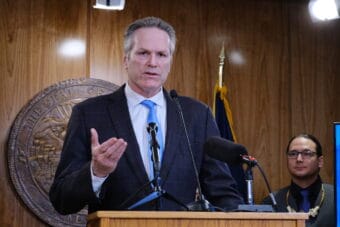
Gov. Mike Dunleavy speaks to reporters during a news conference on April 17, 2025. (Eric Stone/Alaska Public Media)

Gov. Mike Dunleavy on Thursday announced he had vetoed a bill that would have boosted the basic per-student funding amount for public schools, the base student allocation, by $1,000. Instead, Dunleavy said he would introduce a $560 BSA increase, along with $35 million in targeted education funding, attached to a set of policies in a bill that he said he would introduce Friday.

“There were really two reasons for the veto,” he said at a news conference. “One of the reasons is that the revenue situation has deteriorated a lot since we submitted the bills and worked off a budget in December, and the second reason for the veto is there’s no policy in the bill.”

The veto was widely expected. Dunleavy called the bill the House and Senate sent to his desk “a joke” after senators stripped out a variety of policy provisions that lawmakers previously included in the bill as an effort to seek compromise. Some policy measures — including an expansion of intra-district open enrollment and a ban on cellphones in schools — were items the governor favored.

Others stripped out by the Senate Finance Committee were items Dunleavy opposed, including a requirement that homeschooled students take a standardized test or alternative assessment to access state funding known as correspondence school allotments.

The leaders of the House and Senate say they plan to meet in joint session to attempt to override the veto on Tuesday afternoon.

“Our schools are in desperate need of this additional funding,” said Sen. Bill Wielechowski, D-Anchorage.

Given that the bill passed with a one-vote majority in each chamber, though, minority Rep. Will Stapp, R-Fairbanks, said he didn’t believe lawmakers would come close to the two-thirds majority necessary to override the governor’s veto.

“It would be very strange for me to see people who voted no on a bill to vote yes on an override of the bill,” he said.

Senate President Gary Stevens, R-Kodiak, said he, too, was skeptical the override would succeed.

“That’s not going to happen,” he said.

Lawmakers failed by one vote to override the governor’s veto of a compromise education bill last year that would have included a $680 boost to basic per-student funding while making numerous policy changes.

New bill would boost education funding — but there’s a catch

Dunleavy’s new bill, according to a draft provided to reporters, would provide $35 million in education funding in addition to the $560 base student allocation increase, including an increase in funding for homeschool students in correspondence schools and incentive payments to school districts tied to student performance on literacy assessments. The governor said that’s “equivalent” to a $700 increase in basic funding.

“The schools need more money. We had a huge spike in inflation just a couple years ago,” he said.

That’s been a chorus repeated by school districts, parents, community leaders and businesspeople for years, though lawmakers and the governor have failed to agree on a substantial boost to education funding since Dunleavy took office in 2018.

Debates over education funding, responding to those calls from Alaskans across the state, have dominated the last two legislative sessions. Dunleavy said Thursday that he was open to removing education funding as a perennial item of legislative debate.

“We should have a discussion about inflation-proofing education funding going forward, to be perfectly honest with you, and I would have that conversation,” Dunleavy said.

But it’s unclear whether the governor’s bill, if passed as is, would actually boost funding for schools across the state.

Schools this fiscal year got the equivalent of a $680 increase in basic funding on a one-time basis. It was entirely tied to total school district enrollment, rather than the approach the governor’s bill takes, tying some of the funding to reading performance and homeschool enrollment.

That means it’s possible the bill could result in some school districts — especially those with few homeschool students and poor scores in reading, or few young students — receiving less money next year than they did this year.

The new bill would also make a variety of changes to state law around charter schools and require school districts to “regulate” the use of cellphones in schools.

Lawmakers open to further negotiation with governor — if he’s willing

Key lawmakers say they’re open to continuing to work with Dunleavy on a compromise.

“There’s a lot of ‘Yes, and…’ in what I heard today,” said House Education Committee Co-Chair Rebecca Himschoot, I-Sitka, who sponsored the bill the governor vetoed.

She said the governor’s new proposal was an improvement over the last education bill Dunleavy introduced, which did not include an increase in the base student allocation. Himschoot said she was especially encouraged by the governor’s apparent willingness to tie school funding to inflation. The original version of the education funding bill she filed would have tied school funding to the Consumer Price Index.

But Himschoot took issue with the fact that the governor’s bill provides less general-purpose funding than schools received last year.

“None of us is willing to go there,” she said.

Minority House Republicans said the governor’s bill provided a foundation to build upon.

“The bill looks like a pretty reasonable bill to me, with the permanent increase in education funding,” said Rep. Will Stapp, R-Fairbanks, a member of the all-Republican House minority. “If he says he’s going to sign in, I don’t see a reason why we wouldn’t pass the bill at this moment.”

But key members of the Senate said they had reservations about some of the governor’s new proposals. Wielechowski, who chairs the powerful Senate Rules Committee, said he’s not sure the governor’s proposed policies will actually improve student performance.

“They really don’t do anything at all to advance education,” Wielechowski said.

The governor’s office estimates the cost of the bill to be $179 million. Status quo funding for schools and other state services — slightly less than the funding Dunleavy proposes — would leave the state budget hundreds of millions of dollars in deficit.

Dunleavy suggested filling the gap with the state’s roughly $3 billion in savings, a prospect that has been dismissed by Senate leadership.

Wielechowski and Himschoot said they were frustrated by their experience negotiating with the governor’s staff, both this year and last. Himschoot, the primary sponsor of the bill the governor vetoed, said negotiations over the bill, the Legislature’s No. 1 priority, had run through the governor’s staff rather than Dunleavy himself.

“I’ve had no meetings with the governor,” she said.

Wielechowski said he hoped Dunleavy would be open to a little give-and-take.

“We worked last year and we thought we had a compromise. (We) gave the governor, quite frankly, 95% of what he asked for, and it still wasn’t enough,” Wielechowski said. “If he’s coming into this with the perspective of, ‘Give me everything, or we don’t have a deal,’ that’s probably not going to happen. I guarantee that’s not going to happen.

“But if he’s coming into this in a manner where he genuinely wants to compromise, then sure, absolutely we can find a deal,” he said.

KMXT’s Brian Venua contributed reporting.

Alaska Gov. Dunleavy vetoes education funding boost for second year in a row

Gov. Mike Dunleavy discusses his new proposed omnibus education legislation at a news conference on Jan. 31, 2025. (Photo by Corinne Smith/Alaska Beacon)

For the second year running, Alaska Gov. Mike Dunleavy vetoed an education funding bill on Thursday, citing the state’s current finances and a lack of policy changes he supported.

House Bill 69 would have increased the base student allocation — the core of the state’s per-student funding — by $1,000 in the funding formula. The BSA has not been substantially increased for more than a decade, and public school advocates testified that inflation-driven cost increases have resulted in cuts to programs, school closures, and larger class sizes.

The governor’s veto is subject to a vote of the Alaska Legislature. Under the Alaska Constitution, a vote to confirm or override the vote must be held “immediately,” but multiple lawmakers have said that the bill lacks enough support for a veto override. Votes from 40 of 60 state legislators, meeting in joint session, are needed for an override.

Last year, the education funding bill included a $680 per-student increase. That bill had broad bipartisan support, with only three Republican legislators voting against it. But after Dunleavy vetoed it, 20 Republicans voted to uphold the veto. This year, none of the 25 members of the two Republican minority caucuses voted for the bill. The three co-chairs of the Senate Finance Committee voted against it.

Editor’s note: This is a developing story. 

This story was republished with permission from Alaska Beacon. 

State seeks preliminary injunction against Eklutna Tribe casino

Aaron Leggett, president of the Native Village of Eklutna, and Ryan Walker, manager of the tribe’s gaming hall. (Rhonda McBride/KNBA)

The Chin’an Gaming Hall is in a doublewide trailer off the Birchwood exit on the outskirts of Anchorage, a far cry from a Las Vegas style casino, but there are often long lines of people waiting to get inside. Since it opened in January, its 85 electronic bingo machines stay busy.

This picture could change if the state is successful in its bid to shut down the gambling operation. Last Wednesday, the Alaska Attorney General asked a federal court in Washington, D.C. to issue a preliminary injunction against it.

This latest motion follows a lawsuit the state filed in February, after the federal government approved the project in the final days of the Biden administration.

The outgoing assistant secretary of Interior, Bryan Newland, gave the Eklutna Tribe final approval for the gambling operation on Jan. 16, one of his last acts before the Trump administration took the reins of power.

The tribe immediately went to work. In four-and-a-half days, it bolted together several modular buildings and opened its doors to limited gambling operations. The building, it said, was temporary and would eventually be replaced by a permanent gaming hall with about 700 machines and restaurants.

A security guard watches over rapid construction of the Chin’an Gaming Hall on Jan. 20, 2025. (Rhonda McBride/KNBA)

The project had been on the fast track since February 2024, when the U.S. Interior Department’s solicitor, Bob Anderson, issued a new opinion on the legal status of Native allotments in Alaska.

Anderson’s opinion upended previous court decisions on Native allotments in Alaska. He said under certain conditions Alaska tribes could operate gambling establishments, just as tribes do on Lower 48 Indian reservations.

After the new legal interpretation, the National Indian Gaming Commission and the Bureau of Indian Affairs green-lighted the Eklutna tribe’s proposed gaming hall. Anchorage Mayor Suzanne LaFrance also endorsed the project in her comments in a federal environmental review, despite a lawsuit filed by a group of neighboring property owners to block the gaming hall.

The neighbors claim it will change the rural character of their community and force them to pick up the costs of the new development, such as increased public safety services and road upgrades, because Native allotments are not subject to state and local taxes.

The tribe has promoted its gaming hall has a boon to the region, that could eventually bring 400 jobs and 70 million dollars in economic activity on an annual basis.

In a statement, Aaron Leggett, president of the Native Village of Eklutna, called this latest court filing against his tribe disheartening, a sign that Governor Mike Dunleavy is escalating his attack on tribal sovereignty.

“If Governor Dunleavy and Attorney General Treg Taylor are successful in their quest to preempt the Native Village of Eklutna’s tribal sovereignty and self-determination, it could mean an end to the Chin’an Gaming Hall and the permanent facility that the Tribe intends to develop,” Leggett said. “It will undoubtedly discourage other Tribes across our state in our communities.”

The Chin’an Gaming Hall sits on about eight acres of Native allotment land near the Birchwood Airport. Although it’s a tiny sliver of the 1.5. million acres of Native allotments in Alaska, it has become a huge test case for the state.

In a statement, Deputy Attorney General Cori Mills said the state’s jurisdiction over these lands is at stake.

“We are asking a court to reaffirm what it has already said—the State maintains primary jurisdiction over Alaska Native allotments. A solicitor’s opinion cannot convert them into Indian reservations,” Mills said. “We are asking for the court to make sure the issues can be resolved before further development occurs—we believe keeping the status quo best protects all parties involved. Once the litigation is completed, then everyone will know where their lane is.”

For now, the Native Village of Eklutna is staying in its lane and will continue to operate the gaming hall. The profits will be used to fund tribal health programs and create jobs for its members. Leggett said the tribe has struggled in the past to help its members but calls its gambling establishment an “incredible success.”

Alaska House votes down symbolic antiabortion budget language, passes amendment against trans care

Rep. Andy Josephson, D-Anchorage and co-chair of the House Finance Committee, in charge of the operating budget, listens to debate Monday, April 14, 2025, on the operating budget. (Photo by James Brooks/Alaska Beacon)

For the first time in more than 25 years, the Alaska House of Representatives has voted against budget language that seeks to limit Medicaid coverage for abortions.

On Monday, the House failed by a single vote to approve a budget amendment that would forbid the state from spending money on abortions unless they are deemed a “mandatory service” under Medicaid.

The amendment received 20 votes, all from Republicans; 21 votes were needed to approve the amendment, which has been a feature of the state budget since at least 2001.

Hours later, the House approved a different amendment that seeks to adopt a similar approach with regard to gender dysphoria and care for transgender Alaskans.

That amendment passed 21-19 on a strict party-line vote, as both Republican members of the House’s coalition majority joined members of the minority Republican caucus to pass it.

Both actions are not final — they would have to be mirrored by the state Senate — but nonetheless have significant symbolic value.

The Alaska House of Representatives has repeatedly and unsuccessfully attempted to restrict abortion access since the Alaska Supreme Court ruled in 1997 that the privacy clause of the state constitution protects abortion rights.

Each year, under an amendment to the state budget, state lawmakers have attempted to restrict abortion under Medicaid by limiting coverage to only what’s deemed medically necessary.

Introducing the abortion amendment was Rep. Sarah Vance, R-Homer.

“The courts have weighed in on this issue, and it is the value and the principle of Alaskans that we preserve life,” she said.

“The executive branch has provided support for this, the Legislature has provided support for this. So this is simply restoring the language that we have previously had,” Vance said.

The budget language has had limited practical effect because doctors need only fill out a form to demonstrate that a procedure is medically necessary, and an attempt to define what’s medically necessary was struck down in court.

The Alaska Supreme Court ruled that using different definitions for abortion and for other cases violated the right to equal protection of the laws under the Alaska Constitution.

Nevertheless, the amendment has turned into an annual statement of intent. In 2019, the state Senate initially failed to adopt the amendment, though the final budget included language from the House. Until this year, the House had never failed to adopt the amendment.

This year’s amendment came down to Rep. Louise Stutes, R-Kodiak, who initially voted in favor of the amendment but changed her mind before voting closed.

“I’m just trying to do the right thing, and putting it in the budget is the wrong thing,” Stutes said afterward. “Aside from the fact that I believe the state doesn’t belong between a woman and her doctor — and our state constitution protects that — I think the intent language, if it were enforced, it’s unconstitutional. So it’s kind of meaningless to put it in the budget.”

Hours later, Stutes and Rep. Chuck Kopp, R-Anchorage, the majority leader, joined 19 members of the House’s Republican minority to add similar language regarding gender dysphoria to the state budget.

If adopted by the Senate and Gov. Mike Dunleavy, it’s unclear what effect the amendment would have. Although a 2021 lawsuit resulted in a federal ruling that requires Alaska’s Medicaid program to cover gender-affirming care, the Alaska Supreme Court has not considered the issue, and the case law around the topic is not established as well as it is for abortion, experts said.

“We’re grateful that for the first time in recent memory, the House did not insert the harmful and performative amendment aimed at stripping patients with low incomes access to coverage for abortion. Unfortunately, the same body adopted an equally harmful and performative amendment attacking gender affirming health care,” said Rose O’Hara-Jolley, Alaska State Director for Planned Parenthood Alliance Advocates. “We urge the body not to adopt either amendment in its final version — we’re relying on them to stand with all Alaskans, regardless of their income or gender identity.”

Debate continued Tuesday on more amendments to the House’s version of the state operating budget.

Juneau road and Nome port lose funding as Alaska Senate passes capital budget

Sen. Bert Stedman, R-Sitka, presents the Alaska Senate’s draft capital budget on Tuesday, April 15, 2025, as fellow senators listen. (Photo by James Brooks/Alaska Beacon)

As Alaska legislators confront a major state budget deficit, the state Senate on Tuesday voted unanimously to approve a “bare bones” $162 million capital budget to pay for construction and renovation projects across the state.

The spending plan, which would take effect July 1, remains a draft subject to approval by the House. Gov. Mike Dunleavy may also make line-item vetoes.

The budget bill passed by the Senate is almost entirely limited to the minimum needed to unlock more than $2.5 billion in federal grants for road maintenance and other priorities.

With oil revenue down and costs up — including the Permanent Fund dividend — analysts are projecting a significant budget deficit for the coming year. On Friday, the House voted to reduce the proposed 2025 dividend, but not enough to erase the deficit.

To help the issue, members of the Senate Finance Committee clawed back millions of dollars previously allocated to construction projects, reducing the need for new state revenue to pay for the capital budget.

Among the clawbacks: $37 million set aside for the Juneau Access Project, an effort to improve road and ferry service to the capital city.

“To even get to the bare-bones capital budget, my district ended up contributing half a dozen ribs and a femur. … I’m not pleased,” said Sen. Jesse Kiehl, D-Juneau and a member of the Senate Finance Committee.

Other notable clawbacks included $10 million for a proposed deep-draft port in Nome, and $138,611 remaining in an account to be used for Ketchikan’s proposed Gravina Island Bridge, once dubbed the “bridge to nowhere.”

Members of the finance committee also turned to the state-owned investment bank, the Alaska Industrial Development and Export Authority, for an additional $12.5 million above the $20 million already pledged by the bank to the state treasury.

Budgeters rejected some of Dunleavy’s budget requests: $2.5 million for a proposed road in the western portion of the Matanuska-Susitna Borough, $4.2 million for development of the trans-Alaska natural gas pipeline, $2.5 million for firefighting aircraft, and $6.5 million for a new state plane to be used for emergency response.

They also rejected all $3.2 billion in requests from individual legislators for their specific districts.

Senate Minority Leader Mike Shower, R-Wasilla, called the result “a fair and balanced approach” in a statement released after the vote.

Some projects saw reduced funding: A $6.5 million request to expand the Bradley Lake hydroelectric project’s capacity was cut to $6 million. Bradley Lake is among the cheapest sources of electricity on the Railbelt.

The Senate’s biggest addition was $19 million for major maintenance at public schools — the governor had proposed no funding for the major maintenance list.

“This is just the beginning of many tough decisions you’re going to see over the next few weeks, between now and the end of May, and I don’t think some of the folks in the building have quite grasped that yet,” said Sen. Bert Stedman, R-Sitka and co-chair of the Senate Finance Committee in charge of the capital budget.

Alaska education funding boost, sent to governor, awaits his veto

Gov. Mike Dunleavy signs Senate Bill 43, declaring March to Women’s History Month in Alaska, on April 3, 2025, in his office in the Alaska State Capitol. (Photo provided by the Office of the Governor)

A bill that would increase Alaska’s K-12 education funding formula by $253 million per year is on the desk of Gov. Mike Dunleavy after both the House and Senate passed it.

On Monday, a spokesperson for the governor said Dunleavy intends to veto it, confirming prior posts on social media.

The Alaska Legislature transmitted House Bill 69, containing the formula funding increase, to the governor on Saturday. Under the Alaska Constitution, the governor has until April 30 to sign it, veto it or allow it to become law without his signature.

If the governor vetoes the bill, lawmakers must meet “immediately” in joint session to vote and either confirm the governor’s veto or override it.

Overriding a veto on HB 69 would require 40 of the Legislature’s 60 members. Lawmakers for and against HB 69 have said they doubt there are enough votes to override a Dunleavy veto on the issue.

And even if the bill became law, actually funding the formula would require action in a separate budget appropriation bill. Overriding a budget veto would require 45 of 60 legislators.

Site notifications
Update notification options
Subscribe to notifications