State Government

Salary study shows large segment of Alaska state workforce is underpaid

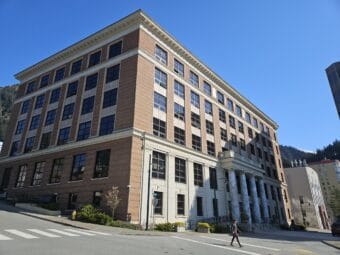
State Office Building Willoughby Avenue entrance 2021 01 22
The State Office Building’s Willoughby Avenue entrance in Juneau was open on Jan. 22, 2021, though the offices inside were all closed to the public. (Photo by Jeremy Hsieh/KTOO)

Gov. Mike Dunleavy’s administration released a long-delayed study on state worker salaries on Wednesday. The study shows that more a quarter of the jobs surveyed, 28%, pay less than the median market wage, and 43% pay less than a key benchmark the state has used for decades.

“The report found several areas where the State is doing well and very competitive, as well as several areas that need improvement,” Department of Administration spokesperson Forrest Wolfe said via email after declining an interview request.

Nearly 3,000 state jobs were vacant at the beginning of this year. Alaska State Employees Association head Heidi Drygas, whose union represents a majority of the state’s rank-and-file workers, said in an interview that the salary report offers some insight on that problem.

“It’s no wonder why they’re having a difficult time attracting applicants to apply for these jobs, because they simply will make more money in the private sector or in public employment in other states,” she said.

A few job classes stand out as especially underpaid, according to the study. State biologists, physical scientists, wildland firefighters and economists all earn far less than the market rate. Law enforcement officials tend to earn above the market rate.

The salary study looked at more than 400 benchmark job classes, covering about half of the state’s more than 15,000 employees. It compared the salaries for those jobs to similar roles in other governments and the private sector.

State agencies have traditionally sought to align their pay with the 65th percentile- essentially paying employees a bit better than average. Compared to that benchmark, more than 40% of the surveyed jobs are underpaid. Drygas says the state’s decision to look at the median salary obscures how much the state underpays its employees.

“I think the state has done its level best to … look at it through rose-colored glasses, but when you look at the details, it’s abysmal,” she said. “State salaries have fallen miserably behind.”

The Department of Administration says it asked for both figures in line with past practice.

“For a large employer and complex employer, such as the State of Alaska, market studies often use more than one market competitive point. This allows consideration of different market competitive frameworks,” Wolfe said.

Wolfe said state officials will review the findings of the study to determine whether salaries need to be adjusted, starting with those that are 10% or more below the market rate.

Drygas said she hopes the study spurs the state to offer more competitive wages. She said the union plans to continue a lawsuit seeking to obtain earlier drafts of the study, which the state says were not used in decision-making and are thus not public records.

Alaska Senate prepares to vote on public education funding boost as Dunleavy vows veto

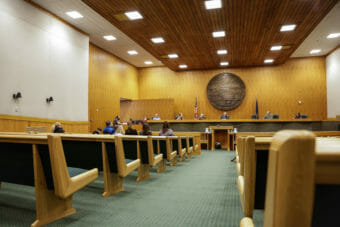
The Senate chambers are seen at the Alaska State Capitol on Friday, May 13, 2022 in Juneau, Alaska. (Photo by James Brooks/Alaska Beacon)

The Alaska Senate will vote as soon as Friday on legislation that seeks to permanently increase K-12 public school funding, but Gov. Mike Dunleavy has vowed to veto the bill if it passes as currently written.

On Thursday morning, the Senate Finance Committee approved a modified version of House Bill 69, which would increase the base student allocation — the core of the state’s per-student public school funding formula — by $1,000 per student.

School districts and public school advocates have testified for years that state funding, which has been kept flat amid rising inflation, is inadequate and has caused extensive cuts that hurt student performance.

The bill is a top priority for the multipartisan majorities in both the House and Senate.

If the new formula is fully funded by legislators and the governor, the effect would be an additional $253 million per year for public education.

The state House has already approved a version of the bill, meaning that if the Senate approves it, members of the House would be asked to approve the Senate’s version or send the bill to a conference committee to negotiate a compromise.

In a statement posted on social media, Dunleavy called the bill’s present form “a joke,” adding, “Unless it is amended to address needed policies, if this lands on my desk, it’ll be vetoed immediately.”

If the governor vetoes the bill as promised, it would take 40 of 60 legislators, meeting in joint session, to override him. Multiple legislators said that as of Thursday, the necessary votes were not present.

“I do not believe in its current form, it will get through the process,” said Sen. Shelley Hughes, R-Palmer.

Some legislators, including Senate Minority Leader Mike Shower, R-Wasilla, suggested that a smaller increase, on the order of $680 per student, might find success if coupled with policy changes.

The bill advancing toward a Senate vote was introduced at the start of the legislative session by Rep. Rebecca Himschoot, I-Sitka, after Dunleavy vetoed a different bill, with a smaller funding increase, last year. Lawmakers failed to override the governor’s veto by a single vote.

Himschoot’s bill was repeatedly modified, and lawmakers held closed-door negotiating sessions with a representative of the Dunleavy administration in an effort to find a compromise between legislators’ preferences and the governor’s.

Most legislators have supported an unrestricted funding boost, which would allow school districts to choose how to spend the new money. The governor has introduced bills that place more emphasis on policy and would empower charter schools, homeschool parents, and alternatives to traditional schools.

The closed-door negotiations ended without success, and the House passed a bill focused on new funding. The Senate Education Committee amended that proposal to include policy items, a step toward the governor’s preferences, but in a statement, the governor said that version of the bill “does not pass muster.”

Rather than try further modifications, the Senate Finance Committee acted Thursday to strip all policy measures from the bill and leave just the funding increase.

“There’s a lot of discussion on what level of funding the BSA should have,” said Sen. Lyman Hoffman, D-Bethel and co-chair of the finance committee.

“We’re putting this forward to see what support there is on this funding level in this building and on the third floor,” he said, referring to the Capitol floor occupied by the governor’s office.

Sen. James Kaufman, R-Anchorage, objected to that line of thinking, saying that the bill must have more support than its failed predecessor from last year, Senate Bill 140.

“I just want to say on the record that if we’re going to get something done, it’s going to have to be a thoughtful compromise that is durable, that hopefully the governor and the (House) will accept to the degree that it has as many — I’ll say friends, supporters — plus one more — at least — than we had with SB 140, which unfortunately failed,” Kaufman said.

“And so I’m afraid we’re going down the path to failure.”

Whether a ‘pickle’ or a ‘crisis,’ the Alaska House is struggling with a deficit budget

The facade of the Alaska State Capitol in Juneau on May 22, 2024. (Eric Stone/Alaska Public Media)

The Alaska Legislature’s quest to pass a viable state budget before the end of the legislative session in mid-May isn’t getting any easier.

“Ladies and gentlemen, we’re all in a pickle,” House Speaker Bryce Edgmon, I-Dillingham, told reporters on Tuesday.

At this point in a normal year, Edgmon said, House lawmakers would be on the verge of passing their version of the state’s operating budget, marking the lower chamber’s preferred level of spending on state agencies, public schools and the Permanent Fund dividend. Last year’s budget passed the House on April 11.

But this is not a normal year. Low oil prices are fueling large deficits, meaning tough budget decisions are ahead. With a razor-thin 21-19 majority for the chamber’s Democrat-heavy bipartisan coalition, House lawmakers are struggling to come to an agreement that meets their constitutional obligation to pass a balanced budget.

Nowhere is that struggle clearer than in the state operating budget, which House Finance Committee members voted out of committee last week. The $13.5 billion appropriations bill contains $2.5 billion for dividends, enough for a roughly $3,800 PFD, in line with Gov. Mike Dunleavy’s budget proposal and a formula in state law that has not been used since the mid-2010s. The budget also includes a so-called “unallocated cut” of nearly $80 million, an unusual step that would give the governor the freedom to make substantial cuts on his own. Legislative attorneys warn the step could be unconstitutional.

Altogether, it adds up to a $1.9 billion deficit. And that’s before accounting for recent volatility in the markets for crude oil, equities and bonds, which further threatens the state’s financial stability.

“It is a crisis. We cannot pay an unsustainable dividend,” said Chuck Kopp, R-Anchorage, the House majority leader.

The state has approximately $2.8 billion in its main rainy-day fund, the Constitutional Budget Reserve.

Large dividend figure is largely a mirage — but a persistent one

Members of both the coalition majority and Republican minority have called the $3,800 figure unrealistic in a year when roughly status quo spending would leave a $677 million deficit between the current fiscal year ending in June and the next year beginning in July. That figure, spotlighted by Senate budgeters, includes a roughly $1,400 dividend and a long-term extension of this year’s $175 million boost to education funding.

But House lawmakers have so far failed to come to an agreement on a more realistic dividend.

Majority lawmakers, including members of House leadership, have called repeatedly for reducing the PFD to $1,000 in an effort to balance the budget while boosting funding for public schools. But so far, they haven’t mustered the votes to pass, or even advance, a budget that reflects that stated preference.

During the marathon budget-writing process, two majority-aligned members of the House Finance Committee — Rep. Neal Foster, D-Nome, and Rep. Nellie Unangiq Jimmie, D-Toksook Bay — voted with all of the House Finance Committee’s minority Republicans to reject a proposal that would have reduced the PFD to $1,000.

Foster and Jimmie were not available for interviews Wednesday afternoon, but Foster has in the past said PFD reductions amount to a tax that falls disproportionately on the poorest Alaskans.

The House’s chief budgeter, House Finance Committee Co-Chair Andy Josephson, D-Anchorage, said he’s sympathetic, but the dire fiscal picture is forcing lawmakers’ hands.

“We don’t yet live in a world where the Alaska people, writ large — although we heard different messages in Anchorage — are ready for themselves to invest in their state government, so here we are,” he said. “I’m not saying that people who want the PFD in its entirety aren’t speaking to a set of values. We just have a significant math problem.”

House leaders turn to minority and governor for help

With members of his own caucus apparently unconvinced, Edgmon on Tuesday pleaded with his Republican counterparts for help.

“We need the help of the minority caucus. We also need the help of the governor to come forward and to put all these pieces together,” Edgmon said.

Reducing the PFD would only go so far when it comes to balancing the budget, though. Even with a $1,000 PFD, the nonpartisan Legislative Finance Division estimates a $169 million deficit for the next fiscal year — if a House-passed $1,000-per-student funding boost, a key campaign issue for the Democrat-dominated majority, is included.

“That’s just not possible,” said Rep. DeLena Johnson, R-Palmer and the senior Republican on the Finance Committee, said.

House minority Republicans say they’d like to see some additions to the governor’s budget rolled back, though those would not close the gap. Johnson said she anticipated cuts to both the PFD and the House’s $275 million education bill that’s now in the hands of the Senate.

“We’re looking at really having to cut things back, and [that’s] probably going to include having to discuss both of those two very, very, very difficult things,” Johnson said.

‘Maybe we can get to yes’ on Senate tax bills

Even reducing the education funding boost to a status quo level, $175 million, same as schools got this fiscal year in one-time funding, would not close the remaining gap.

Another option for balancing the budget is raising state revenue. Members of the bipartisan Senate majority have suggested expansions of corporate income taxes and reductions to oil and gas tax credits.

“I hope they pass,” said Senate President Gary Stevens, R-Kodiak. “I’d like to see us have reasonable education funding and a reasonable dividend, and not have to slash everything, as we would if we don’t have those revenues.”

Stevens also suggested that the Legislature may not have a choice when it comes to determining the appropriate school funding level.

“I suspect that the legislature may pass a $1,000 [school funding increase],” he said. “I have no doubts, from having spoken to the governor, that he will veto that.”

Stevens said he expected efforts to overcome a veto with a two-thirds majority vote would be “dead on arrival.”

Josephson, the Finance Committee co-chair, suggested the House may agree to Senate-proposed reforms that would capture corporate income taxes for large S corporations in the oil and gas industry — namely, BP successor Hilcorp, which is not subject to typical state corporate income taxes — and companies that do business in the state via the internet.

“Maybe we can get to yes,” Josephson said.

But the House majority’s one-vote margin may make that difficult. Kopp, the majority leader, said he opposes the Senate’s revenue measures.

“Not this year,” he said last month.

Stevens, though, reiterated Wednesday that he continues to oppose spending from savings for the coming year’s budget, despite recently acknowledging a withdrawal will likely be necessary to close the budget gap in what remains of the current fiscal year.

If the House fails to pass a budget, the Senate could push forward with its own budget bill, cramming the Legislature’s typically separate operating, capital and supplemental spending bills into a single budget document colloquially referred to as a “turducken.”

Despite the political headwinds and mounting time pressure, Edgmon says he remains optimistic lawmakers will settle on a budget before the constitutional end of the legislative session on May 21. Edgmon estimated that the House would have to pass a budget next week to remain on track.

“We still have time,” he said. “We don’t have a lot of time.”

Alaska Permanent Fund suffers multibillion-dollar decline amid Trump tariff-driven market crash

""
The offices of the Alaska Permanent Fund Corp. are seen Monday, June 6, 2022 in Juneau, Alaska. (Photo by James Brooks/Alaska Beacon)

The Alaska Permanent Fund, the No. 1 source of general-purpose revenue for state services and the Permanent Fund dividend, suffered a multibillion-dollar loss during last week’s stock market crash.

According to preliminary figures published by the Alaska Permanent Fund Corp., which manages the fund, the fund’s assets declined from $81.7 billion on Tuesday to $79.7 billion at the end of the day on Friday. Figures for Monday were not immediately available.

From Wednesday through Friday, the S&P 500, a leading American stock market, declined 10.5% as markets reacted to President Donald Trump’s imposition of tariffs on most imported goods.

Paulyn Swanson, a spokesperson for the Alaska Permanent Fund Corp., said the Permanent Fund’s value declined by 2.7% during the same period.

Speaking last Thursday, APFC executive director Deven Mitchell noted that the fund is invested in a variety of assets, including real estate, bonds, private equity and gold, as well as publicly traded stocks.

That means the Permanent Fund hasn’t performed as well as the S&P 500 in recent years, but during a downturn, it doesn’t suffer as much.

“In our public equity portfolio, we’ve had a tilt away from growth stocks and the S&P 500, which we’ve suffered under over the last two years, but now we’re benefiting from that tilt towards value. So in some ways … we’ll be making up ground relative to our benchmark,” he said, referring to a mix of investments that the corporation measures its performance against.

Since 2018, an annual transfer from the Permanent Fund to the state treasury has been largest source of general-purpose revenue for services and the dividend.

In the fiscal year that starts July 1, that transfer will be worth $3.9 billion. All of the state’s oil revenue combined is expected to be worth less than half that — $1.6 billion.

For the moment, money for the transfer is kept in the earnings reserve, a spendable account within the fund. As of Feb. 28, Swanson said, the earnings reserve contained $9.8 billion — enough for the upcoming transfer, an inflation-proofing payment, and part of the upcoming fiscal year 2027.

At that time, the earnings reserve also held $1.8 billion in unrealized gains — much of which may have been lost in the market slide.

University of Alaska regent appointees face legislative criticism over decision to remove DEI language

The University of Alaska Southeast campus in Juneau on Monday, March. 4, 2024. (Clarise Larson/KTOO)

State legislators grilled two University of Alaska Board of Regents appointees at a Senate Education Committee meeting last week as part of their confirmation process. That’s after the board approved a motion to scrub mentions of diversity, equity and inclusion from university communications. 

The February vote from the board has brought up criticism about the decision itself and the lack of transparency in the board’s process. 

Sen. Löki Tobin, D-Anchorage, criticized the decision during last week’s Senate Education Committee meeting. Tobin is also a PhD student at the University of Alaska Anchorage and said the board should have heard from the university community before making the decision.

“I have had my faith shaken over the last few weeks,” Tobin said. “It has been deeply shaken, and I know many of my fellow colleagues and fellow students are feeling similar. We are feeling unheard. We are feeling unseen.”

The University of Alaska Board of regents is composed of 11 members. Each regent serves eight-year terms, except for the student regent, who serves for two years. Members are appointed by the governor before going through a confirmation process with the Legislature.

Only one of the two appointees being considered was actually at the meeting. Anchorage-based Regent Christine Resler was appointed for her first term this year. She voted in favor of the motion to scrub DEI mentions from the university.

“I stand behind that we were trying to do the right thing, but I also recognize how hard it was for the community,” she said.

Sen. Jesse Kiehl, D-Juneau, said the decision gives the federal government a lot of power over the university.

“It doesn’t just say we’re going to follow the U.S. Constitution or federal law,” he said. “It said any guidance and executive orders or guidance on executive orders that come out of the federal government, anything from the U.S. Department of Education on Maryland Avenue in Washington, D.C. is the law of the University of Alaska system.”

Resler said she’s committed to supporting the UA community through any other changes from the federal government.

“We are in a very dynamic environment, and I can’t predict what’s going to happen next or what we’re going to be faced with, but what I can tell you is I will make sure the Board of Regents will react to support the students, the faculty and the alumni of the state and the university system,” she said.

Regent Karen Perdue was reappointed this year. She wasn’t at the meeting when the board approved the motion, but said that the university needs to maintain a stable environment to face what comes from the federal government.

“We see directives coming out sometimes on short notice,” she said. “But what we can do is we can stick together, talk to each other, and try to figure out how we might react and best adapt to these activities. I value the principles of academic freedom and the right to speak about issues. These are core values of our university.”

Senate President Gary Stevens, R-Kodiak, was the only other senator to question the appointees during the hearing. He asked about accreditation and research within the UA system.

Resler and Perdue’s confirmations will be heard at a joint legislative session that has yet to be scheduled.

Alaska lays off 30 public health workers as Trump cuts ripple through state government

The offices of the Alaska Department of Health and Social Services are seen in Juneau on Friday, July 1, 2022. The department is being split into two separate agencies. (Photo by Lisa Phu/Alaska Beacon)

The Alaska Department of Health abruptly laid off 30 public health employees last week after the federal government canceled a series of grants unexpectedly early.

“Their last day of employment is today, and they found out — I believe — earlier this week. So it is very abrupt,” said Heidi Drygas, director of the Alaska State Employees Association, the union that represents 22 of the 30 laid-off employees.

The layoffs are believed to be the first round of significant Alaska state-government job losses caused by President Donald Trump and the arm of the White House named the “Department of Government Efficiency,” coordinated by Elon Musk.

Trump-ordered cuts have already had significant effects on federal government programs and nongovernmental organizations that rely on federal grants, but until now, state-government jobs had been relatively protected.

“I fear that there are more (layoffs) coming,” Drygas said. “I’m worried that this is the tip of the iceberg, and this rapidly evolving news story … is causing a lot of anxiety for our members, many of whom work under federal grants, or they work on a daily basis with their federal counterparts. It’s hugely disruptive.”

Alex Huseman, a spokesperson for the Alaska Department of Health, said the federal government brought an early end to two major COVID-19 response grants.

Those grants had been expected to expire no later than 2027. The state’s current operating budget and Gov. Mike Dunleavy’s proposal for the coming year list millions of dollars in expected grant spending.

“The amended notice of awards for the impacted grants now reflect an end date of March 24, 2025,” Huseman wrote by email. “The reductions in federal funding had an impact on 30 employees. The DOH is working with the Division of Personnel and the Rapid Response Team from the Department of Labor and Workforce Development, in accordance with the respective union contracts and regulations, to assist affected employees.”

Drygas said the affected positions are spread across the state, and that as with any job losses, these cuts will have ripple effects in the local communities, since state salaries lead to local spending.

“In some of these smaller communities, there’s not that many jobs, and so it could have a huge impact, or a disproportionate impact,” she said.

Site notifications
Update notification options
Subscribe to notifications