State Government

Why a surge in gold prices won’t solve Alaska’s budget woes

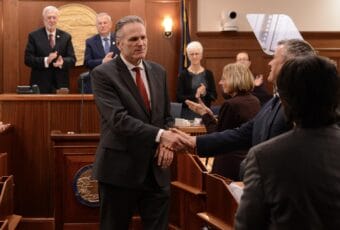
Lawmakers at the Alaska State Capitol would have to approve any changes to mining taxes. (Photo by Nathaniel Herz/Northern Journal)

When oil prices rise, the state of Alaska gets a windfall in taxes and royalties.

When gold prices rise — as they have, in dramatic fashion, this spring — state revenue barely ticks up.

Industry critics often draw this comparison, arguing that the huge mining corporations that operate in Alaska aren’t compensating the state enough for the minerals they produce.

Those minerals yielded just $28.5 million from Alaska’s mining license tax, on average, during each of the past four fiscal years.

In that same period, the state’s oil and gas industry paid an average of roughly $1.2 billion each year in production taxes, according to state figures.

“Essentially, Alaska is subsidizing a huge giveaway of its public resources,” an economist wrote in a 2022 report commissioned by the mining watchdog group SalmonState.

Mining boosters and some economists say simply comparing state revenue from oil production and that from mining can be misleading, given the huge scale and high profit margins of the petroleum industry. They also note that the value of Alaska’s oil and gas pumped from state land, where production is subject to royalties, dwarfs that of minerals mined from state land.

“Our world class oil fields — Prudhoe Bay, Kuparuk — are in fundamentally a different category,” said Dan Stickel, chief economist at the state’s revenue department.

Dan Stickel of the Alaska Department of Revenue testifies in front of the Alaska Senate Finance Committee on Friday, Jan. 20, 2023, at the Alaska State Capitol in Juneau, Alaska. (Photo by James Brooks/Alaska Beacon)

The market value of all the minerals produced in the state last year was roughly $4 billion, according to state estimates — though mining advocates say that number overstates actual value because mines sell the concentrate they produce at lower prices than pure metals. The total market value of oil produced on the North Slope was about $14 billion.

Even if the state raised taxes on mining companies, economists have long said the industry isn’t large or lucrative enough to make up for Alaska’s decades-long decline in oil revenue.

But the recurring question of whether miners should pay more has bubbled up again recently, with calls from newspaper publishers and environmental advocates to tweak the state’s mining tax and royalty policies to generate more income for Alaskans.

These suggestions have not translated into any formal proposals from elected officials. But they come as record gold prices promise to boost some of Alaska’s biggest mines, as more businesses apply for permits to mine in Alaska and as the state government navigates an ominous financial outlook.

The state uses a few tools to generate income from mining.

It levies a severance tax on minerals, called the mining license tax. It takes 3% in royalties from mining profits on state land. It rents mineral claims and leases. And, like other businesses, mining companies pay corporate income tax.

State agencies brought in an average of $90 million from those sources and various other taxes and fees, such as tolls on a state-owned ore haul road, each year between 2016 and 2021, according to state data.

That’s a fraction of the more than $2.5 billion in annual revenue that mining companies averaged during that period, according to state estimates.

Last year, the Red Dog zinc mine in Northwest Alaska reported more than $600 million in gross profits; Fort Knox, the state’s biggest gold mine, reported more than $300 million in profits after deducting operating expenses, according to corporate financial disclosures.

Proposals to generate more state revenue have focused on raising production royalties and overhauling the mining license tax — a maximum 7% levy on profits that hasn’t changed since 1955.

For large mines, the license tax is currently a $4,000 payment, plus 7% of net income over $100,000. New mines get a 3.5-year exemption.

By contrast, the state taxes oil at a base rate of 35% of net production value — the value of the oil produced minus certain capital and operating expenses — with tax credits that increase when oil prices fall.

Without knowing the taxable income of each mine and oil operation and exactly how much each owes in taxes — numbers that aren’t disclosed publicly — it’s difficult to compare the effective tax rate across each industry. The effective rate is the percentage of a company’s profits that it pays in taxes, and it’s a figure that economists often use to describe a company’s tax burden.

recent report on mining policy commissioned by the Alaska Conservation Foundation recommended restructuring the mining license tax so that it applies to a company’s overall income rather than being tied to profitability.

“We’re just giving away these precious metals and allowing these multinational corporations to dig them up,” said Dan Cannon, senior public lands coordinator at the Anchorage-based conservation organization. “What does the average Alaskan get from this? Not much.”

If the state kept the maximum rate at 7%, but taxed gross instead of net income, that would be a “very large tax increase,” according to Stickel, the state economist.

The state’s most recent revenue forecast assumes about $3.6 billion in gross mining income during the next fiscal year. Its forecast of $36.7 million in revenue from the existing, profit-based tax structure, would be similar, roughly speaking, to a tax on gross income at around 1%, Stickel said.

Even if revenue stayed steady, a gross income tax “would be more regressive – with tax due even when a mine is unprofitable and with a lower tax burden when there is higher income,” Stickel wrote. “What impact this structure would have on production and company decisionmaking is difficult to say.”

Industry representatives say raising taxes would make Alaska less attractive to miners and would thwart investment, potentially leading to decreased revenue in the long term.

“Alaska’s mining record does not show that we are a jurisdiction widely viewed as a low-tax environment where industry is flocking to invest,” trade group Alaska Metal Mines wrote in a recent paper responding to the report commissioned by the conservation foundation. “This is not a record that supports a significant increase in revenue obligations for the industry.”

A tax hike could make new mines too expensive to build and operating mines too costly to expand and keep in production, said Karen Matthias, director of Alaska Metal Mines. Costs are already higher in Alaska than other states because of its remoteness and lack of infrastructure, she added.

Kinross’s Fort Knox mine outside of Fairbanks. (Kinross photo)

In the past four years, Alaska’s annual mining license tax revenue ranged from more than $50 million to a loss of about $1 million. That loss, reported during the 2024 fiscal year, was caused by a shift in the timing of one-time tax filings and refunds, as well as by low base metal prices and high operating costs caused by inflation, according to Stickel.

Rents and royalties are a smaller fraction of Alaska’s mining related income and have recently amounted to just over $15 million in yearly revenue. Corporate income tax paid to the state by mining companies has averaged some $7 million over each of the past five years.

In all, mining accounted for just 0.2% of the state’s total revenue last year — a proportion that state officials expect to double this year.

With gold prices soaring, the revenue department forecasts mining license tax revenue to see a modest boost from the recent average of $28.5 million — reaching about $33 million this fiscal year and $36 million the following year.

The state won’t see a bigger bump because costs have gone up across the industry and not all metal prices are rising like gold’s, Stickel said.

Zinc prices, for instance, have fallen about 8% this year, potentially cutting into profits at Red Dog mine, a pillar of the state’s industry.

That mine also is often cited by industry supporters as an example of how mining stands out more for its impact on local and regional economies than on the state government.

Red Dog accounts for more than 80% of the Northwest Arctic Borough’s revenue through payments similar to taxes. It has also generated billions of dollars for shareholders of the Alaska Native corporation that owns the land where the mine sits, which receives a 40% royalty share of net profits.

Similarly, large mines are the biggest property taxpayers in the Juneau and Fairbanks areas.

“Where mining truly makes a difference in Alaska is regionally,” Matthias said. “Red Dog is to the Northwest Arctic Borough what the entire oil industry is to the state.”

Northern Journal contributor Max Graham can be reached at max@northernjournal.com. He’s interested in any and all mining related stories, as well as introductory meetings with people in and around the industry.

This article was originally published in Northern Journal, a newsletter from Nathaniel Herz. Subscribe at this link.

Lawmakers fail to override Gov. Dunleavy’s veto of school funding bill

Man speaking in crowded legislative chamber
Sen. Lyman Hoffman, D-Bethel, speaks on April 22, 2025 against the override of Gov. Mike Dunleavy’s veto of House Bill 69. (Eric Stone/Alaska Public Media)

Alaska lawmakers on Tuesday failed to override Gov. Mike Dunleavy’s veto of a bill that would have provided a $1,000 boost to basic per-student funding for public schools.

The combined House and Senate vote was 33-27, well short of the 40 votes needed to override Dunleavy’s veto. All but two members of the House and Senate’s Democrat-heavy bipartisan majority caucuses voted for the bill; all 25 members of the all-Republican minorities voted to sustain the veto.

Dunleavy vetoed the bill on Thursday, saying it didn’t include his preferred policy changes and that the bill’s $250 million price tag was too steep.

On that second point, chief Senate budgeter Sen. Lyman Hoffman, D-Bethel, said he reluctantly agreed, voting against an override. Hoffman acknowledged the need to boost funding for the state’s schools. Superintendents, parents, principals and business leaders have said for years that inadequate state funding has forced them to increase class sizes, slash beloved programs like sports and electives, and lay off staff.

But Hoffman said the state can’t afford a $1,000 increase right now given the worsening fiscal picture, driven in part by low oil prices.

“We need to take our heads out of the sand, look at the fiscal realities that we live in today and do what the people have sent us down here to do, to balance this budget,” Hoffman said.

Hoffman repeated a call for lawmakers to pass a series of revenue measures that he said would allow the state to fund schools appropriately. The largely Democratic Senate majority has backed three bills that would roll back oil and gas tax credits and expand corporate income taxes.

The head budgeter in the House, Rep. Andy Josephson, D-Anchorage, took issue with Hoffman’s view.

“I can’t go to my constituents and say this is just unaffordable, because it’s not. It’s just a question of will, that’s all,” he said.

Josephson said the $1,000 boost would cost just $77 million more than the state approved for public schools last year on a one-time basis. That’s a small fraction of the nearly $3 billion that the state has in savings.

Lawmakers fell seven votes short of overriding Dunleavy’s veto. (Gavel Alaska)

Status quo spending would leave the state hundreds of millions of dollars in deficit, and it’s unclear how lawmakers will resolve the shortfall. The state Constitution requires lawmakers to pass a balanced budget every year.

Senate Finance Committee co-chair Bert Stedman, R-Sitka, said before voting against the override that drawing from the state’s primary rainy-day fund, the Constitutional Budget Reserve, was not prudent with oil prices and financial markets in turmoil.

Stedman said he didn’t want to risk being forced to reduce school funding next year.

“The headwinds coming at the state over the next year or so look significant, more significant than they have ever looked in my 20 years here,” he said. “We are very concerned over the next year that we may have demands on our treasury that we have not foreseen.”

The top three sources of state revenue are investment earnings, oil taxes and the federal government, all of which are under pressure.

Stedman said lawmakers should focus on passing a minimum $680 boost in long-term funding, matching the one-time funding schools got last year. He said lawmakers should consider an additional “incremental” boost next year.

Minority Republicans were largely silent on the floor but echoed Stedman’s budget concerns in a news conference after the vote.

The veto — and the failed override — were expected. The Senate Finance Committee stripped out policy measures aimed at finding common ground with Dunleavy and avoiding a repeat of last year’s veto. The governor took to social media to call the new funding-only bill a “joke” and pledged to veto it. It passed with a one-vote majority in each chamber, and Dunleavy made good on his veto threat days later.

Sen. Bill Wielechowski, D-Anchorage, said Tuesday that senators thought at the time that the bill had a realistic chance of passing despite a veto from the governor.

“Before Gov. Dunleavy came out and called it a joke, we thought there were 40 votes there,” Wielechowski said, though it’s not clear where those votes would have come from.

Dunleavy applauded the failed override on social media Tuesday.

Lawmakers say they’ll keep trying

Gov. Mike Dunleavy proposed a $560 boost to basic education funding, the base student allocation, in a bill he announced alongside his veto. The bill also includes additional funding aimed at boosting correspondence homeschool and an incentive program that would reward school districts with large numbers of young students who read at grade level or demonstrate improvement.

Dunleavy’s bill also includes provisions that would change the appeal process for charter schools terminated by a local school board and an open enrollment policy that would allow parents to enroll their students in brick-and-mortar schools outside their home district.

Those provisions are already causing some heartburn from Senate leadership. Senate President Gary Stevens, R-Kodiak, said he worried they would take power from locally elected school boards.

“There are some things that we’re very concerned about,” he said, adding that he hoped to continue discussions aimed at finding common ground. He said he had not yet discussed Dunleavy’s new bill with the governor.

Lawmakers on all sides said they hoped to come to a compromise in the month left in the legislative session.

“It does feel like the wind has come out of the sails a little bit after this, after this override session, but we’ve still got time,” Wielechowski said. “Our schools are counting on us.”

Rep. Mia Costello, R-Anchorage and the House minority leader, said she looked forward to digging into the governor’s proposal to find a way forward.

“We just have to work through the process and I think work together in the last weeks of session in order to get the governor’s bill across the finish line,” she said.

Rep. Rebecca Himschoot, I-Sitka, the primary sponsor of the bill Dunleavy vetoed, said she thought the veto and failed override were “somewhat predictable, but that doesn’t make it any less disappointing.”

“I know that right now in every school district, personnel are being laid off, programs are being cut, families are asking themselves, ‘Is this what I signed up for when I decided I was going to raise my kids here in this state?'” she said. “So we have some work to do.”

Alaska House encourages school districts to limit students’ cellphones, with some exceptions

Rep. Zack Fields, D-Anchorage, speaks Friday, April 26, 2024, on the floor of the Alaska House of Representatives. (Photo by James Brooks/Alaska Beacon)

Legislation passed Wednesday by the Alaska House of Representatives would require the state’s school districts to adopt policies that restrict the use of cellphones by students during school hours.

House Bill 57, which will advance to the Senate after a 34-6 vote, does not require districts to ban students’ cellphones altogether but does require them to regulate students’ use of phones during regular school hours, including during lunch and the time between classes.

An earlier version of the bill would have required the Alaska Department of Education and Early Development to draft a model policy as an example for districts to follow, but that requirement was eliminated in a floor amendment.

The amendment also eliminated a requirement that school districts report their academic performance before and after the new cellphone policy.

Cellphones would be allowed for translation purposes, in emergencies, for medical reasons, and as needed for instruction.

Restrictions on cellphones in the classroom are growing in popularity across the country, and eight states — including Florida, California, Virginia and Indiana — have banned them altogether.

Every state except Nevada and Wyoming has proposed or is considering a statewide ban or restriction, according to a tally kept by the Associated Press. Some members of Congress are considering national legislation.

The bans come amid a broadening base of research that shows smartphone and social media use can contribute to negative mental health and poor academic achievement among students in grade school and high school.

Several lawmakers, including Gov. Mike Dunleavy, proposed legislation this year that would restrict cellphone use in schools.

HB 57, from Rep. Zack Fields, D-Anchorage, became the leading bill.

On April 11, Rep. Justin Ruffridge, R-Soldotna, proposed an amendment that rewrote the bill’s language to reflect a section of an education bill approved by the Senate Education Committee.

Ruffridge said he thinks Alaskans believe in local control of education.

“The language of Amendment No. 2 gives that ability to govern yourselves and be as strict or as permissive as possible at the district level,” he said.

Fields spoke against the amendment, saying it turned HB 57 from a cellphone ban into “a cellphone discouragement policy.”

The amendment passed on a 19-18 vote.

Five days later, when the bill came up for a final vote, Fields voted for it.

“The amendment adopted to this bill substantially weakens it,” Fields said. “I’m still going to vote for the bill and send it to the next body because I think there’s an opportunity to resurrect better language.”

Other legislators also stood up in support, offering anecdotal stories about the way cellphones have affected their children and children they know.

“Parents and our state are at war against these screens,” said Rep. Andrew Gray, D-Anchorage, speaking in favor of the bill.

A handful of legislators spoke against the bill, including Ruffridge, whose amendment significantly rewrote it.

Ruffridge said he supports giving local school districts the authority to make decisions like this.

“It’s not up to us to do,” he said.

Rep. David Nelson, R-Anchorage, said that there are plenty of reasons to be concerned about kids’ mental health, but that is a wider issue than just cellphones.

“If we’re going to be trusting young people and saying, ‘Hey, you are the future,’ why are we banning communication devices in public schools?” he said.

HB 57 is subject to a reconsideration vote on the House floor before it advances to the Senate, but legislators said they don’t expect the tally to change much, if at all.

The bill has been tentatively scheduled for a hearing in the Senate Finance Committee on Wednesday.

Alaska’s governor flew to Taiwan to sell LNG. China’s not happy.

Gov. Mike Dunleavy and other state of Alaska officials pose for a photo with Taiwan President Lai Ching-te, center, and other government officials during Dunleavy's trip to Taiwan last month.
Gov. Mike Dunleavy and other state of Alaska officials pose for a photo with Taiwan President Lai Ching-te, center, and other government officials during Dunleavy’s trip to Taiwan last month. (Taiwan Office of the President photo)

JUNEAU — Republican Gov. Mike Dunleavy flew to Taiwan last month to pitch business and government leaders on Alaska’s state-sponsored liquefied natural gas export project.

The same day Dunleavy and other Alaska officials arrived in Taipei on the unannounced trip, his office received an email from China’s vice consul in San Francisco, Ba Yanfeng. The consulate was aware that Dunleavy was leading a trip to the “province” of Taiwan, and Chinese government officials wanted a meeting with his chief of staff, Ba said.

Dunleavy had stepped into a simmering geopolitical conflict — an issue that China’s government describes as the most important and sensitive in its relationship with the U.S.

China claims Taiwan as its own territory and regularly conducts military drills nearby — including some that have simulated blockades and involved firing missiles over the island.

The U.S. doesn’t officially recognize Taiwan’s independence. But it’s a longtime ally, sells arms to the government and has committed in legislation to support the island’s defense.

Taipei is Taiwan's largest city.
Taipei is Taiwan’s largest city. (Nathaniel Herz | Northern Journal)

In a formal follow-up note, the Chinese government said Dunleavy’s trip “sends a very wrong signal to the ‘Taiwan independence’ separatist forces,” and it urged the governor “to correct such mistakes and avoid their recurrence.”

But Dunleavy, in an interview, said he was undeterred.

“I don’t allow myself to get pushed around by too many entities or people,” he said.

Alaska does significant trade with China, namely in seafood products, though that’s diminished since President Donald Trump began levying tariffs during his first term. Still, Alaska exports more than $500 million in seafood products to China each year.

But amid China’s broader, ongoing trade war with America, experts said it’s unlikely that the country will target Alaska with retaliatory action even if the LNG project moves forward with Taiwanese partnership.

“I think this is probably fairly low on China’s list of priorities. They have a lot on their plate,” said David Sacks, an expert on Taiwan and China and a fellow for Asia studies at the Council on Foreign Relations.

Sacks described the Chinese correspondence with Dunleavy’s office as “pretty pro forma,” even if it sounds strident. He also said there’s nothing unusual about an American governor or legislator traveling to Taiwan — and he noted that other states, like Arizona, have done robust business with Taiwanese firms without prompting a backlash from China.

“I think it would be fairly unprecedented for the Chinese to take aggressive action here that specifically targets Alaska,” he said.

Dunleavy’s trip to Taiwan last month came amid a new push by his administration to recruit investment in the $44 billion LNG development. Top Trump administration officials have also been touting the project to Asian allies, and a private firm, Glenfarne, has taken over leadership of the development from a state agency.

Dunleavy’s trip also included stops in Thailand, South Korea and Japan, where he met with politicians and corporate executives.

But his Taiwan visit garnered the most headlines. In Taipei, Dunleavy met for an hour with President Lai Ching-te and held a lunch with the vice president, according to his schedule. He also met with officials from Taipower, the country’s primary electric utility, and from the state-owned oil and gas company, CPC.

Alaska Gov. Mike Dunleavy shakes hands with Taiwan's president, Lai Ching-te.
Alaska Gov. Mike Dunleavy shakes hands with Taiwan’s president, Lai Ching-te. (Taiwan Office of the President photo)

CPC has signed a nonbinding letter of intent to buy one-third of the LNG produced by the Alaska project, and the letter also contemplates investment in the development, according to a description by officials from the state’s gas pipeline agency. The letter itself is confidential, according to the agency.

Promoters of Alaska’s LNG project, including Dunleavy and Republican U.S. Sen. Dan Sullivan, say that investment in and purchases of gas from the development can provide Asian allies with a secure source of fuel — with a shorter transit time than shipments from the Middle East. Importing Alaska gas would also lower Taiwan’s trade deficit with the U.S., which could curry favor with Trump.

But it’s still far from certain that the project will be built. Alaska’s government has spent decades studying construction of a gas line, and the current iteration of the project has been dogged by projected high costs.

Taiwanese investment in the project, and any American engagement with the island’s government, also risk pushback from China.

In a prepared statement to Northern Journal, the spokesman for China’s embassy in Washington, D.C., Liu Pengyu, called Taiwan “an inalienable part of China’s territory” and urged “the relevant U.S. side” to cease all forms of official contact with Taiwan.

“China firmly opposes any form of official interaction between the United States and Taiwan, under any pretext or in any capacity,” the statement said.

Dunleavy, in the interview, said he did not know how the Chinese government became aware of his visit to the island.

They “wanted me to abort the trip, apparently,” he said.

Dunleavy would not directly say whether he recognizes Taiwan’s sovereignty, calling that “the biggest loaded question.”

“These are human beings, 23 million people. They would like to have a great relationship with the United States,” he said. “We want to sell energy. They want energy. I’d love to partner.”

Alaska has a long history of trade with Taiwan, and other state officials have traveled there in recent years, including two state senators in 2024. Former Gov. Frank Murkowski has visited more than a dozen times, including as an observer of one of Taiwan’s presidential elections.

The Chinese response to Dunleavy’s trip, first reported by conservative news site Must Read Alaska, is “pretty boilerplate,” said Sacks, the expert from the Council of Foreign Relations.

But its “ominous” language could also be an attempt by the Chinese to ward off business dealings in Taiwan by an American official who’s not well-versed in the island’s tense political dynamics, Sacks added, in comments that were echoed by a statement from the U.S. Department of State.

“Around the world, including in the United States, the Chinese Communist Party attempts to leverage economic and diplomatic pressure to try to prevent officials from interacting with Taiwan,” the statement said. “Robust cooperative activities with Taiwan, including by state leaders, are consistent with U.S. policy.”

The statement added that the letter of intent from CPC “is another example of the longstanding, deep, and growing trade and investment ties between the United States and Taiwan, which create American jobs and mutual prosperity.”

Sacks said he sees the LNG project as being in America’s interests — both because of its potential to reduce Taiwan’s trade deficit and to give its people a more reliable supply of energy.

But while Sacks described the risk of repercussions to Alaska as low, he also wouldn’t completely rule them out. He pointed to a recent move by China instructing the nation’s airlines to stop accepting deliveries of jets made by Boeing.

“The context might change now, because the Chinese are looking for ways — in a way that they weren’t before — to punish the Trump administration for the tariffs,” Sacks said. “I wouldn’t foreclose that.”

Nathaniel Herz welcomes tips at natherz@gmail.com or (907) 793-0312. This article was originally published in Northern Journal, a newsletter from Herz. Subscribe at this link.

Education bill veto leaves Alaska school leaders disappointed, frustrated and confused

More than 30 Unalaska students march from the Unalaska City High School toward City Hall in support of a boost to education funding on April 11, 2025. (Lucy Bagley/KUCB)

Gov. Mike Dunleavy vetoed an increase to school funding on Thursday, saying the bill was too expensive and didn’t include policies that he said would bolster school choice and improve student performance.

Instead, he proposed a smaller funding and policy package for schools.

It’s the latest development in a yearslong saga. Lawmakers and Dunleavy for years have struggled to come to terms on the state’s first substantial boost to long-term funding in nearly a decade.

Alaska Public Media spoke with school leaders from Ketchikan to Kotzebue on Friday to hear their thoughts on the news. Here’s what they had to say.

‘It’s our students that are going to lose out’

There were some themes.

“My reaction was, once again, disappointment,” Unalaska City School District Superintendent Kim Hansich said.

“I think frustration is the word I’m going to choose here,” said Ketchikan High School principal Rick Dormer.

“Frustrating and a little bit confusing,” said the president of the Anchorage School District board, Andy Holleman.

“It’s our students that are going to lose out,” Northwest Arctic Borough School District Superintendent Terri Walker said.

Walker leads a district based in Kotzebue with 12 schools spread out over a land area about the size of Virginia. Each of those schools, she said in a phone interview, is the center of a community.

“Everything happens in that building, weddings and funerals and meetings, because it’s the … largest place for gathering for the whole community,” she said.

They’re also a haven for often under-resourced communities in times of crisis, she said.

“Oftentimes, many of the villages have catastrophes. Floods, the electricity goes out, their housing freezes up,” she said. “And the school is a safe place to go.”

The veto of House Bill 69 — and the ongoing uncertainty around funding for schools across the state — means her schools’ ability to continue to serve as community hubs is at risk.

Schools in Walker’s district keep their lights on from the early morning late into the evening in recognition of their roles as community gathering places, she said. But costs have skyrocketed. At least 38% of her district’s budget goes to utilities, she said.

“The cost of buying fuel, the electricity bill, water and sewer, it’s gone way up in the last few years,” she said.

Schools have gotten infusions of one-time funding in recent years. But lawmakers and the governor failed to come to terms on a long-term funding boost.

That means Walker is looking at deep cuts to core programs, student activities and even second helpings at meals for hungry students.

“We are really cut to the bare bones right now,” she said. “Chipping at the bones, actually.”

Walker said she’s disappointed that the governor vetoed a bill that would boost basic per-student funding, the base student allocation, by $1,000. She said the $560 increase Dunleavy proposes in a new bill he announced Friday — less general-purpose funding than lawmakers approved in one-time funding last year — won’t stop the bleeding.

“That does not cover half of the deficit that we are looking at,” she said.

In Fairbanks, Superintendent Luke Meinert said that even with status quo funding, equivalent to a $680 increase this year in the base student allocation, his district is bracing for deep cuts. Three elementary schools and 160 staff members are on the chopping block, he said.

“That is on top of devastating cuts that Fairbanks has had to work through in the last several years,” including the closure of seven schools last year, Meinert said.

Jomo Stewart, the president of the Fairbanks Economic Development Corp., said the community’s struggling education system is putting the future of its economy at risk.

“If you have the choice of living in a place (or) staying in a place that has a high quality, well-funded, well-supported educational system, and one that either doesn’t or looks suspect, you will choose the better one,” he said. “So making the proper investments in our educational system, and I mean from pre-K through university, is important.”

According to a report from Stewart’s organization, though the community’s population grew by 0.7% from 2019 to 2023, that’s due largely to an influx of seniors.

The number of elders grew 23% over that period. Meanwhile, school enrollment dropped 6% and the number of working-age adults and school-age children dropped by 2%.

‘We don’t actually understand what the strategy is’

In the state’s largest school system, the Anchorage School District, school board President Andy Holleman said leaders are waiting anxiously to see where school funding lands. He said Anchorage, like districts around the state, is also steeling itself for cutbacks.

“We’re starving a little bit, and there’s not much food on the table to begin with,” he said.

The veto was not unexpected. Lawmakers had been working with the governor on a compromise before negotiations appeared to fall apart.

Though lawmakers in the Democrat-dominated caucuses in control of the House and Senate say they’d like to increase funding with a standalone bill, Dunleavy has said again and again that any funding increases should be tied to policy measures that improve the state’s school system.

Senators stripped out policy measures aimed at avoiding a repeat of last year’s education bill veto shortly before the House and Senate approved the bill. The governor called it a “joke” and pledged to veto the bill before the final version even passed. The co-chairs of the Senate Finance Committee, which stripped out the policy provisions earlier this month, voted against the bill’s passage, saying it was too expensive.

Holleman’s not expecting any surprises in an upcoming veto override vote. The bill passed with a one-vote majority in each chamber. It takes two thirds to override. Even supporters say they’re pessimistic about the override’s chances.

Holleman said he’s just fed up with the politics of it all.

“We don’t actually understand what the strategy is,” he said.

He said he’s also not sure whether the governor’s new proposals — which include easing the process of creating and maintaining charter schools, allowing parents to enroll students outside their home district and requiring districts, and placing a new emphasis on growth-based testing — will truly improve student achievement.

There’s also what’s not in the bill. Dunleavy took issue with a provision inserted into a prior version of the bill that would have required correspondence homeschool students to take state assessments to access public funding.

“What they’re calling accountability is confusing to me,” he said.

Holleman stressed that he was speaking on his own behalf, not for the board. But he’s not the only Anchorage School District board member concerned.

Another one, Kelly Lessens, emailed a chart: with the governor’s proposed increase in basic funding, the Anchorage School District is going to need to find more than $31.2 million in cuts from a $71 million budget amendment identifying programs and staff that would be restored with a $1,000 increase in basic per-student funding.

Ketchikan High School Principal Rick Dormer said he was also dismayed by the back-and-forth that culminated in Thursday’s veto.

“A lot of us were kind of holding our breath,” he said. “And then the governor steps in as one person, … and just says, ‘No, I have a different plan. We’re going to do less funding, and what we’re going to do is a lot of my own personal ideas.’ That’s hard to stomach.”

‘I want them to explain why this is an OK business model’

Dunleavy isn’t just proposing $560 in basic funding. He’s also proposing $35 million in what he calls “targeted” funding — an increase in formula funding for correspondence homeschool, plus an incentive program that would provide a boost for each young student who performs well on literacy assessments. Dunleavy is pitching the total package as equivalent to a $700 base student allocation increase.

But school leaders like Deidre Jenson, the superintendent in Sitka, say that leaves them with a lot of questions.

“Does that mean that we’re going to get it beforehand because we’ve had good scores, because we’ve shown growth? Well, what does it mean for the ones that have been doing all these cuts and they’re not making as good growth?” she said.
“Like, it’s just, what does it mean?”

The one-time funding boosts lawmakers have approved in recent years have not come until the end of the legislative session in late May, weeks or months after school districts have built their budgets.

That leaves districts flying blind, uncertain how much money they’ll receive in the next year, school leaders said. Instead, school boards take guesses on where they think the political football will land.

Some are planning around no increase in long-term funding. Others are budgeting for a $680 boost to the base student allocation, equal to the funding lawmakers approved on a one-time basis last year.

“They want change and incentives to make growth better. You need to give us the money, and then maybe we can do our job,” Jenson said. “Right now, we can’t do the job, because we’re just trying to figure out our budgets and who to cut and where to cut and what not to cut.”

Dormer, the Ketchikan High School principal, said he’s frustrated at the uncertainty over education funding. He recalled his time working in the private sector, including for businesses like Hewlett-Packard and Nike.

“None of them run a business like this. And they make shoes!” he said. “We’re working with people’s children. I have children in Alaska’s schools today. Like, I want them to explain why this is an OK business model and a funding model for people’s children.”

Dormer, echoing other school leaders interviewed for this story, said he wants lawmakers and the governor to work together to figure out a way forward in the 30 or so days left in the legislative session.

“We have leaky roofs and broken boilers. I mean, it’s just degrading,” he said. “I know that’s not what Alaska’s people want.”

Bill seeks to cover fewer workers with paid sick leave recently approved by Alaska voters

Joelle Hall, president of the Alaska AFL-CIO, and other advocates carry boxes of signed petitions for a pro-labor initiative for delivery to the Alaska Division of Elections on Jan. 9, 2024. Voters passed the initative in November. To go into effect on July 1, it increases workers’ minimum pay, mandates paid sick leave and ensures that workers are not required to hear employers’ political, religious or anti-union messages. Hall said she and others who campaigned successfully for the intiative will fight efforts to change the provisions for paid sick leave. (Photo by Yereth Rosen/Alaska Beacon)

Alaska’s voter-approved mandate for paid sick leave has not yet gone into effect, but some lawmakers are already trying to reduce the number of workers who would benefit from it.

A bill pending in the Alaska Legislature, House Bill 161, would exempt businesses with fewer than 50 employees, a change from the 15-employee threshold in the labor-rights initiative that voters approved in November. The bill would also drop seasonal workers from the mandate for accrued paid sick leave. The bill was introduced on March 28 by Rep. Justin Ruffridge, R-Soldotna, with Rep. Julie Coulombe, R-Anchorage, as a co-sponsor. Both are members of the House minority. It has the support of a key majority member; House Majority Leader Chuck Kopp, R-Anchorage, signed on as a co-sponsor on April 14.

It addresses Ballot Measure 1, a three-part citizen initiative that will raise Alaska’s minimum wage and protect workers against any employer-imposed political or religious meetings, as well as mandate paid sick leave, based on time accrued over work periods. Voters approved Ballot Measure 1 by a 58-42 percent margin. The new law is set to go into effect on July 1.

Ruffridge and Coulombe, during the bill’s first hearing on Wednesday, described the proposed changes as modifications that fit within the state constitution’s limits. While the constitution forbids sweeping changes within two years to any voter-passed initiatives, the bill “in no way seeks to repeal or change some of the key provisions of Ballot Measure 1,” chiefly the minimum-wage hike that was probably the most popular element, Ruffridge told the House Labor and Commerce Committee.

Coulombe said the changes amounted to a “few tweaks” that are necessary to help small businesses.

“What will happen if we don’t try to amend this a little bit, make the language a little cleaner and make it more adaptable to small businesses, we have small businesses that might actually just go out of business,” she told the committee.

The bill has the enthusiastic backing of the Alaska Chamber, a business group that campaigned against the ballot measure.

In testimony at Wednesday’s hearing of the House Labor and Commerce Committee, Kati Capozzi, the chamber’s president, called it a “vital correction” to a pending mandate that burdens small businesses, especially in the tourism and hospitality sectors.

“Maybe well-intentioned or maybe not, Ballot Measure 1 introduced a one-size-fits-all mandate that failed to account for Alaska’s unique economic landscape,” she said.

Echoing earlier comments by Ruffridge and Coulombe, Capozzi said voters were less aware of Ballot Measure 1’s sick-leave provisions than they were of the wage hike. “It’s become clear that many voters did not understand the true and full implications of the ballot measure,” she said.

One of the leaders of the Ballot Measure 1 campaign vowed to work against House Bill 161.

“For me, it’s really important that the voters will be respected here,” Joelle Hall, president of the Alaska AFL-CIO, said Thursday. “The voters have made this choice. The voters have said, ‘We would like this to happen.’ And whether or not the business groups can use a smaller group of people, the Alaska Legislature, to try to undo their will — that is something we will fight.”

Hall disputed the bill sponsors’ characterization of the changes as minor.

“This, in my mind, is a substantial change. It is repealing the benefit that the voters voted for,” she said.

She also disputed the contention that voters had not paid attention to the sick-leave provisions in the initiative.

“That is just silliness, because we were very clear that it was earned sick leave,” she said. “Almost all of our advertising was about that, so almost every single ad we put out was about somebody’s earned sick-leave benefit.”

She said she was expecting some pushback on the bill’s provisions, but not this soon.

“It’s a little bit shocking to me that it’s such an aggressive overreach of what the voters passed,” she said. “I’m not surprised that they’re going to fight us on this tooth and nail every single session, to try to claw it back. I’m a little surprised they’re starting before it’s even a law.”

Alaska was not the only state where voters in November approved a mandate for paid sick leave. Similar initiatives passed in Missouri and Nebraska.

Several other states already required paid sick leave prior to last year’s election.

Site notifications
Update notification options
Subscribe to notifications