Health

In third week of trial against former Juneau chiropractor, judge declares two charges a mistrial

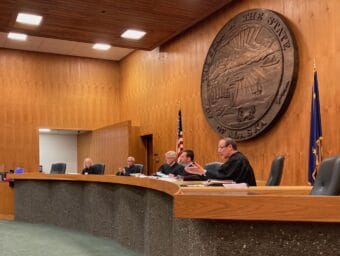
Judge Larry Woolford in the Dimond Courthouse in Juneau on August 14, 2025. (Photo by Yvonne Krumrey/KTOO)

Friday marked the end of the third week of a sexual assault trial against former SEARHC chiropractor Jeffrey Fultz, who stands accused of abusing patients in Juneau between 2014 and 2020. 

Presiding Judge Larry Woolford declared a mistrial Wednesday for two of the 16 sexual assault and harassment charges. Fultz will continue to stand trial for the remaining 14 charges.

The mistrial happened because a witness testified that she had experienced misconduct from Fultz beyond what she had previously testified to on record. The witness is an alleged victim of sexual assault and has not been publicly identified outside of the courtroom. KTOO is not identifying her in this story.

Woolford ruled that state prosecutors withheld information from the court and Fultz’s attorneys, which then came up in the witness’s testimony in front of jurors.

“After an objection by the defense, it became clear that the prosecution knew of [the witness’s] allegation at least as early as the day before her testimony in court but intentionally withheld the allegation from the defense,” Woolford’s order states.

The jurors have been told to disregard that witness testimony.

Fultz’s defense attorney James Christie said the prosecutors intentionally withheld the witness’s disclosure. 

“We are entitled to have all of the evidence that is in the state’s possession ahead of time,” he said. “There’s no question about that.” 

Former Juneau chiropractor Jeffrey Fultz sits during his sexual assault trial in Juneau on Wednesday, July 30, 2025. (Photo by Yvonne Krumrey/KTOO)

Prosecutor Krystyn Tendy said she thinks Woolford’s ruling is assuming that the prosecutors had bad intentions. 

“The state disagrees with the characterization of the bad faith analysis that the judge conducted,” she said.

The charges can be retried if state prosecutors choose to pursue them again. Tendy said they are still deciding how to move forward with these charges. 

This week, the court also heard from two people who have been mentioned a lot in the trial so far — two medical providers that worked with Jeffrey Fultz in SEARHC’s physical therapy department at the time of the alleged crimes.

The women accusing Fultz of assault repeatedly contrasted Fultz’s treatment — the amount of touching, the places he touched, and the way he encouraged them to take their clothes off — with the treatment they received from these two providers. 

Emily Haskell is a physical therapist who worked in SEARHC’s physical therapy department. The prosecution asked how she approaches patients with a history of sexual trauma — something a few of the alleged victims told Fultz they experienced.

“I think especially if someone has had experienced sexual or interpersonal trauma, I think I was a lot more cautious with if I was going to touch them,” Haskell said. “Probably a lot more cautious with asking them to, you know, pull their shirt down to look at their shoulder, or pull their pant leg up, or something like that.”

Haskell said she doesn’t give massages to patients in the course of her physical therapy treatments.

“Because it really is not within the scope of practice of physical therapy. I’m trying to find, like, dysfunctional or painful spots in muscles, sometimes a whole muscle itself,” she said. “But I think of massage therapy as like a more broad and less direct approach to managing muscle tension.”

A massage therapist with SEARHC, Amanda James, also worked with some of Fultz’s patients. 

She said she would work with patients on their comfortability level with covering their bodies.

“If you’re not comfortable taking off certain clothing, or any, that’s okay,” James said she told patients. “I can work over the sheets.”

James said she wouldn’t ask a patient to disrobe fully to treat upper body issues. She said she always does work on the glute muscles over sheets and as a rule, doesn’t work on muscles in the groin area. 

Fultz’s defense asked James if any of the alleged victims she treated complained to her about their treatment with Fultz. She testified that they did not.

The trial was scheduled through Friday, but it’s continuing into another week. The state has called about two dozen witnesses — each alleged victim, partners of complainants, medical experts, former SEARHC employees and one Juneau police detective. The state rested its case Friday. 

The defense began calling its witnesses Friday. The trial is expected to wrap up at the end of next week.

More women testify in trial against former Juneau chiropractor

Former Juneau Chiropractor Jeffrey Fultz and his defense team at the Dimond Courthouse in Juneau on Thursday, July 31, 2025. (Photo by Yvonne Krumrey/KTOO)

This was the second week of testimony in the trial against Jeffrey Fultz, a former Juneau chiropractor who is accused of assaulting more than a dozen women under the guise of medical care. 

This week, the jurors heard from more complainants — alleged victims. Thirteen women have accused former Juneau chiropractor Jeffrey Fultz of touching them inappropriately and without their consent while they sought treatment for pain and injuries. As of Thursday afternoon, we heard from most of them. 

They testified that they felt discomfort during their appointments. Some said their experiences with Fultz caused them to avoid medical care later. 

Rebecca Parkey testified on Friday. She worked at Southeast Alaska Regional Health Consortium and saw Fultz for treatment of recurring migraines. She said she was uncomfortable with the way he touched her, but she assumed he must have been acting within the bounds of medical care. She kept going back to treat her pain.

“Every time I walked down the hill, I kept questioning myself, like, ‘what are you doing?’” Parkey said. “‘Why are you going back?’ And then I would argue with myself, like, stop being crazy.”

Defense attorney James Christie asked Parkey to compare her care with Fultz to that of other chiropractors and massage therapists she’s seen, including when she lived in Missouri. 

“And the chiropractor in Kansas City, who you really liked, they didn’t do massage therapy? Well, your chiropractor, I mean?” Christie asked.

“No, because he wasn’t a massage therapist. And technically, neither was Jeff,” Parkey said.

Tori Talley, another woman who testified, was in her early 20s when she was treated by Fultz. She said he touched her in sensitive places, making her very uncomfortable. But like Parkey, she doubted herself. 

Prosecutor Jessalyn Gillum asked Talley if Fultz asked for permission or warned her that he would touch those areas.

“Do you remember if at any point the discussion of touching sensitive areas of your body — did that ever come up with Mr. Fultz prior to that last appointment, when he was doing the massage?” Gillum asked.

“No,” Talley said.

“Did you give any consent to that part of your body being touched, even for medical purposes?” Gillum asked. 

“Absolutely not,” Talley said.

Talley said experience with Fultz caused her to avoid all medical care in general.

“I took a break from seeing anyone at SEARHC and a long break from physical therapy,” she said. 

“How did that affect your symptoms, if at all?” asked Gillum.

“I definitely had a lot more headaches, and I stopped seeing all providers, and I developed really bad anxiety, and I developed a panic disorder, and not being able to see my providers,” Talley said.

During cross-examination, Fultz’s lawyers pointed out that Talley had anxiety and panic disorders before seeing Fultz. She said they escalated after her experience and break from medical care. 

Marcy Sowers was a Fultz patient in 2014. She said she worried at the time that confronting him or avoiding physical therapy appointments with him could jeopardize her ability to access health care in the future. 

“Your PT was linked in with your compliance with everything else,” she said.

Defense attorney Wally Tetlow quoted her telling the police years ago that she would have acted if Fultz was being inappropriate.

“Did you say you would have run to [Juneau police] quicker than quick if Fultz touched you inappropriately? He never crossed the line with anything inappropriate did he?,” he asked. 

“He flirted with the line,” Sowers said.

On the stand, Sowers said that now she thinks about the women who say they were harmed by Fultz years after she was. She initially reported him to Indian Health Services. She wonders if things would have been different for them if she reported it to police then.

Proceedings are scheduled to continue for at least one more week. 

Correction: this story has been updated with more information about Marcy Sower’s reporting process and with the correct prosecutor’s name. 

State health official says Alaska will be spared from some national Medicaid cuts

Application for Medicaid for Alaska Residents. (Rachel Cassandra/Alaska Public Media)

Medicaid coverage throughout the country will change starting in 2027 due to President Donald Trump’s “Big Beautiful Bill,” which the U.S. Congress passed in July. But in Alaska, experts say those changes will look very different from other states.

Emily Ricci, the deputy commissioner of Alaska’s Department of Health, spoke about what the state can expect with the new Medicaid rules Wednesday on the program “Line One.” She said Alaska’s federal match for funding the insurance program won’t change because it doesn’t rely on two funding mechanisms impacted by the bill.

“Alaska is not impacted by reductions to those programs that were contained in the reconciliation bill,” Ricci said. “And that’s important to understand, because every other state will likely experience some form of reduction in the kind of federal share of Medicaid dollars that is going to their state associated with those two programs.”

In 2024, the federal government paid about three-quarters of Medicaid spending in Alaska overall. It’s health insurance for people who are low-income or disabled.

Ricci said one major change is that some able-bodied adults on Medicaid will need to fulfill so-called “community engagement requirements” to keep their coverage. She said a variety of activities will be allowed.

“They include things like education, so being a student, being in a vocational school or technical school,” she said. “They involve volunteering, and they also involve employment. There’s also opportunities that are in the bill for individuals who engage in seasonal employment.”

She said community engagement requirements won’t apply to several groups of people like pregnant people, people who are Alaska Native or American Indian or parents with young children under 13. She said communities will also be able to apply for “hardship exemptions” if they have high enough unemployment rates.

RFK Jr., on visit to Anchorage, casts doubt on mRNA vaccines

A man in a suit attends a press briefing
Secretary Robert F. Kennedy, Jr. spoke to reporters at Alaska Native Tribal Health Consortium on Aug. 5, 2025, the same day he canceled nearly $500 million for mRNA vaccine development. (Matt Faubion/Alaska Public Media)

U.S. Health and Human Services Secretary Robert F. Kennedy Jr. on Tuesday canceled projects worth nearly $500 million for vaccine development using mRNA technology. He defended that action while speaking at the Alaska Native Tribal Health Consortium.

“The mRNA vaccines, we know from COVID, don’t work against upper respiratory infections,” he told reporters. “They don’t work very well — Let me put it that way.”

Kennedy is a long-time skeptic of the scientific consensus on vaccines. Reports published in peer-reviewed journals have found COVID-19 vaccines, using mRNA technology, to be highly effective. Kennedy said mRNA vaccines might be useful for cancers and diseases other than respiratory infections.

Alaska’s U.S. senators flanked Kennedy as he spoke. Both voted to confirm him in February, though Sen. Lisa Murkowski said at the time she was concerned about his “selective interpretation of scientific studies.” She said Tuesday she didn’t agree with some of his actions, such as dismissing the entire Advisory Committee for Immunization Practices and installing new members, some with controversial views.

“I am a strong believer that vaccines save lives,” Murkowski said, “as I believe the secretary himself has stated.”

(From left) U.S. Sen. Dan Sullivan, U.S. Health Secretary Robert F. Kennedy, Jr. and U.S. Sen. Lisa Murkowski speak to reporters at the Alaska Native Tribal Health Consortium on Aug. 5, 2025. (Matt Faubion/Alaska Public Media)

Kennedy, as secretary, has sometimes spoken of vaccines as a crucial public health tool but also undermined their credibility.

He just happened to be in Anchorage on the day his agency announced he was canceling mRNA vaccine development contracts. It’s the season for cabinet secretaries to visit Alaska, and the secretaries of Homeland Security, Housing and Transportation are coming next week, Sen. Dan Sullivan explained.

“We have a lot of people — a lot of cabinet officials, sub-cabinet officials, admirals, generals — that we’re going to be hosting in Alaska in August,” he said. “It’s an exciting time.”

Unlike most cabinet members, Kennedy has visited Alaska many times. He came in years past to campaign for environmental causes. He also says he feels committed to carry on the work of his father and uncle, Sen. Ted Kennedy, to improve the lives of Indigenous people.

Outside the building, Susan Soule was among several dozen people who came to protest Secretary Kennedy.

“My sign says, ‘Respect the science. Vaccines save lives.’ That’s why I’m here,” she said. Kennedy, she said, “has not given any sign that he respects science. He’s killing people by what he’s doing to vaccines and the research.”

The medical campus where Kennedy spoke has for years championed vaccines to improve community wellness. In late 2020, the Alaska Native health care system led the rest of the state on COVID-19 vaccination.

Susan Soule was among the protesters outside the Alaska Native Tribal Health Consortium on Aug. 8, 2025. Health Secretary Robert F. Kennedy, Jr. “is killing people by what he’s doing to vaccines and the research,” she said. (Matt Faubion/Alaska Public Media)

Witnesses begin to testify in the sexual assault case against former Juneau chiropractor

Former Juneau chiropractor Jeffrey Fultz sits during his sexual assault trial in Juneau on Wednesday, July 30, 2025. (Photo by Yvonne Krumrey/KTOO)

Content warning: This article includes mentions of sexual assault and abuse that may be uncomfortable for some readers. Resources are available at the bottom of this post.

The trial against former Juneau chiropractor Jeffrey Fultz, accused of assaulting more than a dozen women under the guise of medical care, is underway. KTOO reporter Yvonne Krumrey breaks down the first few days of witness testimony with reporter Clarise Larson. 

Listen:

Clarise Larson: Where are we in the trial now?

Yvonne Krumrey: After two weeks of jury selection and Tuesday’s opening statements, the trial is now really in full force. That means we are starting to hear from expert witnesses and alleged victims. This will likely be the bulk of the next two weeks: both the state prosecutor and Jeffrey Fultz’s defense team will be using these witnesses to try and establish their side of the story.

Clarise Larson: Tell me more about the opposing sides. What did the attorneys say during opening statements? 

Yvonne Krumrey: The state is arguing that Fultz used his position as a medical provider at Southeast Alaska Regional Health Consortium to gain access to vulnerable women and assault them when they sought medical care.

This is state prosecutor Jessalyn Gillum:

“We are here because the defendant engaged in sexual contact with his patients under the guise of legitimate medical treatment,” she said. “He violated their trust and he violated their bodies. ” 

The state points to repeated testimony from witnesses who say Fultz touched them in a sexualized way and in sensitive places without reason or consent, and denied them appropriate coverings during treatment.

The defense team argues that Fultz was giving appropriate medical treatment, and that the women who accused him didn’t express their discomfort at the time. 

“The evidence in the case is going to show that during legitimate medical treatment, Dr. Fultz did make contact with sensitive areas of the body, but he did not make any contact with sensitive areas of the body without consent,” said defense attorney Wally Tetlow.

He also said that the former investigator for this case — a Juneau police officer who died in 2023 — led the women to the conclusion that they were assaulted. 

Clarise Larson: Okay, so who have we heard from since those opening statements?

Yvonne Krumrey: Tuesday and Wednesday we heard from Dr. James Lehman, an expert witness called by the state. He’s a doctor and professor at the University of Bridgeport School of Chiropractic. Attorneys asked him about a whole lot of specific medical treatments. Remember, this case is about medical treatment and whether it was appropriate or abuse. 

The state asked Dr. Lehman about what areas are appropriate to touch based on what treatment the women accusing Fultz requested.

“Are you aware of any legitimate chiropractic or any legitimate chiropractic treatment that requires a practitioner to make direct contact with the breast or vulva of a patient who comes in complaining of generalized back pain?” asked Krystyn Tendy.

“No,” Lehman said.

This went on for about two minutes, as the prosecutor asked about other medical conditions the women sought treatment for. The answer was always no. 

In cross-examination, the defense showed Dr. Lehman charts that show that tension muscles and tissue in the chest area can impact muscles down the arms. And that treating the chest area can be appropriate for treating other pain elsewhere in the body.

The state then asked Dr. Lehman about informed consent – something the women claim Fultz did NOT do before touching sensitive areas.  

“You explain to the patient what you’re going to do, why you’re going to do it, and what they should expect the outcome to be, make certain that they understand it and they approve of your proceeding,” he said.  

Clarise Larson: And I know witnesses and alleged victims were expected to speak this week. Has that happened?

Yvonne Krumrey: Yes, Wednesday and Thursday we heard from Christina Love. The court is now using alleged victims’ full names but we are only using ones who have given us permission. Love has given us permission to use her full name.

She testified about how her experiences with Fultz got progressively more uncomfortable and how different they were from other SEARHC providers she saw.

Love said initially things were comfortable but his behavior started to change [after a few years]. He walked in on her changing. He gave her a covering that was too small.

He began touching her in places she wasn’t comfortable with, without permission, and moved her hands away when she tried to cover these areas. 

She began requesting other providers, but would only get scheduled with Fultz, who she understood to be in charge of appointments. And the weird behavior escalated. 

“I trusted him,” she said. “I was so mad and betrayed. I felt betrayed by myself that I should have known.”

Love reported it to AWARE, who called JPD, and from there, the criminal investigation into Fultz began. Her testimony dug into that process as well.

Fultz’s attorney James Christie questioned Love next. He asked about her previous testimony  earlier in the case and questioned her memory. He also pointed out her lack of experience with medical treatment.

“We can agree that you have no training as a chiropractor,” Christie said. 

He argued that her testimony has changed throughout official proceedings and asked about Detective Darbonne guiding or leading her to the conclusion that she was assaulted. 

Clarise Larson: So what do you expect the rest of the trial to look like? 

Yvonne Krumrey: I believe more of what we saw this week. The prosecutor said we would hear from more of the women who have accused Fultz of similar behavior. Based on the defense’s opening statements, I’m expecting they will call their own expert witnesses, too. All told, they’re expecting to call dozens of witnesses to the stand. 

There are two more full weeks scheduled for this trial. 

Trial of former Juneau chiropractor accused of assaulting more than a dozen women begins

Former Juneau chiropractor Jeffrey Fultz sits during jury selection ahead of his sexual assault trial in Juneau on Wednesday, July 30, 2025. (Photo by Yvonne Krumrey/KTOO)

Content warning: This article includes mentions of sexual assault and abuse that may be uncomfortable for some readers. Resources are available at the bottom of this post.

After 10 days of jury selection, lawyers read opening statements Tuesday in the trial of a former Juneau chiropractor arrested four years ago on multiple sexual assault charges. Jeffrey Fultz is accused of assaulting more than a dozen women under the guise of medical care while he worked at Southeast Alaska Regional Health Consortium.

While the charges against Fultz have been public for years, this was the first chance to hear from his defense.

One of Fultz’s defense attorneys, Wally Tetlow, opened with arguments that Fultz provided legitimate care to the witnesses.

“The evidence in the case is going to show that during legitimate medical treatment, Dr. Fultz did make contact with sensitive areas of the body, but he did not make any contact with sensitive areas of the body without consent,” Tetlow said.

He said while the women accusing Fultz of assault may have been uncomfortable during their treatment, that does not mean he committed assault. 

He also argued the investigating officer Daniel Darbonne — a former Juneau Police officer who died in 2023 — told women they were assaulted without reviewing the medical records himself.

“They didn’t know at all whether it’s legitimate medical treatment or not, but it was,” he said. “But Darbonne tells them it’s not, and they believe him.”

The defense attorney ended with a plea to the jury. 

“At conclusion of the evidence in this case, we’re going to ask you to find Mr. Fultz not guilty on all of the charges,” he said.

The Fultz trial comes after years of delays, and will decide whether he perpetrated the crimes more than a dozen Juneau women accuse him of. He could face years in prison.

Judge Larry Woolford read instructions to the 16 jurors seated.

“This is a criminal trial, and the fundamental obligation of jurors in a criminal trial is to apply the presumption of innocence and the burden of proof beyond a reasonable doubt,” he said. “The defendant, although accused of a crime, begins trial with a clean slate with no evidence favoring conviction.”

State prosecutor Jessalyn Gillum opened the state’s case against Fultz by outlining what he’s accused of. 

“We are here because the defendant engaged in sexual contact with his patients under the guise of legitimate medical treatment,” she said. “He violated their trust and he violated their bodies. ” 

She read the list of witnesses and what they sought treatment for in chronological order, beginning with when they started treatment. 

“Upon these allegations becoming public, additional women stepped forward,” Gillum said.

Gillum outlined what witnesses will say: women who sought care for injuries in their hands and arms would find Fultz spending extensive time on their buttocks and breasts. In some instances, they claim he touched their vaginas. They said that Fultz didn’t leave the room when women undressed and that he ignored “no” and dismissed uncertainty from his patients. 

The jury will hear from expert witnesses and alleged victims in the coming days. The trial is expected to last for at least another two weeks.

The Indian Health Services established a hotline for callers to report suspected child abuse or sexual abuse by calling 1-855-SAFE-IHS (855-723-3447) or submitting a complaint online on the IHS.gov website. The hotline may be used to report any type of suspected child abuse within the IHS, or any type of sexual abuse regardless of the age of the victim. The person reporting by phone or online may remain anonymous.

Locally, people can call AWARE in Juneau at 907-586-1090.

Site notifications
Update notification options
Subscribe to notifications