Health

Backers of new Alaska ballot measure seek to permit ‘magic mushrooms’ and other hallucinogens

“I voted” stickers are seen on display in the headquarters offices of the Alaska Division of Elections in Juneau on Tuesday, Nov. 12, 2024. (Photo by James Brooks/Alaska Beacon)

A draft ballot measure proposal under review by the Alaska Department of Law would decriminalize “magic mushrooms” and similar psychedelics, allowing home cultivation and personal use, as well as their use for medical and traditional reasons.

The measure does not allow commercial sale.

“For most people, their lives will not change, but for people who really need support, they may be able to find it,” said Ismail Ali, interim co-executive director of the Multidisciplinary Association for Psychedelic Studies, a national nonprofit devoted to studying psychedelic substances and advocating their safe use.

The “Alaska Natural Medicine Act” is modeled after Colorado’s Proposition 122, which was approved by voters in that state in 2022 and became effective this year. Oregon has also decriminalized the growth and use of psychedelic mushrooms.

If the Department of Law approves the measure for full-fledged signature-gathering, supporters would have to collect at least 34,099 signatures from registered voters, including specific minimums in at least 30 of 40 state House districts, in order to put the measure in front of voters.

If supporters gather the signatures before the Alaska Legislature convenes in January, the measure could be up for a vote in 2026. If the signature-gathering ends after the Legislature convenes, the measure would be subject to a vote in 2028.

The new measure is being supported by Natural Medicine Alaska, a group that submitted its initial draft with 230 signatures on June 18. In a post on social media, the group said it is attempting to get the issue on the ballot in 2026.

Members of the group did not return multiple calls and emails seeking comment.

One hundred signatures were needed to start a legal review, a prerequisite before full signature gathering begins. The review, usually a formality, is expected to finish by Aug. 17.

The text of the ballot measure states that it would no longer be a crime to possess, use, display, store or transport “fungi containing psilocybin or psilocyn, psilocybin or psilocyn in extract or other concentrated form, or plants or fungi capable of producing psilocybin, psilocyn, dimethyltryptamine (DMT), or mescaline (except from Peyote).”

The possession or use of those psychoactive chemicals would be restricted to people at least 21 years old.

Personal cultivation would be restricted to an area no more than 12 feet wide by 12 feet long.

The sale or trading of personally cultivated psychoactive fungi would be prohibited, and public consumption would still be banned.

In many ways, the measure would legalize practices that already happen quietly in Alaska.

“There’s millions and millions of Americans who use psychedelics every year, and most of the time that goes off without a hitch, and people don’t even know about it,” Ali said.

He said Alaska’s proposed ballot measure is similar to the one enacted by Colorado but also takes into account subsequent rulemaking by that state.

In addition to permitting personal use and setting up a regulatory system for medical use, the measure also creates a third channel of regulation, for traditional, Indigenous use of psychedelics.

“This is the first time that I’ve seen an advocacy group that includes a number of Native leadership and people who are not just geographically local, but also of the Indigenous tribes there,” Ali said.

Alaska setting up a way to allow and regulate traditional use of psychedelic substances is something new, he said.

“I find that really beautiful and really ambitious, because it is something that comes up a lot, and it’s sort of like direct Indigenous to Indigenous conversation, which is happening increasingly in other states as well,” he said.

Psychedelic mushrooms remain a Schedule I drug and illegal under federal law, except for clinical research, but Colorado, Oregon and more than a dozen cities have decriminalized them.

In those places, federal officials have not prosecuted people and businesses that use psychoactive substances, which has allowed individual states to experiment with different ways to regulate and use them, Ali said.

There is growing interest in psychoactives’ ability to treat people with depression, anxiety and post-traumatic stress disorder.  Clinical studies have found varied results, and additional research is underway at a variety of universities and laboratories nationwide.

In 2024, the Alaska Legislature voted to create a task force to draft recommendations for psychedelic medicines if approved by the U.S. Food and Drug Administration.

That task force released draft recommendations in May.

Because the FDA rejected an initial psychedelic medicine application, those recommendations have never been implemented. In addition, the task force did not consider personal, recreational use as proposed by the ballot measure.

Currently, only one ballot measure — proposing new limits on financial contributions to candidates for public office — has been approved for the 2026 ballot. A second measure, seeking to repeal Alaska’s ranked choice voting system, is gathering signatures and is expected to garner enough support to also appear on the 2026 ballot.

If it does so, it will be the third time in six years that Alaskans have voted on the issue of ranked choice voting.

Compensation program for health damage from Alaska weapons tests is extended

Harlequin Beach on Amchitka Island is seen in this undated photo. The island, now part of the Alaska Maritime National Wildlife Refuge, was the site of atomic weapons tests in 1965, 1969 and 1971. (Photo provided by the U.S. Fish and Wildlife Service)

People who might have been exposed to radiation from atomic weapons tests conducted in the Aleutians half a century ago have extra time to apply for compensation from a federal program, under the sweeping tax and budget bill passed by Congress and signed into law last week.

The bill, which was signed by President Donald Trump on July 4, includes a provision reviving the Radiation Compensation Exposure Act, which was enacted in 1990.

The act’s compensation system distributed one-time payments to people who were exposed to radiation from the weapons tests and who later were diagnosed with certain types of cancer. The program has distributed about $2.7 billion to date, according to the U.S. Department of Justice.

While most of the tests covered by the act were conducted in Nevada, the program also covers health damages from underground weapons tests conducted on Alaska’s Amchitka Island in 1965, 1969 and 1971.

The program covers former uranium mine workers, as well, many of whom were Navajo Nation members.

The compensation program had been on track to expire, with a previous deadline of June 10, 2024, for any new claims.

The budget bill extends the deadline for new claims to Dec. 31, 2027, and it sets a Dec. 31, 2028, sunset date for the trust fund that administers the claims.

The bill also raises compensation amounts. For “downwinders,” people who were not on site at the time of the tests but may have been exposed to radiation carried by the wind, the compensation is hiked from $50,000 to $100,000. For on-site workers, the compensation is raised from $75,000 to $100,000.

Of the Alaska weapons tests, the third — called Cannikin — was the most controversial.

It was the biggest underground nuclear test ever conducted by the United States. The tested bomb was 5 megatons, about 250 times as powerful as the bomb dropped on Hiroshima, Japan, in 1945. There was widespread opposition to the project, including from environmentalists who later founded the organization Greenpeace.

Legal opposition to the test went all the way to the U.S. Supreme Court, which ultimately allowed the project to proceed.

The test created what was the equivalent of a magnitude 7 earthquake, killing up to 2,000 sea otters and thousands of fish.

The island continues to undergo environmental monitoring, for which the U.S. Department of Energy is responsible. The Alaska Department of Environmental Conservation and the Aleutian Pribilof Islands Association, a tribal organization, are partners.

Tongass Voices: Juneau’s mobile crisis responders on meeting patients where they’re at

Two women stand smiling by a car marked "Capital City Fire/Rescue." Meghan DeSloover and Sarah Zaglifa respond to mental health emergencies in Juneau as part of a new mobile crisis team. July 1, 2025. (Photo by Yvonne Krumrey/KTOO)
Meghan DeSloover and Sarah Zaglifa respond to mental health emergencies in Juneau as part of a new mobile crisis team. July 1, 2025. (Photo by Yvonne Krumrey/KTOO)

This is Tongass Voices, a series from KTOO sharing weekly perspectives from the homelands of the Áak’w Kwáan and beyond.

A new mobile crisis team has been operating in Juneau since November. Each team is comprised of a clinician from Bartlett Regional Hospital and an EMT from Capital City Fire/Rescue.

Meghan DeSloover and Sarah Zaglifa reflected on their role in filling some of the gaps in behavioral health care in Juneau. The first responders broke down how their unit helps get patients care on their own terms. 

The following transcript has been lightly edited for clarity.

Sarah Zaglifa: So this is what goes in the crisis bag. We have a resource binder with everything you can imagine, treatment applications, resource lists, different assessment tools. Is in there, clean socks for someone who’s walking around in wet socks. That’s never a healthy thing, so I always keep a stash. I’m Sarah Zaglifa, and I’m a licensed clinical social worker on the mobile crisis team.

Meghan DeSloover: My name is Megan de Slover, and I am a community health specialist with Capital City Fire/Rescue and an EMT, and I work on the mobile crisis team.

I’ve been working with the fire department since 2018 just naturally, being a part of the mobile integrated health team, I have become a part of the mobile crisis team. We’ve done a number of trainings to prepare us for this, and so that’s how I’m here.

Sarah Zaglifa: So I got involved in mobile crisis way back in the 90s, believe it or not, I got my master’s degree way back then. I was living in San Francisco and part of the domestic violence task force there, and really immersed into crisis work at that point, and was married to the military. We relocated. Were stationed in Alaska, decided to settle here and wanted to commit to the community. I was working at Bartlett in the emergency department for four years. Then I worked in behavioral health and a little bit in oncology, and then when this program started getting up and running, I really wanted to get back to my crisis roots, because it’s the best job. Love it. 

Meghan DeSloover: I learned that we have a huge need in this community for assistance, and that there isn’t always money and there aren’t always avenues, and there aren’t always people to fill those roles. So I’ve just, I’ve been really thankful to be a part of this, because I feel like our role has been very helpful.

Sarah Zaglifa: I feel really inspired by Bartlett and other community partners like CCFR being very invested in the safety net of the community, and being part of the fiber of that safety net is really important. 

I think the best part about this position and where I’ve learned the most is how important it is to meet the patient – literally and figuratively – where they’re at. Your assessment is so much more rich and respectful when you’re on their turf and you are their guest versus the natural change in dynamics when you’re in an emergency department or in more clinical setting, 

I feel really proud of how our team as co-responders can just sit with someone and just be with them and whatever It is they’re in with no agenda, with no pressure.

Meghan DeSloover: We don’t fix everything for everybody. Certainly that’s not even the goal, because it would be impossible. But just people feeling like, oh, I have someone else to reach out to. 

Sarah Zaglifa: I feel like crisis is an invisible illness. Behavioral health is an invisible illness. It’s not outward. So a lot of people, I think, can easily hide some of these things and not identify it as a crisis. And we come judgment-free to just see where we can go with what we have. 

There’s plenty of times we go on a call thinking it’s about one thing, finding out the root is actually something very different, and we can work on that root. Or maybe the person’s not ready to open up to complete strangers, and so we can offer other types of support, and then maybe follow up with them. Or now, now they know us, and when they call, we’re not starting from square one. 

Juneau chiropractor accused of assault scheduled to start trial Tuesday

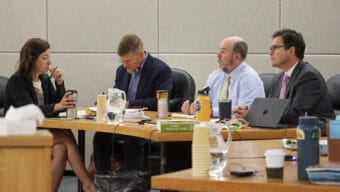
Courtroom A at the Dimond Courthouse in Juneau on Dec. 11, 2024. (Photo by Yvonne Krumrey/KTOO).

Editor’s note: This story originally reported the trial would begin Monday, July 14 due to a clerical error on the court system calendar. It actually begins Tuesday, July 15. 

A new trial date has been set for the Juneau chiropractor arrested four years ago on multiple sexual assault charges. Jeffrey Fultz is accused of assaulting more than a dozen women under the guise of medical care. His trial is scheduled to start next Tuesday.

This is Fultz’ third trial date. It comes after nearly 50 hearings and numerous postponements. But at a pre-trial hearing Tuesday, the state prosecutor, judge and Fultz’s defense attorney all said they plan to avoid further delays. 

A final pretrial hearing is scheduled for Friday. 

Police arrested Fultz in 2021 based on seven initial accusations that he had assaulted patients while he was a chiropractor for Southeast Alaska Regional Health Consortium. Fultz now faces 15 felony sexual assault charges and one misdemeanor harassment charge. 

Fultz has been living in Colorado since posting bail four years ago. He has made one in-person appearance in Juneau court since.

One of Fultz’s accusers, a woman the courts are identifying as C.E.L., said that she is relieved and grateful this case may finally go to trial. 

“So many of us have lived in this limbo, and we’ve been unable to fully heal, because the system that promises accountability has kept stalling,” she said.

Several factors contributed to the delay. The investigating Juneau police officer died. The first judge assigned to the case retired. Fultz’s first attorney was deemed “mentally unable” to continue with the case. 

Fultz hired his current attorney, James Christie, in January of last year.

Fultz’s case was first scheduled to begin trial in February of this year but was delayed as the court continued to process and release outstanding records. Then, it was scheduled for a trial date in April but was delayed yet again when a member of the defense team experienced serious health issues.

Some of the charges Fultz faces date back to 2014. 

“Once we get into trial, what we’ll see is that some of the victims, the harm happened to them 11 years ago,” C.E.L. said. “Like, that’s when Obama was in office.”

The Anchorage Daily News and ProPublica reported early this year that felony cases in Alaska often face years of delays requested by defense attorneys and approved by judges.

Due to new limitations established by the Alaska Supreme Court, cases filed before 2023 now have a limit of 270 days before they must go to trial starting in May. 

The order says the defense and prosecution are each allotted 90 days of delay requests, and a further 90 days is included for “other periods of delay for good cause.”

C.E.L. said long delays can take a toll on alleged victims of assault.

“This idea that ‘justice delayed is justice denied’ is absolutely true, and that every delay reinforces the idea that harm against victims isn’t urgent, isn’t serious,” C.E.L. said. 

The trial is scheduled for a five-week time period, starting next Tuesday and lasting into August. Judge Larry Woolford will be presiding. 

The public may attend proceedings in person in Courtroom A at Juneau’s Dimond Courthouse, or by phone.  

In early 2021, the Indian Health Services established a hotline for callers to report suspected sexual abuse by calling 1-855-SAFE-IHS (855-723-3447) or submitting a complaint online on the IHS.gov website. The hotline may be used to report any type of suspected child abuse within the IHS, or any type of sexual abuse regardless of the age of the victim. The person reporting by phone or online may remain anonymous.

People who suspect they may be the victims of sexual abuse in Juneau can also call AWARE at (907) 586-1090.

Utqiagvik residents gather to share joy and loss during this year’s whaling festival

Quincy Adams prepares to jump on a sealskin blanket during Nalukataq festival in Utqiagvik in June, 2025.
Quincy Adams prepares to jump on a sealskin blanket during Nalukataq festival in Utqiagvik in June, 2025. (Photo courtesy of Sarah Betcher/Farthest North Films)

Back in June, whaler Quincy Adams soared above a seal blanket at Simmonds Field in Utqiagvik, with a bag of candy in his hands. He leaped even higher and tossed the kaleidoscope of sweets, as the children around him whooped with joy and caught treats.

Quincy and his wife Bernadette Adams are the captains of the Aaluk whaling crew. They were among those who landed a bowhead whale this spring and threw a feast for the community – especially for elders and widows who can’t hunt for themselves.

“It’s all for the community, not just for us or our crew,” Quincy Adams said. “It’s to make sure everybody gets a bite to eat, to make sure that nobody goes hungry.”

Several coastal Arctic communities – including Utqiagvik, Point Hope, Wainwright, Nuiqsut and Kaktovik – hosted festivals throughout June to celebrate a successful whaling season. The event is often called Nalukataq, or blanket toss in Iñupiaq.

The Brower family enjoys muktuk during the 2025 Nalukataq in Utqiagvik. (Photo courtesy of Sarah Betcher/Farthest North Films)

In Utqiagvik, the festival this year spanned four days and included feasts, prayers, dance and a traditional blanket toss. Each day, the whaling crews served several courses of subsistence dishes: caribou, duck and geese soup, doughnuts, boiled whale meat, muktuk, akutaq, and a delicacy – fermented whale meat and blubber, or mikigaq.

Everyone on the crew had a task, even teenagers and children who helped serve coffee and tea. Flossie Nageak celebrated her 70th birthday on one of the Nalukataq days and said that having children participate helps them learn Iñupiaq traditions.

“We work together, trying to teach them our tradition,” she said. “We need to let them get into subsistence. They’ll be next in the future.”

When the feast was over, the whalers stretched a sealskin blanket, inviting everyone to jump on it. Then, the crowd moved indoors and continued with Iñupiaq dancing and drumming throughout the night.

Several whaling crews join in a traditional Inupiaq dance during Nalukataq. (Photo courtesy of Sarah Betcher/Farthest North Films)

This year’s Nalukataq also had an emotional side for Adams. A young member of his crew died by suicide earlier this year, and the crew dedicated their whaling season to him. They also opened one of the days of Nalukataq with a prayer and a message of hope.

Adams said it is still hard for him to process the loss of the crew member who was hardworking and always eager to learn.

“He always liked to learn, always asking, ‘What’s next?'” Adams said. ” He was a young man just starting his life out.”

Adams said his sons were friends with the young man and are struggling too, so he is encouraging them to share their feelings.

Historically, suicide rates in the North Slope region have been high compared to more urban areas and Alaska as a whole, according to data from the borough. Adams said he is worried about young people who have a hard time seeking out help.

“It’s just something we wanted to get out to the other people and to the young people and the teens, tell them that there is hope, there is family that loves them,” Adams said. “If they need to talk to somebody, talk to somebody.”

Nalukataq festival in Utqiagvik in June, 2025. (Photo courtesy of Sarah Betcher/Farthest North Films)

Whaling captain Herman Ahsoak said that dedicating Nalukataqs to those who passed is not new. He said the event is about the community coming together.

“We put on the blanket and jump,” he said, “and let it all out on the blanket and just jump for joy.”

If you or someone you know is in crisis, contact the 988 Suicide & Crisis Lifeline via call, text or chat.

An investigation found a Juneau woman’s death was an overdose. Her family is still searching for answers.

Tanya Ulrich holds a picture of her sister, Isabelle Sam, with family on May 20, 2025. (Photo by Yvonne Krumrey/KTOO)

Content warning: this story contains details about suspected sexual violence against women.

On a cold afternoon in January 2023, Tanya Ulrich opened her door to see a Juneau police officer. He told her that her sister, Isabelle Sam, was found dead in a van outside of a local grocery store.

“I asked if we can go and see her really quick, make sure that it is her – because I didn’t, I didn’t want to believe it,” Ulrich said. “And they said that you can’t come see her.”

Ulrich wouldn’t get to see her sister’s body for more than a week.

“I called again the next day at the morgue, and they said they were already sending her up to Anchorage for the autopsy,” she said.

The state medical examiner in Anchorage found the cause of death was an overdose from fentanyl and alcohol. Sam’s death was classified as an accident. The police said there wasn’t enough evidence to make a case against anyone.

Now, two years later, her family still has questions about the circumstances surrounding her death. After seeing the police report, they worry she may have been the victim of a crime. 

This family’s story isn’t uncommon. Alaska Native families often carry the burden of unanswered questions when their loved ones die of unnatural causes.  

For Sam’s family, questions began to surface almost immediately, when authorities released her body. 

“We didn’t get to see her until the day we had her funeral over in Sitka, and that’s when we realized that she had some bruises on her – on her face,” Ulrich said. “It really, really upset me and her kids.”

The state medical examiner’s report on Sam’s death says Sam had “contusions” on her face and neck, but those injuries didn’t cause her death. Later, the family saw autopsy photos and Ulrich said there were also bruises all over her body.

Isabelle Sam’s death is similar to that of many Missing and Murdered Indigenous People, or MMIP, cases where the family’s suspicions go unresolved because authorities don’t have enough evidence to investigate further, or make arrests. 

Sam was Lingít – Kaagwaantaan from Sitka. She was a mother and a grandmother. She had been unhoused and struggling with addiction for some time. Ulrich said Sam experienced domestic violence from partners in the past, and she was always worried about her. 

Ulrich said her sister loved going berry picking and playing softball. She said Sam always made things fun.

“You could really just see her out on the dance floor, like dancing away,” she said. “Doesn’t really matter which song. She was just fun-loving.”

Ulrich lost another sibling shortly after Sam’s death, and she was juggling multiple jobs and a child with special needs. But she couldn’t stop thinking about her sister. This past February, she requested the police report from the investigation into Sam’s death. 

In the report were details that made her feel even more uneasy. For example, there were two men with Sam in the van when she died – and one of them told police the other was acting guilty. When police saw her body, she was partially undressed.

The medical examiner ordered a sexual assault examination. The nurse who filed the report said there were signs of sexual assault after death on Sam’s body. But a doctor with the medical examiner’s office told police he wasn’t sure of that. 

Though the medical examiner’s report determined Sam’s death was accidental, Ulrich says she sees enough suspicious details in the reports that she thinks a crime took place around her sister’s death. She’s read them over and over again. 

“I keep getting confused,” Ulrich said. “That’s why I keep rereading everything, seeing if I missed anything. Or, like, maybe it’ll make more sense. I put it down. Every time I look at it, like, there’s stuff that contradicts stuff, there’s stuff that don’t make sense.”

Juneau Deputy Police Chief Krag Campbell said the investigating officer for Sam’s case followed normal procedure, and that there wasn’t enough evidence in this case to proceed with any charges related to her death. 

Campbell said the medical examiner determines the official cause of death and that influences how an investigation will proceed. 

“We’re looking at them to say, like, is this suspicious in nature?” he said. 

Unless there is unmistakable evidence of a crime, he said.

“Outside of seeing a – during an investigation – seeing an obvious sign of something that would cause death, or someone saying, ‘I saw so-and-so kill them,’ you know, that type of stuff,” he said. 

In this case, the medical examiner’s office wouldn’t confirm to JPD that there were definite signs of assault on Sam’s body, despite contusions on her face and neck, and trauma to other areas of her body. 

Campbell confirmed that her case was taken to the prosecutor, but there wasn’t enough evidence to take it to trial. 

Now, Isabelle Sam’s family doesn’t know what to do with their questions. 

“That is unfortunately too common of an experience where families have followed every end that they can. They’ve done everything that they can,” said Aqpik Charlene Apok, founder of Data for Indigenous Justice.  

Apok’s nonprofit collects and publishes data about missing and murdered Indigenous people. Her database is different from what state authorities report. It includes cases that have been officially closed – ruled as suicides and accidents – where families think there is more to the story.

Apok said deaths like Sam’s often go without prosecution, even when the family thinks they should be taken to court. 

“We may not be seeing eye to eye, from family to prosecution or family and law enforcement,” she said. 

Apok said families often still have questions after authorities close their loved one’s case. 

“And that’s why we have awareness about this issue,” Apok said. “That’s why we’re trying to have systemic change. That’s why we’re trying to see patterns like that, so that we can identify, then, where is that gap? What is happening?”

The legal system may not be able to answer all of the questions Isabelle Sam’s family has about what happened in the last hours of her life. But there are structural disparities that affect Alaska Native people – stemming from generations of colonial violence – that could have contributed to her death in that van.

In 2022, Alaska Native people died from overdoses at more than three times the rate of white people in Alaska. 

Alaska Native people make up nearly half of the state’s unhoused population, while only making up 16% of the state’s population as a whole. 

Apok said families shouldn’t be left to question the circumstances around their loved one’s death. But many still do. 

“I call them survivor families,” she said. “They shouldn’t have to burden as much as they are, to carry it forward.”

And for Tanya Ulrich, the loss is still fresh. She read a message from Sam’s daughter, who lives in Sitka, that said what a good mom Sam was, how she always looked out for her kids.

“‘She made sure her kids were always safe and okay,’” Ulrich read. “‘She took care of us the best that she could.’”

Site notifications
Update notification options
Subscribe to notifications