Military

Alaska National Guard responds to allegations of sexual assault

The Alaska National Guard is responding to allegations of sexual assault within its ranks.

Brigadier General Mike Bridges, the Commander of the Alaska National Guard says there have been nearly more than two dozen alleged cases of sexual assault since 2009.

Brigadier General Mike Bridges. Photo from the Department of Military and Veterans Affairs.

“There have been 29 cases of alleged sexual assault reported to the Alaska National Guard – and that’s with Army and/or Air National Guard,” Bridges said. “The majority of those were alleged by civilian perpetrators on guard members, whether they were in the guard then or since then.”

This week, the Anchorage Daily News reported that there was an investigation into soldiers, including some in the Alaska Army Guard’s recruiting and retention unit headquartered at Joint Base Elmendorf-Richardson.

Alaska National Guard officials would not confirm but did not deny the report.

Bridges says the Alaska Air National Guard has a new trained sexual assault investigator, as part of a military-wide effort to get a handle on the problem.

“Across the Department of Defense the recent expanded amount of reports that were coming in across the whole Department of Defense indicated a need,” Bridges said. “And Department of Defense has now provided that and we received ours within this last year, back in the springtime.”

A statement released from the Alaska National Guard offices Tuesday said local law enforcement, such as the Anchorage Police Department of the Alaska State Troopers have been contacted in 21 cases.

Bridges says he can’t disclose how many of the cases are under investigation.

Alaska WWII Vets visit DC Memorial

(Photo by Tim Evanson)

An estimated 1,500 World War II veterans live in Alaska. The generation that fought the Nazis and the Imperial Japanese Army are now in their 80s and 90s, battling the devastations of old age. A group dedicated to honoring these Alaskans just completed its first mission. The Last Frontier Honor Flight flew two dozen veterans to Washington, D.C. last week to visit the World War II Memorial.

Most of the 25 vets arrived at the Memorial wearing blue and yellow windbreakers, with “Alaska” emblazoned on the back. But not Mike Hunt. The 91-year-old aviator stood out in his original Air Corps uniform and leather bomber jacket

“This jacket was issued to me in Long Beach, California in 1942. I’m just thankful it still fits. And the reason I still got it is I hung it in my chicken house after the war and my son retrieved it and wiped the mold off it and put bear grease on it and here it is. It still fits!”

During the war, Hunt flew aircraft to Russian pilots at Ladd Field in Fairbanks, hauled supplies over “The Hump” in the Himalayas, and delivered troops to occupy Japan. Then he homesteaded in East Anchorage.

Like most of the others on the trip, he toured the Memorial in a borrowed wheelchair. As the group rolled toward the central fountain for a group photo, a passing jogger stopped to shake hands and thanked them for their service.

When Hunt looks back on the war, he thinks of how the whole country pulled together to win it, and of those who never made it home.

“All these heroes sacrificed so that we’re all free. I feel fortunate that I’m still here, a survivor. Could have been the other way around.”

Most of the Alaska honorees came with a family member — In Hunt’s case, his son, Howard. Together they looked at one of the memorial’s more subtle features — a series of panels around the perimeter that depict scenes of the war and of the homefront.

Howard Hunt: “What’s that they’re listening to?”

“The war report, I guess.”

“It’s probably the bombing of Pearl Harbor. See, this is the beginning of the War and it goes down each relief has a different image: enlistment to training to service, to shipping out, and then fighting the war and coming home. It goes from the beginning to the end.”

“A lot of thought went into that.”

Among the Alaska vets were two elders from Metlakatla, and two women.

“It’s a real thrill to come here with this group. It’s a real honor,” says Ellen Jean White of Anchorage.

White spent more than two decades in the Air Force.

She joined the war effort hoping to serve her country as a pilot.

“Well, I went in in 1944. I tried to get in WASPS, but they wouldn’t let me in because I was a quarter inch too short, and I had a pilot’s license and was fully qualified otherwise. So I joined the Air Force. And I wanted to do something with aviation and they made me an admin clerk and finally I got into aircraft maintenance, … and they wouldn’t let us do that very long because they said that wasn’t lady-like. So then I went into supply, and I was in supply and logistics from then on.”

After the war White was twice stationed at Elmendorf, and she retired in Anchorage in the 1970s. Still agile at 92, she popped in and out of her wheelchair to pose for pictures with her granddaughter.

Last Frontier Honor Flight, along with its Fairbanks sister organization, raised money to fly the veterans to Washington. Founder and president Ron Travis of Big Lake is a Vietnam War veteran.

“Well the real value is just what you see here: families interacting. They’re seeing this for the first time, the families, or hearing stories for the first time. I think it’s kind of a closure somewhat to some of the veterans when they look around, and it’s kind of an ending thing for them. It’s kind of shutting the door because it never really got shut. To me, that’s really what it’s about.”

Travis says he hopes this is the first tour of many.

Storis Supporters See Ray of Hope in Saving Cutter

U.S. Coast Guard Cutter Storis was decommissioned in 2007. Courtesy U.S. Coast Guard.

Fans of the retired U.S. Coast Guard Cutter Storis have been holding their collective breath all weekend, hoping there might be a way to prevent the scrapping of the ship in Mexico. Documents were forwarded to members of the Storis Museum Saturday morning indicating the ship might contain too much hazardous material to be exported under the federal Toxic Substances Control Act.

Jon Ottman is a historic preservation consultant and marine historian based in Michigan. He authored the successful application to place the Storis on the National Register of Historic Places.

He says that while some PCBs were removed from the ship, more may be contained in parts of the ship that would only be exposed and made dangerous if the Storis were broken up.

“The information that we have received indicated that the report that was used to clear the vessel for export for scrapping was flawed in that while the report had indicated the un-encapsulated PCBs on-board the vessel was removed the report does not indicate the other PCBs that would have been contained on the vessel in various locations throughout the ship, such as paint, gasket material, rubber insulation and various types of wire insulation aboard the vessel, that’s all still on board the ship.”

Because of that, Ottman says the Storis should not be exported to another country that might not have as strict environmental laws as the U.S.

“It’s an unfortunate situation but it would appear the EPA, the Unite States Coast Guard, the U.S. Maritime Administration and the U.S. General Services Administration should have been aware of all this, and they’re basically complicit in releasing a ship that should not be going to a foreign ship breaker. They let her go.”

PCBs, or poly-chlorinated biphenyls, were once widely used in electrical systems, paint and heat shielding until being banned in 1979 because of their persistent environmental toxicity and link to cancer.

Ottman says supporters of the Storis have contacted Alaska Senator Mark Begich for assistance.

“At this point, Senator Begich’s staff are trying to reach out to the EPA to see where the process went wrong and what the situation is from that perspective. They’re also reaching out to the Mexican authorities through the Mexican Embassy to let them know the vessel is actually en route at this point so that they can be aware that there is a contaminated vessel that is en route to their country. They may have the opportunity, the Mexican authorities, to turn the ship away because of what she contains on board.”

Ottman says if the Storis can be kept from leaving the country and the federal government can be convinced that the disposal was flawed, the process could go back to square one:

“Because the GSA listed the vessel as a repairable ship and did not indicate in their original listing for her on the GSA auction site that she contained hazardous materials that would have to be handled in a special fashion, or that should she be desired by someone for ship-breaking, that it would have to be done domestically. Those are all very serious shortcomings in the original General Services auction listing.”

The current owners of the Storis are Mark Jurisich and John Bryan, co-owners of US Metals Recovery of San Diego. They bought the 71-year-old ship at auction this summer for $70,100. The Storis was taken under tow late Friday near San Francisco.

The Storis was commissioned in September 1942 and served until February 2007. It was named to the National Register of Historic Places last December.

Storis to be junked

Storis
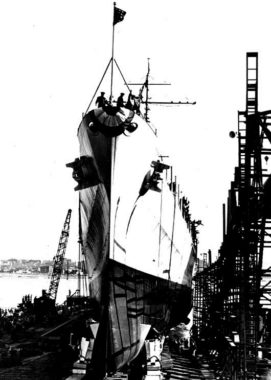
Sometimes called the “Galloping ghost of the Alaska Coast,” the retired USCGC Storis (middle) sits in storage at the National Defense Reserve Fleet shipyard at Suisun Bay, California. Photo courtesy Storis Museum and Educational Center.

The  U.S. Coast Guard Cutter Storis will be towed to Mexico on Friday and cut up for scrap metal.

Once the longest-serving cutter and called the Queen of the Fleet, the Storis was sold this summer to a scrap metal dealer for $71,000.

The medium-endurance cutter was built in Ohio for $2 million and launched in 1942.  After serving through World War II and as a cutter in Juneau and Kodiak, the Storis was decommissioned in 2007.  In 1957, the cutter became the first American flagged ship to sail the Northwest Passage through the Arctic Ocean.

Juneau attorney Joe Geldhof is secretary of the Storis Museum, the non-profit that was trying to save the ship and turn it into a museum.

Geldhof says the museum group does not harbor hard feelings toward the businessman who bought the Storis, but thinks the U.S. General Services Administration bungled the entire proceeding.

“General Service Administration botched the disposal. They didn’t give non-profits the opportunity to select the Storis before it was put on the scrap market,” Geldhof says.

He also blames personal politics by former U.S. Senator Jim DeMint, a South Carolina Republican, for keeping the Storis from being transferred to the museum.

“Jim DeMint routinely was putting a hold on the congressional authorization to transfer it to the non-profit museum a couple years running,” he says.

DeMint was a one-term Republican senator from South Carolina.

Geldhof says the Storis Museum organization still has some money left and the board will meet to decide what to do next to memorialize  the ship and those who served on it.

The Storis has been in the Suisun Bay mothball fleet storage in California and will be towed by tug to Ensenada, Mexico, where it will be stripped down and cut up for its scrap metal value.

Its final fate comes less than a year after the Storis was named to the National Register of Historic Places.

Army claims responsibility for Stuart Creek 2 wildfire

stuart creek 2
Photo courtesy of Alaska Fire Service

The US Army Alaska yesterday released the results of two investigations into the cause of the Stuart Creek 2 Wildfire that burned more than 87,000 acres and threatened a small mushing community just outside Fairbanks this summer. Investigations conclude that artillery training caused the fire. As a result, the army will change its training procedures.

In July, Fort Wainwright Garrison Commander Colonel Ron Johnson told Two Rivers Community members the Army was responsible for igniting the Stuart Creek Two Wildfire on June 19th.

“They allowed the training to occur, it was artillery training. It did start a fire. So it was monitored, smoked, up hit it again and then when the weather changed, it just flared up and now we got what we got.”

Days after his admission, the Army back-tracked. Colonel Johnson has since announced his plans for retirement. But the Army says he’s not stepping down because of his comments. Lieutenant Colonel Allen Brown is US Army Alaska’s Chief of Public Affairs. He says the situation at the time was much too fluid to make that kind of determination.

The plume of smoke above the Stuart Creek Fire
The plume of smoke above the Stuart Creek Fire. (Photo courtesy of the Alaska Fire Service)

“We had to rule out lightning strikes, we had to rule out other human causes. But mostly we just had to look at all the data and make sure we were making the right call.”

An investigation into the cause of the blaze indicates that the Army was in fact responsible.

“I know that there’s been some frustration in the community and I think justifiable so. We live there too and we’re just as much a part of the community as anybody else and we want to do things as safely as we can and we don’t want to put anybody else unnecessarily at risk.”

The 87,000 acre fire forced the evacuation of Two Rivers and Pleasant Valley residents and their animals and livestock. One of those residents is Melinda Shore. She and her 13 sled dogs left their home twice as the blaze edged within miles of her property.

“Well, I was really appreciative of the way Colonel Johnson came forward at the meeting and then there was that little bit of tail covering – not little bit, there was considerable tail covering afterwards, but he seemed genuinely concerned about what had happened and taking responsibility for it. That’s a good thing. Certainly the Army contributes a lot to the community here and they’re an important part of the community, but this was just such a massive screw up.”

A second Army investigation reveals what John Pennell calls “systemic problems” with Army training procedures. Pennell is the Chief of Media Relations for US Army Alaska.

“During an extreme fire warning, only the USARAK G3 who’s the Chief of Operations can approve a waiver for training to continue, but in this case that was delegated down to an installation range officer instead.”

tree fire
(Photo courtesy of the Alaska Fire Service)

The Installation Range Officer was based at Joint Base Elmendorf-Richardson near Anchorage when the decision to continue training was made. Pennell says explosive artillery was also used during the mission.

“During an extreme fire warning, one of the munitions that the regulation tells us to not use is high explosives and those were what were used on the 19th that caused the initial ignition.”

From now one, the only person who can approve live fire training when fire danger is extreme, is Fort Wainwright’s Deputy Commanding Officer. The Army plans to acquire non-explosive artillery rounds at times when Red Flag Warnings are issued. Allen Brown says they will also build on a partnership with the University of Alaska Fairbanks to use Unmanned Aerial Vehicles to monitor fire prone areas.

“Obviously, the fire and the results and everything adds a lot more validity to expanding that relationship.”

The Army typically plans training mission at least a year in advance. Brown says new procedures will apply for any training set to take place over the Yukon Training Area next summer.

What Alaskans can expect from the shutdown

The Mendenhall Visitor Center will also be closed. (Photo by Reywas92/Wikimedia Commons)

The shutdown of the  U.S. government is the first in nearly 20 years.

In Alaska, there are five major impacts:

All post offices remain open, including the office in Juneau’s downtown federal building. Many of the U.S. government offices in the federal building will be partially or completely shut down and employees furloughed until Congress passes a budget.
All post offices remain open, including the office in Juneau’s downtown federal building. Many of the U.S. government offices in the federal building will be partially or completely shut down and employees furloughed until Congress passes a budget. (Photo by Rosemaria Alexander/KTOO)

First, any federal employee who isn’t considered essential will be put on furlough until Congress passes a budget. And as a state with a lot of government workers, that’s a big deal for Alaska. About 13,000 of them could get sent home without a paycheck.

Second, members of the military will continue to serve and earn money, but it won’t be business as usual. Medical treatment facilities are expected to be scaled back, and maintenance work that isn’t directly tied to military operations and deployments could be put on hold. The U.S. Coast Guard will continue its core mission, including search and rescue, law enforcement, and environmental protection.  The major impact of the shutdown will fall on civilian contractors and civilian employees.

Number three also has a military bent: One in ten Alaskans is a veteran. And while they should still receive benefits, their claims could be processed at a much slower rate. It also could take more time to get new veterans their pension and educational benefits.

Four: National Parks and visitors centers will be closed.  In Juneau, that means the Mendenhall Glacier Visitors Center, which is already on winter hours, so the public may not notice much change.

The fifth major impact falls on poor women and children.  They could see benefits reduced especially if a shutdown goes on for more than a few days. The WIC program, which provides food, would run out of money and it would be up to the state to keep it going. Head Start programs could also close down, leaving low-income kids without pre-school instruction and their parents without daycare while they’re at work.

Here’s what won’t change. Food stamps, unemployment benefits, and social security will still be paid out. The post office will remain open, and so will airports. And members of Congress will still continue to meet, since they — of course — count as essential staff.


Site notifications
Update notification options
Subscribe to notifications