Military

Pain, Loss And Tears Come With Medal Of Honor

U.S. Army Staff Sergeant Ty Michael Carter near Dahla Dam, Afghanistan in July 2012. Ho/AFP/Getty Images

The Army staff sergeant who Monday afternoon will receive the Medal of Honor at a White House ceremony has mixed emotions.

“I would never tell any soldier or service member, ‘Hey, go out and get the Medal of Honor’, because of the amount of pain and loss and tears that has to be shed in order to receive it,” Staff Sergeant Ty Michael Carter tells Morning Edition host Renee Montagne.

Carter, 33, is being given the nation’s highest military honor for his actions during a 2009 firefight in Afghanistan. He was a specialist at the time and stationed with the Army’s Black Knight Troop at Command Outpost Keating.

The soldiers’ location was vulnerable — a remote valley surrounded by three steep mountains. It’s the type of place the military no longer posts troops in Afghanistan, in part because of what happened there on Oct. 3, 2009.

Even though Taliban fighters fired at them nearly every day, Carter tells Renee it was immediately clear something much worse was happening on this day.

“It was as if somebody kicked an ant hill,” he says. “The bullets, the rockets, the mortars, everything, a wall of spikes — they’re pointing at you.”

The Army says Carter killed enemy troops, resupplied ammunition to American fighters, rendered first aid and risked his own life to save an injured soldier who was pinned down by a barrage of enemy fire.

Carter says he’s honored to be recognized for his bravery. But, he adds:

“Even though this award is an awesome honor and a great privilege, in order to get such a prestigious award, you have to be in a situation where your soldiers, your family, your brothers, are suffering and dying around you. And then, you just did everything you could to save lives or prevent further loss.”

According to the Army, “of the 53 members of B Troop, 3rd Squadron, 61st Cavalry Regiment, who defended the position, eight soldiers were killed, and more than 25 were injured.”

President Obama is scheduled to bestow the medal at a 2 p.m. ET ceremony. C-SPAN is among the news outlets that will stream the event.

Carter will be the fifth living recipient to be awarded the Medal of Honor for actions in Iraq or Afghanistan.

His other military awards:

“Include the Purple Heart, the Army Commendation Medal (with 4 oak leaf clusters), the Army Achievement Medal (with 2 oak leaf clusters), the Army Good Conduct Medal, the Navy/Marine Corps Good Conduct Medal, the National Defense Service Medal, the Afghanistan Campaign Medal (with two campaign stars), the Global War on Terrorism Service Medal, the Noncommissioned Officer Professional Development Ribbon (with numeral 2 device), the Army Service Ribbon, the Overseas Service Ribbon, the NATO Medal, the Combat Action Badge, the Expert Infantryman Badge, and the Air Assault Badge. He is also authorized to wear the Valorous Unit Award and the Meritorious Unit Commendation.”

Copyright 2013 NPR. To see more, visit http://www.npr.org/.
Read original article
Pain, Loss And Tears Come With Medal Of Honor

Air Force Nuclear Unit Fails Inspection

The 341st Missile Wing at the Malmstrom Airforce Base in Montana handles one-third of the United States’ land-based nuclear missiles.

Today, it failed an inspection after making “tactical-level errors during one of several exercises,” the Air Force’s Global Strike Command said in a statement.

The AP reports this is the second setback in a year for the unit. The news service adds:

“Without more details it is difficult to reliably judge the extent and severity of the problem uncovered at Malmstrom, home of the 341st Missile Wing, which is one of three nuclear missile wings. Each wing operates 150 Minuteman 3 intercontinental ballistic missiles, or ICBMs, on alert for potential launch against targets around the globe.

On Capitol Hill, a spokesman for Rep. Howard ‘Buck’ McKeon, R-Calif., chairman of the House Armed Services Committee, said that “two troubling inspections in a row at two different missile wings is unacceptable” to McKeon.

‘It is his sense that the Air Force must refocus on the nuclear mission,’ spokesman John Noonan said. ‘The Air Force should hold failed leadership at the group and wing level accountable, recommit itself from the top down to the nuclear deterrent mission, and ensure a daily focus on its centrality to our nation’s security.'”

In its press release, Lt. Gen. Jim Kowalski said this failure doesn’t mean “the wing isn’t able to accomplish its mission.”

He added: “Commanders use these inspections to continually improve our training and procedures. These inspections allow us to identify causes and find solutions to problems in areas that aren’t meeting our exacting standards.”

Copyright 2013 NPR. To see more, visit http://www.npr.org/.
Read original article
Air Force Nuclear Unit Fails Inspection

USCG Arctic strategy requires more ice breakers

The number of ships through the Bering Strait grew 118 percent between 2008 and 2012, according to the U.S. Coast Guard.

As nations attempt to stake claims for rich Arctic resources, the U.S. currently has little presence there.   The Coast Guard has two ice breakers capable of operating in the region.  That’s four short of the six required to fulfill the agency’s mission in both the Arctic and Antarctic.

One of those cutters, the Polar Star, is back in service after a major rebuild.

Here’s a look as part of our occasional series on Coast Guard cutters that visit Juneau.

The heavy ice breakers Polar Star and Polar Sea create an access channel for supply ships in McMurdo Sound, during the 2002 Deep Freeze Mission. The Polar Sea is now in caretaker status and could be decommissioned. The Polar Star has undergone a thee-year $90 million overhaul. Courtesy U.S Coast Guard.

Several staggered metal ladders aft the bridge go straight up to a perch called the Aloft Conning Station.

“We have a 360 degree view.  That allows us to pick a good way through the ice.”

Kenneth Boda is Executive Officer aboard the Coast Guard heavy ice breaker Polar Star.  It’s his third ice breaker tour.

“Typically when you are an ice breaker, you don’t want to break ice. You want to avoid ice as much as possible.  So you look for the open water leads and being up there allows you to pick the path of least resistance.”

In the ice, the Polar Star is often driven from the Aloft Conning station. Photo by Dick Isett.

The Aloft Con is 110 feet above waterline on  the Polar Star, under the command of Capt. George Pellissier.

“Most of the time in the ice you’re driving from there,” he explained during a recent interview when the ship stopped in Juneau after Arctic ice trials.

Pellissier will command the ship to Antarctica this winter.

The ice breaker’s primary mission there is to resupply McMurdo Station, the largest U.S. research station at the South Pole and the logistics center for other Antarctic facilities.  Pellissier said two-thirds of the job is transit time. Then there’s the ice.

“You have to break a channel through the fast ice, which is ice that’s attached to the land, and then you  have to make a channel straight enough and wide enough to get a container ship and a tanker in,” he said.

 “I’ve seen it as much as 85 miles of ice and as little as 12.”

The upcoming Antarctic trip – called the Deep Freeze mission — will be the first in recent years for a U.S. ice breaker.  The Coast Guard has had to lease Swedish and Russian ice breakers.

With only one heavy and one medium ice breaker in the Coast Guard fleet,  “there’s no bench strength,” Pellissier said.

The latest study prepared for the Coast Guard indicates the need for three medium and three heavy ice breakers to fulfill U.S. statutory duties in the polar  regions.

The Arctic poses the most immediate challenge.

The Coast Guard is responsible for law enforcement, search and rescue, security, and environmental protection where many nations want to drill, mine, fish, and tour.  The ice breakers are also scientific research platforms.  U.S.  Homeland Security predicts a million adventure tourists could visit the Arctic this year.

Other nations have government and commercial ice breakers operating in the region year around.  Commander Pellissier points to the region on a large map in his Polar Star office.

“As we come up the Bering Strait and then we head off to the west, all along the North coast of Russia, that’s already a viable route,” he said.  “And that’s where you find a large number of Russia’s ice breakers plying that route to keep it open.”

Map courtesy of the U.S. Coast Guard.

The  window is narrow now, but as the ice diminishes ships could go through the Chukchi and Beaufort seas to the Northwest Passage, linking the Pacific and Atlantic Oceans.

“If the ice continues to recede, which most scientists are predicting it will, then that route will also become much more viable in the future, pretty much cutting through all the small  islands up in the northern part of Canada, and then down through the Labrador Sea and down the East Coast,” Pellissier said.

The new National Security Cutters are the core of the Coast Guard fleet.  Despite their versatility,  they can’t cut ice.

“They have a very limited window of time they can operate, particularly up in the North Bering and beyond.  The ice breakers, particularly our heavy ice breakers, can stay up there year around,”  Pellissier said.

Multiple studies indicate the U.S. needs a year-round presence in the Arctic. Existing ice breaker capacity is not enough, even with additional non-ice cutters and aircraft, more operating locations and improved communication  and navigation systems.

How the Coast Guard’s ice breaker crushes through 21 feet of solid ice

The heavy ice breaker Polar Star at the ice edge of the Chukchi Sea north of Wainwright, July 16, 2013. Photo by USCG PO1 Sara Mooers.

The Arctic ice cap reached a new low in September 2012.  In just six months last year, 4.5 million square miles of Arctic Ocean ice melted, according to a report by the United Nations.

While that may be hard to imagine, the commanding officer of the U.S. Coast Guard Cutter Polar Star says Arctic ice was the lowest he’s ever seen in all his ice breaking trips to the region.

After three years in a Seattle shipyard and a $90 million makeover, the Coast Guard’s heavy ice breaker just returned from trials in the Beaufort Sea and made a brief stop in Juneau.

“It’s capable of breaking over 21 feet of solid ice, with an inch and a quarter thick steel hull, and a design that allows it to ride up on the ice and crush it with its weight,” said MST1 Brian Carr, at the start of a Polar Star tour.

He is one of the 150 crew members and officers aboard the rebuilt ice breaker, 115 of them making their first trip to the Arctic.

Their commanding officer has spent much of his 30 years in the Coast Guard breaking ice.

“Pretty much the most fun job on the planet.”

Captain George Pellissier started his Coast Guard career as a naval engineer on an ice breaker.

“We pretty much get to live the Discovery Channel. I mean where they send us and where we get to go, most people only get to see watching TV or reading about it in a magazine.”

That includes deployments to both the Arctic and the Antarctic.  It’s a toss-up as to which Pellissier likes best, though the trip south from the Polar Star’s Seattle home port is more diverse; such as crossing the tropics.

USCG Cutter Polar Commanding Officer George Pellissier. Photo by Dick Isett.

“Pulling an ice breaker into, say, Tahiti is always interesting,” he said.

Penguins greet the ship at the South Pole; polar bears and walrus at the North.

“Even the ice that you’re actually going through is a little bit different,” Pellissier said.

On this shakedown trip to the Arctic, the Polar Star found heavier ice than the captain anticipated.

“What we found was essentially first year ice where we went, although in the vicinity of Barrow it was all rafted together and piled on top of each other, so it was fairly tough ice,” he said.

The ship reached Barrow’s ice-choked shore on July 2nd.

“We did find that a couple weeks into the trip the ice was breaking up and receding rapidly,” he said.  “So this trip there was less ice that we encountered than I’ve seen in years past.”

The Polar Star spent most of the time in the Beaufort Sea, reaching 78 degrees north latitude, “not terribly far, but enough to find some nice good ice to play around in for a while and do all of our testing.”

The rafted ice is some of the hardest to break, a good test for the ship’s rebuilt engine, propeller and navigation systems.

The propellers are driven by a diesel-electric or gas turbine power plant.

The diesel generators are capable of 18,000 horsepower, and the three turbines, more than 75,000 horsepower. The thickness of the ice determines which system to use.

Pellissier gets a real twinkle in his eye when he talks about testing his “new” ship on the piled-up ice.

“We kind of tested the full power by nosing up to a large pressure ridge and running the turbines one at a time and just running them all the way up through the whole horse power range, which was kind of neat,” he said.

So what does it feel like when the 13,000 ton Polar Star is breaking a mound of ice?

“We are one of the few ships on the planet that intentionally runs into things. It makes a fair bit of noise and everything shakes.”

The entire ship is an ice breaker.  The trials also tested the Polar Star crew; some  fresh out of basic training.

“You’ll be going through the ice and making good progress, if you hit a pressure ridge, or a little bit of thicker ice,  all of a sudden the ship will lurch off to one side or the other with not a lot of warning for the folks.  So they learn right quick to close or latch open the doors and hold on,” he said.

Pellissier said backing up in the ice is one of the more dangerous things to do. The ship draws 31 feet; the three propellers are 16 feet in diameter and sit about 15 feet below the water line.

“You know the spinning propeller will kind of knock the pieces of ice aside. You’ll feel it; it’s what we call milling ice and it does feel like all of a sudden your ship becomes a giant blender.”

Two new cranes are part of the Polar Star overhaul completed late last year by Vigor Shipyard, Seattle. Photo by Dick Isett.

The bigger concern is the rudder, so the key, he said, is taking it slow to make sure the rudder remains centered “so that it’s going directly back into the ice and not getting knocked over to the side and potentially wedged over to the side.”

He said backing up is always a bit tense.   “You just take it nice and slow for the back and then you get a running start at the ice again.”

The newly rebuilt Polar Star is the only operating heavy ice breaker in the Coast Guard fleet.  Pellissier says the Arctic ice trials show she’s a better ice breaker now than when commissioned in 1976.

He has a list of work to be done in home port over the next four months then the ship will head south to Antarctica.


Check out this footage from one of the Polar Star’s early journeys to Antarctica in 1998

USCG celebrates 223rd birthday

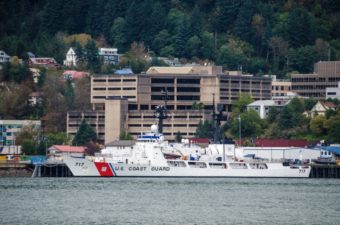
The U.C. Coast Guard heavy ice breaker Polar Star pulled into Juneau’s AJ cruise ship dock on Friday. The ship was open to the public on Saturday and left Sunday morning for Seattle. Photo by Dick Isett.

The U.S. Coast Guard is 223 years old.  The maritime service was created on Aug. 4, 1790 as the Revenue Cutter Service under the U.S. Department of Treasury.

Juneau is headquarters of the 17th Coast Guard District, which includes the Arctic.

Part of Juneau’s weekend celebration included a visit by the heavy ice breaker Polar Star, on its way to its Seattle home port after conducting ice tests in the Bering Sea.

The ship has been rebuilt and is the Coast Guard’s only heavy ice breaker in operation.   The Polar Star was open to visitors on Saturday.

Polar Star Executive Officer Kenneth Boda was one of the tour guides and offered a Coast Guard history lesson without prompting.

“We were built to basically collect customs and taxes, collect tariffs of vessels coming into port.  Over the years, we absorbed the Lighthouse service and the Life Saving Service, the Bureau of Steamboat Inspections as well.  Along the way along we were part of the armed forces,” he said.

The modern Coast Guard was created in 1915 as the fifth military uniformed service.

“Our vessels are fully compatible with all the Navy standards so we can operate in conjunction with the Navy,” Boda said, “but we also have the law enforcement side, the Homeland Security side, as well.”  

Boda called the Coast Guard a unique entity of the federal government. Its presence is local, regional, national and international, from the North Pole to the South Pole.

Most coastal Alaskans are familiar with the Coast Guard missions of safety, security and stewardship.

“Saving people’s lives is one of the big responsibilities of the Coast Guard,” Boda said. “Making sure that the ships that leave port are safe, we do vessel inspections.  Making sure that foreign ships that arrive have been inspected and have cleared all the U.S. regulations before they come into U.S. ports.” 

In 2012, according to the Coast Guard website, more than 436,000 vessels and their 29 and a half-million crewmembers and passengers were screened prior to arrival in U.S. ports.

The Coast Guard is the only military organization within the U.S. Department of Homeland Security.  Boda said that means it is responsible for ensuring U.S. harbors and ports are secure from any kind of threat.

“When I say threats, people think terrorist threats, but it’s not always terrorism that’s a threat, sometimes just a hazard to navigation.  For instance, a vessel that might wander out of the shipping lane and lose situational awareness.  In some other ports like Valdez, for instance, we have a vessel traffic service, you know that basically monitors ships as they come in and out and make sure everyone’s safe,” he said.

While enforcing U.S. fisheries laws is one of the most visible roles of the Coast Guard in Alaska, stewardship is protecting the oceans.

“Stewardship is environmental pollution response, so that the Coast Guard is called out to an Exxon Valdez or a Deep Water Horizon as well,” Boda said.

The Coast Guard is still investigating Royal Dutch Shell’s 2012 Alaska drilling operations after some vessels failed inspections, the oil rig Kulluk ran aground, and the company had other safety and environmental violations.

During the Polar Star’s brief stop in Juneau, KTOO had the opportunity to speak with Commanding Officer George Pellissier about its Arctic and Antarctic missions.  Check back for those stories.

Polar Star to visit Juneau

The ice break Polar Star will visit Juneau on Saturday and will be open to the public. Photo courtesy U.S. Coast Guard.
The only heavy ice breaker in the Coast Guard’s fleet will be in Juneau this weekend and open for tours.

The Polar Star is returning from its first trip to the Arctic Ocean since a four-year, $57 million overhaul of the ship.  It was reactivated in December in Seattle then tested in the open ocean before heading to the Arctic.

Coast Guard Petty Officer Kip Wadlow says the ship and crew have been conducting ice tests.

“The ice tests allowed the crew of the Polar Star to travel back up into the Arctic, test the ship’s capabilities going through the ice and also train their crew up so that they’re going to be ready to meet the Coast Guard’s Arctic and Antarctic missions in the future,” Wadlow says.

The Polar Star is returning to its home port in Seattle.  It was commissioned in 1976 and is one of two active Coast Guard ice breakers.

The smaller Healy paid a port call to Juneau in November.

Tours of the 399-foot Polar Star are Saturday from 1 to 4 p.m. at the AJ Dock.

Children must be accompanied by an adult.  Pets are not allowed on board.

Site notifications
Update notification options
Subscribe to notifications