Staff Sgt. Robert Bales, charged with the murder of 16 Afghan villagers in one of the worst atrocities of the American-led war in that country, will plead guilty as part of a deal to avoid the death penalty, his attorney told The Associated Press on Wednesday.
Bales’ attorney, John Henry Browne, says his client was “crazed” and “broken” in March 2012 when he entered a village in southern Kandahar province and opened fire on sleeping Afghan civilians. He said Bales would plead guilty next week.
The AP writes:
“The Army had been trying to have Bales executed, and Afghan villagers have demanded it. In interviews with the AP in Kandahar last month, relatives of the victims became outraged at the notion Bales might escape the death penalty.
…
Any plea deal must be approved by the judge as well as the commanding general at Joint Base Lewis-McChord, where Bales is being held. A plea hearing is set for June 5, said Lt. Col. Gary Dangerfield, an Army spokesman. He said he could not immediately provide other details.”
Army prosecutors say Bales, who had served four combat tours in Iraq and Afghanistan, acted alone and that he returned from his base to the village to twice on the night of the shootings to continue his killing spree.
The rampage marked the worst mass killing by a U.S. soldier acting alone since the Vietnam War.
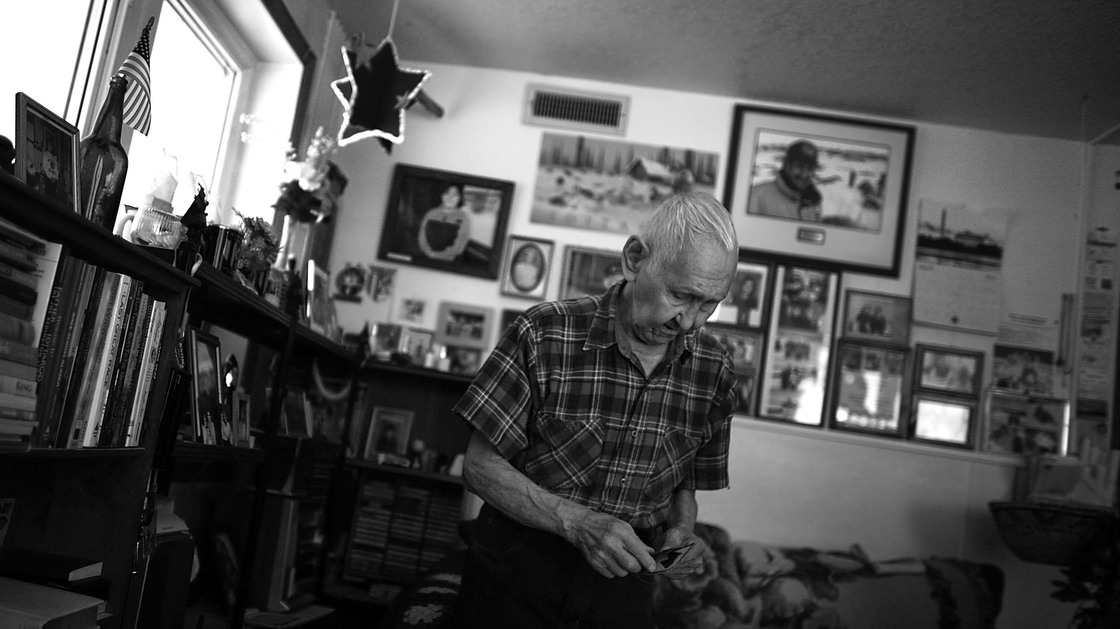
Howard Lincoln, 82, lives in the village of White Mountain in Alaska. Lincoln served with the U.S. Army in Korea, where he was seriously wounded in combat and received a Purple Heart. He recently suffered two minor strokes and now “visits” a doctor over a video link, part of a growing trend in the VA. David Gilkey/NPR
Howard Lincoln of White Mountain, Alaska, doesn’t always hear it when people knock on his door. He’s 82 and he still has a little shrapnel in his jaw from a mortar shell that nearly killed him in the Korean War 60 years ago.
“We heard it whistling, but I was the third one in line running toward the bunker,” he recalls.
Wounds to his face, arm and hip laid him up in a Tokyo hospital for quite a while. But he recovered, came home to Alaska in 1955 and says he never applied for Veterans Administration (now the Department of Veterans Affairs) benefits.
The nearest VA hospital was hundreds of miles — and at least two plane rides — away. White Mountain, along the Fish River, is still pretty remote. It’s a day’s journey by snowmobile or dog sled to Nome or a short flight if the weather allows. But the distance to health care just got a lot shorter — virtually.
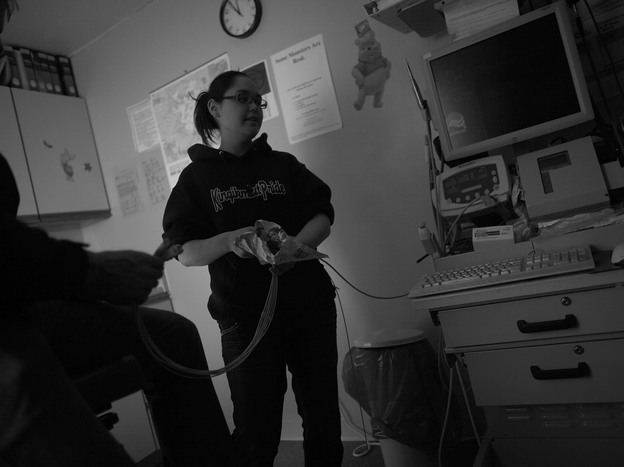
Octavia Wilson looks through supplies in a telemedicine cart in Wales, Alaska. Patients can see a therapist or have an exam via satellite-linked video, which is helping rural veterans in Alaska, where weather and distance can be extreme. David Gilkey/NPR
“Travel is a big burden on a veteran who may be older, not feeling well,” says Susan Yeager, who directs the VA health care system for the state, “and just the sheer expense of travel. That can be a barrier to care, and that’s part of what telemedecine is about.”
“Telemedicine” happens over a secure computer connection between the big VA hospital in Anchorage and hundreds of small clinics across Alaska. Each clinic has a cart — picture your old desktop computer with retractable cables that connect it to everything in a doctor’s little black bag — a stethoscope, an otoscope to look in ears, high-resolution cameras and an ultrasound.
Saving Time, Money And Travel
Brian Laufer, chief health officer at the Anchorage VA hospital, recalls a recent case where he showed a patient’s skin lesion to the head of dermatology at the VA in Seattle, a thousand miles away.
It could have taken weeks and maybe a plane ride to get a specialist to look at the lesion in person. Instead the specialist asked — over the video link — for an immediate biopsy.
“Turned out to be a melanoma. Within three weeks it was fully excised and had surgery here and had a cure because the melanoma was caught very early,” said Laufer.
Quick action like that can save lives — and lots of money on travel. The VA estimates it has saved more than 800,000 miles of travel that patients didn’t have to make since the program was set up.
Vets with post-traumatic stress disorder can sit in group therapy by video. Therapists say that can be more discreet for veterans in tiny towns where everyone knows everybody’s business.
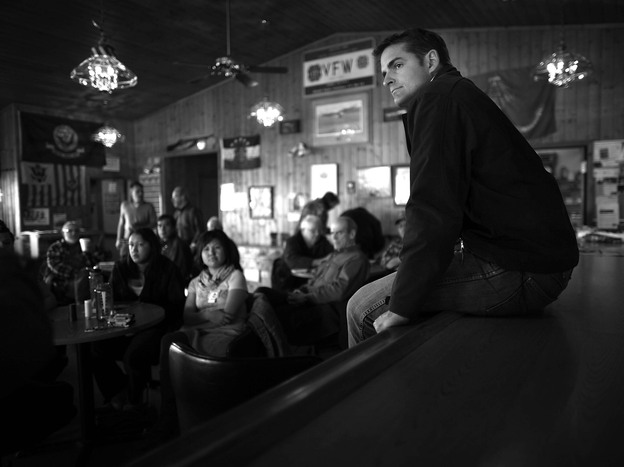
Tommy Sowers, assistant secretary for public and intergovernmental affairs at the Department of Veterans Affairs, meets with vets at the VFW Hall in Nome, Alaska. David Gilkey/NPR
Last year the VA made the distance to get care even shorter by joining with the Indian Health Service, which already has hundreds of clinics around rural Alaska and six other states. Vets, whether they are Native Americans or not, can now use the Native clinic system and the VA will pay for it.
That means vets like Howard Lincoln in White Mountain can get care near home. For Lincoln, it’s just a short walk to the village clinic, or a snowmobile ride when the snow is too deep.
Aging Veterans From Vietnam And Korea
Vets from the Korean and Vietnam eras make up the large majority of those seeking care these days, as they reach an age where health complaints are common. Lincoln’s sister Willa Ashenfleter helped him get signed up with the VA — and not a moment too soon. Lincoln had two minor strokes last year. Now he’s monitoring his health more closely.
“There’s a machine by his table that he takes his blood pressure around 8:30 every morning,” says Ashenfelter, adding that the information can be beamed directly to the VA.
At 82, he’s still fiercely independent, Ashenfleter says. Her brother worked hard to recover and stay active even after his strokes, she adds.
“Couple times he’s been on his roof … working on his stovepipe … and when we tell him he shouldn’t be up there, he isn’t happy,” she says.
Howard Lincoln was back up on his roof last winter. His sister says he doesn’t like people telling him where he should or shouldn’t go.
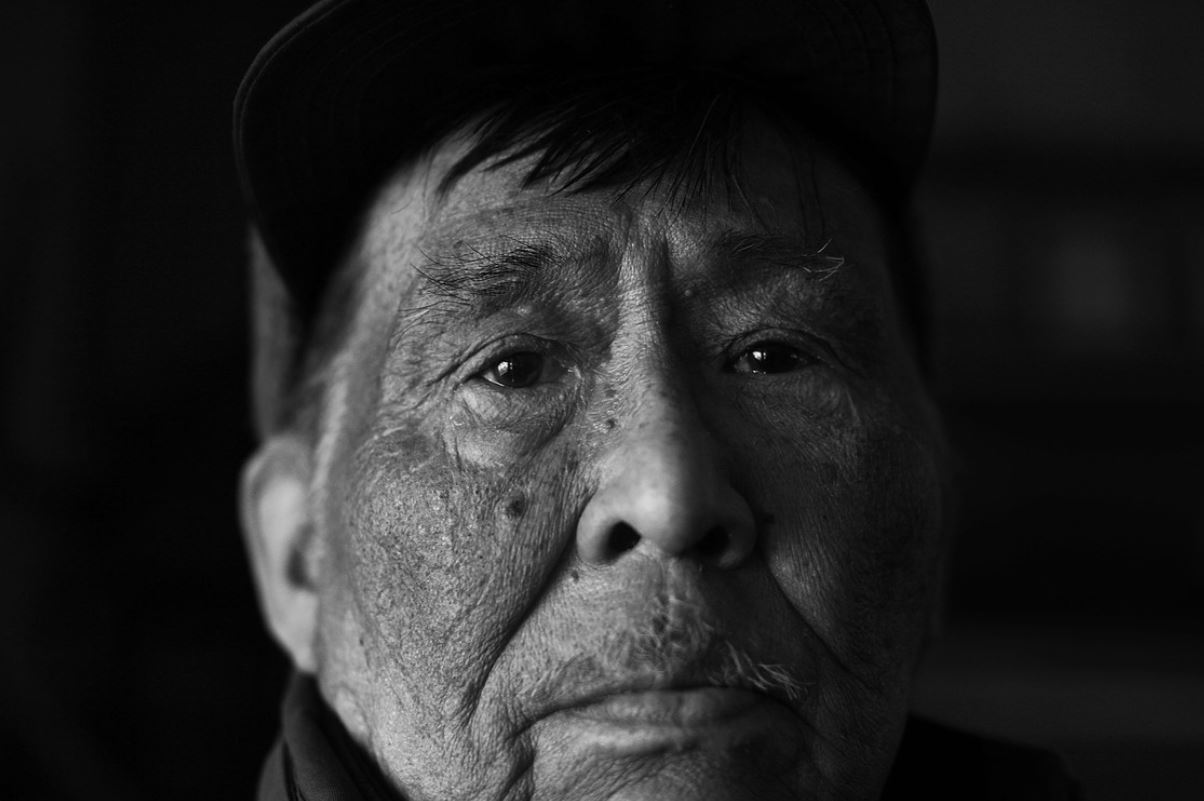
Isaac Oxereok, 69, served in the infantry of the U.S. Army from 1966-67. After “tunnel ratting” in Vietnam, he returned home to Wales and struggled with post-traumatic stress disorder. David Gilkey/NPR
When he was in Vietnam, Isaac Oxereok’s small build made him ideal for tunnel-ratting: running with a pistol and a flashlight into underground passages built by the Viet Cong. In 1967 he finished his tour with the Army and returned home to Wales, Alaska. Oxereok knew he wasn’t quite right, but there wasn’t anyone around to tell him how to get help.
“Post-traumatic syndrome?” he said. “I went through that I guess, mostly on my own. Some wounds never really show. So inside was kind of messed up.”
Wales, Alaska, has a population of about 150, including about a dozen veterans. The hunting and fishing village is cut off, except by aircraft, all winter long until the ice breaks up on the Bering Strait. David Gilkey/NPR
Now Oxereok is 69 years old and living at the edge of the Bering Strait in a village of about 150 people. On a recent clear day, the Russian mainland peeked on the horizon over just 50 miles of broken spring ice. Oxereok snowmobiled over to the community center when he heard that someone from the Department of Veterans Affairs was visiting. He had no idea what benefits he might be owed.
“The fact that Isaac doesn’t know about this? That’s why we’re here,” said Tommy Sowers, the VA’s assistant secretary for Public and Intergovernmental Affairs.
Sowers visited Alaska recently to look at what challenges rural veterans face in getting benefits, but it turns out that just finding them can be a challenge.
Twenty-two million Americans served in the military, but the vast majority are from the Vietnam and Korea generations. They’re getting older now, and many live in rural, sometimes remote areas. Alaska has the highest number of veterans per capita in the country — native Alaskans and other vets who got posted up here and never left.
“Once you get Alaska in your blood, it’s hard to get it out,” says Ron Huffman, originally from Virginia, now living in Nome.
The Air Force sent Huffman here in 1963. Then he met a local woman and got married. He and his wife still return to her tiny village each summer, where they fish enough salmon to last through the winter. He volunteers as a tribal veterans representative — a liaison between the VA and local veterans.
“Most of these vets, they’ve never applied for any type of entitlement whatsoever,” Huffman said. “And a lot of them are at the age now that they’re suffering with some pretty severe-type ailments. It would be very beneficial for them to try to get connected with” the VA.
But getting connected up here isn’t easy. And though it would seem pretty basic, the VA has no master list of who served. That means someone has to go find them, a point demonstrated by the delegation from Washington, D.C.
“We live in a country where people get to choose where they want to live,” Sowers said. “And, you know, once they raise their hand, volunteer and serve, we’ve got that obligation”
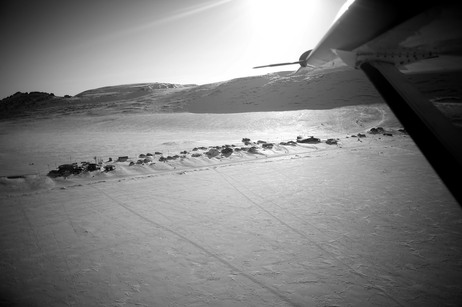
Sowers and other officials flew from Anchorage to Nome and then on a one-prop plane up to a snowy runway in Wales. The local veterans representative, Sean Komonaseak, met the visitors at the plane on his snowmobile, wearing a parka fringed with polar bear fur. Komonaseak allows that the town is pretty small.
“On a good day about 150 people. As far as government organizations, there’s hardly any representation,” he said. Komonaseak had advertised a meeting for the many veterans and their family members, including a free lunch with fresh fruit and whale meat.
By midafternoon, about a dozen veterans, family members and kids had turned out for the meeting, and Sowers introduced himself as a VA official and a former Green Beret with two tours in Iraq.
“How many here are veterans? Raise your hand if you’re a veteran,” he said.
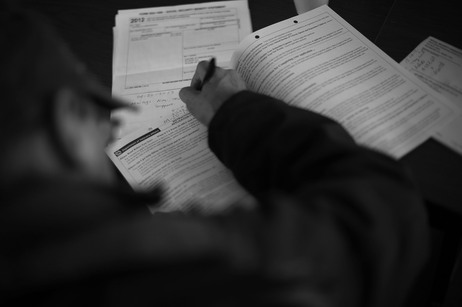
Isaac Oxereok, 69, fills out the papers needed to register for full VA care and benefits. Oxereok was in the Army and served in Vietnam from 1966-67. David Gilkey/NPR
But even that turns out to be a complicated question. Some of them were in the Alaska National Guard — and not all guard members qualify for VA. Others asked what benefits they might be able to still get from an uncle or a father who has passed away — survivors’ pensions pass to a spouse but not usually to older children.
Many say they’ve maybe filled out forms in the past but aren’t sure they filled them in properly, or mailed them, or ever heard that the VA got the papers. Sowers knows the VA is battling a reputation for red tape and backlog.
“Now, the process is not a quick process. … But the clock starts the moment we get that form in,” he said.
Sowers knows he’s only adding to the backlog by bringing these veterans in from the cold, but that’s his job. The country owes these veterans, he said, whether it’s a home loan or health care or a pension.
But even after traveling 4,000 miles to the opposite edge of the continent, Sowers finds that some of the vets in town don’t want to be found.
“Alaska has the highest proportion of veterans that serve,” Sowers said. “And in these tribal communities they have an incredibly high percent of folks that served. But even here in a town of 152 people, when we had a veterans gathering, not all of the veterans showed.”
A couple of hours into the meeting, people started to get restless. Sowers had registered a few vets and asked folks to go out and tell the other veterans in town to get in touch.
“I asked people here can we get email addresses,” he said. “They wisely told me not all have email. Our task is to reach out, but in the time, the tone and the medium the veteran prefers.”
A few questions focused on the final benefit for veterans, which is in demand these days as vets get older: a government-issued headstone. It turns out that some of the families in Wales haven’t been able to get the heavy markers delivered because they have no street address. The director of the VA for the state, Verdie Bowen, told them to just put down any address on the form and he’ll make sure the headstone arrives.
American flags and flowers marked many graves Monday at Alaska Memorial Park, where one of two Juneau Memorial Day observances is held. Photo by Rosemarie Alexander/KTOO.
Small American flags and flowers decorate Juneau grave sites as families and friends observe Memorial Day.
Monday’s warm, sunny weather brought out many more people than usual to Alaska Memorial Park Cemetery in the Mendenhall Valley. The annual observance is hosted by the American Legion as a reminder that Memorial Day is more than a federal holiday; it’s an opportunity to remember America’s fallen veterans. Retired Coast Guard Captain Carl Uchytil called it a “duty.”
Uchytil, now Juneau Port Director, noted the history of the day that began in the 1860s when families would decorate the graves of soldiers who had died in War Between the States.
Three years after the end of the Civil War, Major General John Logan coordinated the first large event at Arlington National Cemetery.
“On May 5th, 1868, the head of an organization of Union veterans, the Grand Army of the Republic, established Decoration Day as a time for the nation to decorate the graves of the war dead with flowers. Major General John Logan declared Decoration Day to be observed on May 30th. It is believed he chose this date because flowers would be in bloom throughout the country,” Uchytil told those gathered at Alaska Memorial Park.
Prior to the Arlington ceremony, springtime tributes to soldiers who had died in the Civil War had been held in many places across the country. Now at least 25 U.S. communities in both the North and South claim to be the birthplace of Decoration Day.
In 1966, Congress declared Waterloo, New York as the official birthplace of that day, now called Memorial Day. The first observance was held in Waterloo in 1866.
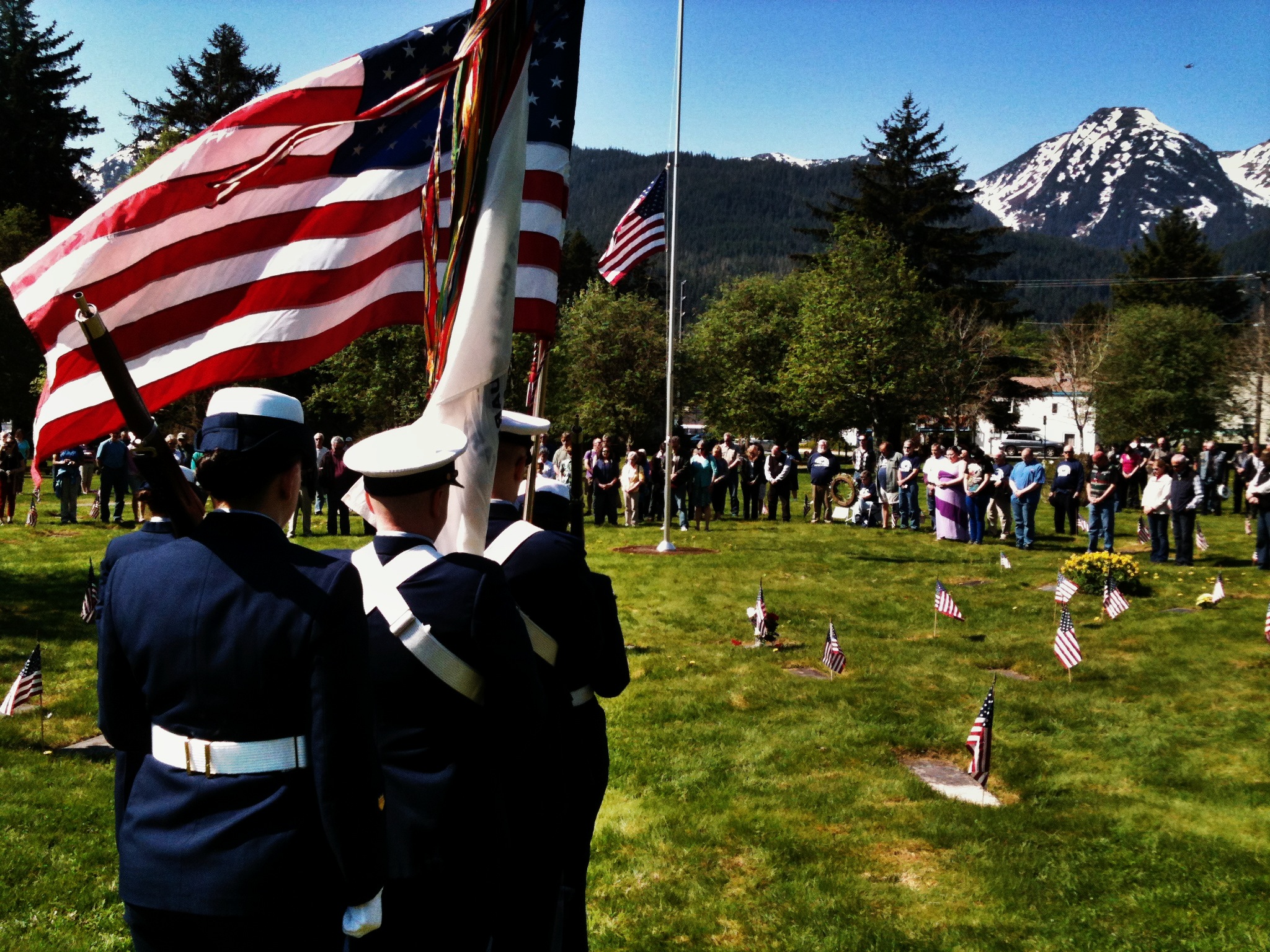
U.S. Coast Guard color guard at Evergreen Cemetery during Monday’s Memorial Day ceremonies. Photo by Matt Miller/KTOO News
Two Memorial Day services are held annually in Alaska’s Capital. Veterans of Foreign Wars Taku Post 5559 hosted this year’s ceremony at Evergreen Cemetery downtown and it included Mayor Merrill Sanford, a U.S. Marine Corps veteran, as the keynote speaker.
Today is a wonderful day to be here and I’m proud to be here as a veteran. And I’m proud of each and every one of you who are veterans. We’re here to give thanks to people who have lost their lives in our country’s battles, some of our own right here in Juneau. I was lucky enough to go to school with Donald and Charles back in the sixties.”
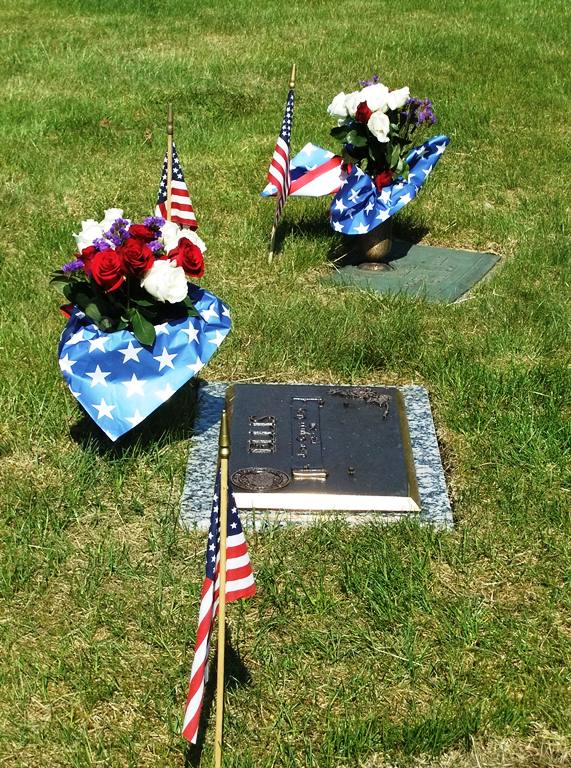
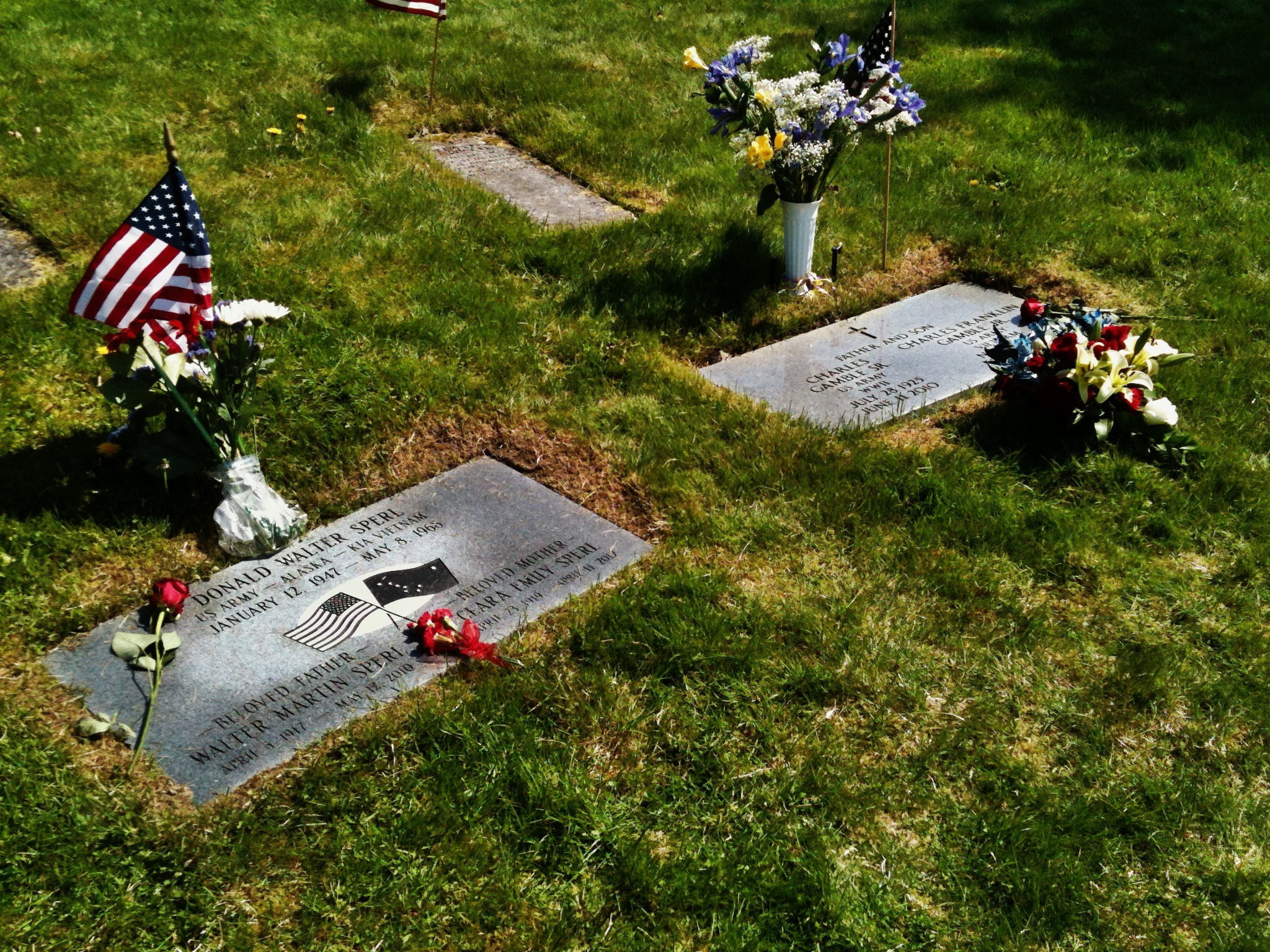
Sanford was referring to Donald Sperl and Charles Gamble. Jr. who were killed in Vietnam and are laid to rest just a few steps from where he was speaking. He read an essay and set of poems about the sacrifices of soldiers and veterans.
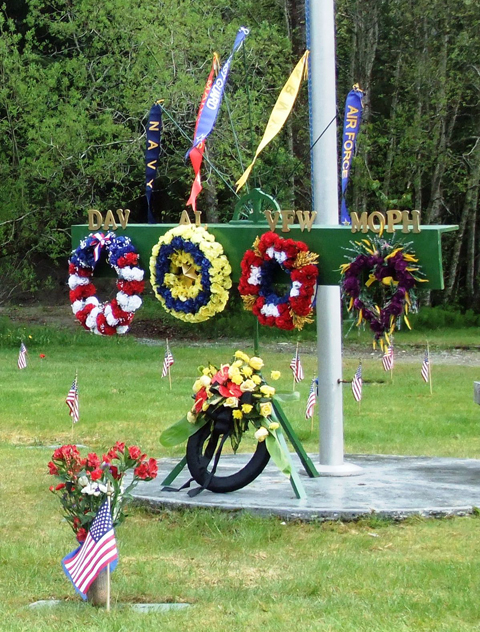
Various local groups including the Veterans of Foreign Wars, Elks, Juneau Veterans for Peace, and Harley Owners Group all laid wreaths around the base of the flagpole at Evergeen Cemetary.
The headstones of Donald Sperl and Charles Gamble, Jr. during Memorial Day observances on Monday. Photo by Matt Miller/KTOO News
Post vice chaplain Kirk Thorsteinson read the opening prayer and closing benediction, a Coast Guard color guard presented the colors, and Juneau-Douglas High School student Adrienne Sypeck played taps.
Small American flags were placed at the headstone of each service member who was buried at Evergeen Cemetery. They included Juneau veterans who served during the Spanish-American War.
Wreaths at at the Alaska Memorial Park Cemetery, Memorial Day 2012. Photo by Rosemarie Alexander.
Memorial Day observances will start at 11 a.m., Monday, at Evergreen Cemetery in downtown Juneau and at Alaska Memorial Park on Riverside Drive in Mendenhall Valley.
The annual events are Juneau’s recognition of the national holiday and a local remembrance.
Veterans of Foreign Wars Taku Post 5559 will host the event at Evergreen Cemetery. Mayor Merrill Sanford will be the keynote speaker.
Auke Bay American Legion Post 25 Commander Dick Hand will officiate at the Alaska Memorial Park observance. Juneau Port Director and retired U.S. Coast Guard Captain Carl Uchytil is the keynote speaker.
Veteran Tim Armstrong says remembrance is the purpose of the events. Though the memorials are relatively short, each is an important observance.
“It’s a way to remember those who have fought and died in the service of their country,” Armstrong says.
On Memorial Day, the American flag should be at half-staff until noon then raised to full staff.
Originally known as Decoration Day, Memorial Day was first observed after the American Civil War.
Five members of Alaska’s Air National Guard reached to the top of Mount McKinley in Denali National Park on May 9.
Maj. Matt Komatsu, Chief Master Sgt. Paul Barendregt, Tech. Sgt. Kyle Minshew, Staff Sgt. William Cenna and Staff Sgt. Brett Wilson spent two weeks ascending the mountain as part of a training exercise in winter survival skills.
Two men on the team had been on Denali before. Barendregt had summited twice before and Cenna had previously climbed. For Komatsu, Minshew and Wilson, it was their first trip up Denali.
“We were dropped off by the 210th Rescue Squadron in a HH-60 Pave Hawk helicopter on April 25 and began our training the next day to enhance our high altitude winter rescue and glacier skills,” Komatsu said in a press release.
“The nature of climbing Denali provided our team the training we needed in terms of being able to survive in those types of climates. We went out there to train, with the added benefit of summiting Denali if possible.”
The group started their ascent on April 26 and climbed for approximately 6-8 hours each day. The group had 4 storm days where they had to stop climbing and stay in their tents. The worst weather happened in the lower altitudes while the group was making their way up the glacier.
“Our daily plan was pretty predictable,” Komatsu said. “You wake up when the sun hits your tent, spend a couple hours getting something to eat and drinking plenty of water before preparing for the day’s movement. Nothing super spectacular, but sort of the patient approach to the route is the best way to avoid getting altitude sickness.”
Since it’s still early in the season, the team benefitted from the lack of people on the mountain and allowing them to train in isolation. By the time the team came back down, they say that people were starting to fill up camps.
“Nowhere else can we experience true winter environments, true glacier environments to help facilitate our training for overland movement, rope travel, glacier techniques so we’re more confident in the mountains and traveling through them to assist with rescues…This training is absolutely essential and borderline mandatory for guys to get up there and experience,” Cenna said.
“I had never been on a mountain like that with any kind of altitude. I’m the new guy up here,” said Minshew. “You’re living it day in and day out. You’re constantly immersed in that environment. It just forces you over time to just adapt.”
The Guardsmen are part of 212th Rescue Squadron, also known as Guardian Angels. Two more teams from the squadron will head to Denali this season to train in rescue and climbing operations.
Three members of the squadron are assisting National Park Service climbers in rescue operations on the mountain as part of the Volunteers-in-Parks program.