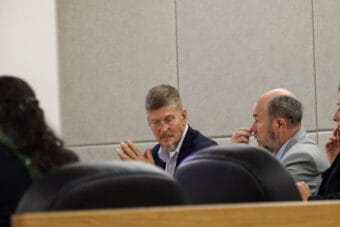
U.S. Sen. Dan Sullivan speaks to reporters in Juneau on March 20, 2025. (Screenshot from Gavel Alaska)
U.S. Sen. Dan Sullivan veered into criticizing a federal judge when he spoke to reporters at the state Capitol on March 20.
“I don’t want to get specific, but we have a couple district judges that rule with the far-left radical environmental groups every single time,” Sullivan said. “And that judge, in my view, has done more damage to our state than almost anyone imaginable.”
It was obvious whom he was talking about, because Sharon Gleason is now Alaska’s only fully active U.S. District Court judge. He went on to assail her impartiality again a moment later, when discussing his intentions for selecting the next federal judge to serve with Gleason.
“My red line is, we’re not going to have another judge like the one that we were talking about,” Sullivan said. “I’m going to make sure Alaska does not get a federal judge who sides with the far-left radical enviros on every case.”
Sullivan’s remarks caused a stir in Alaska’s legal community. Lawyers familiar with Gleason’s record say Sullivan is mischaracterizing her.
“She does not always rule in favor of environmental groups,” said former Anchorage attorney Jeff Feldman. “And I can say that both by looking at her history as well as from personal experience, because she has ruled against me in environmental cases, or against my clients.”
To cite a few prominent examples:
In 2021, Glease ruled against environmental groups trying to block oil leasing in the Arctic National Wildlife Refuge.
In 2023, Gleason dismissed lawsuits aimed at stopping Willow, ConocoPhillips’s oil and gas project in the National Petroleum Reserve.
And then, on March 25 she issued her decision favoring a state-owned investment bank that won leases in the Arctic Refuge.
Feldman, now a law professor at the University of Washington, said 81% of Gleason’s decisions are upheld on appeal, a slightly higher rate than other federal judges who have served in Alaska. Feldman considers Sullivan a friend. He said that while it’s fair to criticize specific judicial decisions, it’s inappropriate to “throw rocks at a judge” by alleging a bias that doesn’t exist.
“When a leader makes that kind of allegation, that suggests that a judge’s rulings are both wrong and politically motivated, that undermines faith and confidence in the judiciary,” Feldman said.
Federal judges are nominated by the president and confirmed by the Senate. By tradition, the senators from the state with the judicial vacancy play a big role. They usually select a candidate and send the name to the White House. For several decades, Alaska’s U.S. senators have made their selection with the help of the Alaska Bar Association. The Bar Association collects names of applicants and then polls its members about them.
Sen. Lisa Murkowski likes the process. Sullivan doesn’t.
“One bar poll is not a reflective of what’s out there, in my view, and I feel very strongly about that,” Sullivan said.
Case in point, Sullivan said, is Joshua Kindred’s selection. Kindred was the District Court Judge who resigned last July amid findings of improper conduct. Sullivan praised Kindred at his 2019 Senate confirmation hearing but speaks of him with disgust now and is quick to point out he wanted someone else.
To Sullivan, the Kindred fiasco shows the need for more pre-nomination screening. So Sullivan is using a method he devised: He’s appointed a committee of Alaskans to collect and review applications.
Sullivan has been keeping most of his process under wraps, including who the potential nominees are. Sullivan said confidentiality attracts more applicants.
Retired state court judge Elaine Andrews said the Bar poll works well if senators choose from the top end of the list. Kindred finished near the bottom. Andrews says she wonders about applicants who will only step up for Sullivan’s secret process.
“If they’re afraid of a terrible bar poll,” she said, “because they’re either inexperienced, intellectually unqualified, or an ideologue that they know people do not believe will be fair — well, then we’ve got a problem.”
Andrews said nominees should represent the best and the brightest, and that the Bar poll helps with that because attorneys are the ones who know the work habits and professionalism of their colleagues.
“The goal should be to find a person who is willing to work, who’s capable of understanding the complex matters that comes before the federal court, and who has the courage to apply the law to the facts and decide the case,” she said.
Alaska has two vacant positions on the U.S. District Court bench. Sullivan said he and Murkowski could not agree on judicial nominations last fall but are working to find candidates they both like.
The Alaska Judicial Council holds a public hearing about applicants for two Anchorage Superior Court judge positions in the Boney Courthouse in Anchorage on Nov. 16, 2022. . (Photo by Matt Faubion/Alaska Public Media)
This story was originally published by ProPublica. ProPublica is a Pulitzer Prize-winning investigative newsroom. Sign up for The Big Story newsletter to receive stories like this one in your inbox.
Alaska’s Supreme Court has placed new limits on how long criminal cases can be postponed, part of an effort to reduce the time many criminal defendants wait to face trial in the state.
The court’s order, which takes effect May 12, directs state judges to allow no more than 270 days of new delays for criminal cases filed in 2022 or before. Court system data shows that about 800 active cases fall into that category, making each one more than 800 days old and counting.
The time to resolve Alaska’s most serious felony cases, such as murder and sexual assault, has nearly tripled over the past decade. Victims rights advocates had long complained that judges rubber-stamped delays, particularly in Anchorage, where about half of the cases impacted by the Supreme Court order are pending. Some cases dragged on so long that victims or witnesses had died in the meantime.
In addition to capping the duration of delays, the state Supreme Court’s order says judges must explain why they’ve allowed any request for delay.
“It’s a positive step by the court to be able to work with the lawyers to move cases along,” said state Sen. Matt Claman, D-Anchorage, chair of the Judiciary Committee, which held a hearing on pretrial delays in February.
Alaska Court System spokesperson Rebecca Koford said the new Supreme Court order, issued on March 12, tackles the “most pressing concern.”
The time needed to close out the oldest cases “is exceedingly long,” she said, “and we need to get them resolved.”
The Supreme Court order said judges in pre-2023 cases are to allow only 90 days of new delays at the request of the defense, 90 days for prosecutors and 90 days for “other periods of delay for good cause.”
Koford said that an example of why a case might be delayed for good cause would be when a witness is temporarily unavailable to testify. Additional efforts are in the works to reduce the time it takes cases to get to trial, she said.
“We do not view it as the solution; it is part of the solution,” Koford said.
Alaska criminal rules grant defendants the right to a trial within 120 days of being charged with a crime. Crime victims have the right to the “timely disposition” of their case under the state constitution.
The 120-day deadline is rarely met. One sexual assault case highlighted by the Daily News and ProPublica was filed in 2014 and has been delayed more than 70 times. That case has now been set for trial on April 1.
Several high-ranking state officials have spoken of the need to rein in delays since the news organizations highlighted the issue in January.
Chief Justice Susan M. Carney told state lawmakers on Feb. 12 that the court system was working to curb delays, noting recent news coverage of the issue. The Senate Judiciary Committee held a hearing focused on pretrial delays later that month, when court system General Counsel Nancy Meade told legislators that the cases recently highlighted in news stories were unacceptable but were outliers among criminal cases.
“The time it takes to resolve cases now is certainly longer than it was 20 years ago. Nobody is happy about that,” Meade testified.
The new order signed by Carney and other Alaska Supreme Court justices said that a 2023 judicial order had led to “some decrease” in what the court characterized as “persistent backlogs.” The current order, the court said, “is intended to facilitate the further reduction in the time to disposition of these older criminal cases without undue delay.”
The order also addresses delays caused when attorneys fail to provide evidence to the opposing party in a timely manner. It says that judges should consider sanctions, including dismissing the charges, when prosecutors fail to provide evidence or banning the missing evidence from being used at trial.
French bulldogs Whiskey (top) and Yoda (bottom) were found dead in March 2025, in crab pots near Southeast Alaska’s Thorne Bay. (Courtesy of Esther Rose Martin)
Content warning: this story includes details of possible animal abuse that some readers might find disturbing.
The remains of two French bulldogs that went missing on Southeast Alaska’s Prince of Wales Island over a month ago were found in a pair of crab pots on Friday.
The dogs belonged to Prince of Wales residents Esther, Kane, and Shane Martin. According to Kane Martin, the dogs disappeared just before Valentine’s Day. He’d taken them to work at a logging operation near Thorne Bay.
“We take the dogs to work with us every day and they just run back and forth between us while we’re working,” Martin said. “At about 9:30 a.m., we didn’t see them anymore. We figured they just went up and stayed at the pickup but they didn’t. Somebody came by and picked them up.”
Martin said he thinks someone abducted the dogs from Sandy Beach Road near the timber site. They were about a year old.
“They were great little dogs, I mean, just lovable as hell. I’m sure that’s why they just jumped in somebody’s rig with them,” he said.
Martin and his family posted flyers with pictures of the missing dogs – named Whiskey and Yoda. They advertised a $500 reward for their return. After a couple weeks without a lead, they doubled the reward.
About a month later, Alaska Wildlife Troopers were doing routine inspections of shellfish pots around Thorne Bay Harbor. They hauled up two crab pots that each had the remains of a dog in them. Troopers compared photographs and information from the Martins. They identified the dogs as Whiskey and Yoda.
According to Martin, law enforcement dropped the pots back in the water to see if their owner would come back for them, but someone came in the middle of the night and took the pots.
Trooper spokesman Austin McDaniel declined to share more information on the crab pots or their potential owner. He said the case is being investigated and troopers are attempting to corroborate information from potential witnesses before sharing it with the public.
Martin said he is also offering a $2,500 reward for information on the people involved.
“The troopers told me they thought it was something personal. I mean, there’s only one person on this island that has any kind of vendetta against me at all and it’s not even that much that I know of. I mean, I’ve lived here my whole life,” he said.
Anyone with information regarding the disappearance of the bulldogs are encouraged to contact the Prince of Wales Trooper Post at 907-826-2291.
Left: William Farmer (Photo provided by Robin Farmer) Right: Lawrence Fenumiai (Photo provided by Simeona Galletes-Fenumiai)
The lives of William Farmer and Lawrence Fenumiai ran parallel before merging with deadly consequences at the Anchorage jail in December.
Both men were diagnosed with schizophrenia in their 20s, their relatives say. Both families struggled to find help.
And both Farmer and Fenumiai ended up in Alaska’s correctional system, where people with mental illness make up nearly a quarter of the in-custody population but can’t always get the therapeutic support they need.
On Dec. 17, less than 24 hours after the men began sharing a cell, Alaska State Troopers say Fenumiai fatally beat Farmer, who died in early January.
Now Fenumiai faces first-degree murder charges as both families question the way the Alaska Department of Corrections handled the challenge of housing two people with diagnosed mental health disorders in a crowded jail cell.
Why were Farmer and Fenumiai placed in the same cell to begin with? Why was that cell in a transitional intake area rather than the jail’s designated mental health unit? And why was Fenumiai still there after a judge dismissed the case against him a week earlier?
Farmer’s twin sister, Robin, said her brother had been struggling with mental turmoil and hallucinations and couldn’t always make choices that were in his own best interests.
“I remember thinking, ‘Well, at least he’s safe,’” she said of his arrest in December. “That’s not true. You’re not safe in jail either.”
‘They set him up for failure’
The Department of Corrections is conducting an internal investigation that is ongoing, state officials said this week. Such investigations are standard for any death connected to a DOC facility.
“We want folks to come into our system and leave our system better, and to have a negative outcome like that, it bothers all of us,” said Adam Rutherford, the department’s deputy director for health and rehabilitation services. “None of us want to see that type of event occur.”
Farmer was 36 when he died. He came from an Anchorage family with deep Alaska roots that included a few generations of bush pilots and ownership of a Mat-Su lodge.
Police said Farmer had just entered the jail after a string of robberies at several Midtown businesses in late November and early December.
He was placed in a cell with two other men. Instead of a bunk, he was provided a plastic “boat” on the floor in a cell designed to hold two people.
Fenumiai, a 33-year-old former football standout at Juneau-Douglas High School, was already in the cell when Farmer arrived. He was awaiting release after a judge found him incompetent to stand trial.
Fenumiai had entered the correctional system in May when he was arrested in Juneau after an outburst at his family’s home. He hit his father in the head, destroyed his iPhone and damaged a cabinet, according to a police report summary included with a criminal complaint.
Fenumiai’s mother, Simeona Galletes-Fenumiai, said she doesn’t understand why their son was in a shared cell when he was held alone in Juneau over concerns he could hurt himself or others.
“They set him up for failure,” Galletes-Fenumiai said.
She said she prayed for Farmer’s recovery in the days before he died.
The state’s only psychiatric hospital, Alaska Psychiatric Institute in Anchorage, has come under fire for years for a lack of beds that keeps mentally ill defendants waiting in jail for evaluations or facing monthslong wait lists for treatment.
The state’s overall lack of mental-health treatment capacity bleeds into the correctional system, officials say.
About 22% of people in the state’s jails and prisons “suffer from a severe and persistent mental illness,” according to Rutherford, the deputy state corrections director.
The Anchorage Correctional Complex. (Loren Holmes / ADN)
Corrections officials would rather see many of those people treated by professionals in the community, rather than behind bars in an environment not designed to be therapeutic, he said.
“We’re the largest behavioral health provider in the state, and we shouldn’t be, and we don’t want to be,” Rutherford said.
When December’s encounter occurred, Farmer and Fenumiai shared a two-person cell with a third man on an intake area known as Alpha mod. The unit includes 16 double-occupancy cells on the east side of the Anchorage Correctional Complex.
Alpha mod is considered a “specialty management” open population housing unit, according to Department of Corrections spokesperson Betsy Holley. The area houses people with mental health or addiction issues that may set them apart from the general population.
It’s designed for people who may need more support or observation when they enter custody, according to Holley.
Nursing staff visit that part of Alpha mod at least three times a day, corrections officials said. Mental health staff visit at least once a day.
The mod is not, however, part of the jail’s designated mental health unit.
Perpetual purgatory
Robin Farmer said her brother was a bright person fascinated by aviation and the kind of animal lover who adopted senior dogs at the shelter even though he knew they might not live long.
William Farmer with his sister, Robin. (Photo provided by Robin Farmer)
His personality started to change when they were in their 20s, she said.
William Farmer found their mother dead when he and his sister were both seniors in high school, Robin Farmer said.
It was a week before final exams, a pivotal time in both their lives. She now wonders if the trauma of that time served as some kind of trigger for the mental illness that was coming.
The family noticed that William’s community was shrinking as it became harder for him to stay engaged, she said.
“These symptoms and hallucinations, over time, kept increasing more and more and more,” Farmer said. “That kind of ended up leading to him being in and out jail, in and out of API, on and off medication.”
The family struggled to find treatment, but occasionally found success, she said. During one period in custody, her brother spent three months at API and was moved into transitional housing.
“That was something that was really great: to see him get healthier, get happier and just get more back to himself,” Robin Farmer said.
Several years later, by December, he was back in jail on robbery, theft and assault charges. Police said he stole merchandise from three stores and used or brandished pepper spray before fleeing.
Less than 60 seconds
The Anchorage Correctional Complex. (Loren Holmes / ADN)
The jail cell assault happened very quickly, according to official accounts.
The third man in the cell said Farmer was lying on the floor, talking to himself with phrases like “shut up” followed by an anti-gay slur, when Fenumiai came off his top bunk, according to a sworn affidavit filed with murder charges by the Alaska State Troopers.
The other cellmate told investigators Fenumiai told Farmer to “shut the f— up” before he started punching him in the head, according to the affidavit. The smaller man was unconscious in under a minute, troopers wrote.
Corrections officers couldn’t safely get into the cell to intervene right away, the affidavit said. When they did, Farmer was limp on the floor.
He was rushed to Providence Alaska Medical Center for treatment of a traumatic brain injury.
The family didn’t get to see Farmer until more than 24 hours after the assault, his sister said. His eyes were blackened, his face was swollen, and he was breathing with help from a ventilator.
His feet were handcuffed to the bed even though he was unconscious, she said.
Christmas week passed with no change in his status. The hospital classified Farmer’s condition as critical.
Robin Farmer said the family made the decision to take her brother off the ventilator on Friday, Jan. 3. William Farmer wanted to be an organ donor but too much time lapsed between the ventilator’s removal and when his heart stopped beating, his sister said.
He didn’t die for another three days, nearly three weeks after the attack.
“We had to go through the trauma of experiencing the fact that somebody did this to him and killed him but we also had to go through the weight and heaviness of having to choose to let a family member go,” Robin Farmer said. “Both of those things are pretty unbearable on their own, let alone compounded on top of each other.”
She visited daily and stayed in her brother’s hospital room until 10 p.m. on Jan. 5.
He died early the next morning. Their mother’s ashes sat nearby.
Sharing a crowded cell
Various decisions and delays factored into the paths that put Farmer and Fenumiai together in that cell.
Lawrence Fenumiai appeared in court in Anchorage on February 19, 2025. Fenumiai is charged with murder after the death of a fellow inmate at Anchorage Jail in December. (Marc Lester / ADN)
After his arrest in May, Fenumiai was housed in a segregation unit at Lemon Creek Correctional Center in Juneau, Department of Corrections records show. He was flown to Anchorage in June for assessment and stayed in custody in Southcentral after that.
None of the three men sharing that Anchorage cell on Dec. 17 met the criteria for segregation at that time, according to Holley.
Asked how any decisions to house Farmer and Fenumiai together were made, corrections officials said they couldn’t provide specifics due to confidentiality requirements and safety policies.
Generally, decisions about where to house inmates are made by mental health clinicians who assess people in custody and then make recommendations in collaboration with security staff, Holley said.
Given the limited number of jail cells and the fact that prisoners in specialty management can’t be housed with others, prisoners with similar custody or segregation levels often end up together, she said.
“We do try to avoid assigning three prisoners to a cell but occasionally it happens, especially in specialty housing situations,” Holley said.
Released too late
A Juneau judge dismissed Fenumiai’s charges in a hearing Dec. 13 but the paperwork ordering his release from jail and transport out of custody didn’t get to the right desk for days.
Juneau District Court Judge Kirsten Swanson found Fenumiai was not competent to stand trial in the assault case involving his father and dismissed the charges effective Dec. 16, according to a signed order. She wanted Fenumiai released to his family in Juneau instead of in Anchorage where he didn’t have a support network, state courts officials say.
Such a transport would generally involve at least one escort on a non-commercial flight.
While releases like this usually take two or three days, the court system and Department of Public Safety court services officials were still coordinating Fenumiai’s transport several days later, according to Alaska Court System spokeswoman Rebecca Koford.
Any delays in Fenumiai’s release were due to the challenges of arranging transport, Koford said.
The original release order was emailed on Dec. 13 to the Department of Corrections, she said.
The judge canceled the transport order on Dec. 19 — two days after the assault.
‘Other people’s beloveds’
Fenumiai’s mother believes the system failed both her son and Farmer.
Fenumiai, one of six siblings, was a Juneau high school athlete whose football talents earned him a full ride to Arizona Western College, his mother said.
It was while he was away at school that his family realized he had changed, keeping to himself and exhibiting signs of paranoia, according to Galletes-Fenumiai. The changes led to Fenumiai’s schizophrenia diagnosis.
Fenumiai left college and lived with his family in Juneau, staying in a room they built for him to provide some privacy as well as supervision.
The family managed her son’s diagnosis by trying to keep him on his medication, providing support, and remaining sensitive to his moods, Galletes-Fenumiai said. When he started getting irritated or ramping up, they would let him be alone until he was ready to rejoin them.
Galletes-Fenumiai said during December’s competency hearing process, the family was told her son needed treatment. There was a 140-day waitlist to get into API.
She and her husband traveled to his home country of Samoa for an important ceremony after the mid-December competency hearing. They had listened in by phone from Juneau. They didn’t realize he wasn’t released. They were excited he was coming home.
Galletes-Fenumiai learned about the December assault from an Anchorage Daily News reporter.
She said she is struggling to come to grips with the circumstances that left her son in a position to hurt someone so badly.
There’s a word in Samoan that means “other people’s beloveds,” Galletes-Fenumiai said.
“These people that work at DOC, in mental health and all that, this is what they have,” she said, becoming emotional. “I wish they would just take that thought of other people’s beloveds that are in their hands. Because this could have been avoided.”
This story was republished with permission from the Anchorage Daily News.
Jeremy Cubas, pictured May 23 at Gov. Mike Dunleavy’s Alaska Sustainable Energy Conference in Anchorage. (Nathaniel Herz for Alaska Public Media)
Note: This story contains hypothetical references to sexual assault.
Jeremy Cubas, a former policy adviser to Alaska Gov. Mike Dunleavy, has filed a libel lawsuit against two reporters and three news organizations, according to an Anchorage Superior Court filing dated Feb. 24.
In 2023, Cubas resigned from the governor’s office after the reporters questioned him for an article about a podcast in which he made multiple inflammatory comments, including that divorce was worse than rape and that it was impossible for a husband to rape his wife.
Cubas, representing himself in court, alleges in his filing that reporters Nat Herz and Curtis Gilbert acted with malicious intent when they paraphrased Cubas as having said “it’s fine for a man to force himself on his wife.”
In court filings, Cubas states that he said, “‘I don’t think it’s possible to rape your wife. I think that that’s an impossible act,’ but then immediately clarified that violent penetration of a wife is wrong.”
Cubas taught philosophy classes at the University of Alaska Anchorage for four years and his podcast was devoted to discussions of philosophy. He said by phone on Tuesday that what Herz and Gilbert wrote isn’t the same as what he said.
“One is an ontological claim, a claim of reality, while he then says that I made a normative claim, or a moral claim,” Cubas said.
Cubas also claimed in the filing that a second section of the article incorrectly characterizes his position on rape.
“What’s more important for me than any of the money that I’m asking for is really — I want an apology,” he said by phone. “I want a public apology from them.”
Cubas’ filing did not dispute sections of the article that discuss Cubas’ defense of Adolf Hitler, casual use of a racial slur, disparaging remarks toward transgender activists, and his labeling of Martin Luther King Jr. as a “loser.”
By phone, he said that those conversations involved discussions about the dichotomy of good and evil and how historical figures have more nuance. While he doesn’t agree with the articles’ description of them, “I find that part to be a little more difficult to (legally) argue,” he said.
The filing is taking place two years after his resignation, Cubas said, because he needed to take care of personal matters first. He has nine children, and having lost his job, he said his family took priority.
In his filing, Cubas said his children “suffered emotional distress due to targeted harassment” as a result of the news articles, and claimed the articles gave information about the school that they attended. The article Cubas referenced in his filing does not identify his children’s school.
In his filing, Cubas seeks $5.3 million in compensatory damages, punitive damages, and attorneys fees. In addition to Herz, an Alaska journalist who worked on the article for Alaska Public Media, and Gilbert, who co-wrote the article while working for American Public Media, the lawsuit also named three organizations as defendants: Alaska Public Media and American Public Media, which co-produced the story, and the Anchorage Daily News, which republished the article.
Reached by phone in Norway, Herz declined to comment on the lawsuit. An editor at American Public Media also declined comment. The Alaska Beacon regularly republishes articles by Herz and his newsletter, Northern Journal.
Attorney John McKay is representing Alaska Public Media and the Anchorage Daily News. The ADN had no comment on the case, McKay said, but on behalf of Alaska Public Media, he said, “We are confident this suit is without merit and will defend it vigorously.”
McKay has represented the Alaska Beacon in other matters.
The case has been preliminarily assigned to Judge Christina Rankin. No court date has been set.
Correction: This article has been updated. Cubas’ disparaging remarks were directed toward transgender activists, not transgender people. In addition,Cubas claimed the articles gave information about the school his children attended. The article Cubas referenced in his filing does not identify his children’s school.
Goose Creek Correctional Center is seen in fall. (Photo courtesy of Alaska Department of Corrections)
The family of Lewis Jordan Jr. and the American Civil Liberties Union of Alaska filed a wrongful death lawsuit this week against the Alaska Department of Corrections and several staff.
The lawsuit filed on Tuesday charges that antibiotics and medical care for an acute ear infection would have saved the life of the 53-year-old Jordan, while incarcerated in Goose Creek Correctional Center in Wasilla in March 2023.
The lawsuit alleges that corrections staff displayed “deliberate indifference,” repeatedly ignoring Jordan’s pleas for medical treatment, leaving him in extreme pain with flu-like systems for several days. His condition progressed into a fatal case of bacterial meningitis — he was hospitalized, in a coma for several weeks, until his family removed him from life support, according to the lawsuit. The family said Jordan was otherwise in good health.
A spokesperson with the Department of Corrections declined to comment, and said the state’s attorney will respond in court.
The lawsuit is filed in federal court by the estate and family members of Jordan, represented by the ACLU of Alaska and Colorado-based attorney Zachary Warren.
“He was a son, a sibling and a cherished member of his family, and he unfortunately got tied up in the criminal legal system,” said Megan Edge, director of the ACLU of Alaska’s Prison Project, in an interview Thursday.
“When he was returned to custody, it was for a traffic infraction, and they revoked his parole,” she said. “And that’s such a ridiculous thing to have to die for. His family is absolutely devastated.”
The family is seeking justice for his death, including compensatory and punitive damages, as well as raising awareness around systemwide concerns with DOC policies and treatment of inmates, Edge said.
Edge emphasized people in prison are at the whim of corrections staff in accessing medical treatment. Although Jordan repeatedly submitted requests to visit the medical unit and receive evaluation and treatment, he was never permitted the opportunity to see a medical provider, according to the lawsuit, which charges staff with a pattern of “gate-keeping medical care.”
“Oftentimes what we see is this distrust from staff to inmates when incarcerated people ask for help,” Edge said. “But having an ear infection is so common, it is something that we know how to treat. But incarcerated people don’t have power over their medical care, and so they are at the mercy of this massive system.”
The lawsuit said other detainees pleaded for him to get care, and were also ignored by staff. For days, he became “visibly weaker, sicker, and unable to even get out of bed.” When he was found unresponsive in his cell, prison staff “instead fixated on the unsupported idea that Jordan was experiencing an overdose,” administering Narcan, according to the suit. That caused him not to receive the proper diagnostic treatments in the following hours.
DOC staff placed Jordan in shackles and a spit hood, despite being unconscious, according to the lawsuit, and transported him to the Mat-Su Regional Medical Center.
“Absolutely dehumanizing,” Edge said of the DOC practice of using the restraint device on unconscious people. “Unfortunately, this is something that we see. He is not the only person who has passed (in-custody), and who has been transported to the hospital while they are unconscious and shackled and with a spit hood. It’s so inhumane and disturbing to visualize.”
Additionally, staff’s incorrect identification of an overdose severely delayed proper care at the hospital, the lawsuit charges. The severe progression of meningitis led to medical staff to place him in a medically induced coma, with no recovery. His death was “entirely preventable,” the lawsuit charges.
During the several weeks Jordan was in a coma, he was paroled from DOC, which the lawsuit alleges “uses this power to shield from scrutiny for deaths that are a result of its inadequate medical care.”
“He was paroled while he was unconscious. I have a hard time wrapping my head around that, because it’s so hard for people in the state of Alaska to get parole, and especially after a technical violation, but even more so, like, without applying for it. So, you know, we do have questions there,” Edge said.
“What we would like to see is the department taking responsibility for the death of people, even if they’re in a hospital bed, even if they’re a month later because they’ve been on a ventilator for a month, but if they die because of what happened while they were in the care of the Department of Corrections, the Department of Corrections should absolutely be taking responsibility for their death.”
The lawsuit cites the deaths in outside hospitals that DOC similarly attributed as not being in-custody deaths, including Jimmie Singree and Angelena McCord in 2023.
Since 2022, at least 42 people have died while incarcerated in DOC custody, with at least nine identified as suicides, according to the department.
So far this year, there have been two deaths — the most recent was announced on Tuesday as Reginald Eugene Childers, Jr. who was being held pretrial at the Anchorage Correctional Complex.
“Our interest is ultimately reducing deaths in-custody,” Edge said. “And the only way to be able to problem-solve that, is to have an accurate picture of what actually happened. Where are the gaps in care, where are the issues? And then how can we all work together to solve those? Because, like I said, those are valuable people in our community. They’re someone to someone.”
Edge emphasized the need for further transparency and likely policy changes around the quality of medical care, particularly detox protocols, as well as changes to allow those with serious medical issues to be paroled.
“We do have those mechanisms, but because of how those are designed, they’re very inaccessible to people,” she said. “So there are people who are very sick, who are trying really hard to come home, but their discretionary parole is denied for arbitrary reasons, or they don’t know that they can apply for geriatric or medical parole. So I think, like we do have some of the systems, but they need improvements, and they’re totally achievable.”
This is the third wrongful death lawsuit filed by the ACLU since 2023. The civil rights group is seeking restitution and damages for the families of James Rider and Mark Cook Jr., who died in pretrial custody, without being convicted of a crime.
The Department of Law did not return requests for comment about the status of those lawsuits.
“Many of the people that we have seen die are pretrial defendants who are accused of low-level crimes,” Edge said.
“Alaska does not have the death sentence, but by sending people to our jails and prisons, we’re sending them to a really dangerous place where death is totally possible for things that are entirely out of control,” she said. “Overcrowding, staffing shortages, limited access to medical care, and, like, all of that becomes sort of a dangerous cocktail for people that are stuck there. And they have no ability to advocate for themselves for the conditions that they live in.”
Close
Update notification options
Subscribe to notifications
Subscribe
Get notifications about news related to the topics you care about. You can unsubscribe anytime.