Crime & Courts

State seeks new trial against former Alaska legislator accused of elections misdeeds

Gabrielle LeDoux confers with defense attorney Kevin Fitzgerald, who is seated, during her trial on Nov. 27, 2024, in the Nesbett Courthouse in Anchorage. (Andrew Kitchenman/Alaska Beacon)

Alaska prosecutors will again attempt to convict a former state legislator on election-tampering charges after their first attempt ended with a hung jury late last year.

In a Monday court hearing, Alaska Chief Assistant Attorney General Jenna Gruenstein confirmed that the Alaska Department of Law is continuing its case against Gabrielle LeDoux, a Republican who represented Kodiak in the Alaska House from 2005 to 2009 and an Anchorage district from 2013 to 2021.

In spring 2020, state prosecutors accused LeDoux of illegally encouraging people who lived outside her district to cast votes within the district. Some charges were dismissed, but LeDoux faced five felony charges and seven misdemeanor charges this year.

Her case was repeatedly postponed and reached trial in November, more than four years after initial charges were filed.

Two other people, including a former LeDoux aide, also faced state charges but accepted plea deals in exchange for testifying against LeDoux.

After a week of court arguments, jurors split for and against LeDoux’s guilt, and Judge Kevin Saxby declared a mistrial.

On Monday, an attorney representing LeDoux said he is asking an additional expert to testify at the next trial. The state has filed a motion to preclude that testimony.

Both sides are expected to trade another round of written briefings on the disagreement, with the issue to be decided before a second trial.

On Monday, Saxby set Feb. 3 as the date of the next hearing between the two sides.

Alaskans serving on federal human trafficking council say prevention starts with meeting basic needs

Christina Love (left) and Josie Heyano (right) speaking at an event. Courtesy of Christina Love.

Alaskans Christina Love and Josie Heyano served on the U.S. Advisory Council on Human Trafficking and helped shape the council’s 2024 report.

It outlines the forms of human trafficking, suggests policies to address the underlying causes and points out holes in the justice system that allow this type of violence to continue.

Love, who lives in Juneau, and Heyano, an Anchorage resident, spoke with KTOO’s Yvonne Krumrey to talk about what it means to be a survivor and to take the stories of other survivors — and those who didn’t survive — to the desks of federal lawmakers.

And a warning, these advocates discuss homelessness, sexual violence, drug use and suicide in this interview.

Listen:

This transcript has been lightly edited for clarity.

Josie Heyano: My name is Josie Heyano. I am a presidential appointee to the United States Advisory Council on Human Trafficking, which is an Advisory Council tasked with creating recommendations to the President’s interagency task force to combat trafficking.

Christina Love: Hi. My name is Christina love and I’m 2024’s presidential appointee to the Council on Trafficking. 

People entrusted us with their stories, and we have a responsibility to receive those words, to not let them hit the floor and to lift them up. We recognize that Josie and I are in seats of privilege, you know, that there’s a lot of other people that could be here who aren’t — like, literally — and people who aren’t with us, right? The recognition of people who died, you know, like, what it means to be a survivor, is the recognition that we survive something that a lot of people don’t. 

Josie Heyano: In last year’s report, and I think we put it in this year’s report also there’s a dedication space. That was a really important piece to me when I first came into the council. And to tack onto what Christina said, like, my position on the council, the reason I accepted it wasn’t because necessarily of my own lived experience, but because I was carrying so many stories, and still I’m carrying so many stories.

And that when we work in direct care, when we work in our community, it is our responsibility, or it feels like my responsibility, to do something with those stories, especially my years working with youth experiencing homelessness in Anchorage, so many of those stories were incredibly similar, and there were so many points of intervention that could have been so impactful in those stories. 

And so that’s what the council position meant to me, was taking those stories from not only the clients and the people that I’ve served in my community, but my colleagues at different agencies, law enforcement, NGOs, and being able to take that experience in those stories, and level it up to the federal government level, and say, these are our experiences in Alaska.

I struggle with the word survivor. A lot of the times I actually, I really don’t like it. It doesn’t resonate for me. And it maybe that’s even like a guilt thing, I’m not sure, but it always brings to mind to me that there’s a lot of people that I’ve worked with over the years who aren’t here anymore, and there’s a lot of people who won’t be here in the future. 

And so it was really important to me that the council was rooted in the recognition of that, that when we show up as survivor leaders, we’re also showing up honoring and respecting that there is a lethality to this, that there are people who aren’t here.

I found that my time on the council, there’s a lot of — maybe because it feels protective — there’s a lot of need to like, be really high level, be really federal, be really just top level, macro, everything. And that’s valuable, because that’s where we make our recommendations. But we have to root in people too, and we have to remember that humanity piece, that I’m not just going to write this recommendation because it’s my job on the council. I’m going to write this recommendation because I sat with the people who this recommendation impacts, and I care about them, and I took the time to learn about their experiences.

And I think just in general, in the anti trafficking space, there’s a need to want to just only talk about the crime of trafficking, and so I continue to find myself kind of head-butting up against that. Even, you know, I’ve done trainings here locally where submit the feedback I got on the trafficking training was, “Well, we didn’t talk about trafficking enough. ” I’m like, true, but what we did talk about was traumatic brain injuries. We did talk about our suicide rates. We did talk about the lack of shelter beds in the city. We did talk about all of the things that we really should be talking about, and if you’re listening, you can connect those pieces.

Christina Love: Working professionally, where people didn’t know I was a survivor, and then the moment they knew I was a survivor, treated me so differently, completely differently. And then late, years later, at having this experience, and someone told me, “They’re not going, they’re never going to listen to you, because you’re a survivor. They don’t see you as equal to them.” 

When we talk about the people that I’ve worked with who have experienced trafficking, or even my own experience that I never was the perfect victim and have never been the perfect survivor, you know? So we have people who are experiencing great harm, who are also committing crimes, and the majority of them do end up incarcerated. One of my favorite quotes in the council’s report, and there’s so many great quotes, so many, so many great quotes, is the recognition that that so many of them end up in jail, but the people who harm them never do.

Josie Heyano: There are a lot of Native people and Native women especially, who are doing this work, and they’re doing it grassroots. They’re doing it in their communities. Having Indigenous representation on the U.S. Advisory Council is great, and it is long overdue that should have been a really long time ago, because there’s a lot of people that are doing this work and have recognized this issue in Native communities that just haven’t had a voice in the federal spaces. 

Alaska is so important to me to be talked about because of my experience and because of holding the stories of so many people who their trafficking experience is rooted in drug trafficking in Alaska, it’s rooted in forced criminality. It’s rooted in substance use, and we still do not have the resources to support that. 

You know, if we have a young person who is — or a person at all — who is at the airport, who is being forced to transport substances into the community, there is no legal service or advocacy route for them to access safety whatsoever. It happens consistently, constantly in the state, and has for a really long time. And I’ve had so many conversations with law enforcement, with Department of Law, with service providers where they recognize this. Yet we have no methodology to help support people. So it just continues to happen.

And at the federal level, and you know, there’s so many toolkits that exist, there’s so many trainings that exist, and I still have yet to see this issue really being tackled head on, that forced criminality piece, the forced trafficking into our rural communities, it’s really heavily impacting all of our communities. I don’t know that there’s any community that’s excluded from that. I don’t have an answer for it, other than we need to be paying attention and we need to be doing better.

Christina Love: When we talk about what Alaska needs to be able to do this in a way that would translate to lives being saved, when we’re genuinely asking people what it is that they want — and we have other reports that show exactly that when we’re saying, “What is it that you need?” People are saying that they they want to be treated as a whole human being, that they want to have access to safe housing, that they want their own money to buy food, that they want help getting their children back, or clothes that fit or they want a washing machine, or they want their car to be fixed.

A big part of the report talks about substance use and mental health coercion, that substances are an incredible way to escape or to alleviate pain, and I will say this in every interview and in every presentation and anytime somebody will listen, that trauma and substance use are a very natural reaction to violence, and violence is the unnatural thing. And that people will end their pain in any way they can. For some people, that is suicide, which why we have such high rates. 

We have to make services as easy to access as alcohol and heroin. Whenever I’m working with someone who’s experienced a lot of harm, who’s trying to leave a domestic violence situation or trafficking situation, substances are not my first priority. And in taking those coping mechanisms away, that can drive them right back. 

And the same for people who are perpetrating harm. When we have removed substances, we see higher rates of lethality. So we deeply need to understand substances as a way of coping with pain as well as a tactic of violence.

People who traffic people, prey on people not having their basic needs. For a lot of people, it’s because they did not have transportation that they got a ride. It is because they did not have a place to stay that they were given what they thought was a safe place to stay, or maybe they knew it wasn’t safe, but they didn’t have another option. They had no other option. 

Or from my own experience, that they met a need that I had, and it was so basic — that’s something that we should all be entitled to.

If we are really working toward a solution, then we would be communities and places that when a trafficker comes in, they would have no ability to be successful, that our children would be so protected, that our children would know what healthy and safe feels like. So the moment they come into contact with someone who means to do them harm, they could feel it in their bodies, and all the red flags would go off, and they would have people that they could go to that would trust and that would listen to them, and we would have a response that would also include the meaningful rehabilitation of this person who is doing harm because they are also not well. 

Josie Heyano: I want to tag on to Christina’s message too. Like anybody that hears this or listens to this, doesn’t matter what you’ve experienced, what you’ve done — that shame can feel so crippling, and it doesn’t stay that way forever. If you keep going, it doesn’t stay that way. You find your people, you find the purpose for it. It could be really transformative. 

My experience was like being in a house that was on fire when no one had ever told me what fire was, and I didn’t have a plan. I didn’t know how to put it out, I didn’t know if there was someone you could call. I didn’t know if it was hot, I didn’t know what to do. And I think that that shame, combined with the naivety, like the “how did I not know this? How can I even begin to comprehend or understand it?” It’s such an isolating, lonely place to be. 

And so I think some of the work that’s impactful in the council and being in community with people like Christina is having the opportunity to if anybody that listens or hears this or reads this is in a space where they feel like it’s not overcomeable or believable or understandable, that it is. And I don’t know that you get past it, but life gets bigger.

Juneau police name officers involved in fatal Christmas morning shooting

Tape surrounds the Valley Breeze In on Christmas morning on Wednesday, Dec. 25, 2024. (Clarise Larson/KTOO)

The Juneau Police Department has released the name of the officer who shot and killed a Juneau resident last week on Christmas Day.

According to a news release shared by police on Thursday, Officer Jonah Hennings-Booth fired the fatal shot. Officers Anthony Bates and Geoff Davis were also present during the incident but did not fire their weapons. 

The person killed was identified by police last week as 30-year-old Ashley Rae Johnston. According to family and people who knew them, they went by the name Raye and used multiple gender pronouns. 

The fatal shooting happened early Christmas morning in the parking lot of the Mendenhall Valley Breeze In convenience store. According to police, Hennings-Booth and the two other officers responded to the location after receiving a call that Johnston was allegedly screaming and threatening people while wielding a hatchet.

Police later described it as a “axe-like blade on one side with a hammerhead on the other.”

Police say Johnston did not comply with officers when they ordered them to put down the weapon. Police say they continued to advance toward the officers even after officers tased them. Hennings-Booth then shot Johnston. 

Hennings-Booth has worked for JPD for close to six years. Both Bates and Davis have less than two years of experience in law enforcement. All three are patrol officers and will all be back on duty by Friday. 

Johnston was pronounced dead at the scene. According to family and friends, Johnston had been unhoused throughout most of their life. 

Their death is the second shooting fatality involving police in Juneau within a year. In July, police shot and killed 35-year-old Steven Kissack downtown.

Kissack was also a member of Juneau’s unhoused community. His death sparked public outcry, vigils and protests by Juneau residents. In September, the state’s Office of Special Prosecutions ruled the shooting was justified and cleared all officers involved of any criminal charges. 

Police body camera footage of last week’s shooting has not been released. Police say they intend to release it to the public “as soon as practicable” but did not give a firm timeline. 

The Alaska Bureau of Investigations is now investigating the shooting to determine if lethal force was necessary. State prosecutors will then independently review if the officer was legally justified or will face any criminal charges.

Lawsuit challenges Eklutna Tribe’s right to build and operate a gaming hall near Anchorage

Concept rendering of the Chin’an Gaming Hall, proposed by the Native Village of Eklutna. (Concept rendering by Marnell Companies of Las Vegas. Courtesy of the Native Village of Eklutna.)

A group of homeowners in Birchwood have filed a lawsuit against the Native Village of Eklutna over a small-scale casino planned near Anchorage. The tribal gaming hall would be built on about eight acres of land, a few miles off the Birchwood exit on the Glenn Highway.

Sharon Avery, the acting head of the federal National Indian Gaming Commission, was also named in the lawsuit. Earlier this year, Avery signed off on the tribe’s plans to build the project on a Native allotment leased from the Ondola family.

“There’s a lot of horses and dog mushing, and that kind of activity out here,” said Debbie Ossiander, who lives about a mile from the site.

Ossiander is co-chair of the Birchwood Community Council and supports the lawsuit. She says the council worries that the Eklutna Tribe’s project will destroy the rural character of the area.

“People are fearful of what kind of a traffic impact that would engender. It would be a draw certainly,” Ossiander said. “People would drive from Anchorage and all over the valley to come to this locale.”

Ossiander says there are some other big unknowns, like the impact of drainage from the casino’s parking lot into nearby Peter’s Creek, a salmon spawning stream. Ossiander says she’s also frustrated about the lack of information about the project.

The lawsuit was filed on behalf of eight people who live in the Birchwood Spur Road neighborhood, next to the proposed gaming hall. They are represented by attorney Don Mitchell, a longtime opponent of tribes in Alaska.

Mitchell would not comment for this story, but his lawsuit questions Eklutna’s tribal status as well as the existence of tribes in Alaska.

Aaron Leggett, the president of the Native Village of Eklutna, said in a statement that the litigation is disappointing.

He said Mitchell’s claim that there are no tribes in Alaska has repeatedly been rejected by the courts.

As for the complaints from neighboring landowners about the potential impacts on the Birchwood community, Leggett said the public will have a chance to comment on the project during a federal environmental review.

The land in question is under federal control on a Native allotment awarded to Olga Ondola in 1963. It’s also within the Eklutna Tribe’s traditional territory.

In 2016, the Eklutna Tribe asked the U.S. Department of Interior to make the property eligible for gaming under the Indian Gaming Regulatory Act. It also sought approval of the Tribe’s lease of the land from the Ondola family, but in 2018, the Department issued a decision against the Tribe and concluded that the property did not constitute “Indian lands.”

That decision was reversed earlier this year following a new interpretation of the law from Bob Anderson, the solicitor of the U.S. Interior Department.

Anderson, the agency’s chief legal officer, ruled that the Eklutna tribe has jurisdiction over the Ondola Native Allotment, which opened the door for the tribe to win approval from the National Indian Gaming Commission in July. The Bureau of Indian Affairs has not yet issued the final permit, pending an environmental assessment.

The lawsuit against the Eklutna Tribe cites a long legal history, going back to 1884. It cites past decisions from Congress and previous Interior Departments against tribes in Alaska.

Tribal proponents say the courts have long put those claims to rest. They point to a Federal Register which lists 574 tribes and Alaska Native entities, including the Native Village of Eklutna.

Tribal leaders like Richard Peterson say the lawsuit’s claims about the lack of tribal status in Alaska are ridiculous. Peterson is president of the Central Council of the Tlingit and Haida Indian Tribes of Alaska, the largest tribe in the state.

“When you attack tribes, you are attacking Alaska,” said Peterson, who called the lawsuit short-sighted.

He believes the community will benefit in the long run from the gaming hall, based on the Eklutna Tribe’s track record for environmental stewardship and its clean-up of abandoned military sites and other projects.

“They’re doing wonderful things for their community,” he said. “This has implications on all tribes. All 229 should get behind Eklutna,” Peterson said.

The Eklutna Tribe may face opposition from another quarter. Gov. Mike Dunleavy recently put out a list of priorities in preparation for the incoming Trump administration. One of those calls for reversing Anderson’s recent decision to greenlight the Eklutna Tribe’s proposed gaming hall.

Opponents of the project say Native allotments are not subject to state and local taxes and worry that they’ll have to shoulder the burden for paying for the potential impacts of the gaming hall, such as the need for increased public safety services and road upgrades. But supporters of the project say the Tribe could be an ally in bringing more services and road improvements to the area.

The Eklutna Tribe has said there will be two phases of the project, which will be called the Chin’an Gaming Hall. Chin’an means “thank you” in the Dena’ina Athabascan language.

On its website, the Tribe says it plans to open as a modest 50,000 square foot facility on about six acres of land. It would have no card or table games and but will start out with 350 to 550 electronic gaming machines and expand to 700. There would also be a full-service restaurant with plans to eventually apply for a liquor license.

Marnell Companies, a Las Vegas based firm run by the Marnell family, will design, develop and manage the gaming hall.

Supporters of the project say it will fit in with existing development, which includes an airport, railroad operations, a convenience store, a bar and a small wood panel manufacturing plant operated by Spenard Builders Supply.

The Tribe says it’ll use revenues from the gaming hall for scholarships, housing, healthcare, and cultural programs.

This story has been corrected. The public will have a chance to comment on the project during a federal environmental review.

UPDATE: Juneau woman shot and killed by police on Christmas morning

Tape surrounds the Valley Breeze In as police investigate the death of a woman involving a police officer on Christmas morning on Wednesday, Dec. 25, 2024. (Clarise Larson/KTOO)

Update, 5:40 p.m, Thursday:

A Juneau woman was shot and killed by a Juneau Police officer in the parking lot of the Mendenhall Valley Breeze In convenience store early Christmas morning.

In a news release shared Thursday evening, the Juneau Police Department identified the woman as 30-year-old Juneau resident Ashley Rae Johnston.

Kaia Quinto, the executive director of Juneau Housing First Collaborative, said Johnston frequented the homeless shelter just half a mile away from the scene.

According to the release, three officers responded to the parking lot of the Mendenhall Valley Breeze In at about 5:25 a.m. Wednesday morning when Johnston was allegedly wielding a hatchet, screaming and threatening people. Police say she refused to comply when officers ordered her to put the hatchet down.

According to police, an officer then tased Johnston before she advanced toward the officers with a hatchet and an officer shot her. She was pronounced dead at the scene.

The names of the officers involved have not been released. They have been placed on administrative leave per department policy. The news release says the department will release the names after the officers are interviewed by the Alaska Bureau of Investigation.

Deputy Police Chief Krag Campbell said the department plans to release police body camera footage to the public, but said it’s too early on in the investigation to say when that will be.

The department’s current policies do not provide a timeline for when body camera footage is released to the public. But, that’s something residents asked for after a July incident where police shot and killed 35-year-old Steven Kissack downtown. The state’s Office of Special Prosecutions later cleared all officers involved of any criminal charges.

After the July shooting, Campbell said the department planned to review and potentially revise its policies on body cameras in the next few months. No changes to policies have happened since then. 

Campbell said the department plans to share more information about the incident as the investigation continues. 

“The Juneau Police Department really wants to be as transparent as possible during these types of incidents, because we do understand there’s a large amount of public interest in them,” he said. “We are dedicated in being transparent, as well as just balancing the need to do a thorough investigation.”

Following an investigation of the incident by the Alaska Bureau of Investigations, the Alaska Office of Special Prosecutions will determine whether the officer was justified in the use of lethal force or will face any criminal charges.

Original story:

A woman is dead after an altercation with police in the Mendenhall Valley early Christmas morning.

A release from the Juneau Police Department says it is investigating the death. The woman has not been identified. The department did not specify whether an on-duty officer shot and killed the unnamed woman. 

At the scene at about 9 a.m., Juneau Police Commander Nick Garza said he had little information to share at the time.

“At this point, we’re still collecting information, collecting evidence,” he said. “We will be putting out a more detailed press release once we collect evidence here at the scene and are able to talk to witnesses and everybody involved.” 

Garza said no one else was injured in the incident, but did not know how many officers were involved.

In a text message, Deputy Police Chief Krag Campbell wrote that the incident took place around 5:30 a.m. He said more information would be released later Wednesday. Police Chief Derek Bos is out of town. 

Police blocked off Glacier Highway Christmas morning from the McNugget Intersection to Jordan Creek Center and Trout Street for the investigation. Yellow tape surrounded the area around the Mendenhall Valley Breeze In. The woman’s body was surrounded by cones and covered with a black blanket in the parking lot. 

“This is going to be blocked off until we’re done collecting evidence and processing the scene,” Garza said. “I would expect it to be a couple more hours at least, bare minimum.”

This is the second police shooting fatality in Juneau this year. Police shot and killed 35-year-old Steven Kissack on July 15. The state’s Office of Special Prosecutions cleared all officers involved of any criminal charges related to his death.

This is a developing story and may be updated again.

Federal judge rules that Anchorage police used ‘excessive force’ in man’s death during SWAT standoff

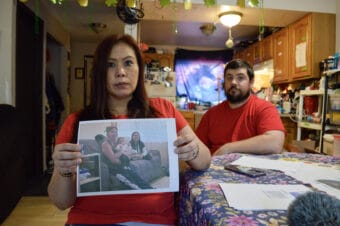
Dan Demott Jr., 66, died during a 2018 standoff with Anchorage police. A federal judge has ordered the city to pay his family $150,000 for using excessive force that evening. (Photo courtesy of Kelsey Howell)

A federal judge has ordered the Municipality of Anchorage to pay $150,000 to the survivors of a man with mental health issues who died six years ago during a standoff with police.

U.S. District Judge Sharon Gleason ruled Monday that officers used “excessive force” in the case of Dan Demott Jr., who died in his home’s crawl space. He was 66 years old. The Anchorage Daily News first reported the ruling.

Gleason’s decision is a rare finding of liability for officers in a local death. State prosecutors have declined to criminally charge any of the Anchorage officers who shot eight people this year, five of them fatally.

The Anchorage Police Department told the ADN that the city plans to appeal the ruling. Police officials declined an interview request Wednesday, but said in a statement that the department is “in the process of carefully reviewing the details and implications of the decision.”

“We take such matters seriously and are committed to upholding the highest standards of conduct within our department,” police said in the statement. “As part of our ongoing commitment to this community, we will ensure that our response reflects our dedication to serving the community effectively and responsibly. We will have a clearer understanding of the next steps once a review has been completed.”

The decision comes in a lawsuit filed by Demott’s daughter, Kelsey Howell, in 2020. Howell said in an interview Wednesday that Demott had retired at a relatively young age and enjoyed helping people. She said she did not believe police took her father’s mental condition into account during the encounter that led to his death.

“I just couldn’t imagine what my dad felt or was going through in his last hours,” she said. “It was just like a nightmare that came true to him.”

According to Gleason’s 36-page ruling summarizing the case, Demott had been diagnosed with bipolar disorder and manic depression before the Nov. 18, 2018 standoff.

Howell said Demott got into an argument with her that day, prompting her to call 911 at about 6:30 p.m. and report that her father had barricaded his front door, was “ripping down curtains” and was experiencing delusions that the police were watching him. She said Demott needed to return to the Alaska Psychiatric Institute, where he had previously been treated, and that he wasn’t taking his medication.

“She also warned the dispatcher that Demott may not cooperate with the police because he had attacked the police on one prior occasion approximately four or five years prior,” Gleason said.

Howell said in the interview that her father had faced earlier struggles with his mental health.

“Sometimes he would have manic episodes that would last for a while, and usually he would go to API and get on the right track,” she said. “I’ve experienced it all my life.”

On that night in November, she said, she and her children quickly left the home, then spoke with arriving officers.

“We were put in a squad car near the residence, and then after a while, we got moved farther away and (the) SWAT team was there,” Howell said. “It was just intimidating, like how it elevated so quickly from just calling to the police and letting them know my dad’s mental state.”

As police reached the scene, they saw Demott holding a sword inside the home. Howell’s brother told police Demott also had a BB gun, but a .22-caliber rifle and handgun were locked in a safe and his father had lost the key. He also said Demott did not have a cellphone, landline or internet access.

Demott remained inside with a roommate, Michael Girardin.

Police obtained a warrant for Demott charging him with assault for placing Howell in fear of being injured, criminal mischief for causing damage inside his home and resisting arrest by barricading himself inside. The incident was marked as a case of domestic violence.

At about 7:40 p.m., call logs showed police “began making several announcements to the residence,” Gleason said in the ruling. Roughly half an hour later, members of the department’s SWAT team arrived.

They included two sergeants at the time: Luis Soto, assigned to a command center several blocks away, and entry team leader Steven Childers. According to the ADN, only Childers still appears to be with the department.

Police made dozens of announcements over a loudspeaker directed at Demott and Girardin. Members of the department’s Crisis Intervention Team were also present, but never used the device.

“At no time was the loudspeaker used to try to negotiate with Demott or Girardin, or to try to address Demott’s mental health needs, or to serve as a means for family or friends of Demott to communicate with him,” Gleason said.

At about 11 p.m., police fired “knock-knock” foam rounds at the home, breaking a large front window. An officer saw Demott retreat from a window, which Gleason said “was the last time that Demott was reportedly seen alive.”

Half an hour later, police heard a “loud banging” inside the home. Officers deployed tear-gas grenades into the home, causing Girardin to leave. Soon afterward, Childers deployed another tear-gas grenade into the home’s garage.

Girardin told officers that Demott was “experiencing a Vietnam flashback,” according to Gleason, and had threatened to shoot him if he left. He also said, however, that he did not see any weapons in the home, except he knew Demott had BB guns. He said Demott dropped his swords when police broke the window.

Demott had encouraged Girardin to join him in the home’s crawl space, calling it a “bunker,” but Girardin refused because it was too cold, the ruling said. The ambient air temperature that evening was 15 degrees.

Police deployed more tear gas into the garage and house and then sent in a robot that didn’t detect any movement inside the home. At about 1:30 a.m. the following morning, police deployed more tear gas into the crawl space, before Childers and other officers entered the home “at some point after” 2 a.m., the ruling said.

Demott was found dead submerged in water in the crawl space at about 4:15 a.m. An autopsy determined that he died of either hypothermia or drowning, but classified his death as an accident.

On Wednesday, Howell questioned police actions like breaking the home’s windows, given the evening’s low temperatures. She also said their tactics reinforced her father’s fears, even though Girardin had explained his state of mind to officers.

Howell sued the Municipality of Anchorage, as well as Soto and Childers, in November of 2020. She alleged that by supervising SWAT actions the officers had used excessive force while trying to arrest Demott, violating both state law and the Fourth Amendment of the U.S. Constitution.

Attorneys representing the city argued that the force used wasn’t excessive under the circumstances. In an April case filing discussing the officers’ qualified immunity, which bars them from being sued over most official actions, the attorneys said that Demott had threatened to shoot patrol officers who first arrived at his home. They added that nobody was ever able to establish communication with Demott during the standoff.

“SWAT was confronted with a barricaded suspect and a potential hostage situation,” the attorneys wrote.

Gleason found that state law supported police efforts to arrest Demott, as a suspect in domestic violence committed within the previous 12 hours. But she also found that Demott didn’t pose a significant threat to others and was not using force against the officers, instead attempting to “disengage” with them.

“After Girardin left the residence, it was unconstitutionally excessive force for the SWAT team to continue to fire multiple rounds of chemical agents into the home, because Demott was suspected of only minor crimes, posed no apparent threat to the officers or others, and was engaged in only passive resistance,” Gleason said.

Soto and Childers later said that they believed Crisis Intervention Team policy didn’t apply to criminal suspects. But once Demott was alone, Gleason said, the officers were “constitutionally required to have considered a mental health intervention or other less invasive alternatives” before deploying more tear gas.

Howell said she hopes police learn to consider people’s mental health conditions during similar situations. After Gleason’s judgment, she said she was disappointed that the municipality responded by offering an appeal rather than an apology.

“I believe in court, one of the officers said, ‘Oh, we should have used more force, more, more,’” she said. “And it just, like – that really hurt to hear because, like at (that) time, my dad was deceased already or was dying.”

Gleason found that the police actions were “a substantial factor” in Demott’s death, awarding his estate $50,000 for his pain and suffering, as well as $50,000 each for Howell and her brother’s loss of companionship. She declined to award punitive damages in the case.

Howell thanked her attorney, Jeff Barber, for his work on the case. She also hoped that police would establish preventive measures to keep incidents like the one in which her father died from happening again.

She urged everybody involved to ask themselves a single question: “What can I do better next time?”

Site notifications
Update notification options
Subscribe to notifications