Crime & Courts

Anchorage restaurant worker, an asylum seeker, detained by ICE

Santiago "Diego" Martinez's work station as sushi chef for Sushi Motto. Martinez was arrested by ICE officials outside the restaurant on Aug. 11, 2025.
Santiago “Diego” Martinez’s work station as sushi chef for Sushi Motto. Martinez was arrested by ICE officials outside the restaurant on Aug. 11, 2025. (Wesley Early/Alaska Public Media)

An immigrant seeking asylum in Anchorage was arrested outside the restaurant where he worked and detained by federal Immigration and Customs Enforcement officials earlier this month.

ICE officials said they detained Santiago “Diego” Martinez, 30, for having a drunken driving conviction. However, his attorney said ICE admitted they made a mistake – Martinez does not have a criminal conviction – but he remained in custody as of Monday.

It was the morning of Aug. 11 that Jennifer Choi got a call from Martinez’s girlfriend, who said he needed help. Choi went behind her restaurant, Sushi Motto, and saw ICE officers detaining Martinez.

“So when I go, Diego was in the car,” Choi said. “And then I said, ‘OK, what’s going on?’ They say he don’t have a green card. I tell them, he has a green card. He has a green card. I tell them, like two, three times, but they said, ‘We have to take him.'”

Martinez had worked for Choi for more than five years as a sushi chef. She said he was a great employee.

“He has a good heart,” Choi said. “He helped, even though he’s a sushi chef, he helped in the kitchen, dishwash, whatever needed help. He did everything. He never complained.”

Martinez is a Mexican national who was in the country illegally, ICE spokeswoman Christine Cuttita said in an email. ICE officials first encountered Martinez in 2019 when he entered the country and was arrested by airport police, Cuttita said. His case was dismissed by a judge in 2022 for “prosecutorial discretion.”

Margaret Stock, Martinez’s attorney, said Martinez is an Indigenous person from Mexico and was seeking asylum in the United States. The charges for his initial immigration arrest were dismissed, because the judge ruled he had a valid asylum case, Stock said.

“He does have a very good reason not to return,” Stock said. “I mean, people in the family have been killed and murdered.”

It’s not uncommon for asylum cases to take years to resolve, she said.

Cuttita with ICE wrote that Martinez, “jeopardized any legal privilege to remain in the United States when he was arrested by the Anchorage Police Department on Nov. 12, 2024, for driving under the influence.”

But the charges were thrown out, Stock said, and Martinez doesn’t have a drunken driving conviction on his record.

“I talked to the ICE people, and they were operating on misinformation that he had a DWI conviction, which he doesn’t have,” Stock said. “But they claim that was the reason, on the telephone to me, that they were arresting him, was that he had a DWI conviction.”

Stock said the ICE officials told her they made a mistake arresting Martinez, since he doesn’t have a drunken driving conviction, but they still won’t release him.

“They told me that once they grab somebody, they’re not allowed to release him anymore,” Stock said. “And they say that this is a new rule that has been made up by the DHS leadership, that people who are pending asylum, they can just grab them anytime and put them in detention.”

Cuttita said that convictions and arrests can both jeopardize someone’s immigration status. But Stock said the Department of Homeland Security isn’t following the law.

“I think it’s illegal and it’s un-American,” Stock said. “It’s unconstitutional, and then on top of it, there’s obviously errors in the system. So how can we trust the Department of Homeland Security when they make these kinds of egregious errors all the time?”

For now, it remains unclear if Martinez will be deported.

Stock said she was able to meet with Martinez when he was being held at the Anchorage Correctional Complex, but the opportunities were limited.

“He was freezing cold and shivering while he was talking to me,” Stock said. “He said it’s freezing in there, and then he also told me that they would only let him make one phone call a day. They’ve denied me access to speak with him because they have special rules that attorneys aren’t allowed to go in there for huge chunks of the day. You know, they have hours that are off-limits to attorneys.”

Those rules, Stock said, contradict what ICE’s website says about the Anchorage Correctional Complex, that attorneys can access clients from 8 a.m. to 6 p.m. every day.

Martinez was transferred to a detention center in Tacoma, and Stock is there, too, working to get him released. But she said she was worried that the center will have similarly harsh conditions and the same lack of access as the Anchorage jail.

Meanwhile, Choi, Martinez’s boss, said she’s concerned about how his detention will impact her business and her employees.

“Everybody is getting sad, like, depressed, I think,” Choi said. “And, you know, some people, they don’t even want to work, even though they have a green card. You know, they’re just scared to work.”

Choi said she’s also pitching in to try to get Martinez back to Alaska.

In third week of trial against former Juneau chiropractor, judge declares two charges a mistrial

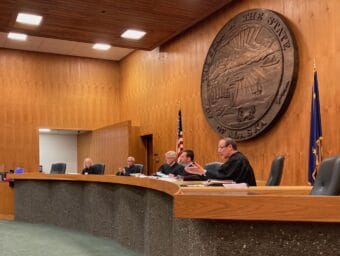
Judge Larry Woolford in the Dimond Courthouse in Juneau on August 14, 2025. (Photo by Yvonne Krumrey/KTOO)

Friday marked the end of the third week of a sexual assault trial against former SEARHC chiropractor Jeffrey Fultz, who stands accused of abusing patients in Juneau between 2014 and 2020. 

Presiding Judge Larry Woolford declared a mistrial Wednesday for two of the 16 sexual assault and harassment charges. Fultz will continue to stand trial for the remaining 14 charges.

The mistrial happened because a witness testified that she had experienced misconduct from Fultz beyond what she had previously testified to on record. The witness is an alleged victim of sexual assault and has not been publicly identified outside of the courtroom. KTOO is not identifying her in this story.

Woolford ruled that state prosecutors withheld information from the court and Fultz’s attorneys, which then came up in the witness’s testimony in front of jurors.

“After an objection by the defense, it became clear that the prosecution knew of [the witness’s] allegation at least as early as the day before her testimony in court but intentionally withheld the allegation from the defense,” Woolford’s order states.

The jurors have been told to disregard that witness testimony.

Fultz’s defense attorney James Christie said the prosecutors intentionally withheld the witness’s disclosure. 

“We are entitled to have all of the evidence that is in the state’s possession ahead of time,” he said. “There’s no question about that.” 

Former Juneau chiropractor Jeffrey Fultz sits during his sexual assault trial in Juneau on Wednesday, July 30, 2025. (Photo by Yvonne Krumrey/KTOO)

Prosecutor Krystyn Tendy said she thinks Woolford’s ruling is assuming that the prosecutors had bad intentions. 

“The state disagrees with the characterization of the bad faith analysis that the judge conducted,” she said.

The charges can be retried if state prosecutors choose to pursue them again. Tendy said they are still deciding how to move forward with these charges. 

This week, the court also heard from two people who have been mentioned a lot in the trial so far — two medical providers that worked with Jeffrey Fultz in SEARHC’s physical therapy department at the time of the alleged crimes.

The women accusing Fultz of assault repeatedly contrasted Fultz’s treatment — the amount of touching, the places he touched, and the way he encouraged them to take their clothes off — with the treatment they received from these two providers. 

Emily Haskell is a physical therapist who worked in SEARHC’s physical therapy department. The prosecution asked how she approaches patients with a history of sexual trauma — something a few of the alleged victims told Fultz they experienced.

“I think especially if someone has had experienced sexual or interpersonal trauma, I think I was a lot more cautious with if I was going to touch them,” Haskell said. “Probably a lot more cautious with asking them to, you know, pull their shirt down to look at their shoulder, or pull their pant leg up, or something like that.”

Haskell said she doesn’t give massages to patients in the course of her physical therapy treatments.

“Because it really is not within the scope of practice of physical therapy. I’m trying to find, like, dysfunctional or painful spots in muscles, sometimes a whole muscle itself,” she said. “But I think of massage therapy as like a more broad and less direct approach to managing muscle tension.”

A massage therapist with SEARHC, Amanda James, also worked with some of Fultz’s patients. 

She said she would work with patients on their comfortability level with covering their bodies.

“If you’re not comfortable taking off certain clothing, or any, that’s okay,” James said she told patients. “I can work over the sheets.”

James said she wouldn’t ask a patient to disrobe fully to treat upper body issues. She said she always does work on the glute muscles over sheets and as a rule, doesn’t work on muscles in the groin area. 

Fultz’s defense asked James if any of the alleged victims she treated complained to her about their treatment with Fultz. She testified that they did not.

The trial was scheduled through Friday, but it’s continuing into another week. The state has called about two dozen witnesses — each alleged victim, partners of complainants, medical experts, former SEARHC employees and one Juneau police detective. The state rested its case Friday. 

The defense began calling its witnesses Friday. The trial is expected to wrap up at the end of next week.

Juneau police release name of officer involved in last month’s violent arrest

A Juneau Police Department vehicle park in downtown Juneau on Thursday, June 13, 2024. (Clarise Larson/KTOO)

The Juneau Police Department has released the name of the officer who slammed a man to the ground last month during an arrest. The department says it also plans to release the body-worn camera footage from the incident at the end of this month. 

The officer’s name is Brandon LeBlanc. He started his position in Juneau last fall. The department placed him on paid administrative leave following the arrest.

The department says LeBlanc has 17 years of law enforcement experience. Before beginning his position in Juneau, LeBlanc worked as an officer in Louisiana.

While there, court documents show that a man sued LeBlanc in 2016 for excessive force and battery, among other accusations. The man claimed he received a broken jaw and was unlawfully tased by LeBlanc during an arrest. 

LeBlanc testified during the trial that the man was punching another officer, and that he tackled and tased him when he resisted arrest. A jury found LeBlanc not guilty. 

During the incident involving the Juneau man last month, witness Ibn Bailey recorded a video of the arrest that circulated widely online. Later, Bailey said the officer responded in “the most professional manner, given the circumstance.”

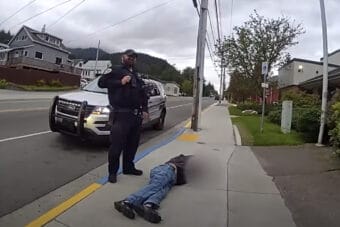
The video showed LeBlanc attempting to handcuff the man before slamming him to the ground. The man appeared to lie unconscious for the remainder of the video and was later medevacked out of town with a head injury. 

Dozens of Juneau residents gathered at the police station days after to protest the officer’s actions. The man’s family has publicly identified him as Christopher Williams, Jr. They say he plans to sue the department.

The Juneau Police Department requested an independent investigation by an external agency to review LeBlanc’s use of force. That investigation is still ongoing. 

Once it’s finished, the state Office of Special Prosecutions will then review the case to determine if LeBlanc was justified in his response. The city says it will also conduct an internal investigation of the incident to examine whether his actions aligned with the department’s current policy.

In May, the Juneau Assembly passed an ordinance mandating that the Juneau Police Department release body-worn camera footage no more than 30 days after a city police officer’s actions cause serious injury. That means the footage will be released on Aug. 29.

More women testify in trial against former Juneau chiropractor

Former Juneau Chiropractor Jeffrey Fultz and his defense team at the Dimond Courthouse in Juneau on Thursday, July 31, 2025. (Photo by Yvonne Krumrey/KTOO)

This was the second week of testimony in the trial against Jeffrey Fultz, a former Juneau chiropractor who is accused of assaulting more than a dozen women under the guise of medical care. 

This week, the jurors heard from more complainants — alleged victims. Thirteen women have accused former Juneau chiropractor Jeffrey Fultz of touching them inappropriately and without their consent while they sought treatment for pain and injuries. As of Thursday afternoon, we heard from most of them. 

They testified that they felt discomfort during their appointments. Some said their experiences with Fultz caused them to avoid medical care later. 

Rebecca Parkey testified on Friday. She worked at Southeast Alaska Regional Health Consortium and saw Fultz for treatment of recurring migraines. She said she was uncomfortable with the way he touched her, but she assumed he must have been acting within the bounds of medical care. She kept going back to treat her pain.

“Every time I walked down the hill, I kept questioning myself, like, ‘what are you doing?’” Parkey said. “‘Why are you going back?’ And then I would argue with myself, like, stop being crazy.”

Defense attorney James Christie asked Parkey to compare her care with Fultz to that of other chiropractors and massage therapists she’s seen, including when she lived in Missouri. 

“And the chiropractor in Kansas City, who you really liked, they didn’t do massage therapy? Well, your chiropractor, I mean?” Christie asked.

“No, because he wasn’t a massage therapist. And technically, neither was Jeff,” Parkey said.

Tori Talley, another woman who testified, was in her early 20s when she was treated by Fultz. She said he touched her in sensitive places, making her very uncomfortable. But like Parkey, she doubted herself. 

Prosecutor Jessalyn Gillum asked Talley if Fultz asked for permission or warned her that he would touch those areas.

“Do you remember if at any point the discussion of touching sensitive areas of your body — did that ever come up with Mr. Fultz prior to that last appointment, when he was doing the massage?” Gillum asked.

“No,” Talley said.

“Did you give any consent to that part of your body being touched, even for medical purposes?” Gillum asked. 

“Absolutely not,” Talley said.

Talley said experience with Fultz caused her to avoid all medical care in general.

“I took a break from seeing anyone at SEARHC and a long break from physical therapy,” she said. 

“How did that affect your symptoms, if at all?” asked Gillum.

“I definitely had a lot more headaches, and I stopped seeing all providers, and I developed really bad anxiety, and I developed a panic disorder, and not being able to see my providers,” Talley said.

During cross-examination, Fultz’s lawyers pointed out that Talley had anxiety and panic disorders before seeing Fultz. She said they escalated after her experience and break from medical care. 

Marcy Sowers was a Fultz patient in 2014. She said she worried at the time that confronting him or avoiding physical therapy appointments with him could jeopardize her ability to access health care in the future. 

“Your PT was linked in with your compliance with everything else,” she said.

Defense attorney Wally Tetlow quoted her telling the police years ago that she would have acted if Fultz was being inappropriate.

“Did you say you would have run to [Juneau police] quicker than quick if Fultz touched you inappropriately? He never crossed the line with anything inappropriate did he?,” he asked. 

“He flirted with the line,” Sowers said.

On the stand, Sowers said that now she thinks about the women who say they were harmed by Fultz years after she was. She initially reported him to Indian Health Services. She wonders if things would have been different for them if she reported it to police then.

Proceedings are scheduled to continue for at least one more week. 

Correction: this story has been updated with more information about Marcy Sower’s reporting process and with the correct prosecutor’s name. 

Juneau residents rally to protest a violent arrest

Andy Cadiente speaks at a protest with is sisters outside of the Juneau Police Station on August 2, 2025. (Photo by Yvonne Krumrey/KTOO)

Dozens of Juneau residents gathered at the police station on Saturday to protest a violent arrest last week.

A video of the arrest generated public concern on social media. It showed a Juneau police officer handcuffing an Alaska Native man, then throwing him to the ground where he appears to lie unconscious for the remainder of the video.

Since, the man’s family has identified him publicly as Christopher Williams Jr. The police department has not released the name of the officer.

Protesters offered condolences to the man’s family and expressed their outrage, including X’ash Kugé ka Yaanasax Barbara Cadiente-Nelson.

“We’re here to hold this system accountable to the words they took an oath to to protect, to serve,” she said. 

Williams’ cousin, Pamela James, said his family didn’t know where Williams was for a full day after they heard he was medivaced for care. She confirmed that Williams was in Anchorage Thursday evening after calling multiple Seattle and Anchorage hospitals. She said he is conscious and speaking.

James said Williams plans to sue JPD. She said her family will continue to speak up.

“We’re not doing it just for Chris, but we’re doing it for everybody that’s been hurt by our cops here in town,” James said.

Assembly Member Paul Kelly was at the protest and said it’s important that the City and Borough of Juneau work to restore trust in the community after a violent arrest. 

“Whenever we have an emergency, whenever we need somebody to intervene, we need it to be somebody that we can trust,” he said. “We need to be able to trust our police force.”

Protestor Ḵáaḵ’utx̱éich Kai Monture said that Lingít people have to support and protect each other, and abide by traditional values of perseverance and community support. 

“Even though asking for police reform is important and something we need to fight for every day, it’s not guaranteed,” he said. “It’s not guaranteed that it’ll happen, but what is guaranteed is that we can protect each other.”

JPD says the officer has since been placed on administrative leave. Officials from the City and Borough of Juneau and JPD say there will be an external investigation of the violent arrest.

Witnesses begin to testify in the sexual assault case against former Juneau chiropractor

Former Juneau chiropractor Jeffrey Fultz sits during his sexual assault trial in Juneau on Wednesday, July 30, 2025. (Photo by Yvonne Krumrey/KTOO)

Content warning: This article includes mentions of sexual assault and abuse that may be uncomfortable for some readers. Resources are available at the bottom of this post.

The trial against former Juneau chiropractor Jeffrey Fultz, accused of assaulting more than a dozen women under the guise of medical care, is underway. KTOO reporter Yvonne Krumrey breaks down the first few days of witness testimony with reporter Clarise Larson. 

Listen:

Clarise Larson: Where are we in the trial now?

Yvonne Krumrey: After two weeks of jury selection and Tuesday’s opening statements, the trial is now really in full force. That means we are starting to hear from expert witnesses and alleged victims. This will likely be the bulk of the next two weeks: both the state prosecutor and Jeffrey Fultz’s defense team will be using these witnesses to try and establish their side of the story.

Clarise Larson: Tell me more about the opposing sides. What did the attorneys say during opening statements? 

Yvonne Krumrey: The state is arguing that Fultz used his position as a medical provider at Southeast Alaska Regional Health Consortium to gain access to vulnerable women and assault them when they sought medical care.

This is state prosecutor Jessalyn Gillum:

“We are here because the defendant engaged in sexual contact with his patients under the guise of legitimate medical treatment,” she said. “He violated their trust and he violated their bodies. ” 

The state points to repeated testimony from witnesses who say Fultz touched them in a sexualized way and in sensitive places without reason or consent, and denied them appropriate coverings during treatment.

The defense team argues that Fultz was giving appropriate medical treatment, and that the women who accused him didn’t express their discomfort at the time. 

“The evidence in the case is going to show that during legitimate medical treatment, Dr. Fultz did make contact with sensitive areas of the body, but he did not make any contact with sensitive areas of the body without consent,” said defense attorney Wally Tetlow.

He also said that the former investigator for this case — a Juneau police officer who died in 2023 — led the women to the conclusion that they were assaulted. 

Clarise Larson: Okay, so who have we heard from since those opening statements?

Yvonne Krumrey: Tuesday and Wednesday we heard from Dr. James Lehman, an expert witness called by the state. He’s a doctor and professor at the University of Bridgeport School of Chiropractic. Attorneys asked him about a whole lot of specific medical treatments. Remember, this case is about medical treatment and whether it was appropriate or abuse. 

The state asked Dr. Lehman about what areas are appropriate to touch based on what treatment the women accusing Fultz requested.

“Are you aware of any legitimate chiropractic or any legitimate chiropractic treatment that requires a practitioner to make direct contact with the breast or vulva of a patient who comes in complaining of generalized back pain?” asked Krystyn Tendy.

“No,” Lehman said.

This went on for about two minutes, as the prosecutor asked about other medical conditions the women sought treatment for. The answer was always no. 

In cross-examination, the defense showed Dr. Lehman charts that show that tension muscles and tissue in the chest area can impact muscles down the arms. And that treating the chest area can be appropriate for treating other pain elsewhere in the body.

The state then asked Dr. Lehman about informed consent – something the women claim Fultz did NOT do before touching sensitive areas.  

“You explain to the patient what you’re going to do, why you’re going to do it, and what they should expect the outcome to be, make certain that they understand it and they approve of your proceeding,” he said.  

Clarise Larson: And I know witnesses and alleged victims were expected to speak this week. Has that happened?

Yvonne Krumrey: Yes, Wednesday and Thursday we heard from Christina Love. The court is now using alleged victims’ full names but we are only using ones who have given us permission. Love has given us permission to use her full name.

She testified about how her experiences with Fultz got progressively more uncomfortable and how different they were from other SEARHC providers she saw.

Love said initially things were comfortable but his behavior started to change [after a few years]. He walked in on her changing. He gave her a covering that was too small.

He began touching her in places she wasn’t comfortable with, without permission, and moved her hands away when she tried to cover these areas. 

She began requesting other providers, but would only get scheduled with Fultz, who she understood to be in charge of appointments. And the weird behavior escalated. 

“I trusted him,” she said. “I was so mad and betrayed. I felt betrayed by myself that I should have known.”

Love reported it to AWARE, who called JPD, and from there, the criminal investigation into Fultz began. Her testimony dug into that process as well.

Fultz’s attorney James Christie questioned Love next. He asked about her previous testimony  earlier in the case and questioned her memory. He also pointed out her lack of experience with medical treatment.

“We can agree that you have no training as a chiropractor,” Christie said. 

He argued that her testimony has changed throughout official proceedings and asked about Detective Darbonne guiding or leading her to the conclusion that she was assaulted. 

Clarise Larson: So what do you expect the rest of the trial to look like? 

Yvonne Krumrey: I believe more of what we saw this week. The prosecutor said we would hear from more of the women who have accused Fultz of similar behavior. Based on the defense’s opening statements, I’m expecting they will call their own expert witnesses, too. All told, they’re expecting to call dozens of witnesses to the stand. 

There are two more full weeks scheduled for this trial. 

Site notifications
Update notification options
Subscribe to notifications