Crime & Courts

Sexual assault case against former Juneau chiropractor will be retried

Former Juneau chiropractor Jeffrey Fultz sits during his sexual assault trial in Juneau on Thursday, Sept. 4, 2025. (Photo by Yvonne Krumrey/KTOO)

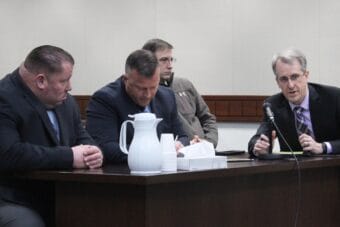
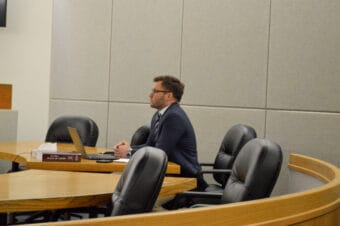
State prosecutors will retry the sexual assault case against a former Juneau chiropractor facing 13 charges. They stated their intention to move forward at a hearing Tuesday.

Prosecutor Krystyn Tendy said the details of how many charges will be retried are still being determined. 

It’s been nearly three weeks since the sexual assault trial against a former Juneau chiropractor ended with two acquittals and 14 charges declared mistrial. Last week, the judge in the case dismissed one of those charges. That means that though Jeffery Fultz wasn’t found guilty, the remaining 13 charges are still active. Those are the charges the state may retry.

More than a dozen former patients have accused Jeffrey Fultz of sexual assault under the guise of medical care between 2014 and 2020 while he worked at Southeast Alaska Regional Health Consortium in Juneau. 

At a hearing Tuesday, Fultz’s attorneys said they are withdrawing from the case.

A representation hearing to determine Fultz’s future legal representation is scheduled for Sept. 30 at noon.

A decade after a man died in Lemon Creek Correctional Center, his widow wants to know what’s changed

Tammy Jablonski Murphy holds a photo of her and her late husband Joseph Murphy on August 9, 2025. (Photo by Yvonne Krumrey/KTOO)

Tammy Jablonski Murphy said she had given up on the prospect of finding love before her first date with Joseph Murphy in the late 1990s. 

“But he kissed me, and it was like, ‘I’ll marry you right now.’ I mean, that’s how I felt in my heart,” she said. “I thought, ‘I can see me with you for the rest of my natural life.’” 

Instead, their years together were cut short.

Listen: 

Joseph Murphy died of a heart attack on Aug. 14, 2015 in Juneau’s Lemon Creek Correctional Center after guards refused him care. He was there on a protective custody hold — a type of hold intended to prevent someone from harming themselves or others while intoxicated. He wasn’t charged with a crime. 

Jablonski Murphy said her late husband had a heart condition, but it was treatable, and that he may not have died if he’d had access to his medications or medical care. She and Murphy’s family sued the state for wrongful death and settled out of court. 

It’s been 10 years, and Jablonski Murphy is still mourning. She wants to know if the state has changed its policies to prevent deaths like this in the future. 

“I want to know what’s changed,” she said. “Because if nothing has changed, I’m not laying my banner down, kid. I’m not.”

A KTOO investigation shows that the state did make some initial changes and the number of in-custody deaths decreased for a couple of years. 

But those changes were undone under Gov. Mike Dunleavy. The state has seen some of its highest number of deaths in custody per year under his administration – peaking at 18 deaths in 2022.

Leading up to Joseph Murphy’s death, his widow said he had relapsed into drinking after years of sobriety. He had quit drinking after leaving military service in Iraq a decade before. She says he was becoming progressively more suicidal. 

Jablonski Murphy helped him try to seek care at Bartlett Regional Hospital and other treatment facilities without success, and it culminated in the sequence of events leading to his death under a protective custody hold in prison. 

“He went to treatment. He was at the hospital. They sent him to the jail,” she said. “It just kept going, and I was watching him fall through every crack you can imagine.”

Then, one night in August a few days before Jablonski Murphy’s birthday, he told her she would be better off without him. She was afraid that if she fell asleep, he would hurt himself. So, she took him to Bartlett Regional Hospital. 

Staff there said he had to go to Lemon Creek Correctional Center. He wasn’t being charged with a crime. He was held on a “protective hold” intended to prevent people who are intoxicated from harming themselves or others. 

Jablonski Murphy said she tried to insist the officers let Murphy take his heart medication with him, but they didn’t allow it. Instead, the officers said they would call 911 if anything happened. 

Murphy died the next morning. 

Tammy Jablonski Murphy holds a photo of her and her late husband Joseph Murphy on August 9, 2025. (Photo by Yvonne Krumrey/KTOO)

Investigation and aftermath

By the time Murphy died, 25 people had died in Alaska Department of Corrections facilities in the preceding years. Then-Gov. Bill Walker had already ordered an investigation of the department prior to Murphy’s death. The investigation’s findings were released in a report in November of that year, and they were scathing. The report included an analysis of how Murphy died. 

The report said that video footage from the prison showed guards dismissing Murphy’s repeated calls for help. The video did not have any audio. 

One staff member said he was in the bathroom when he overheard Murphy saying he needed his heart medication. Another staff member responded, telling him, “I don’t care, you could die right now and I don’t care.”

Emergency medical services were called when a different staff member found him unresponsive on the floor. By then it was too late. Murphy had died of a heart attack. 

Dean Williams, who was special assistant to the Governor at the time, spearheaded the investigation. 

He said the law that allows for protective custody increased the danger Murphy faced in prison.

“Mr. Murphy was not there under any criminal allegation, but under a statute that was designed to protect him,” Williams said. “And unfortunately, the statute that was designed to protect him contributed to his death.” 

Williams said the staff of Lemon Creek misinterpreted the law — it says people can be held until they are sober, or up to 12 hours. Williams said the staff involved with Murphy’s death believed he had to be held for at least 12 hours, The state’s report said Murphy appeared sober  in the hours leading up to his heart attack and could have been released.

Williams said staff also exhibited a blatant lack of concern for Murphy’s well-being.

“They handled Mr. Murphy in a horrible way, in a cruel and callous way,” Williams said. “The man was having a heart attack in front of everyone, and nobody called 911.”

Williams later served  as DOC Commissioner from 2016 to 2018. He created an internal investigations system for Alaska’s Department of Corrections – a change to prevent more deaths like Murphy’s, he said.  

“The death of Mr. Murphy shocks our conscience, and it should, right?” Williams said. “But that was not the only one.” 

Williams said internal affairs units can thoroughly investigate deaths and find ways the system failed and can improve, instead of sweeping custody deaths under the rug. 

“That’s why you have internal affairs,” he said. “It’s not a luxury, it’s an essential component, which is why every other state has it.” 

But Alaska’s next DOC Commissioner Nancy Dahlstrom, under Gov. Dunleavy, dismantled the internal investigations unit in 2018. Legislators said the cut would save the state money. Dahlstrom could not be reached for comment. 

Alaska DOC hasn’t had internal investigations since. The department’s spokesperson said there are no plans to resurrect it. 

KTOO could confirm only that most states have internal affairs units. But Michele Deitch, director of the Prison and Jail Innovation Lab in Texas, said Williams was right — Alaska is the only state she knows of that doesn’t have internal investigation mechanisms. 

Some policy documents reference internal investigations, but Department of Corrections Spokesperson Betsy Holley said the department only conducts reviews, not investigations. She said the investigations are conducted by Alaska State Troopers “ensuring neutrality and objectivity.”

In recent years, deaths in Department of Corrections custody have garnered public outcry, and multiple lawsuits from the American Civil Liberties Union.  

There were 110 inmate deaths in DOC custody between 2015 and 2024. Two-thirds were reported as “natural” deaths, including Joseph Murphy’s.

A photo of Tammy Jablonski Murphy and her late husband Joseph Murphy. (Courtesy of Tammy Jablonski Murphy)

 Juneau’s health care safety net

While changes in the state’s corrections department were relatively short-lived, Juneau health care services have changed in ways that could reduce the chances that someone in Joseph Murphy’s condition would end up in a state corrections facility at all.

Many people in crisis may now get help before they end up in a protective custody hold at Lemon Creek. Jodie Totten is the medical director of Bartlett Regional Hospital’s emergency department. She wasn’t working at Bartlett in 2015, but she said in the several years she’s been with the hospital, she’s seen changes to the landscape of care for people suffering from mental health and substance use conditions. 

Now, Totten said, Bartlett’s emergency services staff rarely sends patients to Lemon Creek Correctional Center. 

“I mean, we’re always trying to avoid having to have people go to Lemon Creek,” she said. “And there are a lot of other great options in the city that I think we should all be really proud of.”

Some facilities like Rainforest Recovery, a residential substance use treatment facility at Bartlett Regional Hospital, have closed in the meantime, limiting care options. 

But Juneau’s CARES teams —Community Assistance Response and Emergency Services – were formed in 2019.  Those teams are staffed by medical providers and emergency responders that help provide crisis care and follow up with patients who have long-term needs.

CARES also offers a sobering center, where people can recover from intoxication under medical supervision. 

With these programs, when someone is experiencing suicidal ideation, loved ones can request providers come to their home and offer support or intervention. 

And the support network may not be improving just in Juneau. Across the state, the numbers of protective holds halved in 2020. The decrease only continued, from 1,301 holds in 2015, to 379 in 2024. 

Murphy’s widow

Tammy Jablonski Murphy said the pain of losing her husband is still with her. She’s 66 years old, and she still works as a social worker. She helps people recovering from addiction and people reentering the community after incarceration. She said her work is a tribute to Murphy. 

“If I can help one person crawl through this fractured, broken system and come out the other end and be able to claim their life back and start over – get their families back, whatever they need to do – then that honors my Joe, and that’s what I’m all about,” she said. “That’s what I’m all about.” 

She doesn’t plan to retire anytime soon. And she doesn’t plan to let go of the memory of her husband, no matter how many years it’s been.

Jury acquits Juneau artist on all four counts of terroristic threatening

Mitchell Watley testifies at the trial against him, presided by Judge Amy Mead, on Sept. 15, 2025. (Photo by Yvonne Krumrey/KTOO)

A jury has declared a Juneau artist not guilty of terroristic threatening. Mitchell Watley was accused of threatening the public in 2023, when he distributed printed notes featuring memes referencing school shootings around town.

Mitchell Watley was accused of four felony counts of terroristic threatening. His attorney argued that he was not intending to cause fear when he distributed the notes.

In March 2023, notes depicting an automatic rifle and the words “Feeling Cute Might Shoot Some Children” on a transgender pride flag were left in grocery stores and the State Office Building downtown. 

Police traced video surveillance footage to a car registered to Watley. He was arrested a few days later.

In the course of the trial, jurors heard from police, school administrators and Watley himself.

Former Juneau School District Superintendent Bridget Weiss testified that schools took the notes seriously.

“In my world, as a K-12 educator in the world we live in, a sick joke is a threat,” she said during trial proceedings. 

Juneau Police Department officers also testified that they were concerned about public safety when the notes were found, and that the department stationed extra officers near the schools that day. 

Watley himself took the stand to say he didn’t intend for anyone to be alarmed by the notes he left around town. 

His attorney Nicholas Polasky asked him if he thought people would perceive it as a threat. 

“No,” Watley replied. 

“Did the thought cross your mind?” Polasky then asked.

“Never,” Watley said.

Polasky argued that the incident did not meet the definition of a “true threat” — the crime Watley was charged with. 

“Broadly speaking – a true threat is something that objectively appears to be a threat and was meant to be a threat,” Polasky told KTOO over email. “It is not required [that] a person must intend to act on the threat, but the person must mean for the message to be a threat.”

Watley’s attorney said it was intended as a meme to spread Watley’s beliefs at the time that transgender people were dangerous. Watley said he was thinking about a Tennessee shooting that happened earlier that year. The perpetrator was a transgender person. 

According to the Violence Project, less than one percent of mass shootings in the United States have been committed by a transgender person. 

“I kind of assumed it would be like when we see a meme on social media,” Watley testified. “They’d look at it and form an opinion and move on.”

Watley distributed the notes on Transgender Day of Visibility, an annual event recognizing the obstacles transgender individuals face and their contributions to society. 

He’s an illustrator, and when he was arrested in 2023, local shops pulled his book from their shelves, pointing to the growing anti-trans climate that his notes perpetuated. 

Watley said that he doesn’t think about transgender people much these days. 

The trial against Watley lasted four days. The jury returned its not guilty verdict on Wednesday.

Jurors say former Juneau chiropractor is not guilty on two counts of sexual assault, other counts a mistrial

Former Juneau chiropractor Jeffrey Fultz (left) and his attorney James Christie (right) await the jury’s verdict in his sexual assault trial in Juneau on Thursday, Sept. 4, 2025. (Photo by Yvonne Krumrey/KTOO)

After eight days of deliberation, the jury in a sexual assault trial against a former Juneau chiropractor returned a verdict of not guilty on two counts, and hung jury on 12 others on Thursday.

Twelve former patients accused Jeffrey Fultz of sexual assault under the guise of medical care. They say the incidents took place during medical appointments between 2014 and 2020 while he was employed at Southeast Alaska Regional Health Consortium in Juneau.

Fultz’s defense argued that he was offering legitimate medical care to these patients. His attorney said he was not available for comment Thursday afternoon.

Jamiann Hasselquist is one of more than a dozen women who filed charges against Fultz. He was acquitted of the charges associated with her complaints and she won’t be able to refile them.

“I thought that he was going to go in handcuffs after this whole time, you know, four years or so,” she said.

Jurors were unable to return a unanimous verdict on the 12 other counts. Those charges resulted in a mistrial. That means those charges, alongside two that were declared mistrial during proceedings, can be retried if the state chooses to do so.

Christina Love reported Fultz to Juneau police in 2021. At the courthouse Thursday, she said Fultz can leave Juneau, but she and other women are left without justice.

“He gets to hop on a plane, and there are 12 victims in this case that are left here holding it,” Love said. “That is absolutely earth shattering that we’re gonna have to do this all over again, like I can’t even comprehend it.”

Love said she plans to move forward with her charges.

“As long as he’s out walking, we’re going to keep trying to make sure that he’s never able to do this to anyone ever again, ever,” she said.

Hasselquist said she plans to support the women who plan to testify again.

The trial lasted six weeks. A status hearing to decide will happen next for the mistrial charges is scheduled for Sept. 23 at 10 a.m.

This story has been updated. 

Should Alaskans be able to sue over SNAP delays? State, citing Supreme Court, says no.

Kodiak groceries
Cereal boxes sit on a store shelf in Kodiak in 2023. (Kirsten Dobroth/KMXT)

Alaska’s Department of Law is asking a judge to throw out much of a class action lawsuit over the state’s failure to process food assistance applications on time. Thousands of Alaskans are caught in backlogs that have plagued the Supplemental Nutrition Assistance Program, or SNAP, and other aid programs for years.

But the state argues a recent Supreme Court case, Medina v. Planned Parenthood of South Carolina, means they shouldn’t be allowed to sue. Rather, the state argues that the federal Food and Nutrition Service, part of the Agriculture Department overseeing SNAP, should be the only entity able to enforce federal requirements.

“The Supreme Court’s recent decision in Medina makes clear that the plaintiffs have no private causes of action. This litigation must now end,” state attorneys wrote in a motion for summary judgment submitted Tuesday.

Attorney Saima Akhtar of the National Center for Law and Economic Justice, part of the legal team suing the state on behalf of Alaskans caught in the backlog, said in an interview that lawsuits like the SNAP case are an important way for citizens to hold their government accountable.

“Unfortunately, for better or for worse, a lot of times, agencies function better when there is oversight and when they are being held to standards and to account for what they are doing,” she said.

In June, the Supreme Court ruled that a South Carolina Planned Parenthood chapter could not sue the state over violations of the federal law that governs the Medicaid program. The justices ruled 6-3 that only the federal government could enforce that law.

Alaska Department of Law attorneys argue in a filing Tuesday that the decision means hungry Alaskans shouldn’t be allowed to enforce deadlines set out in the law that created SNAP.

Late last year, U.S. District Court Judge Sharon Gleason granted a preliminary injunction, requiring the Division of Public Assistance to report monthly on its progress towards ending the backlog.

The state argues the ongoing court battle takes time and resources away from the Department of Health’s efforts to end the backlog — especially because the department continues to struggle with understaffing.

“This is not a situation where a state has moved to dismiss while refusing to take any meaningful remedial action,” state attorneys wrote. “However, the litigation continues to divert DOH’s limited resources.”

That’s no excuse, Akhtar said. She said the state’s continued failure to clear the backlog means oversight is necessary.

“I don’t think anyone is asserting that the time spent on the reports would magically allow them to clear the multi-thousand-case backlog they have,” she said. “That is not the problem.”

Department officials report they are making progress on the SNAP backlog, which stood at roughly 3,000 in August, down from roughly 4,500 in June.

Metlakatla woman charged with fatally stabbing husband

An Alaska State Troopers vehicle.
An Alaska State Troopers vehicle. (Alaska Department of Public Safety)

A woman accused of stabbing her husband to death in the Southeast Alaska community of Metlakatla was arrested early Saturday morning.

Court records show that Jade Jordan, 33, charged with one count of criminally negligent homicide in the death of Kevin Jordan, 36.

In a charging document against Jordan, police said when they arrived at the Jordans’ residence Saturday, they saw Jade Jordan standing in the driveway with dried blood on her. Her husband was lying face down in the driveway with stab wounds. Medics took him to the local medical clinic, where he was later pronounced dead.

The couple’s two children were home at the time.

Alaska State Troopers from nearby Ketchikan assisted in the investigation Sunday. They said Jordan told them that she and her husband had been drinking and were arguing and pushing each other that night. That’s when troopers said she stabbed him near the left clavicle with a kitchen paring knife.

The public defender’s office in Ketchikan is representing Jordan. Staff did not immediately return a request for comment.

A preliminary hearing is set for Friday in the Ketchikan Courthouse.

Site notifications
Update notification options
Subscribe to notifications