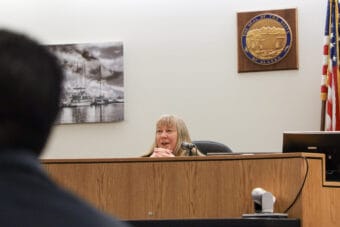
Former Juneau Chiropractor Jeffrey Fultz and his defense team at the Dimond Courthouse in Juneau on Thursday, July 31, 2025. (Photo by Yvonne Krumrey/KTOO)
After a week of deliberation, the jury continues to consider the evidence in a sexual assault trial against a former Juneau chiropractor. As of Friday afternoon, the jurors had yet to return a verdict.
Twelve former patients accused Jeffrey Fultz of sexual assault under the guise of medical care. They say the incidents took place during medical appointments between 2014 and 2020 while he was employed at Southeast Alaska Regional Health Consortium in Juneau.
Fultz’s defense argued that he was offering legitimate medical care to these patients.
The jury has been deliberating 13 counts of sexual assault and one count of sexual harassment against Fultz.
When the trial started, there were two more counts of sexual assault associated with one alleged victim/complainant, but presiding Judge Larry Woolford declared a mistrial for those counts. Woolford said the state failed to disclose new evidence related to those charges.
Those charges can still be tried if state prosecutors choose to retry them.
Jury deliberation follows standard work hours, and will resume Tuesday after Labor Day. There is no time limit on how long the jury can deliberate.
If the jury convicts Fultz on any of the counts, there will be a sentencing hearing. That’s when Judge Woolford will determine Fultz’s penalty for these convictions. Convictions in sexual assault cases can lead to years in prison.
James Dommek Jr. is the executive producer of the new documentary, “Blood & Myth” (Image courtesy of Disney)
A haunting crime story and an Alaska Native legend are at the center of a new documentary that will premiere on Hulu on Sept. 4.
“Blood & Myth” looks into a real-life crime case that happened in Kiana, in Northwest Alaska, over a decade ago.
“It’s all very much rooted in reality,” said James Dommek Jr., the executive producer of the new documentary. “Incredible story of survival and legends and violence and culture.”
Teddy Kyle Smith is an Iñupiaq actor from Kiana who starred in “On the Ice,” a 2011 drama about two Utqiagvik teenagers. In 2012, Alaska State Troopers were investigating the suspicious death of Smith’s mother when he fled to a cabin and had a violent encounter with two hunters. He was later convicted of attempted murder.
In court, Smith said that Iñukuns, or Little People, guided his actions.
Dommek has been intrigued by this incident for years. When he worked at KNBA in 2016, that case came to mind when a coworker asked him if he knew any Alaska stories that would make for a good podcast.
Dommek described Smith’s story in his 2019 bestselling audiobook, “Midnight Son.” The new Hulu documentary is a movie adaptation of the audiobook, where he is also a part of the narrative, trying to uncover what happened in Kiana.
Dommek grew up in Kotzebue hearing about Iñukuns, evil creatures in the high Arctic. They came up in local stories and in conversations with Dommek’s great grandfather, Paul Monroe, who was an Inupiaq storyteller known as Palangun. Dommek said that Iñukuns exist in various legends from Inuit groups across the globe – in Siberia, Alaska, Canada and Greenland.
“If all of us had the same story, and we’re also spread out, it might have an air of truth to it, and my great grandfather’s stories were no different,” he said. “That was one of the big draws to the story for me.”
“Blood & Myth” is a true crime documentary told through an Indigenous perspective, which is rare in today’s entertainment industry, Dommek said.
“There’s the type of story I wanted to see, and no one was making it,” he said. “Everyone else is invited to listen and watch, but at the end of the day, it’s something I made for me.”
With a few exceptions, most of the filming took place in Alaska, including Kotzebue and Kiana. Dommek said it was important for him to make the story look and feel authentic.
“I took my crew up to Kiana, skeleton crew – four wheelers, and boats and village dogs and all that,” he said. “I was like, ‘We’re going to do this, and I’m an Alaskan making an Alaskan story, we can’t fake this.'”
Dommek is also a musician who has played in such Alaska bands as Pamyua
and Medium Build. He has worked in film production, but being an executive producer in his own film is a first. He said he wondered if it was his story to tell but decided to do it after talking to his family and elders in his community. He said he wanted it to be a story about staying true to your culture.
“You pull back all the layers in this story, and at the real heart of the documentary, the main message is, don’t forget who you are,” he said. “Remembering your roots, where you come from, and what makes our people strong, and what has made us survive in a place as harsh as Alaska for this long.”
The film will be streamed on Hulu in the U.S. and Disney+ internationally.
The United States Courthouse and Federal Building in downtown Anchorage. (Photo by KDLG)
A federal trial began Monday in Anchorage for a class-action lawsuit against the Alaska Office of Children’s Services on behalf of all kids in OCS custody.
Marcia Lowry, an attorney and director of a national nonprofit advocating for foster reforms, said the organization is helping with this lawsuit because Alaska’s foster system has some of the worst outcomes in the country.
“They have a very, very high maltreatment rate,” Lowry said. “They do not have the kids visited every month. That’s a federal requirement children have to be visited, because how else can you know whether a child is safe when you put a child in a foster home?”
The complaint alleges OCS caseworkers have too many cases to be able to adequately serve families and that the agency has failed to place Alaska Native foster children in culturally appropriate placements, violating the Indian Child Welfare Act.
Former foster youth testified Monday that under OCS care, they moved placements frequently, missed school because of instability and experienced abuse and assault when they were placed in foster homes and hotels.
OCS director Kim Guay also took the stand Monday. She said all OCS employees are working to make positive changes in the system and that the agency has taken steps to increase recruitment and improve training.
Margaret Paton-Walsh, assistant attorney general for the state, is defending OCS in the trial. She said running the foster care system in Alaska is challenging.
“It’s especially hard in Alaska because of the size and the remoteness of so many of the communities, and we are doing the best that we can to manage the challenges that we have,” Paton-Walsh said. “And there are definitely challenges. Nobody is denying that. And I think critically in this context, we have a very, very severe caseworker shortage.”
Guay also repeatedly pointed out on the stand that OCS is only one piece of the child welfare system.
Attorneys James Christie and Krystyn Tendy speak with Judge Larry Woolford in an aside during the trial against Jeffrey Fultz on August 21, 2025. (Photo by Yvonne Krumrey/KTOO)
The trial against a former Juneau chiropractor accused of assaulting a dozen patients under the guise of medical care has ended, and jurors are set to begin deliberation.
The former patients that accuse Jeffrey Fultz of assault say the incidents took place during medical appointments between 2014 and 2020 while he was employed at Southeast Alaska Regional Health Consortium in Juneau.
The state prosecutors and Fultz’s defense attorneys gave their closing arguments Friday. It was their last chance to show what all the testimony was intended to prove — or disprove – and to sway the jurors to their side.
State prosecutors argued that Fultz abused his patients’ trust and sexually assaulted them in a clinical setting. Fultz’s defense said that he provided appropriate medical care to those patients.
Prosecutor Krystyn Tendy told the jury that from the state’s perspective, the only verdict that is consistent with the evidence is guilty on all counts.
“He believed that he could count on their silence. He believed he could stay in control,” Tendy said. “But he was wrong. They didn’t stay silent. He is no longer in control. You are in control.”
Tendy said that Fultz took advantage of the power dynamic between doctors and patients. She pointed to witness testimony about the challenges of seeking care, and the pain the women sought treatment for.
“That is a relationship that is supposed to be based on trust that is supposed to be based on the principle of do no harm,” she said. “They are literally putting themselves in his hands.”
The prosecutor said all witnesses — the ones they called and the ones the defense called — showed that Fultz didn’t follow legitimate medical practices.
“This wasn’t about treatment,” Tendy said. “This was about what the defendant wanted to do and what he did.”
State prosecutor Krystyn Tendy addresses the jury during her closing arguments in the trial against Jeffrey Fultz on August 22, 2025. (Photo by Yvonne Krumrey/KTOO)
Defense attorney James Christie reminded jurors of Fultz’s education and expertise as a medical provider, and how some of the women accusing him also reported relief from his treatments. He said the questions of informed consent and how exposed the women’s bodies were during treatment come secondary to the primary question.
“Focus on the question,” he said. “Was the treatment recognized, legitimate, and lawful?”
Christie spent some time reminding the jurors of their role, and what it means to deliver a not guilty verdict.
“The first thing I’ll tell you is that criminal cases are not about choosing sides,” he said. “Voting not guilty doesn’t mean you are for Dr. Fultz. It doesn’t mean you are against the state, it doesn’t mean you are against the 12 women. It means the state did not prove its case beyond a reasonable doubt.”
He told the jury to put aside their feelings about victims of sexual assault. He said that criminal trials must come down to the state’s burden to prove Fultz’s guilt, based on more than speculation or probability.
“This is not a heart decision,” Christie said. “This is something that’s going to require thought, careful thought.”
Christie said that most of the women accusing Fultz of assault came forward after reading about initial accusations against him in the media.
He told the jury to deliberate carefully, and remember their duties.
“You all agreed that you would hold the state to its burden,” Christie said. “You all agreed to the presumption of Mr. Fultz’s innocence.”
And Christie told them to carefully consider the weight of their verdict.
“This is not a decision you can undo,” he said.
Defense attorney James Christie addresses the jury during his closing arguments in the trial against Jeffrey Fultz on August 22, 2025. (Photo by Yvonne Krumrey/KTOO)
Jurors will now deliberate until they reach a unanimous verdict. The jury can return a verdict at any time. There is no time limit on their deliberations. The trial lasted six weeks and involved testimony from dozens of witnesses. If jurors cannot reach a verdict, it will be declared a mistrial.
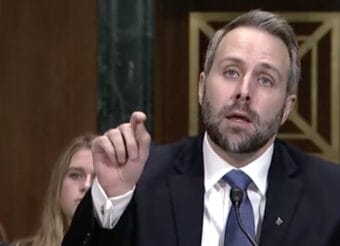
Former U.S. District Court Judge Joshua Kindred speaks at his Dec. 4, 2019, Senate Judiciary Committee confirmation hearing in Washington, D.C. (U.S. Senate Judiciary Committee video screenshot)
The Alaska Bar Association has voted to recommend that former U.S. District Court Judge Joshua Kindred be disbarred in Alaska.
Kindred, appointed by President Donald Trump to serve as a federal judge here, resigned last year from the federal bench after investigators found that he had a “sexualized relationship” with a clerk who became a prosecutor and lied about it to a senior judge and investigators, and maintained a hostile workplace for law clerks.
Since that investigation, additional improprieties connected to the U.S. attorney’s office have come to light.
On Thursday, the bar association’s board of governors voted without dissent to recommend that Kindred be disbarred, forbidden from practicing law in the state. The bar association regulates attorneys across Alaska.
The board’s recommendation will go to the Alaska Supreme Court, which must make the final determination. No date has been set for when the court will consider the issue.
Kindred, whose law license is “inactive” according to the bar association’s database, did not participate in the investigation that preceded Thursday’s hearing, said Rebecca Patterson, president of the bar association’s board.
Louise Driscoll, assistant counsel for the bar association, said the association received “lots of calls” when the investigation into Kindred was revealed to the public.
Typically, she said, the association prefers to act when a grievance is filed by someone other than the association’s own counsel, but in this case, the association’s counsel filed the grievance itself in November.
The subsequent investigation, she said, was slowed by the fact that Kindred didn’t respond to requests for a response to the grievance. He no longer lived at his address on file. He had left the federal court. Former acquaintances didn’t know where he was.
Eventually, Driscoll said, a process server found Kindred sitting on the couch at his mother’s house.
“It was Mr. Kindred’s mother who answered the door and accepted service, but you could see Mr. Kindred on the sofa, so he was on notice,” she said.
Even then, Kindred didn’t respond, and in June, a committee recommended that Kindred be disbarred.
Driscoll said the committee considered it “very serious” that Kindred had lied to federal investigators about his activities.
“Lawyers are expected to be honest, and the members of the public have a reason to consider that they will be dealing with honest counsel,” she said.
Kindred’s actions, she added, have caused real harm — there are dozens of cases whose outcomes are now in doubt because Kindred failed to disclose conflicts of interest.
In addition, Kindred’s resignation has left only one active judge on Alaska’s district court bench.
“There’s been grievous harm,” Driscoll said of Kindred’s actions.
In a footnote to the disbarment recommendation, the committee said, “We enter our decision not with any joy. It is our collective hope Mr. Kindred can recover emotionally, financially and physically notwithstanding the hardships Mr. Kindred confronts.”
On Thursday, after Driscoll’s suggestion, the board of governors deleted that footnote.
Kindred, they concluded, should receive no more special courtesy than any other attorney facing the same accusations.
Former Juneau chiropractor Jeffrey Fultz sits during jury selection ahead of his sexual assault trial in Juneau on Wednesday, July 30, 2025. (Photo by Yvonne Krumrey/KTOO)
A former Juneau chiropractor accused of assaulting a dozen women under the guise of medical care took the stand this week.
Jeffrey Fultz testified that he performed legitimate procedures while working at Southeast Alaska Regional Health Consortium in Juneau. The former patients accusing him of assault say the incidents took place during medical appointments between 2014 and 2020.
“(The) truth is that I was doing the very best I could for the patients I get to work with,” Fultz testified.
In the last few weeks, the jury has heard from medical practitioners, expert witnesses and Fultz’s former colleagues. Some of them said providers should avoid touching women’s breasts and rears during treatment, while others said there are legitimate medical practices that involve touching those sensitive areas.
Fultz denied allegations that he told patients they had to undress fully for treatment, that he intentionally walked in on them while they were undressed and that he limited access to appropriate coverings during treatments.
Several women testified to some or all of these allegations earlier in the trial.
Defense attorney James Christie asked Fultz directly about the allegations against him.
“In performing treatment, was your purpose or intention ever to seek sexual gratification?” Christie said.
“No, no,” Fultz said.
He also claimed that followed informed consent practices, and echoed their importance.
“Do you yourself have conversations with your patients about what to expect?” Christie said.
“Yes,” Fultz said. “Consent is an ongoing process.”
The women accusing him of assault said he did not tell or ask them in advance of touching sensitive areas of their bodies.
Fultz was first arrested in 2021, but it took four years for the case to go to trial. He has been out on bail since his arrest and living in Colorado. The trial against him is in its sixth week.
Testimony is wrapping up in the coming days, and attorneys are expected to give the jury closing arguments soon.
The Indian Health Services established a hotline for callers to report suspected child abuse or sexual abuse by calling 1-855-SAFE-IHS (855-723-3447) or submitting a complaint online on the IHS.gov website. The hotline may be used to report any type of suspected child abuse within the IHS, or any type of sexual abuse regardless of the age of the victim. The person reporting by phone or online may remain anonymous.
Locally, people can call AWARE in Juneau at 907-586-1090.
Close
Update notification options
Subscribe to notifications
Subscribe
Get notifications about news related to the topics you care about. You can unsubscribe anytime.