Search & Rescue

Coast Guard calls off search for trio who went missing flying from Juneau to Yakutat

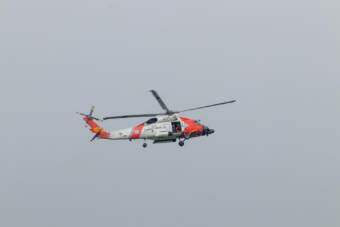
A U.S. Coast Guard HH60 Jayhawk helicopter flies over Juneau, Alaska, on Saturday, Oct. 2, 2021. (Photo by Mikko Wilson/KTOO)

Update 9 p.m.:

The Coast Guard and partner agencies that have been looking for a missing plane bound for Yakutat called off the search late Monday evening.

The plane, owned by longtime Haines pilot Sam Wright and carrying Yakutat couple Hans Munich and Tanya Hutchins, stopped emitting its radar signal near Mount Crillon at the southern end of the Fairweather Mountain Range.

The three left Juneau on Saturday and were reported overdue that evening. Both Wright and Munich are pilots with decades of experience flying in Southeast Alaska.

Coast Guard public affairs officer Mike Salerno said if the agency got more information, it could resume its search.

“The decision to suspend is never easy,” he said. “Our condolences are with the family members of the passengers on board.”

Original story:

A Haines man and a couple flying from Juneau to Yakutat are missing after their plane never arrived at its destination.

Coast Guard public affairs officer Mike Salerno said the owner and operator of the missing 1948 Beechcraft Bonanza is Samuel “Sam” Wright of Haines. Wright was flying two passengers Hans Munich and Tanya Hutchins to their home in Yakutat on Saturday but the plane never made it.

Munich and Hutchins own Coastal Air Service – formerly Yakutat Coastal Airlines – where Munich has been flying for decades. Wright is also an experienced pilot with decades of flying in Southeast Alaska.

The Coast Guard, Alaska Rescue Coordination Center, Civil Air Patrol and Alaska State Troopers are entering their third day of searching for signs of the missing plane in the Fairweather Mountain Range.

“A Coast Guard helicopter from Air Station Sitka, Coast Guard HC-130 from Air Station Kodiak, and also Coast Guard Cutter Reef Shark were all dispatched to the scene on Saturday evening when we received the alert,” Salerno said. “Then Sunday and today’s efforts have included searches from aircraft … MH-60T helicopters, HC-130s and as well as AC-130s from the Air Force and also search assets from the Civil Air Patrol.”

The plane stopped emitting its radar signal near Mount Crillon, which is at the southern end of the range, according to the Coast Guard.

“[It’s] where we saw the FlightAware tracks end,” Salerno said. “We’ve also been in contact with the FAA, the National Transportation Safety Board as well to try to leverage as many resources as we can to try to narrow down the search area.”

Narrowing down the search area isn’t the only problem searchers are running into.

“It’s a very mountainous area, the flight tracking stops at around 10,000 feet which also makes it a difficult search area for some of our search assets, especially with the cloud coverage,” Salerno said. “I can tell you that at that altitude the search assets have been encountering a lot of cloud coverage.”

Weather conditions for the search region are expected to deteriorate. According to the National Weather Service showers showers and heavy rain are expected to move into the region, reducing visibility and bringing wind gusts and lower cloud ceilings Monday evening.

“The weather is a factor, but it isn’t the only factor,” Salerno said. “The altitude combined with the cloud cover is impacting visual searching.”

Searchers are also listening for the plane’s emergency beacon, he said.

As of about 5 p.m. Monday evening, the search was ongoing according to a Coast Guard social media page.

But, it’s not clear how much longer they’ll keep looking, that’s a discussion crews are having now. Salerno said a lot of things go into that decision-making process including the weather, the location of the search area and how large it is.

“Also, we never discount the will to live of any individual,” he said.

Correction: A previous version of this story contained a typo indicating that the Coast Guard was operating an AC-130. That plane comes from the Air Force, the Coast Guard is instead operating HC-130s. Both are being used in the search.  

KHNS reporter Alain D’Epresmenil contributed to this story

A Yakutat-bound charter flight is missing after leaving Juneau on Saturday

Coast Guard helicopter
An aircrew aboard an MH-60 Jayhawk helicopter makes an approach on their return to Coast Guard Air Station Kodiak, June 5, 2019. (Public domain photo by Petty Officer 1st Class Bradley Pigage/U.S. Coast Guard)

Updated July 21 at 7:00 p.m.

Coast Guard staff are searching for a missing charter flight that left Juneau on Saturday bound for Yakutat but never reached its destination.

There were three people on board, but Coast Guard public affairs officer Mike Salerno said they do not know anything more about them. The missing plane is a Beechcraft Bonanza, according to a Coast Guard social media post.

Coast Guard spokesperson Shannon Kearney said the initial call about an overdue plane came in at 5:40 p.m. on Saturday. The agency issued a marine broadcast just after 6 p.m. and sent out the U.S. Coast Guard Cutter Reef Shark about half an hour later.

Later, they launched a MH-60T helicopter from Sitka and C130 from Kodiak and have partnered with Alaska State Troopers and the Alaska Rescue Coordination Center to search for the plane.

The agency is searching near the Fairweather Mountain Range. According to a dispatch from Alaska State Troopers, they got a report that the plane went missing near Mount Crillon, which is at the southern end of the range.

Salerno asked that people flying between Juneau and Yakutat who see something out of the ordinary contact the Coast Guard.

This is a breaking news story. Check back for updates.

UPDATE: Alaska State Troopers identify boater killed in collision near Petersburg

Search boats dot the waters of the Wrangell Narrows near Petersburg on Wednesday, June 5, 2024 after a vessel struck a skiff, leaving one boater missing and a second injured. (Courtesy Bill Flor)

Alaska State Troopers have identified the person who died in a boating accident near Petersburg last week as Susan Paul, age 73 of California. She was in a 20-foot Hewescraft skiff that sank after a collision with a larger seine boat.

A spokesperson with the U.S. Coast Guard, which is leading the investigation, says it’s unclear what led to the accident.

A second person on board the skiff – 71-year-old Gordon Paul also of California – survived. He was taken to a local hospital after the two boats collided about 11 miles south of Petersburg in the Wrangell Narrows on June 5.

The U.S. Coast Guard based in Juneau received a mayday call just before 9 a.m. The larger vessel has been identified as the 58-foot seiner Vis, which fishes out of Petersburg.

Crew from the Vis and a nearby boater pulled Gordon Paul from the water. He was transported to a nearby boat launch at Papke’s Landing and driven to Petersburg Medical Center. He was reported to have minor injuries and symptoms of hypothermia.

Search and Rescue volunteers flew in from Wrangell and used a thermal drone to spot a fuel plume rising from underneath the water, according to a press release from the group. They narrowed their search area and used a trained rescue dog to pinpoint the likely location of the second person. Rescue divers found Susan Paul still with the skiff and were able to recover her body by mid-afternoon.

Alaska State Troopers, U.S. Coast Guard, and the Petersburg Police Department also responded, along with good Samaritans in the area.

This story has been updated.

1 climber rescued, 1 dead after days stranded near Denali’s summit

A photograph of Denali, with elevations marked for its summit and the “Football Field,” where the two climbers built their snow cave. (From Denali National Park)

One of the two climbers trapped since Tuesday near Denali’s summit was rescued alive by a helicopter crew early Friday. The other died in a snow cave while waiting for help, according to park officials.

The rescue at 19,600 feet took place at about 7 a.m., according to a statement from Denali National Park and Preserve staff. Clouds and high winds that had grounded flights near the mountain’s peak relented Thursday night, allowing the park’s high-altitude helicopter to drop a duffel bag of supplies near the snow cave in which the hypothermic climbers had taken shelter.

“The pilot observed one climber waving at him at the time of the air drop, however winds were still too strong to safely conduct a short-haul basket extraction,” park officials said in the statement.

By Friday morning, the helicopter had returned to the area with a pilot and park ranger.

“The surviving mountaineer climbed into the basket and was flown down to the 7,200-foot Kahiltna Basecamp, then evacuated to the Talkeetna State Airport for transfer to a LifeMed air ambulance,” park officials said.

Park spokesman Paul Ollig said no communications had been received from the climbers since Wednesday night. Rescuers first learned of the other climber’s fate from the surviving man after he was flown from the mountain, with a medevac flight later taking him to Anchorage.

“He had expressed that his partner had died approximately two days prior to being rescued,” Ollig said.

Friday’s rescue was the culmination of a days-long effort by air and ground searchers to reach the two climbers. They were part of a trio from Malaysia that summited Denali early Tuesday. But they then used an inReach satellite communications device to request help from the summit, saying they were exhausted, hypothermic and couldn’t get down.

One of the climbers was able to make it to the mountain’s high camp later Tuesday and was flown off the mountain in serious condition, but the other two sheltered in a cave to await help. By Wednesday night, they reported that their inReach was dying.

“We received kind of a flurry of five really brief messages from the climbers at that time indicating that their inReach device was at 1% battery life,” Ollig said.

The deceased climber wasn’t immediately identified Friday morning, Ollig said, as park staff worked with the Malaysian consulate to notify his family. Park rangers plan to recover his body, according to Ollig, but no immediate time frame has been set for doing so.

Rescue teams attempting to reach 2 hypothermic climbers stranded near Denali’s summit

The Denali Park Road curls around a mountainside near the Polychrome Overlook on Sunday, May 3, 2020. (Nat Herz/Alaska Public Media)

Update, 8:15 a.m. Thursday:

Cloud cover around Denali prevented further flights to rescue two climbers stranded near the mountain’s summit since early Tuesday.

Denali National Park and Preserve spokesman Paul Ollig said crews were still awaiting a break in the clouds Thursday morning to launch another flight to the climbers just below the mountain’s summit.

Original story:

Multiple rescue agencies were working Wednesday to reach two climbers stranded for more than a day near Denali’s summit, after rescuing three other climbers suffering from severe frostbite.

Denali National Park and Preserve spokesman Paul Ollig said Wednesday afternoon that the two climbers were at a flat spot on the mountain called the “Football Field,” at an elevation of 19,600 feet.

According to a statement from the park, a team of three climbers atop the 20,310-foot peak sent an SOS signal from an InReach satellite device at about 1 a.m. Tuesday saying they were hypothermic and unable to descend.

“Rangers maintained two-way communications with the team until approximately 3:30 a.m., when the team texted that they planned to descend to the ‘Football Field,’” park officials said in the statement. “Rangers did not hear back from the team after that transmission, nor did the location of the device change.”

The Alaska Air National Guard was called in to help with the search Tuesday morning, due to cloud cover that kept the park’s high-altitude helicopter from reaching the mountain. An HC-130 search plane crew spotted two of the climbers between 19,000 and 20,000 feet, with a guide on the mountain finding the third climber near Zebra Rocks at 18,600 feet.

According to the park, a separate pair of climbers suffering from frostbite were being treated by Park Service patrol members at the mountain’s 14,200-foot camp. The helicopter crew tried to reach the summiters at about 5 p.m. Tuesday, but instead landed at the camp and rescued the two climbers there. Both were flown to Talkeetna, with one transferred to a LifeMed air ambulance for further care.

The Park Service helicopter made a second attempt to reach the summiters at 9 p.m. Tuesday, but was again unsuccessful.

“By that point, one of the three climbers had made their way down to the 17,200-foot high camp with severe frostbite and hypothermia,” park officials said. “A guided party initially assisted the patient until transferring care to an NPS ground team who had ascended to high camp from 14,200-feet to support the rescue effort.”

That climber was helicoptered to Talkeetna at about 10:15 p.m. Tuesday night and also transferred to LifeMed, according to the statement.

“Meanwhile, an experienced expedition guide on the upper mountain had diverted significant time to assist and provide care to the two non-ambulatory climbers at the Football Field (19,600 feet),” park officials wrote. “However, when the clouds moved back in late Tuesday night, the guide was forced to return to the 17,200-foot high camp for his own safety and for the safety of his team.”

Crews have been waiting for another break in the weather Wednesday to make another attempt at reaching the stranded climbers.

Ollig said Wednesday afternoon that details were still coming in about how both groups of climbers ended up in distress, as well as what condition the stranded climbers were in when the guide left them Tuesday.

He also said that high-altitude flight issues further hampered Tuesday’s rescue efforts for the summiters, noting that the helicopter was fitted with a short-haul rescue basket when it tried to reach the “Football Field.”

“Due to weight restrictions, we can’t do a short haul at that high of an elevation with either a spotter or an attendant ranger on the end of the line,” he said. “So the patients need to be either ambulatory or have assistance on the ground.”

This is a developing story. Check back for updates.

Coast Guard says a wave likely overwhelmed charter boat near Sitka last year, killing 5

Morgan Robidou poses with his boat in October, 2022. Robidou and one of his passengers, 61-year old Robert Solis, still remain missing following the accident on May 28, 2023. (Facebook image)

The U.S. Coast Guard presented its findings last week on the sinking of a charter boat near Sitka that killed five people last year, saying the boat likely capsized after it was hit by a wave.

The Awakin was a very typical charter boat for Sitka: 31 feet long, aluminum hull, twin 250-horsepower outboards, eight years old, and fully equipped with radar, radios, and other electronics for the kind of day fishing it was designed to do.

This type of boat is common in Alaska’s charter industry. Called a “well deck,” it has a big central cabin, and tall sides that allow passengers to safely walk all around the perimeter of the boat when fishing.

While the well deck makes for great fishing, it proved to be a conspicuous liability in the tragedy that struck the Awakin on May 28, 2023,  at exactly 2:43 p.m.

“We determined, based on all the evidence before us and an analysis, that the initiating event of the Awakin’s casualty was a sudden flooding of Awakin’s well deck by a large swell,” said Cmdr. Nate Menefee, who led the Coast Guard’s investigative team.

He told Thursday’s standing-room-only crowd in Harrigan Centennial Hall that the Coast Guard’s forensics lab was able to recover the data from the laptop on board the Awakin used for navigation.

Investigators could determine position, speed, and depth of the water under the Awakin from the moment it departed Sitka’s Crescent Harbor at 6 a.m. until the moment it stopped recording at 2:43 p.m., when the Awakin was on a slow drift south of Low Island, its passengers jigging for rockfish at the end of a long day of trolling for salmon and halibut fishing.

The Coast Guard Investigative Team began its Casualty Report with a solemn recognition of those who lost their lives in the incident on May 28, 2023: vessel master Morgan Robidou, 32; Brandi Tyau, 56, and her partner Robert Solis, 61, of Canoga Park, California; and Danielle Agcaoili, 53, and her husband Maury Agcaolli, 57, of Waipahu, Hawaii.

On a good day, the shore of Low Island can be treacherous. The bottom is irregular – formed by lava from the Mount Edgecumbe volcano thousands of years ago – and ocean swells can suddenly heave and break, especially at low tide.

Menefee said the Awakin, its captain busy assisting clients, was likely taken by surprise by a breaking swell that first flooded the boat, and then rolled it.

“The loss of vessel control may have prevented the master from making a radio distress call,” he said. “The loss of control could have been due to electrical or mechanical issues, or the chaotic situation that would likely ensue following the swamping of the vessel’s well deck.”

Robidou, the Awakin’s owner and captain, was young and in his first season operating a charter boat, but he knew his business. He grew up in Sitka and had logged over 800 service days on the ocean toward earning his 50-ton master’s license. Also, he had taken this same route 19 times in just the previous five days.

Safety aboard a charter boat – officially called an uninspected passenger vessel, and unofficially known as a six-pack – is heavily dependent on the master. The Awakin was well-equipped with safety gear, including two “digital selective calling” radios that would have sent an SOS and the boat’s position, if only someone had known to push the button.

The DSC system, called the “Alaska 21 Rescue System,” is relatively new and has “reliability issues. On May 28, 2023, there was no DSC coverage in Sitka Sound from a Coast Guard shore station, although a message could have been relayed – had one been sent.

Unfortunately, Robidou himself was likely among the first two people swept overboard.

“it’s very probable that anybody standing on the back of the well deck may have gone overboard including the master,” said Menefee.

With no captain and no other boats nearby, the remaining passengers on the Awakin were in dire straits. Uninspected passenger vessels in the U.S. are not required to carry a life raft or an emergency position-indicating radio beacon. The beacon, also known as an EPIRB, is a device which automatically releases from a submerged boat and sends an emergency signal.

The investigators said a well-deck hull lacks adequate drainage if a lot of water suddenly floods over its tall bulwarks. Once swamped, it did not take much for the boat to roll and capsize. In perhaps the most tragic detail of the investigation, a passenger remained alive in the submerged cabin of the Awakin for at least half an hour and sent several texts asking the recipient to call 911. Then the person, referred to as Passenger One in the report, tried calling Sitka police dispatchers.

“There were five outgoing calls to 911 on Passenger One’s phone made between 15:01 and 15:12,” a narrator said during a slide presentation. “Data showed all five attempts to call 911 as not answered.”

Sitka police dispatch records show no calls were received during that time. Although there is spotty cell service in Sitka Sound, investigators believe that it was impossible for Passenger One to obtain a signal while trapped in a submerged aluminum boat.

The investigative team examined several other factors that it concluded played no role in the loss of the Awakin or its passengers:

— Although one full and one partially-full bottle of rum were found on board, Morgan Robidou’s blood alcohol level was consistent with the natural post-mortem process between his death on May 28 and his autopsy on June 9, and not from consumption of alcohol. Charter guests often gave Robidou bottles of “Captain Morgan”-brand rum as gifts.

— Awakin’s anchor was found fouled on the bottom near Low island, but investigators concluded that it slipped from the bow roller after the boat capsized.

— Flare sightings reported in Sitka Sound during the search were not related to the incident. The Awakin’s flare kit was recovered intact and unopened.

— Although winds were expected to increase offshore to small-craft level later in the afternoon of May 28, they were not yet high at the time of the incident. The Awakin was under control until the moment it was lost.

— Discrepancies at Low Island between raster charts and the Time Zero vector charts in use on the Awakin’s navigation laptop (although the Team notified Time Zero of this issue).

The Awakin was due back in port at 4 p.m. on May 28. When it failed to arrive, fellow charter operators began calling the Awakin on VHF radio. Others began looking, and at least one boat went all the way out to Cape Edgecumbe following the Awakin’s usual route. It wasn’t until almost 5:30 p.m. that the owner of Kingfisher Lodge notified the Coast Guard of an overdue vessel.

Typically, once the Coast Guard decides to initiate a search, a helicopter can be airborne in a half-hour. On May 28, a half-fueled helicopter was ready at Air Station Sitka, but the pilot, expecting a long search flight, ordered a full tank. The pit crew encountered some problems, however, and it was 58 minutes before the helicopter took off.

Air Station Sitka commander Capt. Vincent Jansen supported his pilot’s decision, although looking back it was clear that the fueling issues weighed heavily on him.

“I’ve been flying for 20 years, the fuel tanks and the fuel pit we have right here in Sitka is the best I’ve ever seen,” said Jansen. “And it’s also the most well-maintained. We had two malfunctions that day with that fueling system. It’s Murphy’s Law. Everything else was by the book but it couldn’t happen at a worst time. And I own that.”

The 58-minute delay likely didn’t matter. By the time the Coast Guard was notified that the Awakin was overdue, the five people aboard had been in the water two and a half hours without flotation devices, or trapped in the sunken vessel’s cabin, and almost certainly no longer alive.

The investigators made a handful of recommendations to Coast Guard Commandant Adm. Linda Fagan to prevent similar tragedies, including requiring uninspected passenger vessels to carry life rafts and EPIRBs – much like the commercial fishing fleet – and to have significantly more drainage on deck. It’s not clear whether anything will change, however.

“We’ve made these recommendations before,” Menefee said, referring to the life rafts and EPIRBs.

Site notifications
Update notification options
Subscribe to notifications