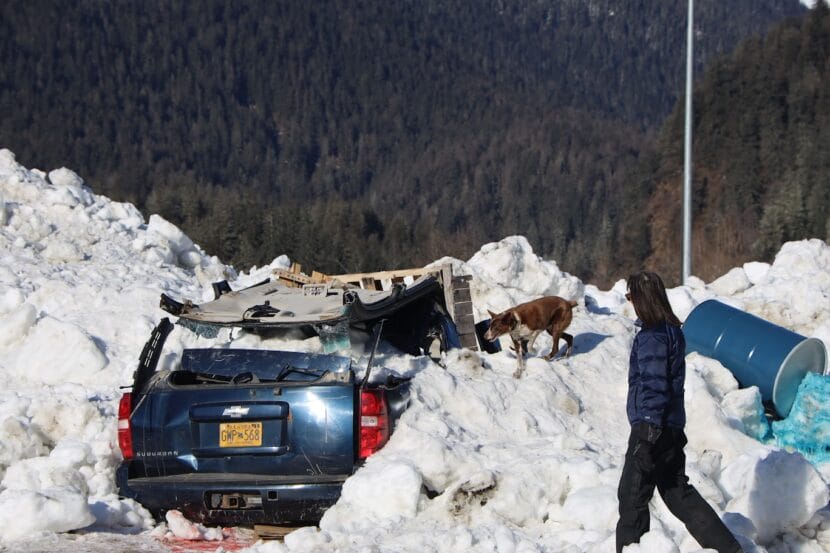
Bizzy, the oldest dog on the SEADOGS team, sniffs out a fake avalanche victim that’s hidden in the car (Clarise Larson/KTOO)
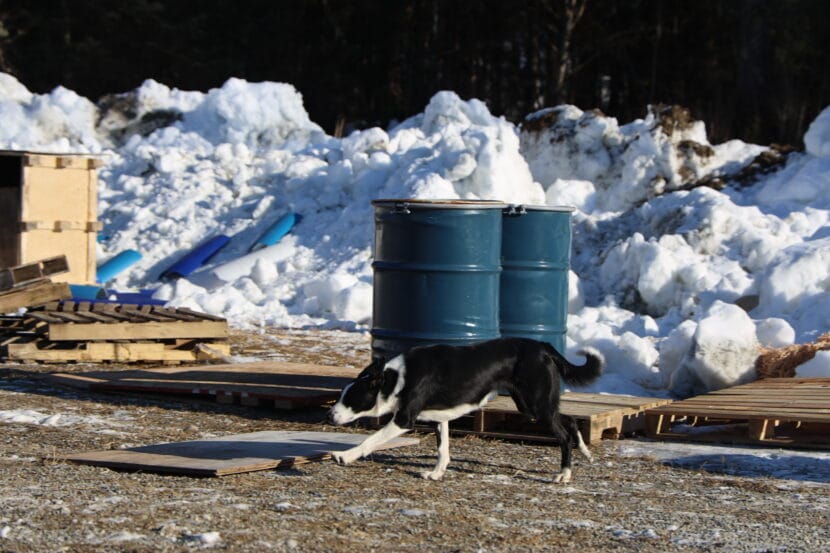
Wren, a black and white border collie, wove through barrels, climbed over snow berms and hopped over piles of splintered timber and hunks of blue plastic scattered beneath her paws.
With her nose to the ground, she could smell the scent of some old moose bones, scattered in the gravel nearby, and a bucket of food buried somewhere deep in the snow. But after a few minutes of sniffing, she narrowed in on the smell she was looking for, and bounded back across the lot to jump on her handler, Will Metcalf.
“Where are they? Point to them. I don’t see them,” Metcalf said.
Wren led him back to a half-buried, junked minivan. She stuck her head into the smashed up windows, and a person in a bright red winter jacket emerged.
“What a good dog,” Metcalf said.
Wren has joined canine search and rescue missions around the state, including at the site of the fatal November landslide in Wrangell. Running the obstacle courses helps her to prepare for scenarios like that (Clarise Larson/KTOO)
Wren is one of the most experienced canines with Southeast Alaska Dogs Organized for Ground Search, or SEADOGS. She was part of the four-legged search and rescue team deployed at the site of Wrangell’s deadly landslide last November.
The obstacle course she just ran through was designed to prepare her for scenarios like that, where disasters hit more populated places. In this case, a snowy 2-acre parking lot in Lemon Creek was set up as a rough imitation of an avalanche coming down on a neighborhood — a realistic scenario for Juneau.
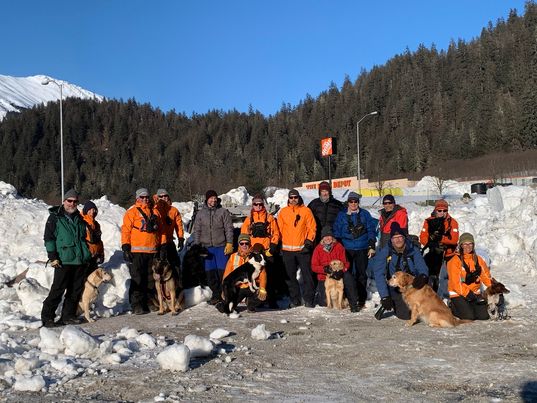
Dog handlers with Juneau’s Southeast Alaska Dogs Organized for Ground Search, or SEADOGS, pose in the snowy parking lot that was designed to imitate an urban avalanche (Photo courtesy of Marcy Larson)
The course features distracting smells to imitate the kinds of things that might get caught up in an urban disaster.
“There’s going to be refrigerators out there and there’s going to be laundry,” said handler Marcy Larson. “We don’t want our dogs alerting on that. We want our dogs alerting on people.”
They also need to navigate junk scattered across the snow and ice to simulate hazards like crushed houses, splintered trees and toxic waste.
“Even something as simple as, as you know, the chips – the wood chips that are out here,” Larson said. “Some dogs that haven’t ever experienced that are like, ‘what’s this?’”
For the SEADOGS, urban disaster search and rescue is an important skill set. But Mike Pilling, one of the most senior handlers, says it’s not the only skill these dogs have to know.
“For Southeast, since we’re kind of in a bubble here, you know, we don’t have the road system, so if anything happens, we’re it,” Pilling said. “And we’re one of the few places in the country – few teams in the country, that we kind of have to do it all.”
Pilling has trained four of his own dogs, who have helped out in all kinds of crises across Alaska. He said perfecting even one discipline of canine search and rescue can take up to two years.
Pilling’s current dog, Bizzy, a stout brown-and-white mutt, has been trained and certified in tracking missing people on both land and water.
According to Pilling, a lot of dog teams in the Lower 48 specialize in just one type of search and rescue mission. In Alaska, that’s not a luxury SEADOGS can afford.
“I’ve always trained our dogs to be able to find anybody, anywhere,” Pilling said.
But to succeed in an urban environment, the dogs actually have to learn when to work against some of their other training instincts.
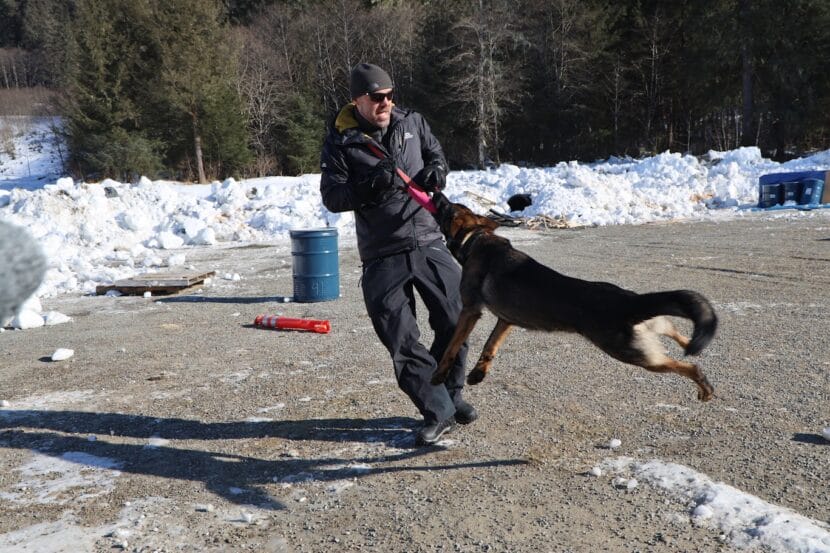
Handler Mike Kreis rewards his dog Korra with a game of tug-of-war after she successfully located a fake avalanche victim who was buried in the snow (Clarise Larson/KTOO)
Take Korra, a German shepherd, for example. She runs the course, keeping her nose glued to the ground, the way she would to track a missing person. And because she can’t pick up their scent, she can’t find her fake avalanche victim the first time around.
With a bit of correction, she does better on the second run. She keeps her head up and catches a scent on the wind, which leads her to Pilling, who is buried in a culvert behind a heavy wooden pallet.
Since Korra can’t dig him out, like she would in a backcountry avalanche, she learns to wait patiently for help.
“Right there, as you can see, there wasn’t anything really for her to dig into. But she stayed right there,” said her handler Mike Kreis.
Once Kreis reaches Korra, he helps to pull Pilling out. With that, Korra earns her reward — a round of “good girls” and a rousing game of tug-o-war.
Correction: An earlier version of this story included the name of the wrong brown-and-white dog. Pilling’s dog is named Bizzy. Both are good dogs.
15-year-old Gabriel Regan has been missing since Wednesday. Photos courtesy of Destiny Panamera.
Update — Jan. 25, 11:45 a.m.
Juneau teenager Gabriel Regan has been found after being missing for two weeks.
His mother, Destiny Penamara says she found him on Wednesday evening, and she says he is now safe.
“I’m super relieved,” she said. “I spent the last two weeks, you know, doing everything I can to find this kid. You know, just driving around knocking on doors.”
The 15-year-old had been missing since Jan. 10.
Original story
Juneau Police are asking for help finding 15-year-old Gabriel Regan. The boy’s mother, Destiny Panamera, says he’s been missing since Wednesday.
“I haven’t been sleeping, and I feel crazy,” she said. “I don’t know what else I can do. I just keep feeling like I’m gonna get a bad call.”
Regan is 6’2 and 200 pounds. Panamera last saw him wearing a black Helly Hansen jacket, tan jogger pants and white Nike Air Force One sneakers.
Panamera said people have contacted her to tell her they’ve seen him. She said anyone who does see him should call the Juneau police.
Krag Campbell with the Juneau police said they’ve been trying to locate Regan for a few days.
“We’ve been following up on locations where he’s been seen,” he said.
But police have yet to make contact with Regan. Panamera said she can’t help but worry about him.
“I wish that he knew how much I love him,” she said.
Any sightings of Regan can be reported at 907-586-0600. Anonymous tips can be made through Juneaucrimeline.com.
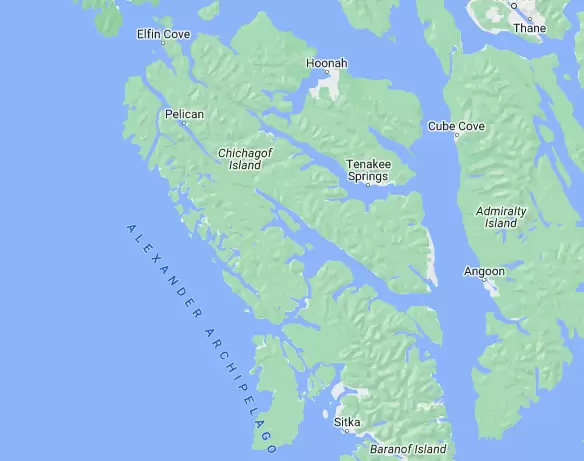
Two people are dead after a boat capsized near Sitka on Tuesday night. Three others survived.
A helicopter from Air Station Sitka responded to the scene at 5:15 p.m. Tuesday near Chichagof Island, north of Sitka, according to a Coast Guard news release.
Three people were rescued from the water by about 5:50 p.m. The Coast Guard cutters Douglas Denman and Kukui, along with an HC-130 aircraft from Air Station Kodiak, also responded Tuesday night, tracked the vessel’s drift, and searched the surrounding area for two people who remained missing.
A team from the Sitka Fire Department arrived early Wednesday afternoon with a state trooper and used an underwater drone to find the bodies of the two victims in the cabin of the vessel, the release said. Recovery operations will begin when conditions improve.
Weather in the area was reported at 8-10 knot winds, with 9-foot seas and below-freezing temperatures.
The three people recovered from the water were flown to medical personnel waiting at the Sitka airport.
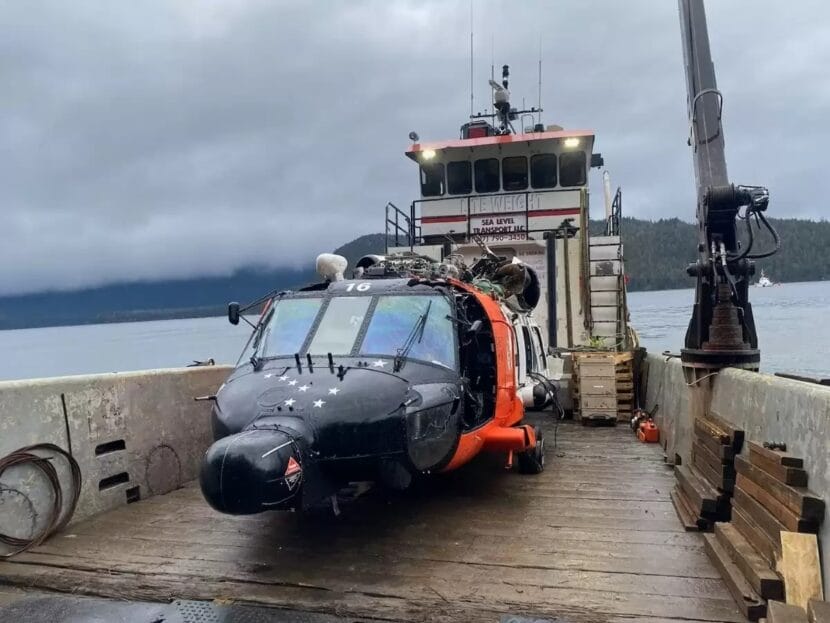
The fuselage of a crashed U.S. Coast Guard Jayhawk helicopter sits on the deck of a boat near Petersburg. (Photo courtesy of USCG)
The Coast Guard has recovered the wreckage of an Air Station Sitka helicopter that crashed last month near Petersburg, but it could take up to eight months to learn what happened.
In a news release, the Coast Guard reports that the aircraft was removed from the shore of Read Island last week. Now, the MH-60 Jayhawk is on its way to North Carolina for an inspection as part of a larger investigation into what caused the crash.
On Nov. 13, the Air Station Sitka crew was responding to a Mayday call from a fishing boat that was taking on water in Farragut Bay, about 20 miles northwest of Petersburg. The skipper of the boat had brought the flooding under control by the time the helicopter arrived. However, something went wrong and the helicopter crashed on nearby Read Island.
The two men on the boat came to the aid of the helicopter crew, and supported them through the night with communications and supplies while awaiting emergency responders from Petersburg and a second helicopter from Air Station Sitka. All four crewmembers were medevaced to Seattle, two of them with serious injuries. The Coast Guard now says that all four crew members have returned home from the hospital and are recovering.
Weather conditions were poor during the mission, with wind speeds up to 40 mph in the area and low visibility.
The Coast Guard established a security zone around the crash site and began an investigation. On Dec. 8, with the help of the U.S. Army’s Downed Aircraft Recovery team, the Forest Service, the Alaska Department of Environmental Conservation, and Petersburg Fire and Rescue, among others, they were able to retrieve the helicopter.
In an email to KCAW, Coast Guard spokesman Cmdr. Mike Salerno said the helicopter is being transported to Aviation Logistics Center in Elizabeth City, North Carolina, where investigators will further examine the airframe.
Salerno told KCAW that aviation experts from across the service have been investigating the crash– from collecting and examining the wreckage to interviewing all parties involved with the accident and reviewing environmental factors. Salerno said the investigation can take up to eight months.
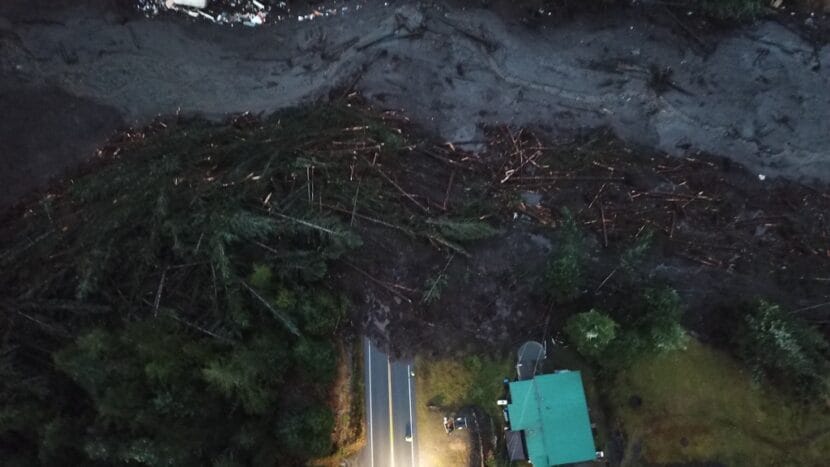
An overhead view of landslide debris across mile 11.2 of Zimovia Highway in Wrangell. (Alaska Department of Transportation photo)
The City and Borough of Wrangell has suspended the search for 12-year-old Derek Heller, who is the only person left missing from Nov. 20’s disastrous landslide.
This follows 15 days of searching and clearing landslide debris by the Wrangell Volunteer Fire Department, numerous support volunteers, K9 scent dogs and local equipment operators.
Kale Casey, spokesperson for the Alaska Interagency Incident Management Team, has been at the landslide site with responders and says the teams all came together with one mission.
“The search has been absolutely monumental,” he said. “It’s a very dangerous slide path, they mitigated a lot of risks. They operated incredibly safely for days, 15 days in a row day and night. A lot of courage being there in inclement weather and, obviously, very emotional.”
Searchers found the remains of five people: 65-year-old Otto Florshutz and four members of the Heller family – 44-year-old Timothy, 36-year-old Beth, 16-year-old Mara and 11-year-old Kara. They also found one survivor – 63-year-old Christina Florshutz, Otto’s wife.
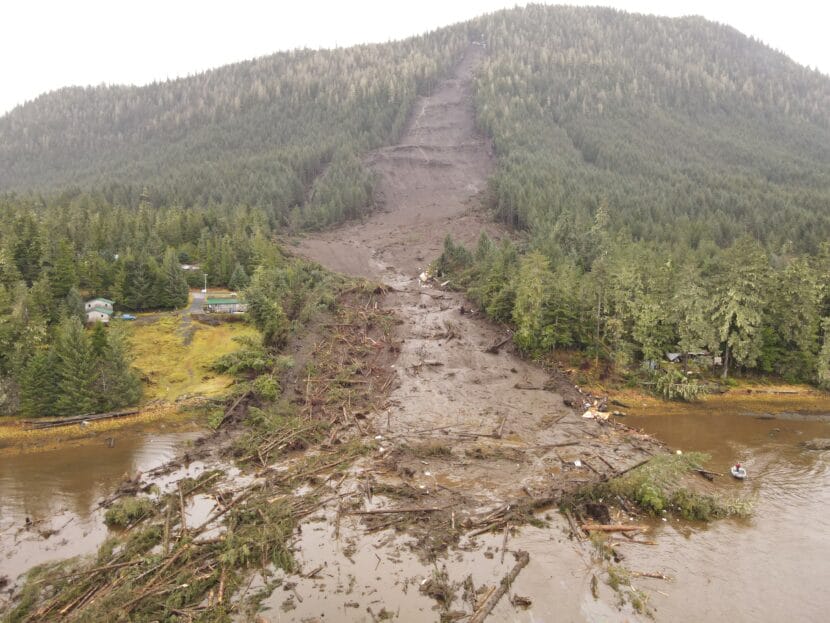
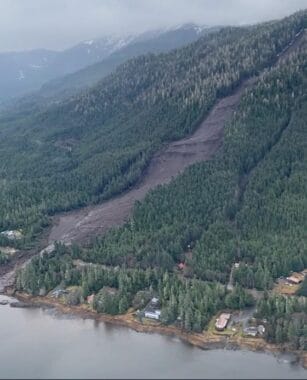
The slide was 4,000 feet long and the bottom of it stretched into the water which complicated the search. The slide around the destroyed homes was about 450 feet wide. Casey says searchers had to work through “endless amounts of clay and slippery surfaces” and the responders reached all accessible areas above and into the intertidal zone.
“They want to find Derek and bring closure to the family,” Casey said. “When you exhaust all your search areas, when you circle back and check them again, when you’re doing the kind of work they’re doing, there is a point where your search areas have been searched and that’s where they got to last night.”
A press release from the City and Borough of Wrangell says Search and Rescue volunteers and a K9 scent detection team will be available if there are any new leads or evidence in specific areas in the future.
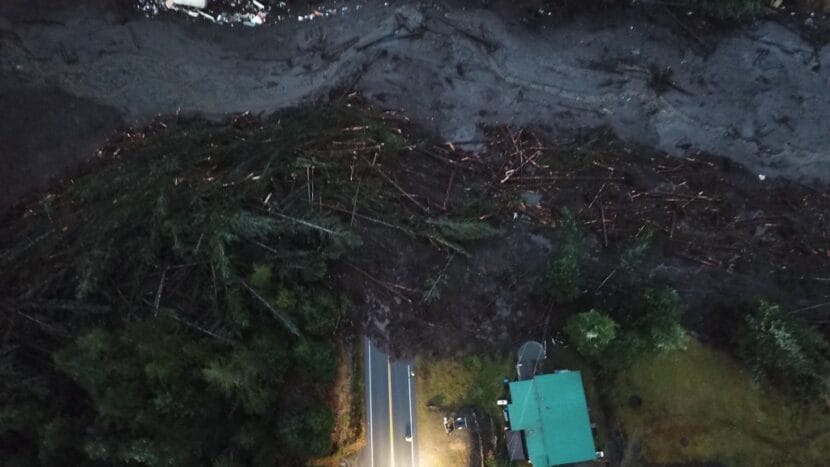
An overhead view of landslide debris across mile 11.2 of Zimovia Highway in Wrangell. (Alaska Department of Transportation photo)
WRANGELL — By Nov. 20, rain had been pouring down on Wrangell for days. It grew even stronger in the late afternoon as Angie Flickinger drove to her house on Zimovia Highway, a road that follows the coast for 14 miles south from downtown.
Around mile eight, she saw water cascading from the steep bluffs above the road. She raced through that stretch nervously, worried about the rockfalls that happen there.
“That type of weather always gives me tons of anxiety,” Flickinger said. “There always seems to be this big storm at the end of November, where trees fall. There’s always carnage.”
Later that night, the rain pounding on her roof sounded like white noise. Then it changed suddenly.
“I heard this very loud sound. Like it had been amplified tenfold,” Flickinger said. “My brain was like, ‘That’s not right.’”
Flickinger’s friend Jamie Roberts lives about a half-mile up the road. To her, the sound was like a jet rumbling overhead. She opened the door to look, and the sound got louder.
“I yelled at my husband, and I was like ‘Alaska Airlines, something is wrong with the jet, it’s coming down,’” Roberts said.
She braced herself for the sound of a crash, but it never came. Instead, the whole house started shaking.
“And we just ran out the door,” she said.
A few hundred feet away, Roberts’ neighbor Christina Florschutz was on the second floor of her house, just out of the shower. She knew what the sound was. She’d heard mudslides before.
“Suddenly I’m like a piece of weightless popcorn being tossed around all over the place,” she said. “And then — I don’t remember anymore for a while.”
Landslide debris stretched from more then 1,500 feet up the slope down to the water. (Caleb Purviance/Alaska Department of Transportation)
The landslide
That evening, a burst of heavy rain drenched the already sodden hillside around mile 11 of Zimovia Highway while 70 mph gusts battered the trees. Eventually, parts of the slope were more water than soil. The earth finally gave way at about 8:45 p.m.
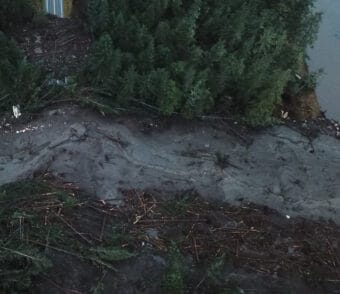
A viscous flow of mud roared down toward the road, carrying hundreds of fallen trees. It picked up the Florschutz house and carried it downhill until it slammed into the family’s workshed and fell to pieces. The slide crossed the highway, burying the house where Beth and Timothy Heller lived with their three children. Some of the debris reached the water.
Beth and Timothy Heller were later found dead, as were their daughters, Mara and Kara. Their son Derek has not been found. Searchers found the body of Otto Florschutz, Christina’s husband, on Nov. 30.
It was the deadliest landslide in recent Alaska history. For about 70 people who live beyond the slide zone, it blocked the road and knocked out power for a week. Now, some who live on the hillside wonder if they should leave their homes for good.
KTOO spoke to a dozen people who were stranded beyond the slide zone that night. They described hours of fear and confusion as some fled their homes — and how that confusion gave way to an improvised evacuation where neighbors helped each other to safety.
“We could still hear the hillside cracking”
After the slide came down, Roberts ran to the beach with her husband and son. She could see the silhouette of a big pile of debris just up the coast. And she could smell it.
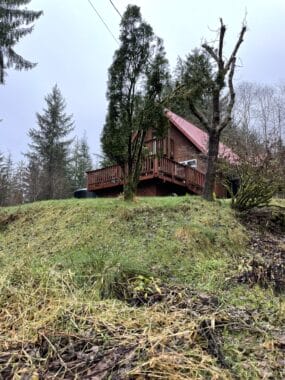
The Roberts’ house stands just a few hundred feet outside the path of the slide (Photo courtesy of Jamie Roberts)
“Like Christmas wreaths,” Roberts said. “It was a very overwhelming, you know, conifer smell.”
Roberts was close with the Florschutzes and the Hellers. They’d celebrated holidays together, and Roberts had coached the younger Heller children at swimming. From what she could see, the slide had plowed right through their properties.
She was shaken and didn’t know where to go. Her family stood in the rain wearing just the clothes they escaped in. Her husband was barefoot. The rain was soaking through their sweatshirts, but they were afraid to move.
“We could still hear the hillside cracking,” Roberts said. “So we figured if we just stand in this one spot and are quiet, we’ll be able to know which way to go if more starts coming down the hill.”
Angie Flickinger, Roberts’ neighbor to the south, didn’t know what had happened. The power had gone out, but she was still in her house.
She stepped outside to investigate, thinking a small slide might have come down close by. That had happened two years ago, during a November storm that snapped utility poles and knocked down dozens of trees.
The landslide debris across Zimovia Highway had a consistency “like soup,” according to a geologist who was on the scene (Alaska Department of Transportation photo)
She couldn’t see much of anything with her headlamp. The roaring had died down, but the two creeks that run through her property were raging, and the wind was shaking the trees.
She tried to reach friends who might know more, but she couldn’t get through to anyone. She thought she might just go to bed, but as she was putting pajamas on, at 9:30 p.m., the phone rang.
“It was a friend in town,” Flickinger said. “And she told me that there had been a big slide. Like a major slide.”
Just then, something caught Flickinger’s eye out the window. A boat with piercing white lights was charging up the coast.
A risky search
Search and rescue teams arrived quickly, just after 9 p.m. by road on the north side of the slide, and soon after that by boat. In the pitch dark, they made a hasty search and recovered the body of the Heller’s 16-year-old daughter, Mara.
But the mud was deep and soft — rescuers who tried to climb the debris sank to their chests. Like the Roberts family, they could hear the unstable hillside shifting in the dark. Before long, they called off the search for the night.
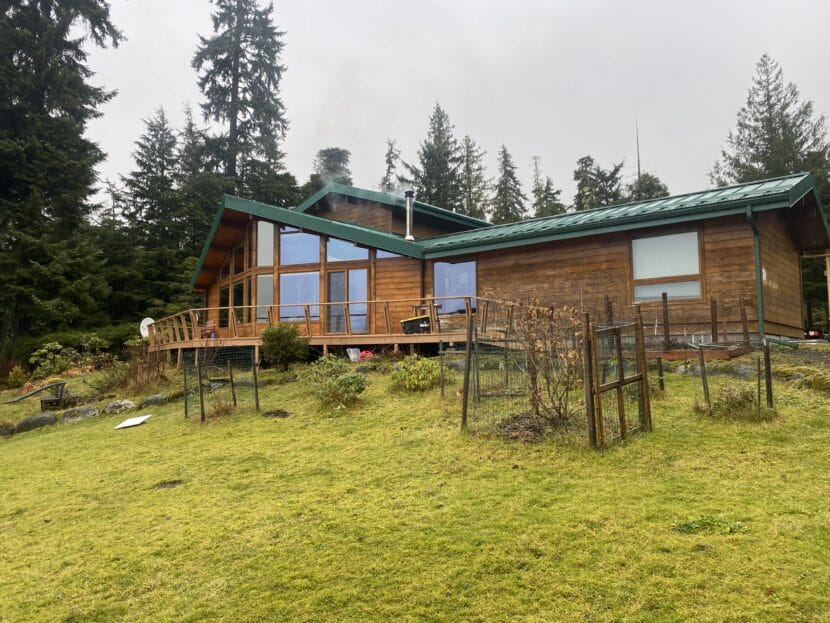
About a mile away, Charlie and Mel Hazel saw the search boats, too. A retired couple, they live at mile 12.7 in a house they built 10 years ago.
“Great big, huge sodium lights. And they were up here, kind of going around in circles,” Hazel said, pointing to the water north of his property.
They watched the lights through the windows of their darkened living room. Then some of the lights started moving their way.
“That boat came down here and landed on my dock,” Hazel said. “Then a search and rescue team got off.”
They told the Hazels about the landslide. Charlie Hazel gave them the keys to his pickup truck, and they tore off down the road.
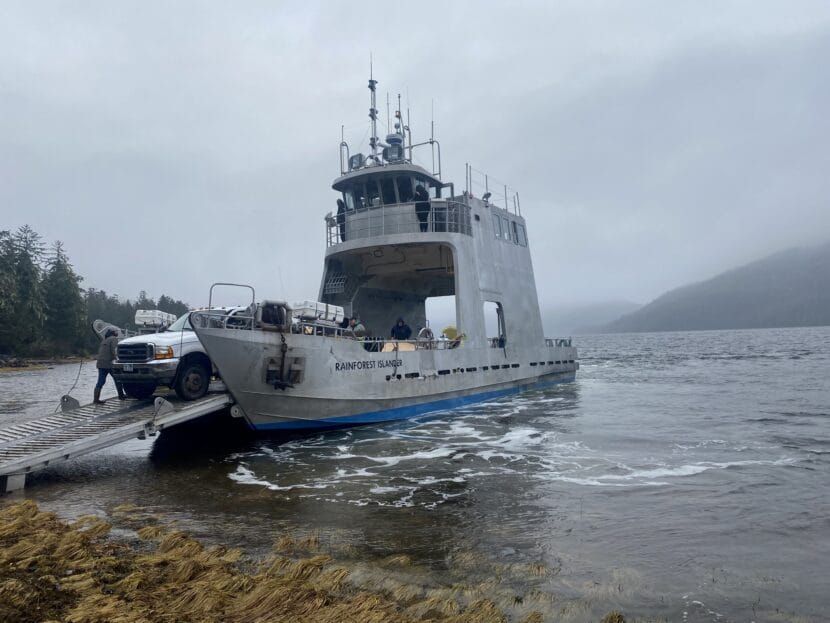
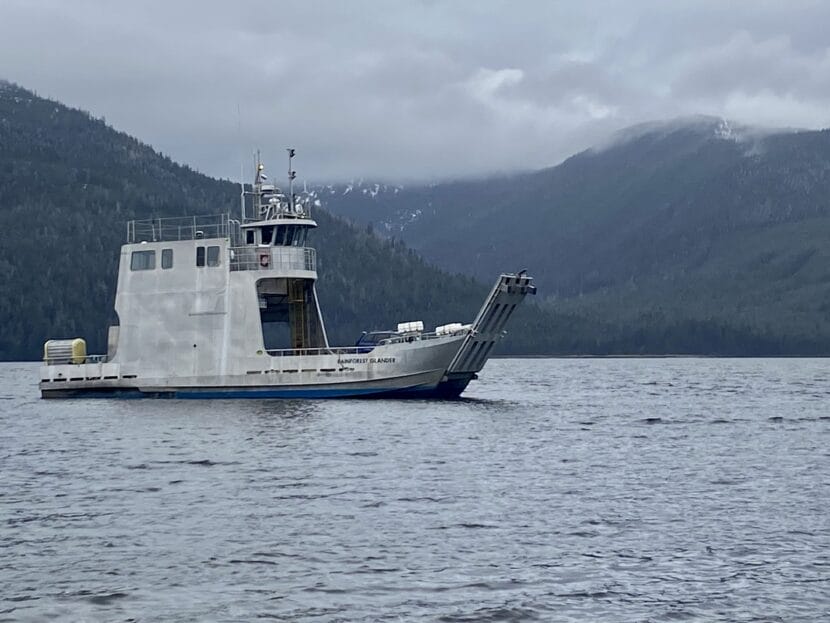
Back in town, Eric Yancey was firing up his private ferry, the Rainforest Islander. He had learned about the slide from his brother-in-law, who took his fishing boat out to help light the search. Yancey wasn’t sure where he was going or how his ferry might be used — he just wanted to help somehow.
Eric Yancey’s Rainforest Islander (Anna Canny/KTOO)
“I didn’t know what I was doing”
Flickinger — and many others — also were not sure what to do or where to go.
“I didn’t really know the full severity of it,” Flickinger said. “I didn’t know what I was doing.”
Cell reception that far out of town is always unreliable, and the slide had taken out landlines and internet along with the electricity.
At 9:36 pm, the city had sent out a text and email alert saying a landslide had happened between miles 10 and 12 — and they sent several more updates through the night. But it’s likely that most people never got them. According to the Wrangell’s interim borough manager, only 10% of residents are signed up for the city’s emergency alert system.
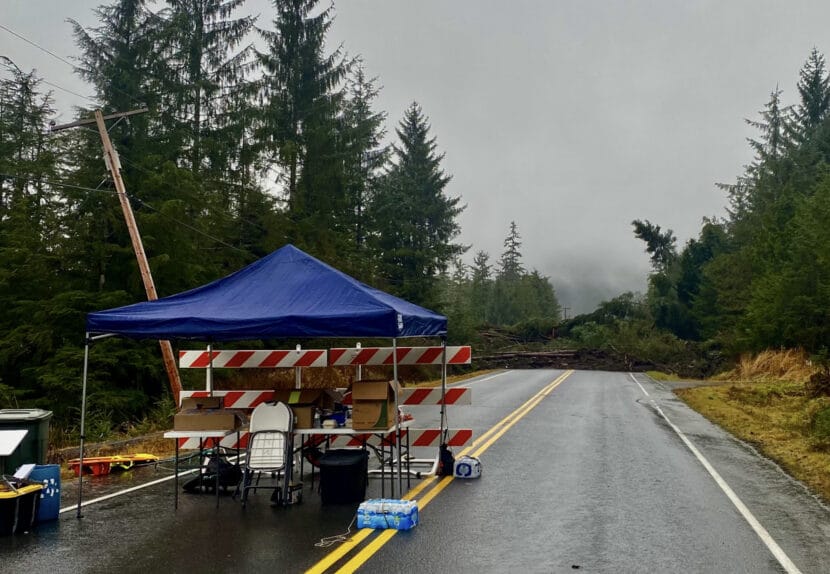
From the road, a mess of downed trees made it hard to see how far the landslide debris stretched (Anna Canny/KTOO)
Out the road, the houses are spread out, and many have long driveways through large, wooded yards. In the dark, it took hours for firefighters to spread the evacuation warning.
Meanwhile, people wandered up and down the road, in cars and on foot. A few went to the slide with flashlights and hand shovels. Some even tried to climb over it, but they retreated once they realized just how far the debris stretched.
Others went back to their houses, packed their bags and waited. Some listened for more slides, ready to make a quick escape.
Flickinger started walking toward the slide, too, but her neighbors up the road pushed her back. They urged her to go to the school bus turnaround — a flat place near the toe of the mountain where many had already gathered.
But Flickinger was worried about her neighbors. She knew the slide had come down near the Roberts’ house, and she hadn’t heard from them. She also thought of a young family down the road. She knocked on their door, but they didn’t answer.
Thinking she might be overreacting, she started to head back home. That’s when a truck full of firefighters stopped her. They told her to leave the area and head to Charlie Hazel’s dock.
For Flickinger, that’s when fear fully set in.
“So I turned around, went back to my friend’s house,” she said. “I screamed and flashed my headlamp in all their windows and doors until they woke up.”
The Roberts family finally ventured up from the beach. They walked toward some lights on the highway, where they found a group of firefighters that told them to go to Hazel’s house. They dashed into their house for some shoes, grabbed their car, and got out of there.
Charlie and Mel Hazel’s house became a safe haven for people who fled their homes on the night of the landslide (Anna Canny/KTOO)
“We were all already grieving”
By then Yancey, the ferry captain, had also gotten word to go to Hazel’s dock. In the wind and rain, the trip took longer than usual. Charlie Hazel described “flat rain” and 35 mph gusts lashing his house as more and more people showed up.
“Everything got pretty crowded with parked cars, and one thing or another. Unloading children and wives and dogs and dog kennels,” Hazel said.
More than half a dozen people had settled in by the Hazel’s wood stove. Not knowing what else to do, Charlie and Mel did their best to feed them.
Evacuees in Yancey’s ferry waited for hours as firefighters tried to reach everyone south of the slide (Anna Canny/KTOO)
When Flickinger got there, Yancey’s 75-foot ferry was waiting, pinned against the dock by the wind. She boarded and waited in the heated cabin. Roberts found her there.
“Jamie and her family pulled up right after I did,” Flickinger said. “And I just gave her a huge hug and cried on her shoulder.”
Sitting in the ferry, Flickinger, the Roberts and a few other families tried to piece together what happened from snippets of search-and-rescue chatter on the boat’s radio.
“We had heard that a couple of neighbors had been impacted. And that likely wasn’t good,” Flickinger said. “I think we were all already grieving at that point.”
For three hours they waited, on edge and exhausted, bobbing by the dock in the nasty weather. By the time they set off for town, 19 people were on board. They got to Wrangell close to 4 a.m.
“There was a lot of people at the dock when we pulled in, loved ones,” Yancey said. “A lot of hugging.”
Yancey, a 21-year military veteran, spent much of the night focused on the task at hand. At home, in front of the TV, he started to process.
“Small town,” Yancey said. “You’re either related to or know pretty doggone well the people that were involved.”
Robert’s phone was flooded with messages from concerned friends, and from the friends and family of the Hellers and Florschutzes.
“My message was like, I have not seen them,” Roberts said. “The slide went right down the path of where they’re living. It would be a miracle if people were able to make it out of there.”
“They came and got me”
Somehow, Christina Florschutz did. She woke beneath a piece of roof from her destroyed house and kept herself warm with pieces of polar fleece from a bag of sewing supplies.
“I was getting rained on, it was very windy,” Florschutz said. “And I kept telling myself, you can breathe. You can see the trees. You’re not buried. You must be near the top of the pile.”
The red roof of the Roberts family house is visible to the right of the Nov. 20 landslide and just downhill from an older slide. (Photo courtesy of Jamie Roberts)
At daybreak, she climbed out and started to make her way across the debris field.
“And I see hats coming through the trees, baseball caps,” Florschutz said. “And they heard me yell, and they came and got me.”
Florschutz says she’ll look for a new home in Wrangell, somewhere on flat land.
Roberts will be looking for a new house, too. At the base of the hill, her little A-frame home now stands frighteningly close to a pair of slide paths — the enormous, fresh gash to the north, and the duller scar of an older slide that stopped just short of her property.
Now, she can hardly stand to be in her house for more than a few minutes.
“We’ve owned our property for a long time. It wasn’t in our plans to ever move and build a new house, nor could we,” Roberts said. “But I just keep being like, I’m alive. And I have my family. And the rest, we’ll just figure it out.”
KSTK’s Colette Czarnecki and Wrangell Sentinel’s Caroleine James contributed reporting.
Close
Update notification options
Subscribe to notifications
Subscribe
Get notifications about news related to the topics you care about. You can unsubscribe anytime.


 Two people are dead after a boat capsized near Sitka on Tuesday night. Three others survived.