Search & Rescue

Coast Guard says some rescue radio towers are down after Monday’s storm, warns mariners about landslide debris

The U.S. Coast Guard Cutter Pike. (Photo by KFSK)

Monday’s region-wide storm in Southeast Alaska knocked out six U.S. Coast Guard Rescue VHF towers. That means the Coast Guard may not be able to pick up calls for distress on VHF channel 16 in certain parts of Southern Southeast.

Four towers — located on Zarembo, Gravina, Sukkwan, and Duke Islands — are back up and running, but the Coast Guard hasn’t declared them fully capable yet. The towers on Mount McArthur and Mount Robert Baron are still out of commission.

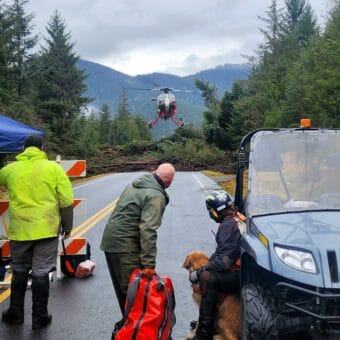
Aaron Hankins is the director of Fire and Emergency Medical Services in Petersburg. He’s helping coordinate the relief effort for a deadly landslide last night in Wrangell.

Hankins also cautions mariners in the region to avoid Sumner and Zimovia straits in order to clear the area for ongoing rescue operations. He says there’s also dangerous debris from the landslide floating in the water, which may not be immediately visible below the surface. That flotsam can damage or even sink small vessels.

Due to the potential gaps in coverage, the Coast Guard is relying on mariners and emergency responders in the region to notify them of mariners in need of help by calling (907)463-2980 if they hear an unanswered distress call on VHF channel 16.

Coast Guard Sector Southeast Alaska will post status updates on the disabled Southeast VHF radio towers online.

Correction: An earlier version of this story gave an incorrect name for Mount Robert Baron.

At least 3 dead, 3 missing in landslide near Wrangell

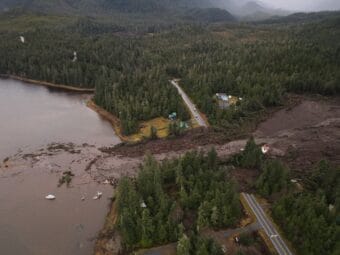
A fatal landslide near Mile 11 of the Zemovia Highway near Wrangell, seen from the air on Tuesday, Nov. 21, 2023. (Courtesy Sunrise Aviation)

A landslide outside of Wrangell late Monday killed three people, destroyed three homes and left three people still missing, according to state and local officials.

Searchers found a girl dead in the slide in an initial search after the first calls for help, but that search was paused for a time due to unsafe conditions and the possibility of further landslides, according to Alaska State Troopers. On Tuesday, searchers found a woman alive and rushed her to a hospital.

Later Tuesday, a drone operator discovered the bodies of two adults, which were recovered from the debris, troopers said.

Two children and one adult remained missing Tuesday night.

Alaska State Trooper spokesperson Austin McDaniel said Tuesday that troopers and other local, state and federal crews are still looking for survivors.

“This is very much still a search and rescue operation,” McDaniel said. “We are approaching it with that in mind, and I know that all of our teams on the ground both volunteer are looking at it with the same with the same lens.”

The names of the girl who died, the survivor, and the missing have not been made public.

Search and rescue efforts resumed this afternoon after geologists determined parts of the slide area were stable. But state geologist Barrett Salisbury, with the Alaska Division of Geological and Geophysical Surveys, said the rainy forecast means that stable areas could still shift more.

“It looks like there’s a lot of moisture in the next week,” he said. “And that’s not a great forecast for being in and around that area.”

The slide — which was about 500 feet wide where it crossed the road — also cut power to many homes and forced evacuations along the Zimovia Highway.

Local officials have urged between 20 and 30 people living near the landslide to evacuate the area with the help of the local fire department and water taxis. Evacuees are being housed in local hotels.

On Tuesday, the National Weather Service in Juneau told KSTK that just over three inches of rain fell in Wrangell during a 24-hour period beginning early Monday morning.

Salisbury said heavy rains can increase the already-present risk of landslides in Southeast Alaska.

“It’s virtually impossible to predict this kind of catastrophe,” he said. “But we do know that the risk of landslides — specifically this type of landslides known as a debris flow — the risk of a debris flow is present throughout Southeast Alaska where we have steep slopes. And we know that heavy rainfall or rapid snowmelt, or otherwise, putting lots of moisture into the soil makes those risks greater.”

Salisbury said people in the area should be on high alert for sounds of rumbling or cracking trees, new springs of water, or physical changes to houses or property like swelling ground or shifting porches or foundations.

Zimovia Highway has been closed to the public from 6-Mile on, with the exception of local access. There’s no timeline for when people who live beyond the landslide might be able to return home.

There’s also no update on when power might be restored for approximately 75 homes without between 9 Mile and the end of Wrangell’s highway.

Wrangell Public Schools are canceled tomorrow. Evergreen Elementary School will be open between 9 a.m. and 1 p.m. to offer support services.

Gov. Mike Dunleavy said Tuesday morning that he had issued a verbal disaster declaration for the Wrangell landslide, adding that he and his wife were stunned by the damage.

“Rose and I are heartbroken by this disaster and we pray for the safety of all those on site and offer all the resources our state has available,” Dunleavy said.

Any missing persons unaccounted for in the slide area should be reported to Wrangell Police at 907-874-3304.

KSTK’s Colette Czarnecki and Alaska Public Media’s Casey Grove contributed to this story.

This is a breaking news story. Check back for updates.

Between flights to Tuluksak, Operation Santa Claus turned into a rescue mission

From the left, Holly Demmert and Clifton Dalton, both flight paramedics with LifeMed, and Cheif Warrant Officer 3 Bryan Kruse, Bethel Army Aviation Operating Facility commander, move a critically ill patient from a Black Hawk helicopter to an ambulance during a medical evacuation from Napaskiak to Bethel on Nov. 15, 2023. (Balinda O’Neal/Alaska National Guard)

Over 100 kids and their parents waited patiently for Santa and Mrs. Claus in the Tuluksak school gymnasium. The Alaska Army National Guard UH-60 Black Hawk from Bethel had to make two trips to Tuluksak, about 34 miles away. The first trip brought six passengers that included this reporter, representatives from the Salvation Army, and Alaska Guard members. Most importantly, of course, it also carried presents. But Santa was a bit delayed.

Chief Warrant Officer 2 Colton Bell is assigned to Golf Company, 2-211th General Support Aviation Battalion. He was the lead helicopter pilot for the mission.  

“We had Santa on the second flight. He was with the medics,” Bell said, referring to staff from the air medical transport company LifeMed.

In the middle of Operation Santa Claus, there was an urgent assistance call from the Alaska Rescue Coordination Center at Joint Base Elmendorf-Richardson in Anchorage.

“We got a rescue mission, patient transport from the village of Napaskiak about in the middle of it. So we took off from Bethel and took two LifeMed medics with us over to Napaskiak to drop them off, and then continue the mission up to Tuluksak. Dropped off those passengers, the second round of presents, and then returned back to Napaskiak. Picked up the patient and the two medics and transported them back to Bethel over to the hospital,” Bell said.

The wind and runway conditions made it too dangerous for LifeMed’s air ambulance to respond to a man from Napaskiak, who had gastrointestinal bleeding. So they called the rescue center for help.

Chief Warrant Officer 2 David Berg was the helicopter’s support pilot. He said, “we as a team, the whole crew here from Bethel. Plus the support team from Anchorage. Air Force and Army really came together to reconfigure the aircraft to include the medics and their equipment.”

Berg also said that it was a seamless transition to go from dropping presents, Santa, Mrs. Claus, and their team of volunteer elves, into a rescue mission. “And then go back and pick up the patient. And it all happened fairly smoothly. We had to shut down a couple times, but it was a smooth afternoon. In my experience, it was definitely a highlight of my career,” said Berg.

“So my role for this was purely to get the passengers loaded for the second leg. So normally when we’re loading and unloading with the rotors turning, we’ll have a backseater on board to make sure everybody gets out. Clear the aircraft safely,” said Chief Warrant Officer 3 Nicholas Lime, who served as the crew chief for the second leg of the mission.

According to the crew, they didn’t want to shut the Black Hawk down.

“We had a rescue mission, so we didn’t want to shut the aircraft off and have something not start back up. So we landed in Tuluksak and unloaded while we’re running. Make sure when he gets out safely away from the aircraft and then reconfigure the aircraft to put the back row or the stretcher across the back row, instead of presents, and then help the LifeMed people put the passenger in the aircraft,” Lime said.

Lime also said that the conditions in Napaskiak were wet, icy, and windy, not ideal conditions to transport a patient.

“Yeah, everyone’s okay. Nobody, nobody got dropped. Nobody slipped and no one got hurt. So yeah, it was a good mission,” Lime said.

The Alaska Army National Guard aviation facility in Bethel has been active since the Black Hawk’s arrival on Feb. 4.

The rescue center, which organized the medevac, said that the patient was stabilized and transported to Anchorage, where they remained in stable condition as of Thursday.

Then it was back to the mission of holiday spirit. The crew reconfigured the Black Hawk to allow for all 12 passengers, including Mr. and Mrs. Claus, to be picked up from Tuluksak, leaving the presents behind.

Although Santa and Mrs. Claus arrived a little later than scheduled in Tuluksak, the community immediately forgot about the tardiness when the honored guests arrived. And the pictures with Santa and Mrs. Claus, free ice cream, and presents helped.

When a Coast Guard helicopter crashed, first on the scene was the fishing crew it came to rescue

“Well, it was it was dark,” said Logan Padgett, captain of the Lydia Marie as the helicopter from Air Station Sitka arrived. “So we were just looking at the helicopter lights and there wasn’t really much to see. But we could hear the rotors one second, and then loud crash the next. Then silence.” In the photo, an Air Station Sitka Jayhawk on a training flight. (Photo courtesy of Don Kluting)

The first people at the scene of Monday night’s crash of an Air Station Sitka helicopter were the crew of the distressed fishing vessel it was sent to assist. The two brothers aboard the Lydia Marie played a critical role in the rescue of the downed air crew.

Logan Padgett is the captain of the Lydia Marie, a 44-foot wooden troller based in Wrangell. The Lydia Marie began taking on water around 8 p.m. Monday in the rough seas of Frederick Sound. Padgett sent out a mayday and steered for the protected northern shore of Read Island in Farragut Bay.

The helicopter launched from Air Station Sitka and made the 81-mile trip to Read Island by 10:15. Padgett spoke to the air crew by radio, letting them know that the flooding was under control.

Then something went wrong.

“Well, it was dark,” Padgett explained. “So we were just looking at the helicopter lights, and there wasn’t really much to see. But we could hear the rotors one second, and then (a) loud crash the next. Then silence.”

Padgett turned on the Lydia Marie’s crab lights. He and his younger brother rowed ashore and met one of the helicopter’s pilots on the beach, near where the aircraft had come to rest, inverted among some trees. Two members of the helicopter crew were pinned inside, and the brothers tried to keep them comfortable with sleeping bags and ibuprofen. And they used their own radios to help the crew call for help.

Petersburg Search and Rescue, EMS, police, Alaska Wildlife Troopers and more Coast Guard personnel answered their call.

Aaron Hankins is the director of Petersburg’s emergency services. He says the ride to Read Island was pretty treacherous — waves were nearly washing over the sides of the boat. And all the while, they were being pelted with snow and rain.

“We were kind of going with it on our way there and it was still pretty lumpy,” said Hankins. “It was pretty rough. At times, it was whiteout (conditions) on our way out there.”

Patrick Fowler leads Petersburg’s Search and Rescue team. He says when they reached the downed helicopter — a couple hours after the crash — they walked into a mess.

“(There was a) strong smell of fuel in the air, as could be expected,” said Fowler. “The helicopter was almost totally on its top side — totally upside down.”

The team was ready to render aid. But they didn’t have the right tools to immediately get the crew out of the fuselage. What they had with them might have been suitable to extract someone from a car accident — not a helicopter. But with time — and some brute force — they were able to free the injured crew.

​​”(It was) just a small space that’s gone topsy-turvy, and people kind of stuck and injured,” said Fowler. “It’s always a tricky environment to work in. And so yeah, cutting some straps, breaking a couple of pieces of metal and ultimately getting where we could transition them up and out of the helicopter.”

In spite of the challenges, Fowler said it was his favorite type of rescue mission.

“At the end of the day, everyone came home — and that’s why we do this,” said Fowler. “You see a direct correlation to your actions and a positive benefit to the people there that were in trouble. So that’s the most rewarding type of mission that we get.”

Back in Petersburg, Dr. Alice Hulebak was the physician on call that night. She says it was all hands on deck. Most of the hospital’s nurses and providers came out to lend a hand — even though they weren’t on call. Hulebak says the attending staff didn’t know what to expect — but they weren’t optimistic.

“There was a lot of unknown,” said Hulebak. “But (we were) sort of planning for, unfortunately, the worst. So that is why we essentially called in as much help as we could.”

Once the patients were stabilized, two nurses and a doctor accompanied the Coast Guard medevac flight to Seattle, because the Coast Guard didn’t have their own medevac team available at the time.

Mary Kravitz is Petersburg Medical Center’s nursing supervisor. She was on that flight, tending to the injured helicopter crew. She’s also the spouse of a Coast Guardsman. Kravitz says that connection made it very easy for her to volunteer her time.

“Thinking of my husband — it’s something that if I was in their shoes, and I couldn’t get to my husband in this sort of situation, I would hope that somebody would do the same for him,” said Kravitz.

Padgett, the captain of the fishing boat, says it did not feel strange coming to the aid of the Coast Guard.

“It’s just people helping people at that point,” he said.

Padgett says he knows nothing about helicopters, or what might have caused the accident. As a mariner, he does know the weather, and it was not a good night.

“I know that visibility was terrible,” he said. “And the gusts of wind were terrible. And it was just really bad flying conditions.”

In all, Padgett says he and his brother spent five or six hours on the beach at Read Island helping the air crew. Shortly after daybreak, the cutter Elderberry came to escort the Lydia Marie.

Asked if he’ll carry any particular memory of the events with him, Padgett said, “It was just kind of all one long, cold night.”

This story has been updated.

2 Coast Guard crash survivors released from hospital, 2 others improving

A Coast Guard MH-60 Jayhawk helicopter from Air Station Sitka pends investigation Nov. 14, 2023 after it crashed on Read Island, Alaska. The helicopter crash occurred Nov. 13, at approximately 11:05 p.m. All four crewmembers survived. (U.S. Coast Guard photo)

Two of the Coast Guard crew members who were involved in a helicopter crash in Southeast Alaska late Monday night were released from the hospital Wednesday.

According to a Coast Guard press release, the other two crew members with severe injuries remain hospitalized in Washington state, but their conditions have improved.

The crew from Air Station Sitka was on a search and rescue mission, responding to a fishing boat that was taking on water near Farragut Bay, about 20 miles northwest of Petersburg, when their helicopter crashed on Read Island. While Petersburg’s search and rescue team and coast guard crews responded to the downed helicopter, the Coast Guard Cutter Elderberry oversaw the dewatering of the fishing vessel Lydia Marie and escorted the boat back to Petersburg.

The Coast Guard has not released the names of the crew members or any information on what may have caused the crash, though weather conditions at the time of the accident included reduced visibility in the area from rain and snow storms and up to 45 mile per hour winds. An investigation into the crash is ongoing.

All 4 crew members survive Air Station Sitka helicopter crash

A U.S. Coast Guard HH60 Jayhawk helicopter flies over Juneau on Saturday, Oct. 2, 2021. (Photo by Mikko Wilson/KTOO)

A U.S. Coast Guard helicopter crashed around 10:40 p.m. Monday night on Read Island in Farragut Bay, about 22 miles northwest of Petersburg. There were four crew members aboard, and all survived.

Two personnel were severely injured in the crash. The other two received only minor injuries.

The crew of the downed Jayhawk helicopter were on their way from Air Station Sitka to assist the Lydia Marie, a commercial crabbing vessel, which was taking on water near Farragut Bay.

Following the helicopter crash, U.S. Coast Guard cutters Elderberry and Douglas Denman responded to the flooding vessel. At the time of the initial response, the crew of the Lydia Marie had contained the flooding to a manageable level.

Several agencies, including Petersburg Search and Rescue and EMS, came to assist the downed helicopter. Air Station Sitka sent another helicopter to take all four crewmembers to Petersburg Medical Center. They were later evacuated to Seattle for a higher level of care.

District 17 spokesperson Petty Officer First Class Shannon Kearney says that the Coast Guard doesn’t have any preliminary information on the cause of the crash.

“We are working to launch a full investigation,” she said. “Any information that we get from the investigation, we’ll be forthcoming with.”

Petersburg Search and Rescue volunteers reported strong winds and snowfall in the area. According to the National Weather Service, there was reduced visibility across the area from rain and snow storms, and wind speeds reached up to 45 miles per hour.

Site notifications
Update notification options
Subscribe to notifications