Search & Rescue

Recovery called off for plane that crashed in Wrangell-St. Elias National Park

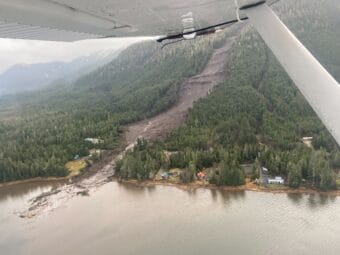
An aerial photo shows the Mt. Leeper airplane crash site and debris field in Wrangell-St. Elias National Park on Sept. 5, 2023. (Courtesy of NPS/Harper)

Recovery efforts for a small plane that crashed in Wrangell-St. Elias National Park last month have been called off. 

Clint Johnson with the National Transportation Safety Board said it’s rare that a wreck is this inaccessible.

“It’s not often we see this where we can’t get to an accident site or recover the victims or the wreckage,” Johnson said. 

Alaska State Troopers reported on Aug. 28 that a Beechcraft Bonanza carrying two people had gone missing after leaving Glennallen the day before on the way to Ketchikan. 

Officials say Clayton McMartin and Melissa McMartin from Roanoke, Texas were on the plane.

The plane was last heard from 18 miles inland of Cape Yakataga, near Yakutat.

A U.S. Coast Guard aircraft spotted wreckage in a glaciated area with deep crevasses near Mt. Leeper in Wrangell-St. Elias National Park on Aug. 28. 

National Park staff, Alaska State Troopers, and the National Transportation Safety Board have been attempting to recover the wreckage since then, but poor weather conditions hampered early efforts. 

Now, officials say that the wreckage location, in an area with deep crevasses, is permanently inaccessible.

The NTSB preliminary report does not give a clear reason for the crash, but Johnson said that based on the information they have and photos of the crash site, it was a high-speed crash.

They logged on to watch the famous fat brown bears. They saved a hiker’s life instead

A livestream set up by Explore.org in the Katmai National Park for bear enthusiasts captured a missing hiker pleading for help on Sept. 5. (Screenshot by NPR/Explore.org)

A handful of wildlife enthusiasts were probably hoping to catch a glimpse of Katmai National Park’s famous brown bears when they logged on to a livestream of a remote Alaska mountaintop last Tuesday. But the resident celebrities were nowhere to be seen when a distressed hiker walked into view instead and pleaded for help.

The scene unfolded on the Dumpling Mountain livestream, one of 12 camera views operated by Explore.org inside the Katmai National Park.

Around 3:30 p.m. local time on Sept. 5, a man in a green rain jacket, wet and disheveled, appeared on screen and looked straight into the lens, clearly mouthing the words “help me.” He returned a few minutes later, giving a thumbs-down signal.

“There is someone distressed on the camera,” one viewer posted in the rolling comments beneath the stream. That message was seen by a volunteer chat moderator, who in turn messaged a Katmai park ranger.

After reviewing the footage, the ranger mobilized a search and rescue team, which found the man just about three hours later, not far from the site of the web camera.

The man was ultimately unharmed, Cynthia Hernandez, a spokesperson for the National Park Service, told NPR in an email. She added that the rangers were notified of the distressed hiker directly thanks to the concerned viewers.

When the chat moderator shared this news with the viewers, there was a flood of kind words and a sweet celebration.

“Aaaand I’m crying because I’m so relieved,” posted the user who originally flagged the man’s appearance. “Those rangers made it up there fast!”

Dumpling Mountain isn’t typically a popular livestream

The cameras have been around since 2012, but really started to take off in 2014, with the advent of Fat Bear Week — a delightful man-made tournament in which the public votes on which of the park’s bears has grown the most rotund as preparation for their winter hibernation. (This year’s Fat Bear Week has yet to be announced, but the competition usually lands in early October).

Roughly 10 million people tuned in to the Katmai live streams last year, according to Mike Fitz, a naturalist with Explore.org who previously worked as a ranger at the park.

But most of those views went to the cameras trained on Brooks Falls, where the bears make daily stops during salmon spawning season.

Sitting about 2,200 feet above sea level, the Dumpling Mountain camera is more of a “scenery cam than a wildlife cam,” Fitz said.

Stunning sunsets, like this one highlighted by Explore.org, are a main reason to tune in to the Dumpling Mountain live camera. (Screenshot by NPR/Explore.org)

The camera auto-pans across a sweeping vista: Colorful alpine tundra shrubs dot the landscape while the largest lake in a U.S. national park (Naknek) stretches out in the foreground. Some of Katmai’s 14 active volcanoes are visible in the distance.

But that height comes with tempestuous weather, which can often obscure the view and offers little in the way of shelter and food for the kind of big-ticket animals viewers crave. When NPR checked the stream on Friday morning, only 12 people were watching.

The camera itself is about 2 miles away from the nearest trail, which is described by the National Park Service as a “strenuous hike” featuring “steep portions” and some overgrown areas.

The climb rises 800 feet over 1.5 miles and ends about 2.5 miles from the actual summit of the mountain, but an unmaintained footpath continues on for a while before petering out.

Fitz says that makes it “a great place to find some quick solitude away from the river, away from the bears,” but also shrouds the path in danger.

It’s still unclear how the hiker found the remote camera

Cell service and shelter can be hard to come by on the rounded and short-shrubbed mountain peak.

And, during poor conditions, like the kind that set in on Sept. 5, “You really have no sense of direction,” Fitz said. “The landmarks you saw on the way up disappear when the clouds come down.”

The 4.1-million-acre Katmai National Park is tucked between the Pacific Ocean and the Bering Sea, making it a prime spot for storms in any season.

Rain and wind were detectable on the camera Tuesday. Due to fog, the visibility appeared to be about 50 feet or less.

It’s still unclear how the hiker found the camera installation. Fitz says the collection of solar panels and wind turbines sticks out amid the short vegetation, but it still isn’t huge — maybe about 20 to 30 square feet total.

“This was certainly a first for us,” Fitz said of the hiker asking for help, though wildlife viewers around the world have flagged pressing emergencies before, like an injured elephant at a Kenyan wildlife sanctuary.

“Our webcam viewers, collectively, are very sharp-eyed and they don’t miss much,” he added.

That was evidenced again on Sunday, when Dumpling Mountain’s viewers, still recovering from the stress of seeing the hiker, caught sight of a big thing in a slim six seconds of the stream: A brown bear, rambling across the camera’s view, miles away from his typical hangouts.

Copyright 2023 NPR. To see more, visit https://www.npr.org.

Pilot of small plane seriously injured in crash near Excursion Inlet

A Coast Guard petty officer approaches a plane crash site near Excursion Inlet, Alaska, Sept. 10, 2023. One survivor was pulled from the wreckage and was transferred to awaiting emergency medical services at Juneau International Airport. (U.S. Coast Guard photo)

The pilot of a small plane was seriously injured Sunday after crashing near Excursion Inlet, about 35 miles northwest of Juneau.

Coast Guard personnel responded after getting an alert from the plane’s emergency locator transmitter at 5:31 p.m. Sunday, according to a news release from the U.S. Coast Guard.

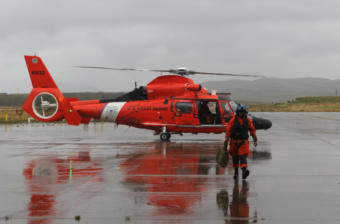
The crew of an Air Station Sitka MH-60 Jayhawk found the wrecked, single-engine plane about an hour and a half later and extracted the sole occupant, who was in critical condition.

The injured person was brought back to the Juneau airport and transferred to emergency medical services there.

This is a developing story. Check back for updates.

Update: Wreckage spotted in search for plane that went missing on its way to Ketchikan

""
An aerial view of Ketchikan. (KRBD file photo)

Update — Aug. 29, 1:19 p.m.

A Coast Guard aircraft spotted the wreckage of an unidentified plane on Monday night while searching for a Beechcraft Bonanza that went missing on its way from Glennallen to Ketchikan, according to a report from the Alaska State Troopers.

The dispatch said the searchers found the wreckage in a remote area but could not say for sure that it was the missing plane. The Coast Guard, Rescue Coordination Center and Wrangell St. Elias National Park are working together to identify the wreckage and look for possible survivors.

The Beechcraft Bonanza, believed to be carrying two people, left Glennallen for Ketchikan on Sunday and was last heard from 18 miles inland of Cape Yakataga.

Original story — Aug. 28, 3:24 p.m.

A plane believed to be carrying two people from Glennallen to Ketchikan has been missing since Sunday, according to a report by the Alaska Department of Public Safety. 

The plane, a Beechcraft Bonanza, left Glennallen at 8:50 a.m. on Sunday. It was last heard from about 18 miles inland of Cape Yakataga, northwest of Yakutat.

The Alaska Rescue Coordination Center is in charge of search efforts, which have been hampered by bad weather.

Alaska State Troopers have informed the occupants’ families that the plane is overdue.

Details emerge about Haines canoe accident that left guiding clients critically hypothermic

Chilkoot Lake (Alain d’Epremesnil/KHNS)

Two weekends ago, a canoe from a Haines guiding company took on water at Chilkoot lake. Its seven passengers and two guides spent a substantial amount of time in the lake’s cold water as they swam to shore before being rescued. We spoke with Haines Fire Chief Brian Clay about the incident, and the department’s response.

The accident happened on a windy Sunday afternoon at the far end of Chilkoot lake. The group was on a canoe tour with Haines guiding company Alaska Mountain Guides.

It was blowing probably 15, gusts to 25 up there,” said Haines Fire Chief Brian Clay, who was at the lake fishing with his granddaughter. “My understanding is they started taking on water and as it swamped, they couldn’t bail fast enough and it just swamped itself.”

As the canoe took on water, seven elderly passengers and two guides found themselves swimming for shore. All reportedly were wearing floatation devices, but they spent about half and hour in the glacier-fed lake before reaching shore.

Another boat front the guiding company reportedly picked them up from the beach and brought them to the parking lot, where Chief Clay met them.

“They all had hypothermia, and three were critical,” he said. “Three were walking, or green as we say in our business.”

The three critical patients were sent by private vehicles to meet with ambulances on their way from town. The other four were escorted to the clinic in fire and police department vehicles.

At least five of the patients were later medevaced, according to Clay, and ambulance volunteers were busy late into the night shuttling those patients between the clinic and the airport.

Clay says once activated, the emergency response went smoothly. But the first call to 911 was directed to the wrong dispatcher.

“I believe the initial 911 call went to Fairbanks regional office for the sat phones, and they didn’t know where Chilkoot Lake was,” Clay said.

KHNS could not check directly on the health of the patients. Alaska Mountain Guide owner Sean Gaffney did not respond to multiple requests for comments.

2 Tennessee hikers survived 8 days lost in the woods east of Fairbanks

Jonas Bare and Cynthia Hovsepian after 8 days lost in the woods near Chena Hot Springs. (Courtesy of Jonas Bare)

Jonas Bare and longtime friend and travel partner Cynthia Hovsepian set out for a day hike from Chena Hot Springs Resort, east of Fairbanks, on Aug. 10.

“By simple bad choices, a three-hour hike that lead to an eight-day survival,” Bare said.  

He said they followed a loop trail that took them into a burn area, where they lost the path and got disoriented.

“You can’t tell between the burn marks and the actual trail,” Bare said.

They ended up hiking through jumbles of fallen trees and marshy tussocks that Bare compared to giant pillows. 

“As soon as you step in, you have to take all your energy just to pull your foot back out and step up again,” he said. It’s exhausting.”.  

They ate the few snacks they carried by Aug 12, and they were cautious about eating wild berries. But the main issue was thirst.

“Food was never an issue. We never thought about it. We never dealt with it. We never felt the hunger,” Bare said. “We just wanted to keep moving, but water was so — we just seemed like we could not drink enough water. We were so thirsty all the time.” 

Bare said they mostly stayed along a creek for access to water, but they made forays away from it to look for a way out. He said they built fires to warm up and get dry after the frequent rains.

“We made camp over those eight days, four different places,” he said. “We ran across a couple bears — nothing that was really scary for us, but we were very vigilant about our surroundings all through the night. You can’t sleep. You have to keep the fire going. You just take little breaks here and there and you just keep pushing.”    

Bare regrets not bringing their cell phones or some other communication or signaling device. He calculates that they were no more than about 6 miles from the resort at any time, and they saw search aircraft. 

“They were just miles away in another range, and there was no way we could ever get to them. We made a smog fire to try to smoke them out, nothing would seem to work,” he said.        

By the night of Aug. 17, Bare says they were weak and becoming hypothermic.

“We knew that if we didn’t get out of there on their own accord, we were dead,” he said.

He says Hovsepian, who is visually impaired, was faring worse.

“She’s physically done. She can’t see. She can’t climb. So I made her a huge safe area with firewood backup, and I said I’ll be back in five hours,” he said.  

That was Aug. 18. Bare says he hiked north.

“We had a general idea it has to be this way because we eliminated all other options at this point,” he said.

Bare says he eventually found a trail, ran into two people walking, and made it back to the Hot Springs.

“There was all these people here. My dad was there from Ohio,” he said. “He didn’t even recognize me, and that’s probably the picture a lot of people have seen in the media.”

Bare says he guided searchers, who used a helicopter and ATV to find and bring Hovsepian back to the Chena Hot Springs. He thanks everyone who participated in the week-long search effort.

“There were so many people, and you’ve got to understand we were dazed and confused Friday night. I could not interact with everyone enough to get everybody’s names and all that, and faces, but these people have to be recognized,” he said. 

Bare and Hovsepian spent the weekend recovering before flying home to Tennessee. He says Alaska is the fiftieth state they’ve visited together. Getting lost kept them from seeing some other parts of the state, so he says they plan to come back.

Site notifications
Update notification options
Subscribe to notifications