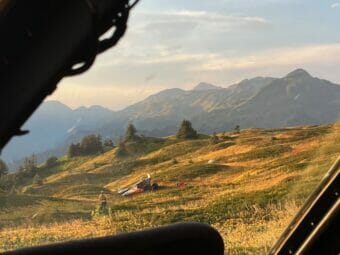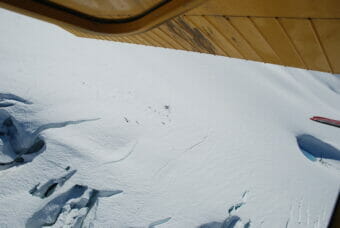
Two sheep hunters were rescued Aug. 11, 2023 by the Alaska Air National Guard from a 6,000-foot-high cliff near Tonsina. Both hunters were wearing camouflage, with one wearing a white backpack (upper center) and the other just to the left. (From Alaska Air National Guard)
Two sheep hunters were rescued near Tonsina last week by an Alaska Air National Guard helicopter crew, after a pilot said they spent about two hours “just hanging on to a cliff face” thousands of feet above the ground.
According to Guard officials, the hunters used an InReach satellite device to report Friday evening that they were trapped on the cliff near Tonsina, about 165 miles east of Anchorage.
Guard Capt. Tim Lezama said the call came in at about 6 p.m. Friday after the hunters had followed a sheep onto the cliff, prompting an urgent rescue mission. He said his Pave Hawk helicopter and a rescue plane carrying pararescuemen, or PJs, were scrambled in half an hour from Anchorage’s Joint Base Elmendorf-Richardson and made the flight in about 50 minutes.
The hunters had reported that they were wearing camouflage, which Lezama said made spotting them on the 6,000-foot-high cliff difficult.
“They were pretty much on the cliff’s face,” Lezama said. “Like the way the PJ described it was, they pretty much had a foot on a rock and they were just holding on.”
U.S. Air Force Staff Sgt. Nathan Weltman, a pararescueman with 57th Rescue Squadron, Aviano Air Base, Italy, hoists a stranded sheep hunter. Weltman was on a rescue exchange with JBER’s 212th Rescue Squadron. (From Alaska Air National Guard)
The helicopter crew opted against immediately hovering over the cliff, Lezama said, due to fears of rotor wash blowing the hunters off its face. Instead, the two PJs first secured belay lines at the top of the cliff and draped them over the edge, giving the hunters something to hold on to during the rescue.
Then the Pave Hawk lowered one of the PJs to the cliff on a line, where he hoisted up one of the hunters before the other PJ hoisted the second hunter. Lezama said it was a 140-foot vertical lift each time.
“Within 15-ish minutes, 15, 20 minutes of us getting there on scene, we were hoisting them off,” he said.
After a midair refueling from the rescue plane, the Pave Hawk’s crew was able to drop the hunters off with an Alaska State Trooper near the trailhead where parked. Neither of them was injured.
Although Lezama has been flying in Alaska for six years, conducting another cliff rescue of an injured hiker the day before the Tonsina flight, he said the hunters’ position was uniquely precarious.
“We were all amazed at the situation they were in to begin with, because they were pretty much just hanging on to a cliff face,” he said. “There was nowhere for them to really go, outside of us picking them off that cliff face.”
Lezama credited the hunters’ decision to carry a satellite communicator – rather than just a cellphone, which can’t summon help in vast areas of Alaska’s backcountry beyond cell tower coverage – with saving their lives. Precise coordinates provided by the device also helped Guardsmen locate the duo despite their camouflage.
In addition, he had high praise for the hunters’ stamina during the rescue.
“That was impressive to us also, that they were able to just hang on for that long,” Lezama said.
JBER’s Alaska Rescue Coordination Center oversaw the rescue, which involved personnel from the Guard’s 210th, 211th and 212th Rescue Squadrons.
Alaska State Troopers say video evidence confirms that Paul Jose Rodriguez, Jr. drowned in Mendenhall Lake.
In a press release Tuesday, Troopers said that during the search for Rodriguez an unnamed person turned over a helmet and GoPro that was confirmed to belong to the missing person.
The GoPro footage confirms that Rodriguez overturned in his kayak on July 11 and drowned.
Teams will continue searching for his remains.
Original story:
A Juneau man has been missing for nearly a week after going kayaking on Mendenhall Lake.
“We performed an aerial search this morning,” said Jackie Ebert with Juneau Mountain Rescue. “The SEADOGS organization are out there with their dogs.”
Juneau Mountain Rescue is assisting the Alaska State Troopers, the U.S. Forest Service and other organizations with the search.
Ebert said officials believe Rodriguez intended to kayak toward the glacier. A post on Rodriguez’s Facebook page on Tuesday shows a picture of a kayak with the glacier in the background and the caption “Headed up to the glacier!” His kayak was found floating unattended in Mendenhall Lake on Tuesday, according to information from the Juneau Police Department.
He was reported overdue Sunday night. Ebert said she did not know why Rodriguez wasn’t reported missing sooner.
For those planning to recreate in the area, Ebert says to consider other options.
“There are a lot of resources out there right now. So maybe not necessarily rush towards that area. But if they are out there, just keep an eye out,” Ebert said. “We unfortunately don’t have a good description of what he was wearing when he was out.”
Alaska State Troopers did not immediately reply to a request for more information.
Biologist Craig George stands on Utqiagvik’s beach on Oct. 4, 2018. George, who went missing while rafting the Chulitna River last week, devoted much of his research to the effects of sea-ice loss. In past decades, the waters here would have been frozen over by October; in 2018, there was no ice within sight. (Photo by Yereth Rosen/Alaska Beacon)
A veteran Arctic scientist who was one of the world’s most distinguished whale experts was missing after a rafting accident in Interior Alaska last week.
Craig George, a retired senior biologist with the North Slope Borough Department of Wildlife Management, went missing on Wednesday while rafting the Chulitna River with companions south of Cantwell near Denali National Park, the Alaska State Troopers reported. His body had not been found as of Monday, a trooper spokesperson said.
George, 70, spent decades studying bowhead whales and documenting their long-term increases. He also studied the myriad ways that reduced sea ice and other climate-change impacts have affected Utqiagvik and the rest of coastal Arctic Alaska.
He moved to the town then known as Barrow in the 1970s. He was an animal caretaker at the Naval Arctic Research Laboratory before embarking on his long career with the North Slope Borough. He became known for his collaborative work with Inupiat experts.
George had talents and accomplishments beyond his scientific work. He was a pillar of the Utqiagvik community. He was a musician, and often performed a song he wrote called “Keep on Whaling.” The son of Newbery Award-winning author Jean Craighead George, he and his sister collaborated to complete one of his late mother’s unfinished books after she died. The book is titled “Ice Whale”; like many of Jean Craighead George’s books, it was partly inspired by her son’s scientific work in Arctic Alaska.
Tributes to George poured in over social media once news of his accident was released.
D.J. Fauske, director of external affairs for the North Slope Borough, wrote on his personal Facebook page about memories from first grade, when he was a student at Ipalook Elementary School and first met George.
“He was kind, gentle, humble, funny, and could teach you something without you even knowing you were in the middle of an academic lesson. No such thing as a dumb question to him. . . . It’s been a pleasure working for my hometown borough, and people like Craig were a big part of the reason. He helped so many people and helped preserve and protect an Inupiat culture that was judged and stereotyped for years by outsiders. He helped combine thousands of years of traditional local Inupiat knowledge with world class technology and data.”
Suzanne Little, who oversees Alaska land conservation for the Pew Charitable Trusts, played in a band with George, and performances included a mid-1980s event in what was then the new Barrow High School.
“Dr. Craig George, aside from being an amazing friend, musician, songwriter, father, spouse and stellar community member, was one of the first western science biologists, along with Dr. Tom Albert, who listened to the Indigenous Knowledge of the Inupiat People and instated a Bowhead Whale census program to prove the Indigenous people were correct about the Bowhead whale population NOT being endangered. . .Craig’s work provides us all a roadmap,” she posted on Facebook.
Cheryl Rosa, deputy director of the U.S. Arctic Research Commission, commented: “Dr. Craig George was a remarkable Arctic research scientist with a unique scientific curiosity that drove his work, his results often endearingly delivered with softspoken humor and humility. He was a great proponent of co-production in research—far before it became a buzzword—and was fair and empathetic, in both science and life. The respect he showed the communities he worked with earned him a place as a trusted partner and showed the rest of the scientific community how research could be improved with local input. Craig was a mentor to many and a friend to even more. Many scientists entered and remained in the field of Arctic research because of him. He was a wonderful person and will be deeply missed.”
The search for George has been hampered by high water in the river, said Austin McDaniel, a spokesman for the Alaska State Troopers. A dive team is waiting for water levels to fall so that specialized equipment can be deployed in the river, McDaniel said.
A U.S. Coast Guard MH-60 Jayhawk helicopter. (Mikko Wilson/KTOO)
A small plane crashed near the village of Old Harbor – on the southeast side of Kodiak Island – on Sunday afternoon. The Piper Cherokee crashed just 6 minutes into its flight; it was reported at 3:30 p.m.
Five people were aboard when it went down about three miles north of Old Harbor on Sunday, according to the Coast Guard.
Two people are reported to be dead. Three survivors were found at the crash site. One person was in critical condition and taken by helicopter to Providence Kodiak Island Medical Center. Two others were injured but in stable condition. Survivors were transported by a good Samaritan Cessna to awaiting medical personnel. Alaska State Troopers also assisted in the call.
A Coast Guard spokesperson said they were unable to provide any additional information about the survivors or deceased on Monday morning.
Clint Johnson is the Alaska region chief for the National Transportation Safety Board, which is leading the investigation into the crash.
“Preliminary information would indicate that they were on their way back from a lodge in Old Harbor, back to Kodiak. As far as the flight, we don’t know exactly what it was,” he said.
During investigations, the NTSB looks for possible causes categorized as human performance, mechanical issues, or environment and weather.
The plane was operated by Kodiak-based Vertigo Air Taxi. The company declined to comment on Monday.
Johnson said it’s too early to speculate the cause of the crash.
“It’s a process of elimination – nothing has been eliminated at this point right now,” he said.
NTSB meteorologists are already looking into weather patterns in the area at the time of the crash. Johnson said they will also question survivors and the pilot as part of the investigation. Preliminary reports will be published on the board’s website in the next two weeks.
This post has been updated. Brian Venua contributed reporting.
Coast Guard officials are silhouetted by rescue aircraft during a change of command ceremony on June 9, 2023, in Juneau. (Photo by James Brooks/Alaska Beacon)
As he handed off command of the Coast Guard in Alaska this month, Rear Adm. Nathan Moore said there’s a lot of good things about living in Alaska — including the ability to watch Monday Night Football at a reasonable time.
But as Rear Adm. Megan Dean takes command, Moore said, his service is facing new challenges in the state, and one of the biggest is a growing — and possibly unprecedented — demand for emergency medevac flights.
“It’s just more maritime activity,” Moore said. “This year, we’re seeing the commercial cruise ship industry go back to what is the pre-2019 level.”
“They’re actually going above the before-COVID level in terms of ships and vessels and passengers here. And so what that means is just more risk for us,” he said.
In just the first half of this year’s summer tourist season, the Coast Guard in Alaska has flown 163 medical flights.
That’s already more than the 150 that the Coast Guard flew in a full federal fiscal year four years ago, the last year before the COVID-19 pandemic.
The largest Coast Guard base in the United States is on Kodiak Island, home to a major port and air station. Sitka also has a Coast Guard air station, and boat crews operate from large and small towns across the southern coast.
Moore said the Coast Guard is keeping up with the demand with people and equipment from those places.
“But is it more of a workload? There’s no question,” he said.
The Coast Guard’s figures include the kind of dramatic helicopter rescues from ships at sea that are properly referred to as medevacs, but they also include what are known as “non-maritime medical transports,” where someone needs to get from a remote onshore location to a hospital urgently.
The number of requests for non-medical transports increased more than 50% from FY19 to FY22, and this year’s number is on pace to surpass last year’s figure.
This data table, provided by Jennifer Whitcomb, manager of the Coast Guard District 17 search and rescue program, shows the number of medevac flights and requests through June 15, compared to prior federal fiscal years. (U.S. Coast Guard data)
“The unique challenge of small towns and villages off of the road system with limited medical facilities creates a frequent need for urgent medevacs to hospitals in bigger cities. While there is a robust network of commercial providers such as Guardian, LifeMed, and Airlift NW, (plus North Slope Borough SAR in the Arctic) there are many locations they cannot fly into after dark or in inclement weather. For years, the Coast Guard has helped fill that gap,” said Jennifer Whitcomb, manager of the search and rescue program for the Coast Guard in the state.
The Coast Guard doesn’t fly to every call for help, Whitcomb said. A Coast Guard flight surgeon reviews every case and decides whether the urgency of the request warrants a flight.
If the patient’s condition improves, the weather clears up or a commercial air ambulance becomes available, the Coast Guard might defer.
Even with those qualifications, the number of medevacs is rising, and officials say there’s one primary cause: the rebound of Alaska’s cruise ship tourism industry.
“This is not only our first full cruise ship season in several years, but it is our largest. And so that is driving the majority of those numbers,” said Erin Hardin, director of community relations at Juneau’s Bartlett Regional Hospital.
Southeast Alaska has a population of about 74,000 people spread across a California-sized stretch of islands and deep ocean channels. Bartlett is the biggest hospital in the region, and many Coast Guard medevacs end there.
In 2019, 1.3 million tourists visited Alaska by cruise ship, most of them staying in Southeast Alaska. This year, 1.65 million tourists were expected to arrive by cruise ship, and actual passenger counts have been close to that projection.
During an emergency at sea in Southeast Alaska — whether aboard a cruise ship or not — the Coast Guard is usually the first responder and typically carries the patient to Juneau or Sitka for further treatment or a transfer to a commercial medevac flight that may take them to Seattle or Anchorage for more advanced care.
Commercial firms also carry patients between communities with airstrips, but when the weather is bad, the Coast Guard can fly at times when commercial flights can’t.
Coast Guard Rear Adm. Nathan Moore, center, talks with Rear Adm. Megan Dean, right, during a change of command ceremony on June 9, 2023, in Juneau. Dean replaced Moore as commander of Coast Guard District 17, which covers all of Alaska. At left is Vice Adm. Andrew Tiongson, commander of the Pacific Area and Defense Force West. (Photo by James Brooks/Alaska Beacon)
Stephen LeMay, director of business development for Airlift Northwest, the nonprofit air ambulance service affiliated with the University of Washington medical center, said his organization has seen the same trend that the Coast Guard is observing.
“We’ve kind of nicknamed it ‘revenge travel’ after COVID,” said Stephen LeMay, “Everyone wants to get out of the house and travel. So we have seen a pretty significant uptick in medevacs from the cruise ships, either going north to Anchorage or south to Seattle,” he said.
But some officials say tourism isn’t solely to blame.
Most of those elderly Alaskans aren’t newcomers: They’re people who arrived in Alaska during the oil boom and have stayed in the state even as they aged.
The SouthEast Alaska Regional Health Consortium has been expanding its presence in Southeast Alaska to meet the region’s needs, and Dr. Cate Buley, its medical director of primary care clinics, said that better health care has reduced an incentive to move away as residents age.
“So I think there’s more people with more severe chronic diseases living in very remote areas than there have been in the past,” she said.
In Southeast Alaska, more than one in six residents is now at least 65 years old.
Telemedicine offerings have gotten better and clinicians are now able to help people in remote places with chronic conditions, “but then you’re also in a very rural spot when something goes wrong. You can get sick, really pretty sick, really fast,” she said.
That, coupled with changes in procedures that have reduced the availability of some commercial medevac companies, has increased the burden on the Coast Guard, she said.
LeMay, at Airlift Northwest, said that group hasn’t seen a significant change in its year-round business, which would be expected if Alaska’s aging population were contributing to the demand for flights.
“The regular — what we call our meat and potatoes stuff, year-round — has been pretty consistent. We have not seen any large uptick or any downfall on that whatsoever,” he said. “So our growth has been seen through the tourism this year.”
For the past two years, Buley said, SEARHC has been meeting quarterly with the Coast Guard, commercial medevac services and representatives from the cruise tourism industry to talk about demand and take steps to reduce the burden on the Coast Guard.
Those have included instructions to shipboard doctors, letting them know about the availability of clinics in different ports and the commercial medevac services that operate in Alaska.
“If somebody breaks their hip, or it’s something that’s not life-threatening, they can be transported out that way,” Hardin said, referring to commercial services.
She said the hospital has been participating in conversations about medevac services as well, because as demand rises, so does the risk that the Coast Guard can’t respond in a true emergency.
“It’s important for folks to know when it’s appropriate to call the Coast Guard and when it’s not,” she said.
Divers begin to open the hatch of Pisces III as she breaks water under the John Cabot after being hauled from the Atlantic seabed off the coast of Cork, Ireland. (PA Images via Getty Images)
The clock is ticking in the all-hands-on-deck search for the tourist submersible that went missing during a deep-sea dive to the Titanic shipwreck on Sunday.
The vessel has five people on board and, according to the U.S. Coast Guard, a dwindling oxygen supply of 40 hours.
That gives responders just two days to locate the Titan — which is believed to be hundreds of miles from the nearest coast and potentially thousands of feet below sea level — plus bring it back to the surface to rescue those inside.
It’s a complex mission, with retired U.S. Navy submarine Capt. David Marquet putting the odds of passengers’ survival at “about 1%.”
And it’s certainly not the first of its kind: There have been several prominent rescue missions for both submarines and submersibles (which are not fully autonomous) over the course of the last century.
The deepest underwater rescue ever accomplished, officially, was that of the commercial submarine Pisces III, off the coast of Ireland in 1973.
In that dramatic incident, two crewmen — both named Roger — spent three days trapped in a vessel measuring 6 feet in diameter, subsisting off a single sandwich and condensation licked from the walls, until they were rescued with just 12 minutes of oxygen to spare.
One of them, Roger Mallinson, told NBC News on Tuesday that the search for the Titan has evoked tough memories of his own experience.
“You just rely,” he said, “on the thing being well-made.”
The submersible sank after a routine dive
It was August 1973, and two British sailors were heading out on a routine dive to lay transatlantic telephone cable on the seabed about 150 miles southwest of Cork.
Senior pilot Mallinson, an engineer, was 35 at the time. Former Royal Navy submariner Roger Chapman, who died in 2020, was 28. They were clocking eight-hour shifts, crammed into a small vessel with very poor visibility, according to the BBC.
On the morning of August 29, as the two were getting ready to be towed back to their mother ship, a hatch was accidentally pulled open. Water flooded a self-contained part of the submersible, adding extra weight and plunging the vessel about 1,575 feet below sea level.
“There was lots of banging of ropes and shackles — as normal during the last phase of the operation — when suddenly we were hurtled backward and sank rapidly,” Chapman told the BBC in 2013. “We were dangling upside down, then heaved up like a big dipper.”
The two hastily prepared to crash, dropping a lead weight to lighten their load, curling up in safety positions and stuffing cloth in their mouths so as not to bite their tongues off. They hit the ground in about 30 seconds, at 40 miles per hour.
“Try to imagine you are in a phone box with a friend, the phone box is at the bottom of the Empire State Building, then everything around you floods to ten stories above the top of the Empire State Building,” he said. “Then turn out all the lights and start bleeding oxygen, then you realize that a rescue — if it can even be attempted — is roughly two days away.”
Mallinson and Chapman didn’t have a water supply, just one can of lemonade and a cheese sandwich, which they wanted to save for later.
By a stroke of luck, Mallinson had replaced the oxygen tank just before the dive — but they only had 66 hours left.
The two decided to conserve oxygen by doing as little as possible. Once they telephoned for help and made sure the nearly upside-down vessel was in order, they didn’t talk or move.
They lay in the pitch-black submersible as high up as possible, where the air quality was better, thinking about their families.
“We hardly spoke, just grabbing each other’s hand and giving it a squeeze to show we were alright,” Mallinson told the BBC. “It was very cold — we were wet through.”
The rescue operations suffered a series of setbacks
Meanwhile, an international rescue operation was underway, involving dive teams from the United Kingdom, Canada and the U.S.
“The plan was relatively simple: a sister sub would go down with a two-man crew and attach a specially designed grapple hook to the sub then lift it to the surface,” McGinty explained. “But they do say: how do you make God laugh? Tell him your plans.”
McGinty said the floating buoy that ran on a rope from the surface had been disconnected from the submersible several minutes before it sank, so crews knew “where the haystack was, just not the needle.” They were able to detect the vessel using sonar by making Chapman sing — “in the hope of picking up the high notes.”
Then they had to actually reach it. Multiple attempts to raise the submersible failed over the next two days, leaving the responders with two broken vessels and the passengers without much hope.
“The first sub to go down lost its lift line; the second sub down couldn’t find them,” McGinty said. “On a third trip they finally found Pisces III, but when they attempted to fix the lift line it locked on then fell out.”
On Sept. 1, a team was finally able to make repairs to one of the other submersibles and send it back down, where it managed to attach a tow rope to the vessel.
Chapman told the BBC that it was only once the pilots knew the line was safely attached that they had the sandwich and lemonade. Mallinson later wrote that “it tasted like champagne to us.”
The lift itself proved difficult and had to be stopped and restarted twice, with lots of swinging around. The crew described the ride up as disorienting, with Chapman saying rescuers “thought we’d died when they looked at us, it had been so violent.”
Once they made it to the surface, it took them about half an hour to open the hatch and get fresh air. And there hadn’t been a moment to waste.
“We had 72 hours of life support when we started the dive so we managed to eke out a further 12.5 hours,” Chapman said. “When we looked in the cylinder, we had 12 minutes of oxygen left.”
The incident left a lasting impact on both survivors
The doctor who examined the pair commented “incredible,” McGinty said. They were dehydrated, and Mallinson had mild hypothermia, but they were otherwise in good shape.
The incident left a lasting impact on both Mallinson and Chapman in other ways, including forming a lifelong bond.
“Each year on the anniversary Roger Mallinson would call Roger Chapman at the exact moment they reached the surface,” McGinty said.
Chapman went on to set up a company specializing in submersible rescues and was able to help with several incidents, according to his obituary. The “grandfather of submarine rescue” said even years later that he occasionally felt uncomfortable in elevators.
Mallinson, who became renowned for his work on steam engines, was awarded an MBE at the beginning of 2023.
In a September 1973 Daily Mail column, Mallinson wrote that he owed his life to Chapman.
“The ex-Navy lieutenant, who was my second pilot and observer aboard the stricken Pisces III, pulled me through the blackest hours of that incredible rescue,” he wrote. “Without him, I would not be here to tell this story.”
Few other sub rescues have been as successful
The Pisces III incident took its place in the history books as the deepest underwater rescue ever achieved, according to Guinness World Records. Many others have been attempted, with varying degrees of success.
Take for example the USS Squalus, a submarine that sank 240 feet off the coast of New Hampshire during a test dive in 1939, killing 26 people immediately.
The remaining 32 crew members and one civilian used smoke bombs and, later, morse code to signal for help. A Navy submarine found them that same morning, and rescuers were able to bring the survivors to the surface in four separate trips over the next day or so. It took another three months to recover the vessel, by attaching pontoons to both sides and inflating them full of air.
Russia saw one of the world’s worst naval disasters several decades later, in 2000, when the nuclear submarine Kursk sank during a training exercise in the Arctic Circle. All 118 crew members ultimately died, though some two dozen had survived the initial sinking.
The Russian government — led by newly minted President Vladimir Putin — was slow to launch search and rescue efforts, even rejecting offers of help from Western countries. By the time a team of British and Norwegian divers found the vessel nine days later, there were no survivors.
Five years later, when the Russian AS-28 sank in the Pacific Ocean after becoming entangled in fishing nets, the government took a different tack and called for international help. British and American rescue crews were able to free the vessel and save all seven people on board.
Copyright 2023 NPR. To see more, visit https://www.npr.org.
Close
Update notification options
Subscribe to notifications
Subscribe
Get notifications about news related to the topics you care about. You can unsubscribe anytime.