Operators at Marine Exchange of Alaska in Juneau split shifts to provide 24/7 coverage and connect distressed mariners to U.S. Coast Guard search and rescue teams when needed. (Courtesy of Marine Exchange of Alaska)
For several years the U.S. Coast Guard’s emergency VHF radio system has experienced outages across Southeast and the Gulf of Alaska. There’s been progress fixing the problem, but some mariners’ distress calls are still falling through the cracks. So another entity has stepped in to help fill the communications void.
And when there is an outage at one of the VHF towers, the Coast Guard typically doesn’t service those themselves. Tatitlek Federal Services Inc., or TFSI, a subsidiary of the Alaska Native Tatitlek Corporation headquartered in Anchorage, is the contractor that services the remote fixed facilities on Kodiak Island. A public affairs officer with Coast Guard District 17, Mike Salerno, said via email that Tatitlek has been the sustainment contractor since June 2022.
Since 2018, the Coast Guard has noted widespread VHF outages within its Rescue 21 Alaska system, which includes 33 sites equipped with radio towers that allow the Coast Guard to monitor and respond to emergency calls from boaters across Southeast Alaska, the Gulf and areas around Kodiak Island.
The Rescue 21 Alaska coverage map shows that there are gaps between the Coast Guard’s towers around Kodiak Island and elsewhere, where calls on VHF radio may not be received from a boat in that area. (Courtesy U.S. Coast Guard)
“And until we started installing equipment, we didn’t necessarily know what calls were going unreceived or unmonitored,” said Bryan Hinderberger, chief technical officer for Marine Exchange of Alaska. “But we quickly started to realize that there were events occurring out there on the water that maybe the Coast Guard was not aware of.”
The nonprofit is currently working to expand its coverage and add more marine safety sites around the Gulf of Alaska and Southeast.
“We started out targeting areas that we already knew the Coast Guard had deficiencies or experienced trouble in so that we could kind of fill the gaps, so to speak,” Hinderberger said. “We aren’t trying to replace Rescue 21. We’re trying to supplement it and provide some additional redundancy to it.”
The Coast Guard gave an updated report to Congress detailing the status of its Rescue 21 Alaska system back in the summer of 2023, after addressing outages at roughly a third of its VHF towers in Southeast from a few years prior.
The Coast Guard Commandant at the time, Linda Fagan, who was recently relieved of her position, committed to upgrading the system to reduce its VHF tower outages. And since then, the Coast Guard says it has made progress on addressing these outages across Southeast.
Lieutenant Jake Carlton, the Chief of Security with Coast Guard District 17, which encompasses all of Alaska’s coastlines, told KMXT in a phone call on Jan. 28 that as of Dec. 31, 2024, the Rescue 21 Alaska network reported an operational availability or up-time of 97.2%.
Towers like the one on top of Elbow Mountain on Kodiak Island are installed with MXAK equipment in partnership with Kodiak Microwave Systems (KMS) and other telecom companies across the state, to help fill the gaps in the U.S. Coast Guard’s Rescue 21 Alaska’s coverage. (Courtesy Marine Exchange of Alaska)
While the outages are less common than they were several years ago, there are still some instances that VHF calls aren’t getting through to the Coast Guard.
Some of those gaps overlap with areas where the Marine Exchange maintains its own equipment around Kodiak Island, in places like Elbow Mountain, Pillar Mountain and McCord Mountain.
The organization also helps fill those gaps elsewhere on Alaska’s coastline with its own infrastructure, and it collects data from more than 60 marine safety sites, many of which can receive and transmit distress calls. Rescue 21 Alaska does not include VHF coverage in Western and Northern Alaska as the Coast Guard’s sites can’t receive distress calls north of Bristol Bay and the Aleutians.
Hinderberger said Marine Exchange’s equipment, which uses VOIP VHF for distress signal communications and still has a line of sight capability, is set up at higher elevations, and at sea level too, which makes it easier to maintain and prevents prolonged outages.
“We don’t just strictly install up on mountaintops, because we know mountaintops in Alaska are some of the harshest environments to operate and exist in,” he explained. “And it degrades equipment faster this time of the year, when the weather is far more harsh than in the summer.”
One incident when Marine Exchange heard a distress call that the Coast Guard did not receive via VHF was a search and rescue in Marmot Bay – north of the city of Kodiak – back in November. It ended positively after several attempts to contact the distressed boat. But Hinderberger said the result could have been much worse.
“Based on the fact that the Coast Guard went back the next day to locate the vessel and it was no longer present, (that) indicates that it either floated out to sea or sunk, is what we’re assuming to have happened,” he said. “And if those three mariners were unable to have been extracted from that event, it very likely would have ended far more tragically.”
A timeline to modernize the Rescue 21 Alaska system that the Coast Guard gave in a report to Congress in July of 2023. Officials told KMXT the Coast Guard is on track to replace all base station radios by the end of Fiscal Year 2026. (Courtesy U.S. Coast Guard)
According to a proposed timeline from the Coast Guard, the agency plans to replace all of its Alaska Rescue 21 base station radios, spread across 33 remote sites, by the end of fiscal year 2026. The Coast Guard says this will significantly improve the system’s up-time and reduce outages by replacing the end-of-life radios with “internet protocol (IP) capable solution, which enables remote management and troubleshooting, and will result in increased operational availability and reduced downtime by allowing significant troubleshooting activities to occur without traveling to the remote site.”
The U.S. Forest Service removed building debris and contaminated material from the Salt Chuck Mine site in 2011. The historical mining equipment was grouped in one area, seen in this October 2011 photo. (U.S. Forest Service)
Fifty-year-old Devin Albert was visiting his cousin in Klawock for the New Year’s holiday, and ventured out with a few other locals on Thursday, Jan. 2 to go rock hunting in the Salt Chuck Mine near Thorne Bay. The mine historically produced gold, silver, copper, and palladium from 1905 to 1941 and has since been designated as an EPA Superfund site.
While deep within one of the mine shafts, Albert suffered a medical emergency, which those with him believed was a heart attack. Alaska State Trooper Sergeant Rob Jensen said the man was having difficulty breathing, so the others in the group tried to assist him out of the mine.
“One particular area was a very steep climb,” Jensen said. “They were on their way out. The individual wasn’t really communicating verbally. They were assisting him along and shortly thereafter, he collapsed.”
Jensen said the group then attempted CPR on Albert for more than 30 minutes, but were unable to resuscitate him. He was presumed dead at that point, as he did not have a pulse and was not breathing. The rest of the group climbed out of the mine, but they weren’t able to carry Albert’s body with them.
By the time Troopers and Village Public Safety Officers arrived on the scene, it was dark and beginning to snow. Jensen said the entry point to the mine site looks like a 400-foot volcano, with a rope leading down from the rim to the mine shafts below.
“In order to go down in there and out, you need both arms, both legs to be working great,” Jensen said. “And be able to kind of hand-over-fist this rope coming out. It’s extremely sketchy, getting in and out of during daylight. Doing it at night time was a suicide mission.”
Troopers decided not to attempt a recovery that night but remained on scene and activated the Ketchikan Volunteer Search and Rescue Squad. Throughout Friday and Saturday teams descended into the mine using a helicopter, ropes and other equipment, but were unable to locate the body. On Sunday, Jan. 5, rescuers tried an alternate shaft entrance near the beach that extended nearly a mile into the depths of the mine, and they were able to locate and recover Albert’s body.
Jensen said there’s no foul play suspected, and that officials anticipate an underlying health issue to be at fault. But he said navigating the mine site is extremely stressful.
“I must emphasize that going in and out of there without the proper gear, training, you know, if somebody does get injured, you are looking at a very protracted time in order to get out of there,” Jensen said.
The body has been sent to the state medical examiner’s office in Anchorage to determine the official cause of death.
A U.S. Coast Guard HH60 Jayhawk helicopter flies over Juneau, Alaska, on Saturday, Oct. 2, 2021. (Photo by Mikko Wilson/KTOO)
Update, 10 a.m. Tuesday:
The U.S. Coast Guard has suspended its search for five missing mariners after their fishing boat capsized near Point Couverden.
The Coast Guard received a mayday call shortly after midnight on December 1 from the Wind Walker, a 52-foot seiner based in Sitka. The crew reported that their boat was overturning. Attempts by the Coast Guard to gather additional information from the crew over the radio failed. Soon after, an emergency position-indicating radio beacon registered to the Wind Walker was detected just south of Point Couverden, in Icy Strait.
For 24 hours, the Coast Guard searched over 108 nautical miles for the missing crew to no avail. Chief Warrant Officer James Koon is a search and rescue mission coordinator for the Coast Guard in Southeast Alaska. In a statement issued on Monday afternoon (Dec 2), he wrote, “We stand in sorrow and solidarity with the friends and family of the people we were not able to find over the past 24 hours.” The Coast Guard did not release the names of the passengers on the vessel, but confirmed to KCAW that next of kin have been notified.
While the Coast Guard has suspended the search for now, it could pick up again pending new information. Anyone with new information about this situation is requested to contact Coast Guard headquarters in Juneau at 907-463-2980.
Initial report:
The U.S. Coast Guard has released no new information regarding the search for a seiner which reportedly capsized in heavy weather near Hoonah early Sunday morning.
The Coast Guard received a mayday call shortly after midnight on Dec. 1 from the Wind Walker, a 52-foot seiner based in Sitka, when the crew reported that their boat was overturning.
Attempts by the Coast Guard to gather additional information from the crew over the radio failed. Soon after, an emergency position-indicating radio beacon registered to the Wind Walker was detected just south of Point Couverden, in Icy Strait.
This type of device – called an EPIRB – is attached to the cabin of a boat, and releases automatically when submerged.
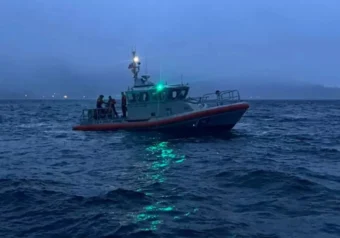
The state ferry Hubbard was in the vicinity and overheard the mayday, and diverted to Wind Walker’s last reported location to begin the search. A helicopter from Air Station Sitka and a 45-foot medium-response boat from Coast Guard Station Juneau arrived and joined the Hubbard, as did the Coast Guard cutter Healy.
The Coast Guard believes five crew were on board the Wind Walker when it capsized. Reports on social media claiming that some of the victims had been found were incorrect: So far, only seven survival suits and two strobe lights have been located in the water in the search area.
Local weather conditions in Icy Strait early Sunday morning included heavy snow, 45 to 60 mile-per-hour winds, and 6-foot seas.
Four people are dead after a plane they were traveling in from Bethel crashed short of the runway in St. Mary’s late Sunday night, according to transportation officials.
The Cessna 207 was operated by Bethel-based Yute Commuter Service. The pilot and three passengers departed Bethel for the roughly 100-mile journey to the lower Yukon River community at around 9 p.m. Sunday, according to National Transportation Safety Board Alaska Chief Clint Johnson.
Johnson said the flight was not operating as one of Yute’s regularly scheduled or chartered flights.
“This is an in-house flight,” he said. “At least two of the folks on board are employees, and we’re still trying to sort out who the other folks are there, but at least two of them are company employees.”
According to National Weather Service data, conditions in St. Mary’s at the time of the crash were overcast, with light rain, fog and mist, and visibility limited to roughly 2 miles.
Johnson said the plane crashed within a half-mile of the runway at St. Mary’s following a request for what is known as special visual flight rules, or special VFR, clearance.
“Basically, what that allows is the airplane to get in under less than basic VFR conditions, into the airport area and onto the airport surface landing there,” he said. “Unfortunately, when they didn’t arrive, a search started shortly after that, and just after midnight is when Alaska State Troopers and good Samaritans found the airplane.”
Johnson said it is too early to say what may have caused the fatal crash.
According to the Anchorage Daily News, the crash is the third fatal airplane accident in Alaska in the past four days. Johnson said an additional investigator is being flown in from out of state to assist.
“We had to bring an investigator from the Lower 48. He arrives here tonight,” Johnson said. “And we also have a representative from the airplane manufacturer in this case, which is Cessna. So they plan on launching out there tomorrow, weather permitting, directly to St. Mary’s.”
Yute Commuter Service has had a string of accidents in recent years. The company’s last fatal crash was in February 2020, when a pilot and all four passengers died near Tuntutuliak. According to the NTSB, the probable cause was the pilot’s decision to fly in what may have been whiteout conditions.
According to Alaska State Troopers, the names of the four men will be released once they have been positively identified and next of kin have been notified. Johnson expects a preliminary report on the accident sometime next week.
This is a developing story and may be updated with additional information.
On the day Sam Wright, Hans Munich and Tanya Hutchins disappeared in the Fairweather Range, Haines pilot Drake Olson was doing much-needed maintenance on one of the three airplanes in his hangar.
The plane, his fastest one, was in pieces on July 20 when he got a call from Munich and Hutchins, who own Coastal Air Service in Yakutat. They were on their way back from Seattle when their flight from Juneau got canceled.
They called Olson who said he couldn’t help them – but then thought of Wright, his neighbor.
“I arranged it,” Olson said, sighing heavily.
“Everybody was busy. It’s the heat of the summer, all the air carriers are busy,” Olson said. So I called Sam and he said ‘no’ because he had to go to a wedding. And then he called back and he said ‘you know, I should go,’ and I said ‘Yeah, I think you should go.’ That was stupid of me.”
It was settled. Wright flew his distinctive 1948 Beechcraft Bonanza to Juneau, and picked up Munich and Hutchins. It’s not a backcountry plane.
“That was his, you know, his commuter,” Olson said. It’s fast and sleek.”
He landed in Juneau and picked the Yakutat couple up.
“I got a picture from Tanya [Hutchins] from the backseat of Sam’s Bonanza as they were departing Juneau,” Olson said.
A few hours later he got a call from Yakutat – long after the trio should have landed, as the flight generally takes less than an hour.
“It was the guy who was actually waiting for Hans and Tanya in Yakutat and .. actually saw the signal stop in the Fairweathers,” Olson said. “He called me and said – like – there’s no airplane here and it’s weird, but the signal stopped in the Fairweathers.”
Olson scrambled to get up into the air, but he was working on a part of it that takes a lot of precision adjustment – think of the serpentine belt in your car – so, it took a few hours to get his plane back together.
“I put it together hurriedly. Thoroughly, but hurriedly,” he said. “I think I left around 7 [p.m.] and I was out until after 10. I was so tired and fatigued that I was like ‘I’m a bloody hazard out here. I’ve got to go home.”
The disappearance of two deeply experienced Southeast Alaska pilots, and Hutchins, touched off a weeks-long search for any trace of the missing plane.
And it left Olson searching for answers. He described Wright and Munich as mentors and some of the few backcountry pilots he relied on for knowledge and friendship in Southeast Alaska.
“These are the closest people that I have there and in my little corner of the world,” he said. “It’s just like, in my current world, that was my inner circle. Like, poof. Gone. Just gone.”
The search
The initial call about an overdue plane came into the Coast Guard just before 6 p.m. on July 20.
Coast Guard spokesperson Shannon Kearney said the agency put out a marine broadcast and sent out the cutter Reef Shark that night. They launched a helicopter from Sitka, and a C130 from Kodiak. The Alaska State Troopers and Alaska Rescue Coordination Center got involved, as did the Civil Air Patrol.
The flight tracking stopped at about 10,000 feet in a specific location near Mount Crillon at the southern end of the Fairweather Mountain Range. So official and unofficial searchers combed the area.
But, just under three days later, the Coast Guard called off the official search. That left people like Olson, Haines pilot Mike Mackowiak, Clayton Jones, and others from Alaska Seaplanes and Temsco helicopters to continue the search on their own.
When pressed, Olson can’t remember everyone but he remembers seeing a lot of people out looking, including: a pilot from Gustavus, another who flies for Alaska Seaplanes but was using his own personal plane, another in a Super Cub from Juneau.
Others went up and photographed the area in high resolution so the photos could be examined for what tired eyes may have missed.
And as the days dragged on and people returned to their busy summer lives and schedules, Olson said they would still pitch in where they could.
Like Randy Kiesel from Ward Air who would send pictures when he flew by the region.
“Cause there was weather and we were always wondering when we could go out there and not get skunked by clouds,” Olson said.
The trio were well-respected, so that explains some of the private effort, but Olson and others also said there’s something of a code in the tight-knit aviation community.
“It doesn’t matter if it’s somebody I don’t even like at all. It’s like, you go. There’s human life involved, something bad has happened, we’ve got to find them. End of story. I would want that for myself,” he said.
Especially early on when there was no sighting of the plane and some, like Olson, wondered if the data showing the plane had stopped suddenly at 10,000 feet was incorrect. Perhaps the plane had landed somewhere else and Wright, Munich and Hutchins survived or needed help.
“Even though the [tracking] data showed that they hit the mountain, there was no evidence,” Olson said. “So, you go, is the data wrong? What’s going on here?”
Confusion and speculation
But while the private search unfolded, publicly there was a lot of speculation about what had happened to the plane – fueled in part by how journalists reported on the situation.
Both Olson and Mike Wright, Sam Wright’s son, said they were frustrated by the way the news reporting impacted people connected to the missing and the private search.
Multiple media outlets, including the Chilkat Valley News, reported on the ongoing search and the point at which the Coast Guard called off its search for the plane.
It relied on interviews with a Coast Guard communications person, the Alaska head of the National Transportation Safety Board, and a report from the Civil Air Patrol which found an “area of disturbance.”
The story initially indicated that the Coast Guard called off its search for the plane based solely on the presumption that the crash site had been found.
“They got the whole community of Juneau and Haines in an elevated state with their misinformation and lack of follow-through,” Wright said.
The story was later quietly corrected to say that the discovery of a potential crash site was “one of the factors,” that prompted the suspension. But there was no indication in the story that a correction had happened until a week later.
In response to questions about community criticism of valuing speed over accuracy, Anchorage Daily News Editor David Hulen wrote in an email that the paper takes accuracy seriously and takes care to quickly fix errors when they learn about them.
“In this case, we initially reported that the apparent discovery of the crash site prompted the suspension of the search. The next day, the Coast Guard reached out and said it was one of multiple factors. We updated the piece to reflect that. What we failed to do was add a note or correction to the article saying it had been updated and that the earlier information had been corrected,” he said.
Both Wright and Olson said the piece caused a lot of confusion among people following the search or who knew any of the three people aboard who were missing.
“The impact that it has is that people, when people have lost anything – a person or a possession – there’s a lot of hope and when hope starts to get fulfilled falsely then it creates a second wave of tragedy when they find out that it was an untruth,” Wright said.
Wright and Olson said they had to tell people over and over again that the plane had not been found and that people were still out there, flying in the Fairweathers, searching for it.
“They’ve got to relive this moment multiple times,” Wright said.
Olson said private searchers lost an entire day trying to verify what was being labeled as the probable crash site, something which ultimately proved to be inaccurate.
A comprehensive account of what happened isn’t expected from the National Transportation Safety Board for some time. But, the agency released a preliminary report in mid-August.
It shows Wright’s plane leaving Juneau around 1:45 p.m. and heading northwest for about 70 miles before turning southwest and heading into the park for another 30 miles. Just after 2:20 p.m., the signal abruptly stops on the side of East Crillon mountain. The plane was flying more than 160 miles per hour.
The report details that a private search of the accident site revealed portions of the plane wreckage on the eastern side of East Crillon Mountain at just over 6,000 feet, some 4,500 feet below where the plane is believed to have crashed into the mountain.
That private searcher was Drake Olson.
Drake Olson on an unnamed glacier between Haines and Skagway. Olson has carved out a unique niche in Southeast Alaska ferrying adventurers into the little-traveled mountains around Haines. (Lex Treinen/Chilkat Valley News)
Finding the plane
On the morning of Aug. 5, when Olson found the wreckage of the missing plane, he woke up early – around 4:30 a.m. He made himself a coffee and headed to his hangar at the Haines airport to prep one of his Cessnas.
“The idea was the morning light, with no clouds, it was a different angle of light,” he said. “Maybe I’d pick up a reflection in that different light.”
He was up in the air at about 6:30 a.m. and out near Mount Crillon to search within an hour. He looked for a while, but – it just didn’t feel right.
“I was so fatigued,” he said. “I didn’t have my … you have to have this gunslinger attitude – your flight swagger – when you fly anywhere around here,” he said. “I felt like a child. I was out there like ‘wow. This is gnarly.’”
So, he descended and landed on a nearby beach. He walked in the warm sand, ate some food and took a nap.
“I looked my airplane over cause I hadn’t flown it in awhile. I did a few little tweaks because it was running a little hot. And, god, we were much better after that,” he said. “We were totally relaxed and in sync. We were like peas and carrots. We were right with the world.”
He climbed inside, took off and started climbing. Zig-zagging back and forth, first over Mount La Perouse, a 10,700ish foot peak nearby.
“The whole thing changed,” he said. “After that rest I was like – f*** – lots of people, professionals and everybody, amateurs have looked and looked and looked and really? This is how it ends? Like, not a shred, really? Because, this is it for me, I think. I’m about over this.”
With that attitude – and the idea that he may never return to searching again – he really started to catalog his surroundings.
“My eyes have never painted this area as thoroughly,” he said. “I’m seeing more of this area than I have ever seen. I’m back and forth and back and forth and back and forth.”
He practiced a few approaches in spots he thought he could land on La Perouse and Mount Crillon – learning the lay of the land, then just low power floating.
“I just kept working my way up, up, up, up, until I was at that kind of crash altitude,” he said.
The place where Wright’s plane stopped broadcasting a signal is right around 10,000 feet. It’s a place he had returned to over and over again. A place people had flown dozens of times looking but never seeing.
And in that angled morning light, Olson saw a flash.
“That reflection, right down below but you’re really right up against the mountain and looking down it,” he said.
Initially it was hard to keep track of it. He could only see a flash for a second at a time as he was flying in circles, then it would be gone.
“It was like a mystery every time. Every time I circled, I wasn’t sure I was going to see it again” he said.
He started descending in his circle. A long slow series of spirals, keeping an eye out for that flash every time. And finally, he got close enough to see the crumpled, polished aluminum.
He pushed a button, marking the GPS coordinates, flew back up and headed toward Gustavus. He got cell phone reception over the Brady Glacier and called flight service and told them to call Eric Main, a helicopter pilot at Temsco.
He also called Mike Wright, Sam’s son. The signal was bad – but Olson said he managed to get across that he’d found the wreckage.
Eric Main, the Juneau-based manager at Temsco Helicopters, got into the air that afternoon in an Airbus350 to verify it.
The helicopter has a distinct advantage in this situation because the spot of the accident site is very essentially on the side of a mountain and something of a bowl. Olson has to maintain some kind of airspeed, so he can only get so low.
Main in his helicopter can hover. He said he could have landed, but to do that they’d have had to have prior permission from the National Park Service.
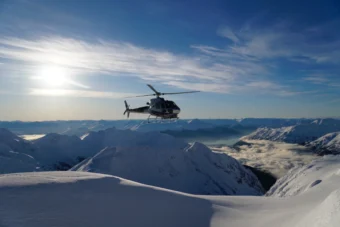
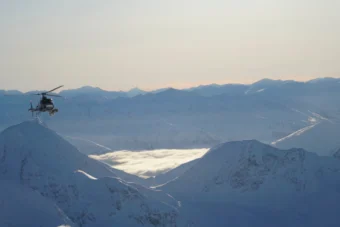
So he hovered within 10 to 20 feet looking at pieces of debris and taking pictures.
“We started finding pieces that were obviously aircraft aluminum of that color,” he said. “We found some a bit later that had markings that more or less identified that it was that aircraft.”
Olson said when he found the wreckage, he fell apart emotionally.
“There it was. It happened. Everything else was just speculation,” he said.
In that moment, Olson said he was finally able to let go of Wright, Munich and Hutchins. Or, at least, the idea that they might still be alive and need help.
“We don’t let go until we know,” he said. “That’s why, you know, that’s why there’s all these – like families are always – if they’ve lost somebody they just go through crazy attempts to get verification. You want to know because otherwise they might be alive.”
In that crumpled piece of aluminum, Olson saw the finality of what had happened.
“Like, all this data was correct. This is bad. This is done,” he said. “It’s a bad scene, but they’re not anywhere else. There’s closure for sure for everybody. But, it’s – there’s also a huge void. My god, these guys were upper echelon pilots and Tanya, too, was – you know – just all good, good people.”
A small plane carrying three passengers from Juneau to Yakutat disappeared over the weekend, launching a search and rescue effort that has so far yielded more questions than answers.
Samuel “Sam” Wright, a seasoned pilot from Haines with decades of experience navigating southeast, took off from Juneau on Saturday. On board with him were Hans Munich and Tanya Hutchins, a couple returning home to Yakutat after a trip. Munich is also a longtime pilot. He and Hutchins run a charter flight business.
The initial alarm was raised when the aircraft, a 1948 Beechcraft Bonanza, failed to arrive at its destination. Coast Guard spokesperson Shannon Kearney said the agency got a call about an overdue plane at 5:40 p.m. on Saturday. The agency put out a marine broadcast just after 6 p.m. and sent out the U.S. Coast Guard Cutter Reef Shark about half an hour later.
Soon they launched a MH-60T helicopter from Sitka and C-130 from Kodiak and partnered with Alaska State Troopers and the Alaska Rescue Coordination Center to search for the plane. Searchers scoured the Fairweather Mountain Range, focusing their efforts near Mount Crillon at the southern end, where the plane’s radar signal stopped abruptly.
“The flight tracking stops around 10,000 feet,” said Coast Guard public affairs officer Mike Salerno. “I can tell you that at that altitude the search assets have been encountering a lot of cloud coverage.”
The search extended into its third day Monday, and at one point the Civil Air Patrol reported finding something – but the Coast Guard was unable to verify that and ultimately decided to suspend the search by that evening, according to Salerno.
“It’s a very mountainous area,” Salerno said, “and the altitude combined with cloud cover is impacting visual searching.”
In the tight-knit aviation community, the news has been devastating – particularly in Southeast Alaska’s remote communities which often rely on planes and ferries to get around, and to get work done.
“Hans and Tanya have been instrumental to the bear research program for the past 15 years,” said Fish and Game bear research biologist Anthony Crupi. “Their friendship and contribution to brown bear conservation will be sorely missed.”
Haines Rafting Company owner and manager Andy Hedden said he has also been working with Hans and Tanya for the past 15 years. Their business provided bush flights for his rafting groups arriving in Dry Bay on the Alsek River.
“Hans was one of the best pilots I’ve ever seen. He was a hard worker and took meticulous care of his aircraft,” Hedden said. “He was as trustworthy a pilot as they come. Tanya was the friendly voice that took reservations and kept us informed when the flights took off. The two of them provided flight service for a number of lodges, fishermen and adventures. They will be sorely missed.”
In Haines friends and family said Wright is known not just for his piloting skills, but for his warm demeanor, jokes, and for being a familiar face at Fort Seward, where he was the cannoneer for ceremonial events – everything from the Lighting of the Fort, marking the beginning of the holiday season, to the Fourth of July bloomer blast, where people in town take bets on how far a pair of underwear will fly when he’d shoot it out of the cannon.
“He’s a heck of a nice guy. We’re all going to miss him,” said Terry Pardee, a longtime friend and who frequently flew with Wright.
Bill Thomas, another close friend who had also shared many flights with Wright, recalled their experiences fondly.
“He was a good friend,” Thomas said.
Thomas, who was a member of the state legislature from 2005-2013, said he got to know Wright because the pilot worked for Wings Airways and flew him back and forth to Juneau often. He joked that it felt like Wright was his personal jet service.
“Pretty much. We always laughed about that. He’d leave in the morning, and I’d like that and he’d be back at night,” he said.
Thomas was an airplane mechanic crew chief in Vietnam and said he felt safe flying with Wright.
“I enjoyed flying with Sam because he took care of his planes,” Thomas said. “He did an honest preflight, I would call it, and he knew what to look for.”
As the search dragged on and in the aftermath of its suspension, Wright’s partner Annette Smith, said the community has rallied around the families and friends of those on board.
“Haines is a wonderful community for people gathering together when there is a problem and tragedy and I really am very grateful for that,” Smith said.
Wright’s son is in town, and Smith said her sister is coming. And despite the suspension of the official search there is still lingering hope among Wright’s loved ones that he may yet make it home. Smith said her ideal resolution would be to find the wreckage and retrieve him.
“But the practicality of that – I’m a very practical person – practicality is elusive,” she said.
She said Wright’s family and Munich’s family are talking about continuing to search on their own.
“We’ll decide what to do after that, it’s kind of a one step at a time kind of thing,” she said.
But, she said, Wright and Munich were seasoned pilots, so they would understand the decision-making.
“Sam’s been flying since he was a teenager,” she said. “They know what they’re up against.”
Close
Update notification options
Subscribe to notifications
Subscribe
Get notifications about news related to the topics you care about. You can unsubscribe anytime.