Science & Tech

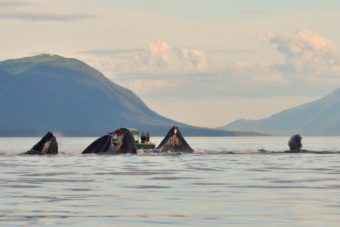
Is whale watching crowding humpbacks in Alaska?

Is the North Pacific humpback whale no longer endangered? The National Oceanic and Atmospheric Administration could decide as early as today whether to pursue taking the whale off the Endangered Species list.

A group of Hawaiian fishermen submitted a petition to de-list humpbacks in April and the agency will determine if it has enough credible information for further review.

Removing the North Pacific humpback from the Endangered Species list would require NOAA to revisit an important regulation specific to watching humpback whales in Alaska waters.

The rapid growth of Juneau’s whale watching industry may be causing some vessels to overlook regulations and guidelines.

“There’s probably eight to ten whales that I can just look at and say, ‘That’s Willy,’ or, ‘That’s Sasha,’ or, ‘That’s Sheila,’ or ‘That’s Monty.’ Flame is out here, you can recognize her very quickly. Spot’s out here, so we recognize her,” explains Larry Dupler, better known as Captain Larry. Dupler started conducting whale watching trips with Dolphin Tours in 1994, back when there were only a handful of local companies on the water.

“Sasha has a scar across her back and down her right side, and on her backside of her tail, she’s got the initials AK on the bottom left fluke,” he says.

Dupler helped start Orca Enterprises in 1997 and has been with the company ever since.

“Some of these whales I know and I know they know me, almost have a personal relationship with some of them.”

But, he says, not all captains feel the same way.

“If you watch the way some of the captains handle their boats around the animals, they’re not worried about the animal itself. They’re more worried about their customers and making them happy, getting them a good show, and some of them even violate the guidelines and regulations that we have in place.”

By 2001 it was clear to NOAA that humpbacks in Alaska were particularly vulnerable to pressure and potential harm from increased vessel traffic and whale watching. The Protected Resources Division came up with the “hundred yard rule” making it unlawful to approach within 100 yards of a humpback whale in Alaska waters.

While establishing the regulation, NOAA considered a permitting system for the whale watching industry, but concluded it didn’t have sufficient infrastructure.

No permitting system exists for vessels that want to enter the industry.

Weather Permitting owner and captain Greg Brown says whale watching should be more tightly regulated, “There is a lot of abuse and a lot of whales getting run over and pressured. That can be avoided if we changed the rules a little bit.”

NOAA’s Enforcement Division received 42 reports of harassment to humpbacks statewide in 2012. While the agency has patrol boats, including one in the greater Juneau area, most complaints come from the general public.

“We really encourage everyone to consider themselves a steward of this animal,” says Marine mammal specialist Aleria Jensen.

Humpbacks are in Alaska May through September, and most spend the rest of the year in Hawaii. “Alaska is the kitchen. It’s completely the time for foraging, for feeding, for bulking up,” explains Jensen.

She says regulations and guidelines are meant to limit disturbance to the whales’ natural behavior.

Gauging a hundred-yard distance for whale watching requires training. Allen Marine Tours, for example, has a range finder on every boat, according to Juneau general manager Eric Majeski.

“In the training week, we’ll go out to an island or a reef, somewhere where we can have a hard surface to get a digital read from, and have all the captains stand at the helm and see how far away that is. They can use every tool they can to make sure they’re staying at least a hundred yards away,” says Mejeski.

Allen Marine started offering whale watching tours in 1995. “We started off with just three boats and now we’re up to 13 boats based in Juneau.”

NOAA Enforcement Division special agent Ron Antaya says the number of humpback harassment complaints has not varied over the years despite the growing number of tour boats. He believes the industry polices itself.

“Given the volume of tour activity out there and the volume of complaints we get, I think that speaks for itself. They’re doing a pretty good job.”

Last month, NOAA fined Alaska Yacht Charters $5,000 for coming within 30 feet of a pod of breaching whales in 2010. The company’s owner Geoffrey Wilson was found liable under the Marine Mammal Protection Act and the Endangered Species Act.

NOAA will look at abundance trends as it considers the petition to de-list. Alaska Fisheries Science Center director Doug DeMaster says the number of North Pacific humpback whales has increased, “We went from what may have been as few as a thousand or so animals in the 1960s to more than 20,000 humpback whales today.”

Orca Enterprises Dupler worries the industry has grown past the point of saturation.

“Today there’s like three or four humpbacks in the general area and it’s not uncommon now to go out and see 15 to twenty-some boats sitting around one animal.”

The Alaska Visitor Statistics Program indicates more than 50 percent of visitors engage in wildlife viewing, including whale watching, making it one of the most popular tourist activities in the state.

Can new studies make gulf fisheries more predictable?

Ron Heintz discusses the gulf groundfish project while checking equipment in one of NOAA’s Juneau labs. Photo by Ed Schoenfeld, CoastAlaska News.

What helps – or hurts – the health of Gulf of Alaska’s fisheries? More than 40 scientists from 11 institutions are searching for answers as part of a five-year study of the gulf’s vast ecosystem.

Among other things, they’re creating a baseline of data to help determine climate change’s impacts on fish growth and populations.

We paid a visit to one Juneau research facility to find out about its part of the study.

Ron Heintz opens a glass case in one of the laboratories where he and his team are studying groundfish.

“So the fish come in here and then we weigh them and we have to cut their stomach contents out and we’ll probably look at those to see what the contents were,” he says.

Ron Heintz holds a test tube of powdered groundfish at the Alaska Fisheries Science Center.

He pulls out a test tube holding what looks like a small amount of powdery dirt.

“They get dried and then ground into this powder here. … It’s just a dried pulverized fish.”

Heintz is a program manager for the Alaska Fisheries Science Center at NOAA Fisheries’ Ted Stevens Marine Research Institute.

His office overlooks Favorite Channel, an Inside Passage waterway about 15 miles northwest of downtown Juneau.

But Heintz and his team are focused farther to the west – in the Gulf of Alaska. 

“What we’re interested in is how climate is influencing the survival of juvenile fish that contribute to these fisheries. So a fishery is conducted on rockfish or pollock or Pacific cod,” he says. “We need to know how the juveniles enter those populations, so we that can manage them more effectively.”

The focus here is on juvenile groundfish. In addition to pollock and cod, they’re also studying sablefish, Pacific Ocean perch and arrowtooth flounder.

Others are researching predators, factors affecting food and differences between the eastern and western gulf.

Information is being gathered at more than 200 locations along the ocean shelf from Southeast’s Baranof Island, north to Yakutat and west to the Kenai Peninsula and Kodiak Island.

“A lot of studies are very single species, single mechanism. This is a real attempt to understand how the ecosystem works as a whole,” says Phyllis Stabeno, an oceanographer at NOAA’s Pacific Marine Environmental Laboratory in Seattle.

She says this project is looking at several species and changing conditions, such as temperature, current and rainfall.

“The reason we’re looking at five species of fish is species interact. The system is very complex and we’re trying to understand the major drivers of what results in survival.”

Before they can be studied, the fish have to be caught.

Wyatt Fornier is a Juneau lab field chief who samples the sea. He says his crew first records temperature, zooplankton populations and other relevant information.

Larval rockfish from the gulf study. Photo courtesy Gulf of Alaska Project Field Notes Blog.

“And then we’ll put on a research trawl, which then we string with buoys along the headrope, which keeps it right at the surface. So we’re just looking for the little fish on this survey … our little guys in their first year at sea,” he says.

Once they’re brought back to the lab, Heintz and his crew run them through a series of tests.

“For the rockfish, it’s very difficult to tell the little babies apart. So we actually have to then send them off to do a genetic analysis, so we can identify what species we actually caught,” he says.

They’re checked for protein and fat content, plus other tests, using a variety of equipment.

“If the fish is doing really well and has lots of body fat, then we would think that the fish is in pretty good condition. And it’s probably not too concerned about lots of predators, it’s finding lots of food, it’s living in an optimal temperature, the currents are providing it with the things that it needs to have a happy life,” Heintz says. “If the fish is really lean and not putting on a lot of fat, then it’s probably suffering somehow.”

These and other tests, when combined with other parts of the study, give researchers a better idea of the health of groundfish stocks.

It’s information needed by scientists and fishery managers. But why should everybody else care?

“Because most Alaskans like to eat fish. And our job is to provide those fish and to make sure that those fish are available for your kids to eat and your kids’ kids to eat. This is the only way we know how to do it, is to make sure we don’t overfish the stock, by understanding how the ecosystem works,” Heintz says.

The Gulf of Alaska study is scheduled to continue through 2014. It’s funded by the North Pacific Research Board.

In addition to immediate information, what’s discovered will give future researchers a well-documented reference point.

Read the gulf project blog, which includes photos from several years of research.

This map shows sample locations of the Gulf of Alaska Project.


True, Blue Planet Found Orbiting Nearby Star

This illustration shows HD 189733b, a huge gas giant that orbits very close to its host star HD 189733
This illustration shows HD 189733b, a huge gas giant that orbits very close to its host star HD 189733. The planet’s atmosphere is scorching with a temperature of over 1000 degrees Celsius, and it rains glass, sideways, in howling 7000 kilometre-per-hour winds. Credit: NASA, ESA, M. Kornmesser

Move over, Earth. There’s another blue planet in town — or at least in our corner of the Milky Way.
Astronomers using the Hubble Space Telescope deduced for the first time the atmospheric hue of a planet outside our own solar system — and it turns out to be a “deep cobalt blue.”

But the similarities between HD 189733b, as the alien world is unpoetically known, and Earth, pretty much end there: While oceans of liquid water give our world its azure tint, that’s unlikely the case with HD 189733b, which orbits a star just 63 light years away from us.

The planet in question is what’s known as a “hot Jupiter” — a term that describes both its large mass and nearness to its parent star. Nature elaborates, describing the weather on HD 189733b as extremely hot and windy, with occasional glass rain:

“Although the planet seems to be the shade of a deep ocean, it is unlikely to host liquid water. The exoplanet is a giant ball of gas, similar to Jupiter, and was previously often painted brown and red in artists’ impressions.

“The blue color may come from clouds laden with reflective particles that contain silicon — essentially raindrops of molten glass. Evidence for this idea dates to 2007, when Hubble observed the planet passing in front of its star. Light from the star seemed to be passing through a haze of particles.”

But Hubble’s optical resolution isn’t good enough to actually “see” the planet. Instead, astronomers analyzed spectroscopically the light from the parent star and the planet together (during an eclipse from our vantage point), then measured it again when the planet was behind the star. The observation from the star minus the planet was less blue, indicating that is the color of the planet itself. According to Nature:

“During the eclipse, the amount of observed blue light decreased, whereas other colours remained unaffected. This indicated that the light reflected by the planet’s atmosphere, blocked by the star in the eclipse, is blue. …

” ‘This is the first time this has been done for optical wavelengths,’ said Alan Boss, an astrophysicist at the Carnegie Institution for Science in Washington DC. ‘It’s a technical tour de force.’ The amount of visible light bouncing off a planet is typically small compared to light fluctuations in a star, making planets difficult to distinguish. Fortunately, HD 189733 b is large relative to other exoplanets — and well illuminated.”

Copyright 2013 NPR. To see more, visit http://www.npr.org/.
Read original article
True, Blue Planet Found Orbiting Nearby Star

Researchers tagging salmon for tracking study

Spawning sockeye salmon
Sockeye salmon

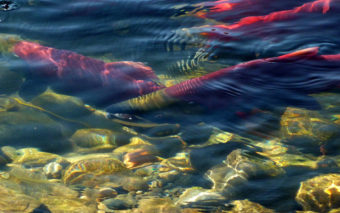
King salmon runs to the rivers of Cook Inlet are down again this year. Complicating matters for Fish and Game managers are the strong sockeye runs that commercial and personal use fishers depend on. After last year’s disastrous fishing season, the Parnell administration launched a 5-year, $30 million effort to find out more about salmon life cycles in the ocean. One of the studies under way is trying to figure out where kings and reds are hanging out in the water just before they return to the rivers.

NASA Has Shut Down Space Telescope Orbiting Earth

"The Galaxy Next Door" — This composite image of the Andromeda galaxy was produced by NASA's Galaxy Evolution Explorer, showing Andromeda's ultraviolet side. NASA sent a decommission command to the space telescope Friday. NASA
“The Galaxy Next Door” — This composite image of the Andromeda galaxy was produced by NASA’s Galaxy Evolution Explorer, showing Andromeda’s ultraviolet side. NASA sent a decommission command to the space telescope Friday. NASA

NASA is sending a reliable servant into a retirement that will end with a fiery re-entry into Earth’s atmosphere in about 65 years. That’s the fate that awaits the Galaxy Evolution Explorer, the “galaxy hunter” space telescope whose original 29-month mission was extended to more than 10 years.

Along the way, the orbiting system, known as GALEX, helped scientists study how galaxies and stars are born, and how they change over time.

Since its launch in the spring of 2003, GALEX photographed nebulae and spiral galaxies, and “used its ultraviolet vision to study hundreds of millions of galaxies across 10 billion years of cosmic time,” NASA says.

GALEX was shut down at 3:09 p.m. ET Friday, when a decommission signal was sent to the orbiting craft, according to NASA, which has also published a photo gallery of compelling images from the project.

“GALEX is a remarkable accomplishment,” says Jeff Hayes, NASA’s GALEX program executive in Washington. “This small Explorer mission has mapped and studied galaxies in the ultraviolet, light we cannot see with our own eyes, across most of the sky.”

The space agency published this list of highlights in GALEX’s career:

— Discovering a gargantuan, comet-like tail behind a speeding star called Mira.
— Catching a black hole “red-handed” as it munched on a star.
— Finding giant rings of new stars around old, dead galaxies.
— Independently confirming the nature of dark energy.
— Discovering a missing link in galaxy evolution — the teenage galaxies transitioning from young to old.

And they’re likely to be joined by other revelations, as the reams of data yielded by the space telescope project are reviewed. NASA and the California Institute of Technology, which manages the Jet Propulsion Lab for the space agency, plan to release the project’s most recent data to the public in the next 12 months.

“GALEX, the mission, may be over, but its science discoveries will keep on going,” says NASA’s Kerry Erickson, the mission’s project manager at the Jet Propulsion Laboratory in Pasadena.

Copyright 2013 NPR. To see more, visit http://www.npr.org/.
Read original article
NASA Has Shut Down Space Telescope Orbiting Earth

Polar Star headed for Arctic ice trials

The Polar Star in port on June 27, 2013. Photo by Audrey Carlsen, KUCB – Unalaska.

The United States’ only heavy icebreaker will soon be back in service after a four-year, $90 million renovation. The USCGC Polar Star was scheduled to leave Unalaska last Friday to undergo several weeks of ice trials in the Arctic.

The 399-foot-long ship is painted bright red. Its decks are clean and shiny, and brand-new anchors rest in neatly coiled piles of chain on the prow. Ensign Paul Garcia explains that this is all the result of a massive overhaul of the ship that wrapped up in 2012. “The engines were getting replaced, the main gas turbines were getting replaced, all of our cranes … those are all brand new,” he says.

The ship also has new navigation equipment, new systems for lowering anchors and small boats, and a newly-equipped gym and movie theater to keep the crew in good spirits during polar voyages that can last up to six months.

The renovations are extensive and impressive, but the question still remains – does the ship actually work?

“Now, we need to make sure that all our equipment is functioning correctly, that we’re still able to withstand the same amount of force and break the same amount of ice that we were back in the ’80s,” says Garcia.

To that end, the crew of the Polar Star will be heading up to the Arctic, where they will perform various ice breaking maneuvers using a strategy that amounts to repeatedly beaching the ship on the ice.

“We have a lot of weight up forward,” says Garcia. “We kind of have a rounded hull and so we use our three main gas turbines to come up on the ice and then use that weight to come down and it smashes the ice and that’s how we create the channels. It’s called backing and ramming.”

And since the Coast Guard hasn’t had a heavy icebreaker for several years now, these ice tests will also be an opportunity for inexperienced crew members to get trained and qualified.

“You’re always going to have some growing pains,” says Garcia. “But this few weeks that we’re out here should hopefully take care of those. Fall time, I think we’ll be fully operational again and ready to perform any mission that the Coast Guard needs us to perform.”

While the Polar Star is heading for Arctic waters this summer, it will actually be spending most of its time in service in the Antarctic, breaking channels through the ice to resupply McMurdo Research Station. In addition to this yearly mission, dubbed Operation Deep Freeze, the ship will be available for scientific research, search and rescue and law enforcement missions, and, most importantly, maintaining a U.S. “presence” in Arctic waters.

Site notifications
Update notification options
Subscribe to notifications