Science & Tech

New Discovery Knocks ‘Oldest Bird’ Off Its Perch

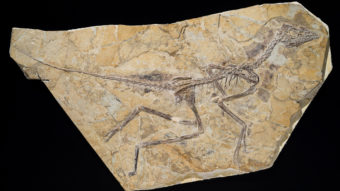
A photo released by the Royal Belgian Institute of Natural Sciences shows the skeleton of a recently discovered dinosaur dubbed Aurornis xui. Thierry Hubin/AP

Move over Archaeopteryx, an older bird just landed on the evolutionary tree.
Scientists writing in Nature magazine, say a feathered, chicken-sized creature known as Aurornis xui, unearthed recently in northeastern China, challenges the “pivotal position of Archaeopteryx” — long regarded as the oldest bird.

Aurornis is dated to the Jurassic period, 160 million years ago and about 10 million years before Archaeopteryx makes its first known appearance in the fossil record.

“Our analyses indicate [Aurornis is] the most primitive bird known,” co-author Andrea Cau, a vertebrate paleontologist at the Museo Geologico Giovanni Capellini in Italy, says. “It looked like a ground bird, but with a long tail, clawed hands and toothed jaws.”

As The Los Angeles Times writes:

“The study authors argue that Aurornis represents the earliest known bird, but other scientists say it could be part of a group of bird-like dinosaurs that were developing feathers and bird-like features but never quite got off the ground, evolutionarily speaking.

‘You’re looking at an animal that is either a very primitive bird or something very closely related to birds,’ said [Luis] Chiappe, a veterbrate paleontologist at the National History Museum of Los Angeles who is not involved in the Nature study. ‘I tend to think that it’s not a bird, but that it’s one of those true very close ancestors of bird.'”

The discovery is not all bad news for newly dethroned Archaeopteryx.

Before the study, there was debate as to whether it was indeed a fully fledged bird, but the authors of the study believe that the discovery of Aurornis puts the branches of the bird lineage in context and restores Archaeopteryx to flight status.

Copyright 2013 NPR. To see more, visit http://www.npr.org/.
Read original article
New Discovery Knocks ‘Oldest Bird’ Off Its Perch

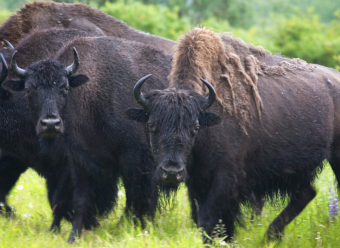
Wood bison DNA spurs species debate

Alaska Wood Bison
Photo Credit: Laura Whitehouse/USFWS

Dr. Matthew Cronin is a research professor of animal genetics at UAF. Cronin and his collaborators say DNA analysis does not support the designation of Wood bison and plains bison as different subspecies:

 “The evidence for them being different enough to be designated a subspecies is, in my opinion, just isn’t there, either with genetics or with the historical mixing of the herds.”

 Cronin, who is based at UAF’s agricultural research farm in Palmer, found that plains bison and Wood bison are genetically similar, and even found that some plains bison are more genetically different from each other than they are from Wood bison. He says that, decades ago, plains bison were introduced to the Canadian Wood bison herds:

“The Wood bison and plains bison were designated back sometime in the 18 or 1900s. But what’s in the literature, abundantly, is that 6700 plains bison were put into the herd of 2000 Wood bison in Canada in the late 1920s, so they were mixed. So we really can’t assess the original condition of the two groups.”

Cronin, who published his paper in the May edition of the Journal of Heredity, studied both plains and Wood bison in five states and in two Canadian provinces. Cronin admits that scientists often squabble over what designates a subspecies:

 “The scientific community has debated the whole subspecies category and many if not most population geneticists like myself recognize the entire category has been used very subjectively, in other words, people have designated subspecies without a lot of rigourous scientific evidence. And that’s been going on since the late 1800s, so there’s a lot of subspecies for which there hasn’t been adequate analysis.”

Wood Bison are currently listed as threatened under the Endangered Species Act, which allows the listing of subspecies. US Fish and Wildlife spokesperson Cathy Rezabek .  She says Fish and Wildlife contends the two groups of bison are separate:

 “And we based our finding on the scientific information available, which indicated that there has been historical physical separation in their ranges, as well as behavioral and physical differences, and genetic differences.”

Rezabek says that the animals were down-listed from the threatened to the endangered designation about two years ago, and the final ruling on their status was made a year ago.

 Cronin says the plains bison and Wood bison should be considered geographic populations, not subspecies. A special breeding program at the Alaska Wildlife Conservation Center in Portage has brought a herd there up to around 200 animals from 53 Wood bison imported from Canada in 2003. Currently Fish and Wildlife is working with the state on releasing some of the animals to habitat in other areas of the state.

Pavlof eruption loses steam

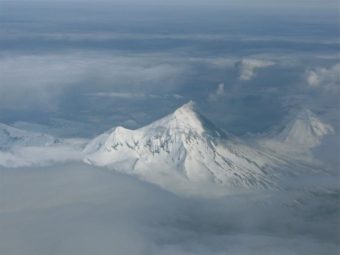
Pavlof Volcano
Pilots saw Pavlof Volcano spitting a small amount of ash on May 22, 2013. (Courtesy of Ryan Hazen and Brandon Wilson)

There’s still some rumbling beneath the surface, and a few small explosions here and there. But for the most part, Pavlof Volcano on the Alaska Peninsula has quieted down.

Rick Wessels is a geophysicist at the Alaska Volcano Observatory. He says the observatory finally got some decent satellite pictures of Pavlof on Friday. They show a lot less ash.

“The plume seemed to be pretty low-level — beneath 15,000 feet. Pretty short,” Wessels says. “It wasn’t nearly the intensity that we saw a week ago.”

Smaller, less intense emissions means that Aleutian communities like Sand Point and Nelson Lagoon are unlikely to be dusted with ash again.

Beneath the surface, Wessels says Pavlof still shows signs of erupting — albeit less violently than before.

“[It’s] basically a low level of what we call volcanic tremor, which just means as fluids and lava are moving through the volcano. It just is kind of a continuous, low-level subsonic hum,” Wessels says. “And then there’s still discrete little explosions we can see on the seismic and infrasound networks. So we are able to hear these little pops once in a while, where things get pushed out a little more energetically.”

Wessels says he and other scientists have been going through records of past eruptions at Pavlof to try to figure out what phase the volcano is in.

“We’re not sure if this is a respite from bigger activity or if this is the weaning stages of the end of activity,” Wessels says. “Really, the only we can tell is just watch it for a few more days and see what it does.”

History shows that Pavlof could still spit tall ash plumes up to 20,000 feet into the air with little to no warning. For that reason, the AVO is maintaining an aviation alert for the volcano.

Beneath A Glacier’s White, Researchers See Green

As the Teardrop Glacier on Ellesmere Island in the Canadian Arctic recedes, researchers have found a kind of evergreen plant called bryophytes coming out from beneath the ice. Here, a researcher stands next to part of the glacier for scale. Courtesy of Catherine La Farge

In the news business, an evergreen is a story that doesn’t have to run on a particular day, but can stay fresh for a long time.

This is an evergreen story about an evergreen. In particular, a group of plants called bryophytes. Turns out they may be evergreen quite a bit longer than most people thought.

The most famous bryophyte of them all is moss. “After a hundred years, a moss may look perfectly natural and even retain its green color,” says Jonathan Shaw, a scientist at the bryology lab at Duke University.

But a hundred years is nothing compared with the bryophytes Catherine La Farge and her colleagues found on Ellesmere Island in the Canadian Arctic. The Teardrop Glacier on Ellesmere Island has been receding rather rapidly recently. “We were aware that there was vegetation coming out from underneath the glacier,” La Farge says. “But we had no idea that there was such a diversity of bryophytes that were coming out from underneath the glacier.”

The small patch in the middle of the image is Aulacomnium turgidum, a type of bryophyte plant. Researchers in the Canadian Arctic say they are surprised the bryophytes were still green, even after being covered by ice. Courtesy of Caroline La Farge

But if the diversity was impressive, even more so was what they saw when they brought the bryophytes back to their laboratory in Edmonton, Alberta.

“The material actually looked quite green when we examined it underneath the microscope. And in examining it in more detail, there was actually growth coming from the material,” La Farge says. In other words, not only were the plants still green, they were green and growing, something La Farge says is pretty amazing.

In the lab, scientists grew cultures of some of the plants found beneath the receding Teardrop Glacier. These are Aulacomnium turgidum, a relative of moss. Courtesy of Catherine La Farge

She says bryophytes don’t typically get a lot of attention from botanists, compared to the gaudier seed plants most people are familiar with.

As La Farge and her colleagues write in the current issue of the journal PNAS, “Our results emphasize the unrecognized resilience of bryophytes, which are commonly overlooked vis-a-vis their contribution to the establishment, colonization and maintenance of polar terrestrial ecosystems.”

In fact, as glaciers around the world continue to recede, we may be hearing a lot more about bryophytes.

Copyright 2013 NPR. To see more, visit http://www.npr.org/.image
Read original article
Beneath A Glacier’s White, Researchers See Green

Ring Nebula Is More Like A Jelly Doughnut, NASA Says

The famous Ring Nebula is shown here in striking detail, in a composite image made from images from NASA's Hubble Space Telescope and infrared data from telescopes on Earth. NASA, ESA, C.R. Robert O'Dell, G.J. Ferland, W.J. Henney and M. Peimbert
The famous Ring Nebula is shown here in striking detail, in a composite image made from images from NASA’s Hubble Space Telescope and infrared data from telescopes on Earth. NASA, ESA, C.R. Robert O’Dell, G.J. Ferland, W.J. Henney and M. Peimbert

The Ring Nebula, whose iconic shape and large size make it a favorite of amateur astronomers, can now be seen in new detail, after NASA’s Hubble Space Telescope captured a sharp image of the nebula. Researchers say the new clarity reveals details that were previously unseen, and a structure that’s more complex than scientists had believed.

“The nebula is not like a bagel, but rather, it’s like a jelly doughnut, because it’s filled with material in the middle,” says C. Robert O’Dell of Vanderbilt University, who leads a team of researchers studying the Ring Nebula. They combined Hubble’s visible-light images with infrared data from telescopes on Earth.

The basis of the new image was captured by Hubble’s Wide Field Camera 3, which was installed in 2009.

Located in the constellation Lyra, the nebula is some 2,000 light-years from Earth. The new view of the nebula allowed O’Dell’s team to create a precise 3-D model of the nebula.

“O’Dell’s team suggests the ring wraps around a blue, football-shaped structure. Each end of the structure protrudes out of opposite sides of the ring,” according to NASA.

By comparing the recent examination of the Ring Nebula with data from 1998, researchers determined that the nebula is expanding at more than 43,000 miles an hour, with the center moving faster than the main ring.

“All of this gas was expelled by the central star about 4,000 years ago,” NASA says. “The original star was several times more massive than our sun. After billions of years converting hydrogen to helium in its core, the star began to run out of fuel. It then ballooned in size, becoming a red giant. During this phase, the star shed its outer gaseous layers into space and began to collapse as fusion reactions began to die out. A gusher of ultraviolet light from the dying star energized the gas, making it glow.”

Copyright 2013 NPR. To see more, visit http://www.npr.org/.image
Read original article
Ring Nebula Is More Like A Jelly Doughnut, NASA Says

Two remote volcano sensors resume sending seismic data

Location of seismic stations near Iliamna volcano in March 2012.
Location of seismic stations near Iliamna volcano in March 2012. (Crddit Janet Schaefer/AVO)

Scientists are now able to monitor two remote volcanoes on the Alaska Peninsula after equipment came back to life this spring.

The Peulik  volcano and Ukinrek Maars are located about 70 miles south of King Salmon. Scientists thought that sensors there died over the winter. Jeff Freymueller is a professor at The University of Alaska Fairbanks and is the Coordinating Scientist for the Alaska Volcano Observatory.

“We know that those stations have suffered physical damage, we know that bears have ripped down doors off enclosures.  It looked like they were down and not coming back.  What actually happened over the last few weeks is that they’ve began coming back,” Freymueller said. “That really means that they were down because the  power had failed.  Now the snow is melting and the sun is out, those stations are actually on power and are transmitting data.”

It’s been decades since either volcano showed signs of activity. The Peulik  volcano last erupted in 1814. But radar decades ago showed magma rising to within several kilometers of the surface. Ukinrek Maars  has been quiet since only 1977 when the two vents erupted and formed deep craters. Scientists want to know what’s happening at the two volcanoes. Freymueller said they rely on that seismic data to provide early warnings.

“Quite often one of the first indications of volcanic unrest is small swarms of small earthquakes.  Having the network there means that if those occur, we can see them and those are likely to among the first precursors to potential activity.  If the volcano were to start to actually erupt, we’d see volcanic tremor and other sub signals just like we’re seeing now on Pavlof.  We can see that if we have seismic stations close to the volcano, but we can’t if there’s not data from close in,” said Freymueller.

The observatory is used to remote stations periodically failing, but the network’s health has suffered over the past few years. Of the observatory’s 200 stations, almost half are out of commission this month.

“When we actually had everything properly maintained, it was not so much of a worry. It was pretty rare that the number of working instruments would get down to the threshold where you wonder if you’re able to catch things.   It’s something we’re starting to have to worry about more and more.  I  expect that this time next year we’re going probably see higher percentages of things not working.  Simply because the amount of maintenance we can do this summer is very limited.  Limited maintenance now means more failures down the road,” said Freymueller.

The network relies on funding from Congress, which Freymueller said has not kept pace with maintenance needs.

“Either that changes because the budget goes up, or we’re have to pull back and reduce the number of volcanoes we monitor and fall back on the highest priority ones. Either because they’re the most dangerous, most eruptive or because they pose hazards to people on the ground,” said Freymueller.

The Alaska Volcano Observatory monitors more than 20 volcanoes across the state.  Two are currently on watch alert: the Pavlof and Cleveland volcanoes.

Site notifications
Update notification options
Subscribe to notifications