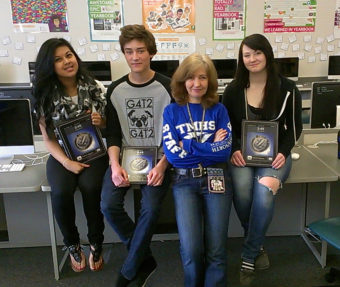
The Thunder Mountain High School (TMHS) yearbook team got inventive this year. The class, led by Janna Lelchuk, used a combination of smartphone technology and raw creativity to come up with what they believe is the first ever “Digitally Interactive Yearbook,” dubbed the “iFalcon.”
Janna attended the Alaska Society of Technology Education (ASTE) conference in February of this year where she learned of a smartphone application called Aurasma:
With the yearbook pages due in March, the team had little time to add such a feature to their already near-complete project.
But after three months of hard work, accompanied by innovative thinking by TMHS junior Gabe Donohoe, the team pulled it off.
The iFalcon in action (that is the actual yearbook cover, not an iPad):
Front of the iFalcon scanned using Aurasma shows a rotating image on the iPhone.This shows the iFalcon bringing smiles to the faces of an unhappy looking crowd.Yearbook team shows in place of credits
Secret image shows in place of the TMHS logo
The whole book is full of these hidden digital gems. For instance, scanning a picture of the school’s band will display a video with sound of them playing live.
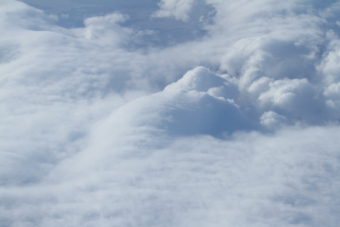
Clouds blanket Pavlof Volcano on May 21, 2013 / Courtesy of Mitch Johnson
Heavy cloud cover over the Alaska Peninsula is making it tough for scientists to monitor Pavlof Volcano. The Alaska Volcano Observary hasn’t been able to get a clear picture of the peak by satellite for almost two days.
Still, there’s some indication that the eruption might be easing up a little. AVO has recorded less violent seismic rumbles at the volcano. And according to pilot reports, the ash plume is much smaller than it’s been over the past two weeks — and it’s blowing out to the Bering Sea.
“The cloud cover today was up around 15,000 feet. That’s why AVO couldn’t see it,” says PenAir president Danny Seybert. “We were able to see it and we were only detecting ash clouds around the 10,000 foot level.”
That’s good news for PenAir and for other regional airlines, which canceled flights to southwest Alaska this week over concerns that the ash would damage their planes.
Seybert says PenAir restored all of its routes today and started adding some extra planes to work off a backlog of more than 300 passengers.
NASA scientists say they witnessed an extremely bright lunar explosion this past March. In fact, it is the biggest explosion they’ve seen since they started keeping track of such events in 2005.
“On March 17, 2013, an object about the size of a small boulder hit the lunar surface in Mare Imbrium,” Bill Cooke, of NASA’s Meteoroid Environment Office, said in a press release. “It exploded in a flash nearly 10 times as bright as anything we’ve ever seen before.”
What’s cool is if you had been looking at the moon at just the right time, you would have seen a one-second flash caused by the impact of a nearly-90 pound meteoroid that was traveling at 56,000 mph. The impact was picked up by one of the Meteoroid Environment Office’s 14-inch telescopes.
One intriguing question is how a meteoroid can cause an explosion on the Moon, which has no oxygen atmosphere.
NASA explains:
“Lunar meteors don’t require oxygen or combustion to make themselves visible. They hit the ground with so much kinetic energy that even a pebble can make a crater several feet wide. The flash of light comes not from combustion but rather from the thermal glow of molten rock and hot vapors at the impact site.”
Since NASA started keeping tabs of lunar strikes, it has counted more than 300 of them. They hope keeping track of these events will help them make decisions during long-term lunar missions.
“Is it safe to go on a moonwalk, or not?,” NASA asks. “The middle of March might be a good time to stay inside.”
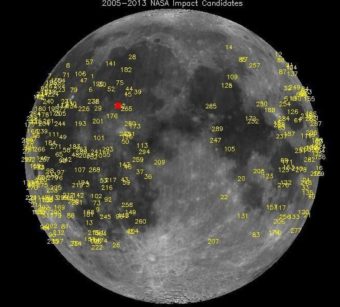
We’ll leave you with a graphic that shows all of the strikes the NASA program has recorded. The red square marks the spot of the March 17 impact:
NASA’s lunar monitoring program has detected hundreds of meteoroid impacts. The brightest, detected on March 17, 2013, in Mare Imbrium, is marked by the red square.
U.S. Forest Service officials and Juneau residents commemorated the opening of the new Juneau Forestry Sciences Laboratory on Saturday.
The dedication of the new facility near the edge of Auke Lake featured the raising of house posts carved by Haines carver Wayne Price.
Forest Service employees assigned to the lab helped raise the posts at the entrance of the building.
The $10 million facility built on federal land is the new, permanent home for the lab’s roughly thirty employees who have worked in at least three other different facilities on a temporary basis over the last 60 years.
Updated story on Saturday’s ceremony:
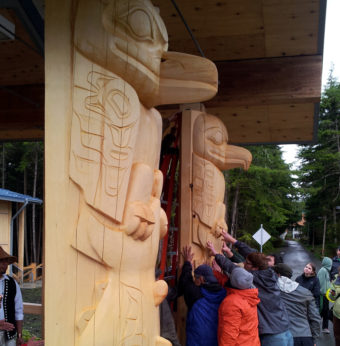
Two groups of Forest Service employees approached the new Juneau Forestry Sciences Laboratory from opposite directions. Each group, about a dozen people each, carried a thousand-pound yellow cedar log carved into a house post. In front of the lab, each of the ten-foot posts were set down, pivoted on the bottom end, lifted up on a mounting pedestal, and pushed upright into place (see slideshow above).
The dedication of the new lab on Saturday was a mix of the traditional and the modern with more of an emphasis on tradition as participants danced, and paid their respects and honored the Aak’W Kwaan who have traditionally owned and occupied the land around Auke Bay. It included the Carver’s Dance which marks relinquishment of title and ownership of the totems.
The modern part of the dedication came at the very end with a ribbon stretched across the entrance and a half-a-dozen pair of scissors.
“We’re delighted to be here on the ancestral grounds of the Aak’W Kwaan,” said Robert Mangold who is acting director of the Pacific Northwest Research Station that is essentially a group of eleven labs in the region. “They’ve been very helpful and instrumental in design of the building and supporting us.”
Mangold says the 12,000 square foot Juneau lab on the edge of Auke Lake and adjacent to the University of Alaska Southeast campus is about medium in size for their facilities.
Construction on the $10 million building started only three years ago. But it’s has been as much as 60-years in making with the lab’s twenty to thirty employees recently working in at least three different facilities on a temporary basis.
“It’s a tremendous building. It really offers the kind of lab facilities that we never had before,” said Paul Hennon, a forest pathologist with the Station.
Contractors used stone and yellow cedar siding obtained in Southeast Alaska while the interior features hickory trim. Upstairs include the offices while the downstairs is devoted to the lab spaces where the botanists, hydrologists, entomologists, and other scientists can work.
Hennon and his colleagues in other disciplines will work together to tackle everything from forest health to human use of the forest, watershed and young-growth management, and climate change issues.
“So, it’s very common at least in our experience that we team up, kind of mix our disclipines together and are able to take on some broader problems that way,” said Hennon.
The new building will also house the Alaska Coastal Rainforest Center and its location next to UAS should foster more collaboration with faculty and students on research.
Other building construction details include triple-glazed windows, radiant heating, and a ground source heating and cooling system for energy efficiency.
But the house posts will be the first thing that any visitor sees. Master carver Wayne Price of Haines says both posts are carved from the same log of yellow cedar found on Chichagof Island. He says he started on them full-time after the New Year, and finished just hours before getting on the ferry for Juneau. Price says the Eagle post features a mudshark of the Wooshkeetaan and the Raven post includes a dog salmon picked by Aak’W elders.
“I’m just very glad to see the house posts in place. They look a lot better where they belong,” said Price.
“And I’m glad to see all the people that turned out today for this big event and thank the Forest Service for supporting the Native culture and the art. Now that we have these here, all the young people have a constant reminder of the people that were here from the get-go. That ties it all together.”
The Alaska Volcano Observatory said Thursday a continuous cloud of ash, steam and gas from Pavlof Volcano has been seen 20,000 feet above sea level. The cloud was moving to the southeast Thursday.
John Power, the U.S. Geological Survey scientist in charge at the observatory, estimates the lava fountain rose several hundred feet into the air.
Onsite seismic instruments are picking up constant tremors from the eruption at Pavlof, located about 625 miles southwest of Anchorage.
Residents of Cold Bay, 37 miles away, have reported seeing a glow from the summit.
Pavlof is among the most active volcanoes in the Aleutian arc, with nearly 40 known eruptions, according to the observatory.
Original Story: May 16, 2013 – 7:12 a.m.
Pavlof Volcano put on a light show for residents of several communities on the Alaska Peninsula Tuesday night. Activity at the volcano has increased, and it’s spewing ash up to 20,000 feet.
Cold Bay resident Molly Watson was watching Pavlof for signs of activity from her kitchen window on Tuesday evening.
“And I’d kind of given up, thinking ‘ehn, we’re not going to see anything else, just smoke.’ As soon as I mentally thought that, and I was actually writing it to a friend — I was emailing — and sure enough, I saw this spark, and I was like ‘what is that?!’”
Watson says at first it just looked like a faint glow on the side of the mountain, but that it got clearer over time.
“As it got darker you could really see it shooting up and out — and then you could see the lava flow going down the side of the mountain.”
Pavlof was also shooting up ash clouds — some of them rising up to 20,000 feet. Alaska Volcano Observatory scientist-in-charge John Power:
“Most of the plumes that we’ve been seeing are more in the 15,000 foot range, and seem to be falling out of the atmosphere quite quickly. So, so far there hasn’t been any widespread ashfall from this, and it certainly has not gotten up high enough to affect international air travel.”
Nevertheless, an advisory has been issued for all flights in the area, and Power says the Observatory will be monitoring for ash clouds reaching 30,000 feet or above. He adds that other agencies are keeping a close eye on air quality in local communities.
“There is some concern for ash fallout, although in the 2007 eruption, it didn’t pose much of problem for those communities, and we’ll be hopeful that that’s the case this time.”
So long as it is, Cold Bay and Sand Point residents can rest easy, and continue to enjoy the light show.
Regent Dale Anderson, left, explains the award before making the presentation to Jan during the UAS Sitka Campus Commencement Ceremony on May 3.
Associate Professor of Marine Biology, Jan Straley, was recognized with the University of Alaska’s Meritorious Service Award on May 3 during the Sitka campus graduation ceremony.
The Board of Regents selected Straley for her work in marine research and education.
Straley has worked with the National Park Service in Glacier Bay National Park and Preserve’s monitoring program and also studies humpback whales at the NOAA lab in Juneau. She’s been based at the Sitka campus since 1994.
“I am truly honored and humbled by this award presented to me by the Board of Regents,” Straley said. The letters of support were so glowing it was hard to realize that they were talking about me. It seems that when you work with great colleagues who are equally passionate about what they do it creates an enjoyable and productive team effort. I think of this award belonging to that team of researchers and educators, including my students and my incredibly supportive and creative family,” said Straley in a press release.
Straley has been studying whales in Alaska for more than 30 years and founded the Sitka WhaleFest and the Sitka Sound Science Center.
Straley is the first person to receive the award since 1995 according to the release.
Close
Update notification options
Subscribe to notifications
Subscribe
Get notifications about news related to the topics you care about. You can unsubscribe anytime.