Science & Tech

Denali wolf numbers down this spring, survey says

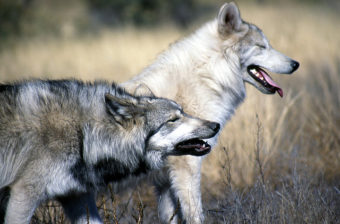
Grey wolves. (Flickr creative commons image by Caninest)

Denali National Park biologists on Thursday released numbers from this year’s spring season wolf survey.

Scientists observed 49 wolves in and around Denali National Park and Preserve in March. That’s down slightly from last fall, when 57 wolves were counted in the region. It’s also the lowest count since the park started monitoring wolves in 1986.
The National Park Service observed nine wolf packs in the area last fall. That increased to eleven this spring. It’s unknown if the two packs are new, or if they split off from existing wolf packs. Scientists were able to collar a wolf from one of those two packs.

Cleveland Volcano eruption continues


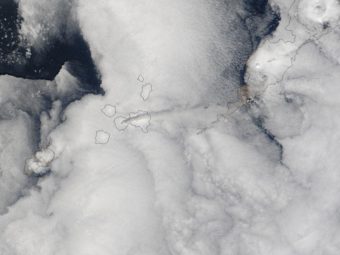
Terra MODIS satellite image of May 4 eruption plume from Cleveland/Credit: NASA

Cleveland Volcano continues to be active, with two additional blasts shaking the volcano on Sunday evening, and Monday morning. Neither explosion produced ash clouds large enough to interfere with air traffic transiting the region.
According to Alaska Volcano Observatory scientist-in-charge John Power, the volcano’s continuous, low-level eruption appears to be waning.

“So far it has not presented anything that would give us an indication of a larger eruption or a greater hazard to come.”

Nevertheless, because of the possibility that sudden explosions could produce ash clouds rising above 20,000 feet, the aviation alert level remains at orange.

Original story: Saturday, May 4, 8:04 pm

Cleveland Volcano is erupting once again. Three small explosions shook the volcano Saturday morning, and a low-level eruption is ongoing.

John Power is a seismologist with the Alaska Volcano Observatory. He writes in an email that the explosions were “similar in size to what we have seen over the past several years,” although he notes that it is unusual to have three in a row.

Power says satellite imagery and a webcam in the nearby village of Nikolski show that the volcano is continuing to emit small amounts of gas, ash and steam, with plumes rising to 15,000 feet. There’s no real-time monitoring network on the volcano.

Cleveland lies on a major international flight path, and in light of the explosions the Observatory has raised the aviation alert level from yellow to orange. They warn that there is the possibility of sudden explosions reaching above 20,000 feet, but so far there have been no reported disturbances to air travel.

Cleveland is one of the most active volcanoes in the Aleutians, erupting roughly two dozen times in 2012. It’s last major eruptive period was in 2001, when the volcano sent ash clouds up to 39,000 feet.

NASA: Warming Climate Likely Means More Floods, Droughts

Flash floods followed heavy rains in northern India in September. AFP/Getty Images

The Earth’s wettest regions are likely to get wetter while the most arid will get drier due to warming of the atmosphere caused by increased levels of carbon dioxide, according to a new NASA analysis of more than a dozen climate models.
Scientists ran simulations of 14 different models, starting with CO2concentrations at about 280 parts per million, which is similar to preindustrial levels but well below the 400 parts per million today. The amount of carbon dioxide was then bumped up by 1 percent per year, an increase that is consistent with a “business as usual” trajectory described by the U.N. Intergovernmental Panel on Climate Change, or IPCC, NASA says.

You can see a video of a composite of the simulations here. Taken as a whole, they show that for every 1 degree Fahrenheit of CO2 warming, heavy rainfall increases by about 4 percent. Total global rainfall remains unchanged because the more frequent occurrence of heavy rainfall in some areas is offset by less frequent moderate rainfall elsewhere, according to the study set for publication in the peer-reviewed Geographical Research Letters.

William Lau, a lead author of the study from NASA’s Goddard Space Flight Center, says his research shows that “the global water cycle undergoes a gigantic competition for moisture resulting in a global pattern of increased heavy rain, decreased moderate rain and prolonged droughts in certain regions.”

The equatorial Pacific Ocean and parts of Asia subject to monsoonal rains, already among the world’s wettest, can expect more heavy rainfall, while the deserts of the U.S. Southwest, Mexico, North Africa, the Middle East, Pakistan and northwest China are most likely to receive even less rainfall.

“In the Southern Hemisphere, drought becomes more likely in South Africa, northwestern Australia, coastal Central America and northeastern Brazil,” NASA’s website says.

According to the models, for every degree Fahrenheit of warming, the periods with no rain at all will increase by 2.6 percent.


Read original article

NASA: Warming Climate Likely Means More Floods, Droughts

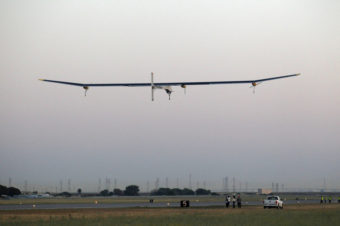
Huge Solar Plane Begins Slow Flight Across The U.S.

Pilot Bertrand Piccard takes off in the Solar Impulse solar electric airplane at Moffett Field in Mountain View, California, on Friday. Beck Diefenbach/Getty Images

The Solar Impulse, a solar-powered airplane with the 208-foot wing-span, has begun a slow journey across the United States.

We’ve told you about the Swiss plane before. A year ago, the plane took 20 hours to fly from Switzerland to Spain and then flew to Morocco completing its first transcontinental flight.

Today, Solar Impulse took off from Moffett Field in Mountain View, Calif. It is expected to land in Phoenix, then head to Dallas, work its way to St. Louis and eventually finish its cross-country trip in Washington, D.C. and New York City.

The ultimate goal of the mission is to have a solar-powered plane fly around the world. The project’s website lists some amazing facts about the HB-SIA: The average flying speed? 43 mph. The take-off speed? 27 mph. Maximum cruising altitude: 27,900 feet. Weight? 3,527 pounds. They also have details on the HB-SIB, a plane being built using the lessons learned from this one. HB-SIB is what they expect will be able to make the around-the-world trip.

What’s more, they hope it will make the trip without using any fuel.

“If we all challenged certitudes by driving change and being pioneers in our everyday lives, we can create innovative solutions for society’s biggest challenges,” Andre Borschberg, Solar Impulse co-founder, CEO and pilot, told CBS.


Read original article

Huge Solar Plane Begins Slow Flight Across The U.S.

Tanner crab stock healthy

Tanner or Bairdi Crab
Tanner or Bairdi Crab. (Photo by U.S. Fish and Wildlife Service)

The National Oceanic and Atmospheric Administration downgraded the southern tanner crab – or bairdi – in its annual report to Congress.

In 2011, the crab was listed as over fished. Now, the federal government reports the stock as safe.

Emily Menashes, a deputy director in the Office of Sustainable Fisheries, said over fishing means the harvest rate is too high for a population. The distinction over fished is when a population is too low. In the case of the tanner, it’s now considered rebuilt.

“Which means that a previously over fished stock has returned to its target population level,” she told a conference call Thursday.

That’s good news, said Gretchen Harrington, who works for NOAA in Anchorage.

Harrington said the change comes from a couple of factors, including highly fluctuating populations and how the federal government measures the volume of the stock. The tanner crab population was considered rebuilt in 2007 as well.

It’s unclear whether the state will open a tanner crab season this year.

“While we might not call it over fished, the state might decide to not open the fishery for a number of other reasons,” she said.

Those include the total amount of female tanner crab. There was no tanner crab season last year. The season runs during the fall and winter.

Video: NASA Details Space Telescope’s Cosmic Near Miss

A new video reveals just how close NASA came last year to losing its $500 million Fermi Gamma-ray Space Telescope in a narrowly averted collision with a defunct, Cold War-era Soviet spy satellite.

On March 29, 2012, Julie McEnery, the project scientist for Fermi, received an automatically generated email warning that the two satellites were due in just a few days to pass within 700 feet of one another as their respective orbits crossed.

“My immediate reaction was, ‘Whoa, this is different from anything we’ve seen before,’ ” McEnery recalls.

The danger to Fermi came from Cosmos 1805, a spy satellite launched in December 1986 that was no longer functional, but still speeding around the Earth at 15,000 mph.

According to NASA:

“Although the forecast indicated a close call, satellite operators have learned the hard way that they can’t be too careful. The uncertainties in predicting spacecraft positions a week into the future can be much larger than the distances forecast for their closest approach.

“This was most dramatically demonstrated on Feb. 10, 2009, when a study revealed that Cosmos 2251, a dead Russian communications satellite, would pass about 1,900 feet from the functioning Iridium 33 communications satellite later in the day. At the predicted time of closest approach, all contact with Iridium 33 was lost. Radar revealed clouds of debris traveling along the orbits of both spacecraft, confirming the first known satellite-to-satellite collision.

“That crash generated thousands of fragments large enough to be tracked and many smaller pieces that evade detection. Much of the wreckage remains a hazard to operating spacecraft because only about 20 percent of the trackable pieces have reentered the atmosphere.”

Fermi Attitude Control Lead Engineer Eric Stoneking says Cosmos 1805 is just one example of all kinds of space junk that pose a danger to space probes such as Fermi.

They include intact orbiting satellites that, like Cosmos, are no longer operating, and even “old parts and … debris down to flecks of paint,” he says.

“If you see a piece of debris far enough in advance, you can decide to alter your orbit to make sure that your orbit and its orbit don’t intersect and that there isn’t a collision,” Stoneking says.

So that’s what he and the rest of the Fermi team set out to do. But the only way to do it was to fire Fermi’s attitude thrusters, which were designed for an eventual de-orbit burn, to allow the huge satellite to safely burn up over the ocean after its scientific usefulness was over.

But any failure of the untested thruster system would have been as equally catastrophic as an impact with the Soviet satellite.

“You can’t help but be nervous thinking about highly flammable fluids heading down pipes they’d never flowed down before,” McEnery says. “But having done this, we now know the system works as designed, and it gives us confidence should we need to maneuver again in the future.”

Scientists ordered Fermi to park its solar panels and pack up its high-gain antenna to protect them during the critical, one-second firing of the thrusters.

“There was a lot of suspense and tension leading up to it, but once it was over, we just sighed with relief that it all went well,” McEnery says.

“A huge weight was lifted,” she says. “I felt like I’d lost 20 pounds.”


Read original article

NASA Details Space Telescope’s Cosmic Near Miss

Site notifications
Update notification options
Subscribe to notifications