Sports

High school swimmer from Juneau qualifies for Olympic trials

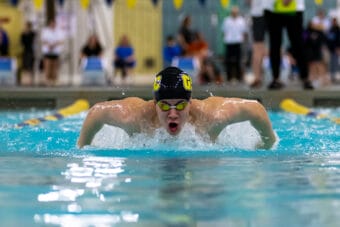
PJ Foy competes at the Alaska Swimming State Championships in April, 2023. (Photo/Kevin Tuning)

For the first time in history, a Juneau high school swimmer has qualified to compete in the Olympic trials.

Thunder Mountain High School senior PJ Foy achieved the milestone after hitting a personal best in the 100-meter butterfly last month in Washington state. But according to Foy, at first he didn’t know he’d done it. 

“I’m not gonna lie — it took me a while to figure that out. Because I read the time wrong, so it took me a while. But I was just really happy,” he said. “All I wanted to do was get out of the pool and hug my parents and my coach, because, without them, I wouldn’t have been able to do this.”

In June, he’ll compete in Indianapolis alongside some of the best swimmers in the country.

Foy — who is just 18 years old — holds multiple swim records in the state. After graduating high school in Juneau this May, he will head to the University of North Carolina at Chapel Hill to compete on its swim team. 

Before Foy, the last Alaskan to make it to the trials was Seward’s Lydia Jacoby. In 2021, she became the first Alaska-born swimmer to win a medal in the Olympics

Foy said he worked hard to make it to the trials and feels extremely proud.

“It means a lot. I’ve been doing my best to represent the swim community since I started high school,” he said. “It’s been an honor to be able to represent everybody in this way.”

The Olympic trials will take place from June 15 to 23.

Juneau Native Youth Olympics athletes tour Lower 48 to promote Arctic sports

Leif Richards is in the 11th grade and an NYO team captain at Thunder Mountain High School. He is doing the One-Foot High Kick on the Santa Clara Pueblo Indian Reservation. (Courtesy of Kyle Worl)

Now that the North American Indigenous Games Council has approved Arctic sports on a trial basis for its 2027 games in Calgary, fans of Native Youth Olympics believe there’s good chance the games might get a foothold in the Lower 48.

Kyle Worl, the head coach for Juneau’s NYO program, took a team of six athletes on a tour of schools in New Mexico and Kansas to promote Arctic sports. He says the were well received.

Six members of the Juneau Native Youth Olympic program formed the letters, NYO, while visiting the Santa Clara Pueblo Reservation in New Mexico. (Courtesy of Kyle Worl)

“Every school and community we’ve gone to, they’ve been very engaged,” Worl said, “and it’s just been fun.”

The team was in Lawrence, Kansas on Friday at the Haskell Indian Nations University. They demonstrated seven games, including the One-Foot and Two-Foot High Kick, the Alaskan High Kick, Scissor Broad Jump, Seal Hop, and the Inuit and Dene Stick Pulls.

Worl says the students were very interested in the stories behind the games and their connection to Arctic survival.

“I think this sport really resonates with Indigenous people, because it’s an Indigenous sport and it’s about community.” Worl said. “And I think all tribes know that community is really important.”

The Juneau NYO team members demonstrated seven games on their tour. At the Haskell Indian Nation University in Lawrence, Kansas, they added the Wrist Carry, beause one of the school’s Alaskan students was a state champion in that event. (Photo courtesy of Kyle Worl)

Worl says he’s hopeful the sport can take root at Haskell, which has two Alaskan students who can help with the coaching. The team also left behind a kit with equipment that includes a kick stand, a hand-sewn sealskin ball and three types of sticks. Worl says the Calgary games will take place four years from now, which gives new teams plenty of time to train for NYO games.

He says it’s important for teams outside Alaska to compete in the North American Indigenous Games, so Arctic sports can become an official sport.

The Juneau athletes also traveled to the nearby Kickapoo Nation School to plant some seeds among kids who are not yet in college. Worl says the Juneau NYO team gave them a chance to try out the games for themselves, which they seemed to enjoy.

“To be able to be in a space where your Indigenous identity is represented and honored,” he said, “you feel a sense of belonging —and that you don’t have to shy away from who you are.”

Athletes from the Juneau Native Youth Olympics program visit the Kickapoo Nation School. Team members, left to right: Leif Richards, Nate Blake, Alex Beierly, Jordan Bennett, Mila Neely, and Sam Sheakley, Jr. (Courtesy of Kyle Worl)

The Juneau NYO team also traveled to New Mexico to visit the Santa Clara Pueblo Tribal school, the Santa Fe Indian School, and the Institute of American Indian Art. They returned to Juneau on Saturday, where they will jump right into preparations for next month’s Traditional Games.

This is Southeast Alaska’s seventh annual competition, relatively new to the region compared to other parts of the state. But Worl says their popularity has spread quickly, starting first in Juneau and eventually including ten other Southeast communities. Worl says the students from the Haskell Indian Nations University are planning to attend.

The tour was sponsored by Sealaska Heritage Institute and the Central Council of Tlingit and Haida Indians Tribes of Alaska.

In its 75th year, Juneau’s Gold Medal Basketball Tournament transcends the court

Kake and Metlakatla teams face off at a game during the Gold Medal Basketball Tournament on Tuesday, March 19, 2024. (Clarise Larson/KTOO)

Marcelo Quinto was just six years old in 1947, when the first-ever Juneau Lions Club Gold Medal Basketball Tournament took place in Juneau. He’s in his 80s now. On Tuesday, he was one of hundreds in the stands to watch this year’s tournament, which kicked off last weekend. 

Throughout this week, more than 500 people from across Southeast Alaska will attend to watch nearly 50 games. Quinto said he doesn’t remember much about that first tournament — beyond one very clear thing:

“It was jammed. Because there was no TV back then,” he said. 

The location of the tournament has changed since then. Instead of the cramped Capital School, it’s now at the Juneau-Douglas High School: Yadaa.at Kalé gymnasium. He said other things have changed too.

“These kids are faster I think. You know they’re faster and a lot of the rules have changed,” he said.

This year’s tournament is special. It marks 75 years of competitions, disrupted only by the COVID-19 pandemic, which hit the pause button for a few years. For Quinto, the tournament — which is older than the state of Alaska — represents decades of memories. 

“The greatest thing about this tournament really is being able to see all your friends from all of Southeast — from Ketchikan and all the way up,” he said.

The first game kicked off Sunday morning, and games will continue daily throughout the week. Twenty-five regional adult teams will play a total of 48 games, competing for titles in four brackets.

Tim Wilson, a Lion’s Club co-chair for this year’s tournament, said for many, this tournament represents something much greater than the game of basketball. In 1947, it started as a way to raise money for Boy Scouts. But now, Wilson said it transcends the court. 

“For it to be in the 75th year is really special to us — I don’t think when they started 75 years ago, I don’t know if they envisioned it lasting 75 years,” he said. “I always say that the Gold Medal is one big, huge family. I honestly believe that.”

Orion Dybdahl is a player on the Hoonah B-Bracket team this year. He recently graduated from JDHS, where last year he was selected by coaches around the state as a senior all-star. Now, he’s playing basketball at Centralia College in Washington, but he says he couldn’t resist coming home for spring break and playing on his home court again. 

“Probably since birth, I’ve been here at these games, watching my dad play, and just watching all these teams battle,” he said. “It’s kind of a dream come true — been waiting to play for Hoonah for a long time.”

Dybdahl said Gold Medal’s roots run deep — not just for his family, but for Southeast Alaska. His family is from Hoonah. Many teams have players who don’t actually live in the communities they represent. But they still have close connections to them. 

For many, Gold Medal is the one time of year they can connect with loved ones. 

“It means everything just to see family members and friends from other communities,” Dybdahl said. “It just I don’t know, this tournament is more than basketball. It’s kind of like a reunion.”

The tournament’s schedule can be found on the Juneau Lion’s Club’s website. 

For the first time, 4 women mushers have finished in the Iditarod’s top 10

Musher Mille Porsild shortly after arriving in Nikolai, a checkpoint in the Iditarod Trail Sled Dog Race on Tuesday, March 5, 2024. (Casey Grove/Alaska Public Media)

NOME – Four women dog mushers have finished in the top 10 of the Iditarod Trail Sled Dog Race, the most ever in the thousand-mile race’s history.

Paige Drobny’s team arrived here in 5th place early Wednesday morning, followed by Mille Porsild in 7th, Amanda Otto in 8th and Jessie Royer in 10th.

It’s Drobny’s highest Iditarod finish in nine races. She commended the other three women in the top 10, but she said the fact that they’re women isn’t as important as it is that they’re great people and great dog mushers.

Musher Paige Drobny puts food in a bucket while preparing a meal for her dogs in White Mountain, a checkpoint for the Iditarod Trail Sled Dog Race, on Tuesday, March 12, 2024. Drobny finished the race in 5th place early Wednesday in Nome. (Casey Grove/Alaska Public Media)

While finishing up some chores in the dog lot Wednesday, she said that even if she hadn’t signed up to be anyone’s role model, she could see how her success in the Iditarod might be an inspiration for women or girls.

“I think it’s great to have people that can inspire other people to do things, like anything that gets people up and outside and excited about something,” Drobny said. “And so I appreciate that I can be that for some people, and that’s really cool.”

In 2019, Drobny had joined Aliy Zirkle and Jessie Royer in the top 10 by finishing 7th, her highest until now and the first time in race history there had been three women in the top 10. This year, it was Amanda Otto who broke into the top 10 as the fourth woman.

Musher Amanda Otto prepares to leave the Galena checkpoint in the Iditarod Trail Sled Dog Race on Saturday, March 9, 2024. (Casey Grove/Alaska Public Media)

Royer has finished as high as 3rd – doing so in back-to-back years, 2019 and 2020 – and she had hoped to do better than she did in this year’s race.

Like Drobny, Royer said the gender of the mushers doesn’t matter much to her. She hopes the message she sends is that anybody can accomplish difficult things if they try hard enough.

“Nothing is out of reach. If you want it, go for it. You have to work hard for it, but go for it,” Royer said. “That’s the thing. Too much of our society is like, ‘You can’t do that, you’re a girl. You shouldn’t do that.’ Or, you know, ‘You’re not good enough.’ Don’t listen to anybody. If you believe it, you can do it. Just work hard, believe in yourself and go do it.”

Musher Jessie Royer in Nome after finishing the Iditarod Trail Sled Dog Race in 10th place Wednesday, March 13, 2024. (Casey Grove/Alaska Public Media)

A teenage girl who many Iditarod mushers, officials and fans think will be following in the top 10 women’s footsteps is Emily Robinson, the three-time Junior Iditarod champion, who was in the finish chute Wednesday to see her father, Wally, finish the race.

After he arrived, they hugged for about 30 seconds, swaying back and forth, with tears in their eyes. Onlookers, including hardened mushers like Royer and Jessie Holmes, who finished in 3rd, also cried.

As for the four-woman top 10, Robinson said she was happy for Drobny, Porsild, Otto and Royer.

“I think it’s awesome that women are consistently getting into the top spots and just proving themselves, and we’ve proven ourselves for a long time, but to just continue to do that, I think, is incredible,” Robinson said.

Junior Iditarod champion Emily Robinson holds a sign for her father, Wally, as he mushed to Nome and an 11th place finish in the Iditarod Trail Sled Dog Race on Wednesday, March 13, 2024. (Casey Grove/Alaska Public Media)

Seeing women succeed in the Iditarod had inspired her to try hard at dog mushing, Robinson said.

“When I was watching dog mushing when I was younger, it was Aliy Zirkle who was out here crushing it,” she said. “To just be here on the streets of Nome, and to watch these mushers come in, and watch their dogs, I think it’s amazing, and it’s an amazing experience.”

Robinson said she plans to run the full Iditarod at some point. She’ll be eligible to enter as soon as next year, once she turns 18, but she said, realistically, it might be another year later, because she has to complete some other races to qualify.

Meantime, as Iditarod sled dog teams continue to arrive in Nome, there could be as many as seven women finishing in the top 20, if the positions of Josi Thyr in 15th, Jessica Klejka in 18th and rookie Gabe Dunham in 20th hold to the finish.

Dallas Seavey wins record-breaking sixth Iditarod

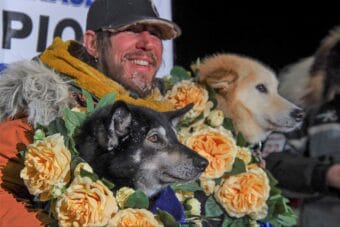
Dallas Seavey celebrates his win of the Iditarod Trail Sled Dog Race in Nome on Tuesday, March 12, 2024. (Anne Raup / ADN)

NOME — The Last Great Race has its first six-time champion: Dallas Seavey has broken the all-time record for Iditarod Trail Sled Dog Race wins, mushing to this Bering Sea city and into the history books Tuesday.

Seavey and his 10-dog team, led by Golden Harness winners Sebastian and Aero, arrived under the famed Burled Arch finish line at 5:16 p.m. to a cheering crowd of onlookers enjoying the evening sunshine. By getting here first again, 37-year-old Seavey has broken a tie with five-time champ Rick Swenson.

Seavey pumped his arms in the air running beside his sled while coming into the finish chute, high-fiving fans along the edge, then picked up Sebastian and carried him around so those gathered could see the 5-year-old dog, whose paw he waved to them.

a dog waves
Dallas Seavey lifts up one of his team members, Timon, so they could wave to the crowd in the finish chute of the Iditarod Trail Sled Dog Race in Nome on Tuesday, March 12, 2024. (Anne Raup / ADN)

Asked at the finish line how he pulled off the sixth win, Seavey said, “one step at a time I suppose.”

“The most important question: What does my team need right now?” he said. “We answered that question every day, and at some point the analytical side said, ‘Holy cow, we got a shot.’”

Seavey’s team completed the 1,000-mile trail in nine days, two hours and 16 minutes. That time includes a two-hour penalty race officials added to Seavey’s mandatory 24-hour layover for failing to adequately gut a moose he shot after it attacked his team earlier in the race.

At the finish line, Seavey said his team faced challenges over the race’s thousand miles, but when they stumbled, they picked themselves back up and took another step forward.

“This one was supposed to be hard. It had to be special,” he said. “It had to be more than just a normal Iditarod. And for me it was.”

This is Seavey’s 14th attempt at the Iditarod, a race from which he has never scratched and often dominated. He hasn’t finished outside the top 10 since his second effort in 2007. He’s the youngest musher to ever win the Iditarod, notching his first victory in 2012 at just 25 years old. He then won the race in 2014, 2015, 2016 and 2021.

a musher speaks into a microphone
Dallas Seavey is interviewed after his sixth Iditarod Trail Sled Dog Race win on Tuesday, March 12, 2024 in Nome. (Anne Raup / ADN)

Over his nearly two decades racing the Iditarod, Seavey, who lives in Talkeetna, has gained a reputation as a serious and deliberate musher who wastes no time at checkpoints, always diligently and quickly moving through his dog chores.

He did just that when he arrived late Monday in White Mountain with a more than three-hour lead over his closest competitor, Matt Hall. As Seavey prepared to leave the checkpoint Tuesday morning, on the final push to Nome, he said he was trying to live in the moment, but a sixth win is something he’s dreamed about.

“It’s what you dream of all year long, what you daydream of all year long as you prepare this team and train them,” he said. “So on one hand, yeah, it’s easy to drift into the future and say, ‘Is this really real?’ you know. ‘Are we actually going to get number six?’ And then you kind of have to pull yourself back.”

Seavey has touted his dogs’ pedigree — many are Iditarod finishers related to those on his past Iditarod championship teams — but he also comes from a family of deep mushing roots. His grandfather, Dan, placed third in the first Iditarod in 1973. His father, Mitch, has won three Iditarod championships and holds the record as the fastest musher to complete the race, in 2017, though the Iditarod was on an alternate route that year that officially started in Fairbanks.

a crowd
Dallas Seavey celebrates his win of the Iditarod Trail Sled Dog Race in Nome on Tuesday, March 12, 2024. (Anne Raup / ADN)

Seavey took command of this year’s race, bouncing back from the penalty, in Unalakleet, when he blew through the checkpoint Sunday while that day’s frontrunner, Jessie Holmes, rested. Seavey never trailed again in the race after that point.

In a press conference after the celebrations in the finish chute – including an oversized check written out for $55,600 – Seavey spoke to a crowded room at the Nome Mini-Convention Center.

“I’ve been doing this my whole life,” he said. “The heart and soul of this sport is sled dogs. It’s spending your life with sled dogs. It’s understanding sled dogs to such an infinite level, that you can go do something really amazing with them and accomplish big tasks with them and goals with them.”

two dogs
Two of Dallas Seavey’s team soak in some sun as Seavey celebrates his win of the Iditarod Trail Sled Dog Race in Nome on Tuesday, March 12, 2024. (Anne Raup / ADN)

This year was a bit slower compared to past Iditarods. A hefty dose of snow south of the Alaska Range put the damper on teams’ speeds early on. Later, it was cold, down to 45 below zero, requiring more attention to dog care and shelter at times.

Three Iditarod dogs have also died in the race, the first since 2019, when a dog died two days after crossing the finish line.

The Iditarod said pathologists would be conducting further tests to determine what caused the dogs’ deaths.

Iditarod CEO Rob Urbach addressed the dog deaths Tuesday in Nome.

“We really have no idea yet, the circumstances of what happened,” Urbach said. “It won’t be in vain. And if there’s an opportunity for us to learn from that, we will.”

It had not just been a tough race, but a tough mushing season, Seavey said. Two of his dogs, running in a team with another musher on the Denali Highway, died when a snowmachine hit them. The moose in this year’s race critically injured another dog, who was expected to survive after two surgeries.

“How many of us have had a pet dog that you cared about so much that when they died, you’re like, ‘I don’t know if I’m ready to have another pet?’ I think that’s a common feeling, and that’s not a wrong feeling,” Seavey told the crowd at the press conference. “I’m not gonna let that bad experience I had there, the pain that that caused, prevent me from sharing the joy of traveling down the trail with the rest of the sled dogs, their next generation, the ones after that, and after that, and after that.”

“We have to choose to live,” he said. “Otherwise, what? You curl up and hide in the corner and have no life and hope there’s no risk. Life comes with risk if you want to live it. That’s my thinking at least.”

‘It was ugly’: Iditarod musher kills and guts moose after encounter on trail

Dallas Seavey runs with Whopper toward the Iditarod ceremonial starting line on Saturday. (Adam Nicely/Alaska Public Media)

Top 2024 Iditarod Trail Sled Dog Race contender Dallas Seavey shot and killed a moose to defend himself and his dog team early Monday about 100 miles into the 1,000-mile race, officials said.

Seavey’s team was about 14 miles past the Skwentna checkpoint when the moose “became entangled with the dogs and the musher on the trail,” according to a statement from the Iditarod. Seavey shot the moose in self-defense and notified race officials at about 1:45 a.m. Monday, the statement says.

When he arrived at the Finger Lake checkpoint at about 8 a.m. Seavey was forced to drop a dog that had been injured in the encounter with the moose, the statement says. Seavey’s kennel identified the dog as Faloo. Race officials said the dog was flown to Anchorage and was in the care of veterinarians.

Race rules allow Iditarod mushers to carry firearms for protection from large animals like moose, but they must stop to gut any big game animal they shoot so it can be salvaged. The rules also say that any mushers who come upon a fellow competitor in the process of gutting a game animal must stop and help, and they’re not allowed to pass until the musher who killed the animal has continued on the trail.

Seavey spoke about the early morning incident to the Iditarod Insider crew in Finger Lake.

“I gutted it the best I could, but it was ugly,” he said.

Race Marshal Warren Palfrey said in the statement that efforts had been underway to salvage the moose meat.

Another Iditarod veteran, Jessie Holmes, had mushed through the same section of trail ahead of Seavey and told the Insider he had also seen an angry moose, possibly the same animal.

“I had to punch a moose in the nose out there,” he said. “Oh my gosh.”

Fellow race veteran Paige Drobny saw the moose up close after it was shot, and so did mushers behind her on the trail.

“It’s dead in the middle of the trail,” Drobny told the Insider. “Like my team went up and over it.”

Gabe Dunham’s dog team hit it, too.

“There happened to be a dead moose in the trail, that kind of flipped the sled,” she told the Insider. “I did laugh and think, ‘Man, even when they’re dead they’re still getting me.’”

Bailey Vitello described it as “the experience of a lifetime.”

“I can’t say I’ve ever ran a 16-dog team over a moose, so that was kind of interesting,” he told the Insider. “It was an experience, you know, that’s what Iditarod is all about, is having experiences. And that was a cool one to say I did. So check that one off the bucket list — don’t know if I want to do it again, but it was cool.”

He said the moose carcass was around a corner, and he had to go over it because if he tried to stop, he worried his team would try to eat it..

Palfrey, the race marshal, said in the statement that he would continue to gather information about the incident.

By late Monday afternoon, Seavey and his 15-dog team had continued down the trail, and were just beyond the Rainy Pass checkpoint at race mile 153.

Site notifications
Update notification options
Subscribe to notifications