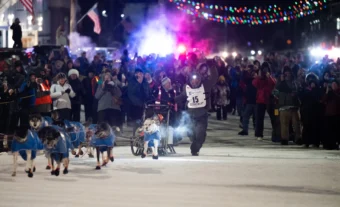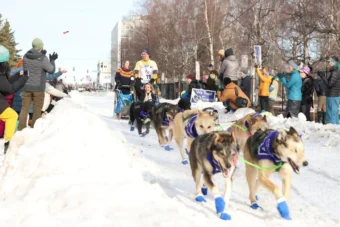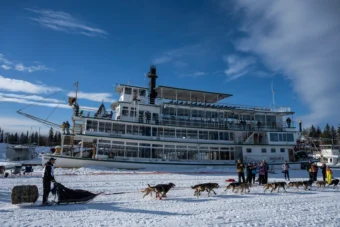
Nicolas Petit mushing into Unalakleet in the lead of the 2019 Iditarod Trail Sled Dog Race. (Photo by Zachariah Hughes/Alaska Public Media photo)
The Iditarod Trail Sled Dog Race will now start in Fairbanks, not Willow, due to a lack of snow, race officials announced Monday.
The last-minute change follows alarms raised by some mushers over the weekend who said stretches of the trail were not safe for their teams.
Race officials still plan to hold the parade-like ceremonial start in Anchorage on Saturday, March 1. Two days later, on Monday, March 3, the 33 teams will officially start their race out of Fairbanks and head to the Nome finish line.
‘Really, really worried’
The portion of trail that race officials have now deemed impassable is in the so-called Farewell Burn area, outside of the checkpoint in Nikolai, about a quarter of the way into the thousand-mile race.
Andy Angstman, the musher representative on the Iditarod’s Board of Directors, said dozens of people called him with concerns about that stretch.
“I got lots of calls, texts and emails from folks who had seen those videos and pictures from the Iron Dog, and they were very concerned about the welfare of themselves and breaking sleds and taking care of their dogs,” he said. “I’ve talked to dozens of people over the weekend who were really, really worried.”
Iron Dog snowmachine racers just traveled that part of the trail. It’s known for low snow. But an aerial photo circulating on social media on Saturday shows particularly snow-free and rough terrain. One Iron Dog racer described the stretch as “frozen tundra and straight hell.” Another wrote, “I don’t know how the Iditarod could run through 75 mi of dirt.”
In the Iditarod statement Monday, race marshal Warren Palfrey said with no snow in the forecast, “there is simply no way” officials could allow teams to travel that part of the trail.
“It is a shame because the remainder of the trail is in great shape all the way to Nome,” he said.
Several mushers competing in the upcoming race who raised fears online over the weekend declined to comment for this story, citing concerns about a rule that prohibits mushers from conduct that is “recklessly injurious” to the race, its competitors or its sponsors.
Hans Gatt, who is not competing this year, finished the Iditarod in 2014 in 9th place, a year when nearly 20 mushers scratched from the race, many due to damaged sleds and physical injuries like broken ankles. He said the photo of this year’s trail looked worse.
“There’s so many obstacles and so many holes in the trail, and that’s a problem for the dogs, you know, they step into that stuff,” he said. “It’s not good to have a lot of injured dogs out there, and that’s the last thing this sport needs.”
4th time race moves north
At the end of January, race officials had confirmed their intention to hold the competition out of Willow on the traditional southern route.
But no snow has fallen since then, organizers said, forcing them to move the start north.
This will be the fourth time in Iditarod history that mushers are leaving from Fairbanks. Teams last raced out of the Interior city in 2017 due to poor trail conditions through the Alaska Range.
This year’s route is slightly different.
According to race officials, teams will travel from Fairbanks to Nenana, Manley, Tanana, Ruby, Galena, Nulato, Kaltag, Eagle Island, Grayling, Anvik and Shageluk before looping back upriver and passing again through Grayling, Eagle Island and Kaltag. Then mushers will head to Unalakleet and follow the traditional trail up the Bering Sea coast to the finish line in Nome.
“While this change will be a logistical feat for many, it is a necessary adjustment to ensure that the race can proceed safely and fairly,” said the Iditarod’s statement.
The finish line of the 45th annual Kuskokwim 300. (MaryCait Dolan/KYUK)
The 2025 Kuskokwim 300 has been pushed back two weeks because of poor snowfall and looming above-freezing temperatures, according to a release from the K300 Race Committee.
The 300-mile race from Bethel upriver to Aniak and back will now start on Friday, Feb. 7.
Race officials say that limited snowfall and unseasonably warmtemperatures in the Yukon-Kuskokwim Delta throughout the winter have made it near-impossible to check or mark trails.
And that pattern is set to continue. In the lead-up to the region’s premier sled dog race, the race committee wrote that the “current forecast for Bethel and checkpoint communities of Tuluksak, Kalskag, and Aniak calls for 5 days of temperatures in the 30s and 40s leading into the middle of next week, which made it impossible to determine whether there would be a trail that is safe for human and canine athletes come race time.”
It’s not yet clear whether the February running of the K300 will have a modified trail route, but race officials say no route modifications were planned as of Jan. 16.
As of late Wednesday evening, no registered teams had dropped out of the race despite the reschedule.
A two-week delay for the K300 is not common. In its 46-year history, the race committee says it’s been delayed “several” times due to extreme weather, usually for a day or two. And in 2021, the Kuskokwim 300 was delayed as part of COVID-19 mitigation plan.
This is a developing news story and may be updated with additional information.
Women’s national podium at the 10k individual start 10k freestyle, U.S. National Championships, Kincaid Park, Anchorage, Alaska. (Scott Broadwell)
Two Alaskans earned national titles at the U.S. Cross Country Ski Championships in Anchorage over the weekend. It’s the first time the city has hosted the national championships since 2018.
University of Alaska Fairbanks senior Kendall Kramer won the women’s 20K classic race in 58:17.2 at Kincaid Park, narrowly beating Erica Laven of Sweden, who skis for the University of Utah, by 2.4 seconds. Kramer is on the U.S. ski team’s development squad, also called the D team.
After winning that race, she told Alaska-grown Olympic gold medalist and executive director of the Nordic Skiing Association of Anchorage, Kikkan Randall, that the win was a surprise.
“I definitely was not predicting this, and I was kind of counting myself out today,” Kramer said. “Once I realized going into the last lap that I could have my first national championship and not settle for second, even though that would have been good, then I just tried for it. So that’s awesome.”
Anchorage’s Luke Jager also earned a medal Sunday after finishing third overall in the men’s 20K race in 50:59.2. He was outpaced by Andreas Kirkeng of Norway, who skis for the University of Denver, and John Steel Hagenbuch of Idaho, who races for Dartmouth.
The 2025 U.S. Cross Country Ski Championships Men’s 10km Interval Start Free Technique podium for top U.S. racers: John Steel Hagenbuch (Dartmouth Ski Team, U.S. Ski & Snowboard Team) won the National title in a time of 21:23.4, followed by Walker Hall (Utah Ski Team) at 21:38, and Alaska’s Luke Jager (APU Nordic Ski Team, U.S. Ski & Snowboard Team) at 21:39.4. The races took place Thursday at Kincaid Park. (Scott Broadwell)
Competitors from other countries are ineligible for U.S. medals, bumping Steel Hagenbuch to gold and Jager to silver.
Jager’s teammate, Michael Earnhart of Anchorage finished 6th in 51:11.5 in the 20K race. Both Jager and Earnhart are on the U.S. cross country B team.
Jager started the championship strong on Thursday, placing fourth in the 10K individual race in 21:39.4. It was the fastest time by an Alaskan for the race by 24.4 seconds. In the classic sprint on Saturday, Jager finished as the first American in 2:56.23.
The national championship finished Tuesday with a freestyle sprint race.
2024 Olympic Gold Medalist Kristen Faulkner waves to fans as they cheer for her arrival home on Friday, Dec. 20, 2024. (Matt Faubion/Alaska Public Media)
Homer’s Kristen Faulkner returned to Alaska Friday for the first time since winning two gold medals at the Paris Olympics last summer. She arrived at Ted Stevens Anchorage International Airport, greeted by a small contingent of fans and family chanting “U-S-A! U-S-A!” as she descended the airport steps.
Faulkner won an individual gold medal in the women’s cycling road race, beating some of the world’s best endurance cyclists. She won her second gold medal with Team USA in the team pursuit event.
Faulkner currently lives in San Francisco but grew up in Homer. She said she plans to see old friends and eat fresh fish while home for the holidays.
Kristen Faulkner receives a kiss from her father welcoming her back after her recent travels at Ted Stevens International Airport on Friday, Dec. 20, 2024. (Matt Faubion/Alaska Public Media)
“I got chills just looking out the window on the airplane,” Faulkner said. “I miss Alaska salmon. We always cook salmon and going skiing and we’re going to go snowmachining in a few days and we always read The Grinch and The Night Before Christmas as books before Christmas Eve.”
Faulkner attended high school in Massachusetts where she competed in three sports. She then rowed competitively at Harvard University before taking up road cycling in 2016. She moved to San Francisco in 2018 and began cycling competitively in 2020. Faulkner said she appreciated the support of her hometown and home state during the Olympic Games.
“It’s so special. I think being from Alaska you feel like the whole state is your community,” Faulkner said. “I’m from a small town, Alaska is a small state, community-wise, and just to feel like I was in Paris with the full backing of my home basically is, yeah, I feel like I’m racing for something bigger than myself.”
Homer Mayor Rachel Lord is excited to welcome Faulkner home. She recalled the beginning of the school year when West Homer Elementary School Principal Eric Waltenbaugh showed Faulkner’s gold medal performance to students, then pointed to her name on a plaque on the wall from when she was a student there.
“The pride and the enthusiasm that those kids felt and feel, and that our staff feel, and our community feels, it’s just really awesome and inspirational,” Lord said.
Former Homer Mayor Ken Castner has known Faulkner since she was a child. Faulkner performed nearly every part in Homer’s annual holiday production of The Nutcracker Ballet, which Castner organizes.
“The sense of community is strong whenever you have excellence showing itself, and there’s that local pride of being part of a community that nurtures that sort of result,” Castner said.
Faulkner will head back to Europe in January to compete with her professional cycling team EF-Oatly-Cannondale.
“One of my big goals for the season is to win a stage of the Tour de France and hopefully defend my title as U.S. National Champion,” Faulkner said. “It’s been a whirlwind you know, a lot of cameras and interviews but all really really great. I’ve been doing a lot of speaking events and hopefully inspiring more youth to go do their dreams.”
A welcome ceremony in Homer is planned for Dec. 27 in the Mariner Theater at Homer High School at 3 p.m.
Paris Olympics two-time cycling gold medalist Kristen Faulkner of Homer celebrates at the Eiffel Tower. (Zac Williams/Courtesy of EF Pro Cycling)
Homer’s Kristen Faulkner came out of relative obscurity to win not one, but two gold medals in cycling at the 2024 Paris Summer Olympics.
KBBI’s Jamie Diep spoke with Faulkner on Friday about how growing up in Homer shaped her fast-paced journey to the podium.
Editor’s note: The following transcript has been edited for brevity and clarity.
Jamie Diep: You went from gradually making a name for yourself in professional cycling to winning the first American Road Race and Team Pursuit in decades. How has that been for you throughout your time at the Olympics?
Kristen Faulkner: Yeah. You know, each race has been really special in their own way. You know, the first road race I think for the U.S. in 40 years. To be honest, I actually didn’t know that fact until after the race, and I wasn’t really thinking about what’s been done in the past or what hasn’t been done. I was just thinking about, you know, ‘how do I win this race?’ And afterwards, people came up to me and told me, you know, the history of it, and it made it quite special and quite unique.
And the same with the team pursuit, actually. It was the first time the U.S. has ever won gold in Team Pursuit. And so that was really special. I think we, we knew we had a really strong team going in. But we also knew that we had to pull a lot of things together on race day, and we had to really have a perfect race in order to win. So they were each very different races, very different journeys to get there, very different preparation. And the road race was more of an individual event. The team pursuit was more of a team event. And so they felt very different, even though they were both bike races. And so each win is very special in its own way.
Jamie Diep: Let’s talk about the road race. You know, that was an incredible finish. What was going through your mind as you pulled ahead of the pack in those last few miles of the race?
Kristen Faulkner: Well, I knew I needed to attack the group before the finish and go away solo to the finish line. And the reason is that I was not the fastest sprinter in the group. I was probably the weakest sprinter, and so I didn’t want to go to the line, because there were four of us and only three medals. And so I said, ‘If I go to the line with these girls, I’m probably not going to end up with a medal.’ And so I knew that the best moment to attack would be as soon as we caught those front two riders, because that’s when everyone was going to be the most tired. And so I said, ‘Okay, as soon as we catch them, I have to go.’ And it’s kind of a now-or-never moment, you know, I need to attack, and I need to go all in, and I can’t look back. And if it works and I’m going to win, and if it doesn’t work, I‘m gonna get fourth. But those are the cards I had to play. And in road racing, you really have to think on your feet. You have to go all in with your decision, and you can’t second-guess yourself, or won’t work. And so, yeah, I think in those last kilometers, I was like, ‘what is happening?’ But also at the same time, you know, just really focused on on the here and now and doing what I had to do to get across the line. There was no celebrating before the line. I wasn’t convinced I’d won until I was 500 meters from the finish line, and then I kind of knew, but yeah, it was a very calculated move, and I knew that I had to go all in, and I had to do it if I wanted the chance to win.
Jamie Diep: What about the team pursuit? You were a later pick for the event. What was it like winning that race as a team versus the road race, which is an individual event?
Kristen Faulkner: So actually the team pursuit, I’d been selected in June. So I was selected the same as all the other riders. There were five riders selected, four of which ended up racing, and so I knew quite early that I would be on that team. I think it was different, though, because I was the newest rider to the team. So the other three had ridden together at former World Championships. They’d rode together in Tokyo at the Olympics, and so I was the only one on the team who hadn’t ridden an Olympics with the team before. And I was also the only one who never won a medal in the event. And this was my very first year competing with the team. And so in many ways, I was the least experienced, and potentially the weakest one in the group in that way.
And physically, I was strong, but I was the least experienced, and so I guess I was the most unknown in the group. And so I think that race was really special to me, because I think I went into it feeling like, if we don’t get a medal, it might be on me, because, you know, they’re all experienced, and I’m showing up as the least experienced one. And so I felt that I had to really level up my game and really prove myself that I belong there.
So the last year has been such a deep learning trajectory. You know, I’m surrounded by three riders who were all way better than me a year ago, and I really felt that I had to earn my spot on that team. You know, I wasn’t the one who’d earned a medal. I hadn’t been to Tokyo before. And so the last year has been, I don’t want to say like an uphill battle, but that’s really, you know, what it is like, having to earn my cards on that team and to earn the respect of my teammates.
And so when, even though I was selected for the team, I still had a lot that I needed to improve on, and a lot to learn. And so on race day, I felt, you know, we had gold-medal potential, and I really wanted to contribute to the team winning, and I wanted to make sure that they felt confident that they’d selected me for the team, you know. And I had to earn that spot, and I really had to earn that spot. And so when we went into the race, I just said that you know, like, I have to make this the race of my life. I have to fight for my life, and I have to give 100% for my teammates.
Jamie Diep: In the midst of winning these races and doing all of these things. I’m sure it’s been a bit of a whirlwind, but we’re all still human. So after your races, what was the first thing that you ate, both for the road race and the team pursuit?
Kristen Faulkner: Well, actually the first thing that I ate was a cold Coca-Cola after the road race, because I needed the bubbles. You know, it was hot out. I needed the sugar, I needed the hydration. And so actually I crossed the finish line and I was given one Coca Cola, and I finished it right away. And I said, ‘Do you have a second one? I need a second one.’ So I actually had two Coca-Colas, were the first thing that I consumed after I crossed the finish line in the road race.
And then in the team pursuit, when I crossed the finish line, actually the first thing was just my recovery shake. It had, like, it was like a protein shake with a little bit of sugar. But then I also had some gummy bears, because I needed to just, you know, get some sugar in me.
And then when I came home, I think I had a really good dinner with some salmon, and I had a chocolate croissant for dinner, because I’ve been holding off on the chocolate croissant since I got to France. I don’t know how I had the willpower to not have one until then, but yeah, that night, I had a chocolate croissant, and it was absolutely delicious.
Jamie Diep: You’re from Homer, but you didn’t really get a start in cycling until you moved to New York and took all of those classes. So how did growing up in Homer shape you as an athlete?
Kristen Faulkner: It made me really resilient, you know, I think Alaskans are just resilient people. I think the upbringing, as a child in Alaska, you’re just exposed to more things, you know? You, you go to the wilderness, it’s the extreme cold. There’s a lot of independence. And in the culture, I think this kind of element of, you know, modern self-sufficiency in in Alaska, you know. We’re not, we’re not living subsistence in Alaska, but there’s still this element of, you know, it’s still kind of the free land up there, you know, and and so I think there’s this really strong sense of independence in the culture.
I think Alaska made me really tough. It made me feel that whatever I wanted in life, I really had to work for. It taught me to really be independent and have conviction in my own belief. And I wasn’t surrounded by the media growing up, I was, I don’t want to say off the grid, but Alaska as a state is a bit off the grid, you know? And in that sense, I think learning to just trust my gut and be independent and not think too much about what the rest of the world thinks, I think, is a really valuable lesson as a kid.
You know, the other thing is just my parents made me work a lot when I was a kid, (I) work(ed) in the hotel. I was scrubbing toilets as a housekeeper for a long time. I worked in landscaping. I was a busser in the restaurant. And so, you know, learning the value of hard work as a kid as well. So those are all really important things.
And you know, I think one of the most underrated things also is the sense of community. So when you, when you grow up in a really small town, you have teachers as your neighbors and everyone kind of knows each other and watches out for each other. And that’s something that I didn’t realize how much I needed and how much I valued for the first half of my life. And then when I moved to New York City, I realized it was such a big place and there were so many people, and I really missed that small-town feel. And that’s when I realized that if I wanted that, I really had to cultivate it. And part of the reason why I joined a cycling team is I really wanted that kind of team camaraderie, that community feel that I had in college sports and that I had growing up in Homer.
And when the Olympics came around, I had so many friends and family that came over to support me, and it just made me realize just how much of a huge deal it is when you, when you have people around you that have known you for so long, seen you struggle. Have seen you work hard? Have seen you when you fell, when you got back up. And I think having that community support me my whole life, hearing them cheer for me from when I went to Paris, and having babysitters and friends wearing T-shirts and said, ‘Go Kristen.’ You know that just meant so much to me, and really gave me a lot of strength, and made me realize that they really believed in me, but also they would be there for me no matter what happened, and no matter whether I earned a medal or not, and I think that really meant a lot to me.
And yeah, that sense of community is something I hope Homer never lets go of, and I hope it continues to cultivate, because it makes a big difference in people’s lives like me.
Jamie Diep: Finally, what’s next for you on and off the race course? Are there plans to return the Homer? I know that our mayor, Ken Castner, has mentioned holding a bike parade to celebrate your win.
Kristen Faulkner: Yeah, I actually have the Tour de France that starts in three days. So on the bike. That’s my next big goal, very soon with my EF-Oatly-Cannondale teammates. And so I’m really excited for that. It’ll be an eight-day stage race. It starts in Rotterdam, and then it kind of goes all the way through the east coast of France, all the way south. So that’s my first on-the-bike goal.
And then my kind of off-the-bike plans, I’m actually going to spend Christmas in Alaska this (December), so I will be returning home. And I just want to give a big hug to everyone who supported me, everyone who cheered for me, everyone who had ‘Go Kristen’ shirts, everyone who didn’t, you know, everyone who just has been there to support me this whole time. You know, I had people who I swam with as a little kid that were posting about what it was like to swim with me, and they were cheering me on and wishing me good luck. And I just want to give all those people a really big hug and tell them thank you, because they gave me so much support and strength when I needed it, and I think it made a big difference.
Jamie Diep: Thank you so much.
Kristen Faulkner: Okay, thank you. I appreciate it.
Two-time Olympian Alev Kelter of Eagle River held a skills camp for youth 13-19 at the Delaney Park Strip on Thursday evening, Aug. 3, 2023. (Bill Roth / ADN)
Alaska tends to be home to more winter Olympians than summer, but there are two Alaskans competing for Team USA at the summer games in Paris and another on the South Sudanese team.
Then there’s JT Thor, who grew up in Anchorage and plays basketball for South Sudan, the youngest country on Earth, making a mark in its first Olympics.
Back here in Alaska, Anchorage Daily News sports reporter Josh Reed has been following the Alaska Olympians and writing profiles on them, starting with rugby star Alev Kelter.
Listen:
This interview has been lightly edited for length and clarity.
Josh Reed: (Alev Kelter) grew up in Eagle River, went to high school at Chugiak, didn’t play rugby growing up at all. So she was a soccer player and a hockey player growing up, and that’s what she did in college, too, at Wisconsin, her and her twin sister. She didn’t discover rugby until after college when she was trying to make the Olympic team for hockey. And then once she didn’t make the cut there, she kind of just wondered, “Well, where do I go from here?” And then one of her coaches suggested to her that she, you know, give rugby a try. And then two years later, she’s in the Rio Olympics for rugby. So that was her first time around, in 2016, and, you know, now she’s on, this is her third time going to the Olympics.
Casey Grove: You talked to her about what it meant to her to come from Alaska and to be, you know, on this international stage. What did she tell you about that? I mean, like, what, you know, from Alaska kind of helped her on that journey?
Josh Reed: So being from Alaska, so she said, “Being Alaskan taught me what it was to be a team player,” and everything she knows about what she became as a rugby player, she learned from being Alaskan. You know, I was born and raised here myself to where you, especially if you live in more rural communities, people have to come together to support each other, right? Because you’re not gonna make it through these cold winters by yourself. So everything she learned about about being a team player, about being a leader about, you know, being who she was, she learned from being Alaskan. And that’s what she took a lot of pride in, not just representing her country, but her home state as well.
Casey Grove: Yeah, and I think in your story, too, she said it’s like, that’s her identity, right? People call her “the Alaskan.” And, you know, now she’s able to hang this bronze medal around her neck. And that was an exciting match. They went into this bronze medal match with Australia, right? And can you can you kind of describe how they pulled that out at the end, to win the bronze medal?
U.S. Army shooter and University of Alaska Fairbanks graduate Sagen Maddalena at the 2024 USA Shooting Air Gun Olympic trials in January 2024. (Lt. Col. Michelle Lunato via DVIDS)
Josh Reed: This is basically equivalent to a Hail Mary in football, or maybe not even a Hail Mary, but like, one of those pitchy-pitchy woo-woo kind of things, a last ditch effort. It was a scrum, and the person who was carrying the ball refused to go down. And I guess they thought it was over, and she busted through and just took off. And that technically tied the game. That tied the match, so it didn’t necessarily win it for them. That’s why, they’re celebrating, but their coach was like, “Hey, calm down, we was still gotta get the extra kick, the kick for the two points to win it.”
And prior to that point, Alev had the only points for them of the game. They weren’t necessarily expected to win after being down. But to have that happen, that play, like the equivalent like a Hail Mary or something in football, that was a pretty exciting way to win the match. And I’m pretty sure Australia was stunned and devastated at the same time. But it was a great way for the American (rugby sevens) team to win its first Olympic medal ever. So that was great.
Casey Grove: And it’s interesting, you said Alev had the only points up to that point in the game, so it’s one of those things where, like, there’s the game winner, but if you didn’t score the try before that, you’re not in contention at all, right?
Josh Reed: Exactly.
Casey Grove: So, yeah, I wanted to talk to you about another athlete with really strong ties to Alaska and to Anchorage, but he’s not on Team USA, and that’s JT Thor. He’s a player on the South Sudanese basketball team. And even before the Olympics, there were exhibition games that that team was playing, other Olympic basketball teams were playing, kind of getting ready for the Olympics. And they made some big news in that exhibition game against Team USA, right?
Josh Reed: Yeah, he’s a kid that, you know, grew up in Alaska for most of his adolescence from, like, age 5 till about he was like 14 or 15 when he moved away to continue his prep career elsewhere in the Lower 48, to get a college scholarship. But yeah, so he was born in Omaha, Nebraska. That’s where his parents, his parents immigrated (to) when they left what was formerly Sudan, now South Sudan. And so a lot of people from South Sudan migrated to the United States. You know, there was a huge contingent of them that migrated to Alaska. JT’s parents weren’t part of that, (but) they eventually came up here. He had some other family that was already up here, his cousin Goy, he’s over there with him right now in Paris.
But yeah, the South Sudanese team, they gave Team USA all they could handle and then some and that exhibition match. JT actually hit what was almost a game winner. So he had he had like a three-pointer with like three seconds left in the game to give them like a one point lead. Unfortunately, you know, LeBron James did LeBron James things and coast to coast and gave Team USA the winning bucket in the end. But it’s the fact that they were able to push that star -tudded group of Steph Curry, LeBron James, you know, Kevin Durant, Anthony Davis, all these well known, best players in the world. Team USA is projected, you know, to win it all. And the fact this South Sudanese team, even though it was an exhibition, they were able to push that team and only lose by a handful of points, was very impressive and kind of gave them confidence heading into, you know, the pool play. And then they got their first Olympic victory against Puerto Rico earlier this week.
Casey Grove: So then, I wanted to ask you, too, there’s a cyclist on Team USA from Homer, and her name is Kristen Faulkner, and she’s a road cyclist. What events or events is she competing in? And are those coming up still?
Josh Reed: Yeah, so she might be competing in three events, but as of right now she’s committed to two, which are happening on (August) 6th and 7th, next week. She may be competing in her first event on Sunday, which is the 4th, but she hasn’t committed to that one yet. But, I mean, she’ll definitely can be competing in two events next week.
Former University of Alaska Fairbanks shooter Sagen Maddalena has also medaled at the Paris Olympics.
Maddalena captured silver in the women’s 50-meter three-position rifle event Friday.
Maddalena, originally from California, graduated UAF in 2018 and now shoots for the U.S. Army. She is the third Nanook rifle team alum to win an Olympic medal.
Maddalena also competed in the 2021 Summer Olympics in Tokyo.
KUAC’s Dan Bross contributed information to this story.
Close
Update notification options
Subscribe to notifications
Subscribe
Get notifications about news related to the topics you care about. You can unsubscribe anytime.