Sports

Juneau’s PJ Foy takes a shot at Team USA at Olympic Trials

PJ Foy competes at the Alaska Swimming State Championships in April, 2023. (Photo/Kevin Tuning)

Recent Juneau high school graduate and soon-to-be collegiate swimmer PJ Foy competed in the U.S. Olympic trials in Indianapolis on Friday.

The Thunder Mountain High School alumni competed in the men’s 100-meter butterfly alongside some of the best swimmers in the country. He finished 49 out of more than 60 swimmers. That means he won’t compete for Team USA in the Paris games. But, he said just being at the trials was an amazing experience. 

“It was so cool to see —  I was able to see a lot of the swimmers that I’ve looked up to in years past,” he said. 

Foy is just 18 years old and holds multiple swim records in Alaska. He’s headed to the University of North Carolina at Chapel Hill to study computer programming and compete on its swim team.

Last week, he traveled to Indianapolis with his family, who helped him get acclimated to the time change and get used to the venue. Foy said their support, along with the swimming community in Juneau, is what made this race so special to him. 

“The only thing I wanted to say is thank you to everyone,” he said. “Like everyone who’s ever supported me in every little way. Whether or not it seems like it means a lot, it always means a ton.”

PJ’s mom, Catherine Foy, said he has received nothing but support from the swimming community across Alaska. Watching him compete on Friday was an extremely proud moment for her as a parent. 

“I was so proud when he came out of that tunnel where they enter the stadium,” she said. “His head was up. And he was in full beast mode. He was ready to race.”

At the trials, Foy joined fellow Alaskan Lydia Jacoby from Seward. In 2021, she became the first Alaska-born swimmer to medal in the Olympics. This time around, she placed third in the 100-meter breaststroke and withdrew from the 200-meter breaststroke final, meaning she also won’t compete in the Paris Olympics. 

But, in a statement on social media, she assured supporters that “I am not defined by my results. I am more than an athlete. I will be back. And I will be better.”

Seward’s Lydia Jacoby won’t swim 100-meter breaststroke event at Paris Olympics

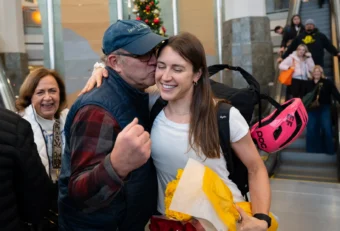
Seward swimmer Lydia Jacoby greets fans at the Anchorage airport after returning home from the 2021 Olympic trials. (Valerie Lake/Alaska Public Media)

Seward swimming phenom Lydia Jacoby fell short of an Olympic sequel Monday after failing to clinch a fast enough time in the 100-meter women’s breaststroke final event.

Jacoby, 20, placed third in the 100-meter breaststroke finals in Indianapolis. She swam a time of 1:06:37, in the same event she took home Olympic gold in 2021 with a time of 1:04:95. Jacoby qualified for Monday’s finals after placing fifth overall in qualifying heats held Sunday.

She could still go to the Olympics this year, as she’s also set to compete in the 200-meter breaststroke event.

According to Team USA, more than 1,000 American swimmers competed for a spot in the U.S. Olympic team trials.

Alaskans rallied around Jacoby when she swam in the 2020 Tokyo Summer Olympics, held 2021. At 17 and still a junior at Seward High School, Jacoby took home a silver medal for the women’s four by 100 meter medley relay in addition to her gold for the 100 meter breaststroke.

Jacoby is the first Alaskan to qualify for an Olympic games in swimming. She swims collegiately at the University of Texas at Austin, where she is majoring in textiles.

Two other athletes with Kenai Peninsula roots have Olympic ambitions this year.

Allie Ostrander, a graduate of Kenai Central High School, will compete for a spot on Team USA’s track and field team June 21-30 in Eugene, Oregon. As reported by the Peninsula Clarion, Ostrander qualified for the Olympic trials in the 3,000-meter steeplechase in April.

USA Cycling announced last week that Kristen Faulkner, of Homer, will compete on the 2024 track cycling team. Faulkner, 32, also races with EF Pro Cycling. As reported by NBC, Faulkner went to Harvard University and quit her job as a venture capitalist in 2021 to do cycling full-time.

The 2024 Olympics kick off in Paris in July.

Brent Sass to retire from sled dog racing months after sex assault allegations

Brent Sass with dogs Slater and Morello in Nome after winning the Iditarod Trail Sled Dog Race in 2022 (Lex Treinen/Alaska Public Media)

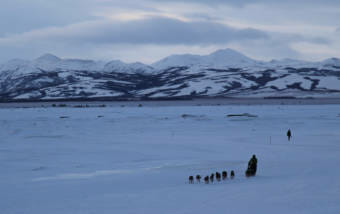
Iditarod and Yukon Quest champion dog musher Brent Sass announced Wednesday that he is stepping away from racing sled dogs.

In February, the Iditarod Trail Sled Dog Race disqualified Sass, its 2022 champion, just days ahead of the 1,000-mile race’s 2024 event amid allegations that he had sexually assaulted multiple women.

Sass, 44, has denied the allegations, which were contained in a Nov. 2 letter to the Iditarod and other top sled dog races from Planned Parenthood Alliance Advocates Alaska.

Two alleged victims also told Alaska Public Media, the Anchorage Daily News and ProPublica, that Sass had forced them to have sex during otherwise consensual sexual relationships more than a decade earlier.

It wasn’t until four months after the letter went to the race boards, in late February, that the Iditarod announced Sass’s disqualification. The disqualification also came a week after the newsrooms first asked the Iditarod about the allegations.

In identical posts Wednesday on the Instagram and Facebook pages for his Wild and Free kennel, Sass announced that he is “stepping away” from competitive dog mushing and from social media to focus on “new adventures.”

“As my life’s journey continues it is bringing change. Big change, one that I didn’t see coming but have to face like I have all other challenges throughout my life….head on and with a positive attitude,” the announcement says.

Sass did not immediately respond to an email, Facebook message or text seeking comment.

Sass is a four-time champion of the Yukon Quest sled dog race, winning in 2015, 2019, 2020 and 2024.

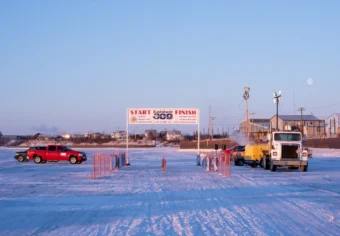
He won the 2022 Iditarod after mushing through a snowstorm to arrive at the finish line in Nome just over an hour before fellow Iditarod veteran Dallas Seavey, who claimed his sixth Iditarod championship in 2024, setting an all-time record.

Homer cyclist wins national title in road race championship

Kristen Faulkner. (EF Education-Cannondale)

Kristen Faulkner, 31, won this year’s Elite Women’s Road Race in West Virginia. She finished the 127-kilometer race in under three and a half hours, beating the next racer by almost a minute.

While she says she competed in sports her entire life, the Homer athlete began her cycling journey seven years ago in New York. Faulkner worked in the finance industry at the time and went to an introductory cycling clinic in Central Park.

“New York City’s this concrete jungle, and so my time in Central Park was really kind of my ‘me time’ every day to feel like I was in as much nature as I could get in Manhattan,” she said.

The next year, she moved to California and got more serious about cycling. After doing her first road race in Europe, Faulkner says she got hooked on professional racing and switched to competing full time.

“When I started cycling, I was working at a desk job, and I thought, you know, I could work a desk job for the next decade, or I could ride my bike outside for the next decade,” she said, “and I think being from Alaska and having such a passion for the outdoors, it was clear to me which one I really loved a lot more,” she said.

She now lives in Girona, Spain, which she says is the epicenter for cyclists.

At the end of last year, Faulkner joined EF Education-Cannondale, an American women’s professional cycling team. The team made a splash earlier this month by placing third overall at La Vuelta Femenina in Spain — one of three grand tours held each year for women. This year’s Vuelta is more than 880 kilometers and is split up into eight races, or stages.

Faulkner won the fourth stage. She says doing well at the Vuelta was especially important for her after getting hit by a car led her to develop a blood clot in her lung last year.

“I had to take three months off of riding, and I wasn’t sure how it’s going to come back,” she said, “and so to come back healthy and strong and be competing against, you know, the best in the world, and winning was a really exciting thing for me to have happen.”

Faulkner eventually began training indoors and even won a race at the end of the last season. She began this season becoming comfortable with racing again. Faulkner says recovering from the injury became more of a psychological journey than a physical one.

“I think emotionally, it was really hard for me to kind of trust cycling again, and trust that I could be safe and to really let myself go all out on these climbs, and especially on the distance,” she said.

As a national champion, Faulkner will be one of two athletes who can compete in road racing wearing a jersey with an American flag design for the next year. In addition to road racing, Faulkner is also one of nine athletes being considered for the U.S Olympic squad for women’s team pursuit — an indoor cycling event where teams of four race against each other on a track.

Stick pulls, seal hops and sportsmanship: Traditional Games bring 260 athletes to Juneau

Anchorage’s Matthew Chagluak performs an Alaskan High Kick during the 2024 Traditional Games in Juneau on Saturday, April 6, 2024. (Clarise Larson/KTOO)

Matthew Quinto stood on an animal skin blanket held taut off the ground by a ring of people. Slowly, they started to pull the blanket out and then in. Quinto got ready to leap. 

As everyone holding the blanket pulled it tight, Quinto jumped frighteningly high in the air, did a backflip, and landed back on the blanket.

“Originally, it was used as a way of lookout over villages in the arctic tundra,” Quinto said later.  

The backflip was just a bonus. 

Last weekend, athletes from across Alaska — and some from the Lower 48 — came to Juneau to compete in the seventh annual Traditional Games, held at Yadaa.at Kalé Juneau Douglas High School. 

The events represent fitness needed for survival and hunting skills in the arctic. But in the gym, the athletes tried to beat their own best scores.

The blanket toss was the first event. Quinto, who coaches for traditional games and Native Youth Olympics, said he only gets to do it a couple of times a year.

“It’s just something we do for fun,” he said. “We can’t really practice it because it takes a whole community to hold the blanket.”

Daanawáaḵ Ezra Elisoff announced the games. He’s an athlete himself. He said each event requires many different skills. 

“There’s agility, there’s explosive strength, there’s flexibility, there’s just a lot of different things. And all the games are different in their own unique way, of course,” Elisoff said.

But his favorite is the Alaskan high kick.

For that event, athletes get into position on the ground with one arm supporting them, grab one foot, and then launch their other foot up to try and reach a ball suspended in the air. If they touch it, officials raise it a bit higher and higher — until the athlete misses.

“That one’s about your technique and how much you can perfect it rather than pure strength and flexibility and whatnot,” Elisof said. “You can out-kick a lot of people once you start going what we call vertical, which is like a one-handed handstand.”

Petersburg’s Andrew Beavers (blue) and Juneau’s Koda Anderson (red) compete in the Dené Stick Pull during the 2024 Traditional Games in Juneau on Saturday, April 6, 2024. (Clarise Larson/KTOO)


Luka Silva officiated some of the events. He said it’s been exciting to see young people push themselves to beat their own records. 

“I’ve heard a lot of like, ‘Wow I can’t believe I just did that. I’m so proud of myself.’”

Mt. Edgecumbe High School in Sitka beat out other high schools for Best Overall Team. They won seven high school events. 

Tessa Anderson won the Overall Athlete title for high school girls. Her favorite event is the scissor broad jump — jumping as far as she can in four steps, as if leaping from ice floe to ice floe.  

“I just like the feeling of the pattern of jumping, I don’t know how to explain it,” Anderson said. 

She won the high school girls scissor broad jump category.

Anderson’s teammate Lennie Brandell said that the camaraderie and support from other athletes is part of what makes Traditional Games so special. 

“Everyone comes together, we’re all nice, no one’s ever talking trash to you. It’s always upbringing,” he said. 

This year, athletes broke 13 records in different categories. About 260 athletes from 31 different schools participated — 200 more than the first Traditional Games in 2018.  

In fundraising pitch, Iditarod planners say financial woes could jeopardize epic sled dog race

Musher Sean Williams’s dogs wait at the start of the 2024 Iditarod on March 2 in Anchorage, Alaska. Williams scratched on March 15. (Andrew Kitchenman/Alaska Beacon)

The future of the “Last Great Race” is uncertain, officials said in an appeal to supporters. The message comes at a time when major Iditarod sponsors have dropped out, and inflation has increased the cost of participation.

On Wednesday, race officials emailed fans to say one of the race’s key fundraisers, its winter raffle, isn’t getting typical levels of support. With five days before the draw, only about 60% of the tickets have sold.

The email suggested the race may not happen next year if the tickets do not sell out. “This may sound dramatic, but it is absolutely the unfortunate truth,” organizers wrote.

“Without this fundraiser and the sale of these tickets, we would not be able to put this race on each year,” they wrote.

This week the race was dealt another blow when a state legislative committee nixed a $1.4 million funding request that race officials said would have buoyed the struggling endeavor.

On Monday, Rep. Andy Josephson, D-Anchorage, proposed a $1.4 million grant from the state budget to the Iditarod Trail Committee, which operates the race.

“I thought it would be a popular amendment,” he said. “And I think it probably pencils out, in terms of economic gain to the state.”

“Who can vote no against the Iditarod?” said Rep. Dan Ortiz, I-Ketchikan.

Six members of the 11-person finance committee could — and did — vote no, and the amendment was defeated.

Rep. Will Stapp, R-Fairbanks, was one of the ‘no’ votes and said Tuesday that no one would say that the Iditarod isn’t important, but there are a significant number of budgetary unknowns facing lawmakers, and those must be addressed before considering a grant. He said there may be opportunities to add funding for the race later in the budget-writing process.

“There are many other bites at the apple,” he said.

Rep. Bryce Edgmon, I-Dillingham, said his no vote wasn’t a vote against the race itself.

“It was more along the lines of just being fiscally conservative. It’s an issue I don’t know a lot about. I’m very much a supporter of the Iditarod race and quite frankly would like to learn a little more about (the issue),” he said.

Race officials did not respond to a request for comment on Tuesday.

It has been a hard year for the race: three dogs died on the trail, ending its five-year streak without a dog death, and five more dogs died in training when teams were struck by snowmachines.

Several major race sponsors have ended their support for the race in the last several years, after criticism from the animal rights organization People for the Ethical Treatment of Animals. Those include the pet food company Nutanix, Alaska Airlines, ExxonMobil and Coca Cola.

The loss of major sponsors isn’t the only problem. Race officials have cited economic realities.

Inflation has increased the cost of dog food substantially. Some mushers report spending more than $40,000 per year to feed their teams. Many mushers are also reeling from the COVID-19 pandemic, when travel restrictions closed off opportunities to offer sled dog tours to tourists — a source of off-season income for many.

This story originally appeared in the Alaska Beacon and is republished here with permission.

Site notifications
Update notification options
Subscribe to notifications