Sports

Inside the weird and delightful origins of the jungle gym, which just turned 100

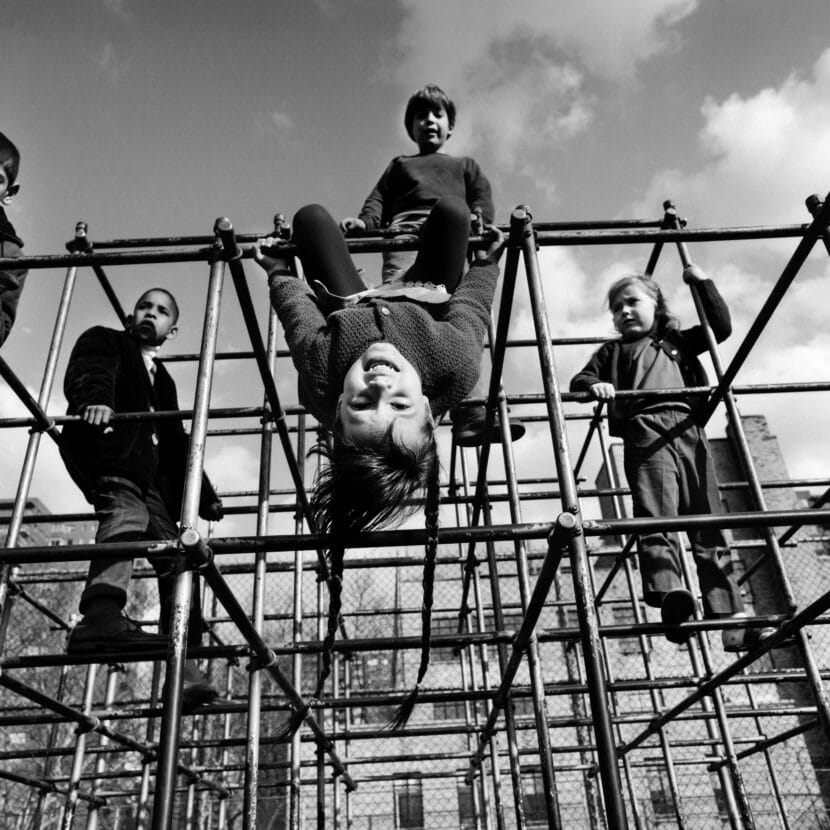
A jungle gym in the 1970s — a staple of playgrounds all across the U.S. (H. Armstrong Roberts/ClassicStock/Getty Images)

This story starts in the fourth dimension.

Or, more specifically, with a British mathematician who, in the late 1800s, was intrigued by the fourth dimension and how to teach disinterested children about it.

Charles Hinton wore a lot of hats. He wrote sci-fi stories before there was sci-fi — he called them “scientific romances.” At Princeton, where he worked for a time as mathematics instructor, he invented a baseball pitching machine powered by gunpowder. He also practiced polygamy, which was against both the mores and laws of his native England. And when he was convicted of bigamy in the 1880s, he was forced to move his young family to Japan where he found work teaching mathematics.

We will save all of that for the biopic, because for the purposes of this story, Hinton was the unintentional inspiration behind the jungle gym — the patent for which has just turned 100.

It turns out that the history of the jungle gym, and its sibling the monkey bars, is full of weird and delightful twists and sub-plots that take us from Japan to suburban Chicago and touch on child development theories and, yes, theoretical math.

Imagining dimensions — in bamboo

Hinton was a mathematician who explored the concept of the fourth dimension and how to represent it. His model of a tesseract as a way to represent the fourth dimension in geometrical space has since inspired a long lineage of science fiction writing and movies — from A Wrinkle in Time to Interstellar.

Yet it was while living in Japan that Hinton struggled to get his students to adequately wrestle with the concept of the fourth dimension.
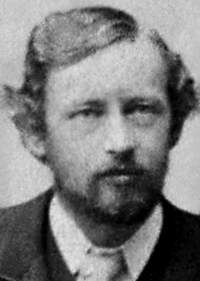
Charles Howard Hinton
Studio of K. Yoshida in Kanazawa, Japan (Papers of Howard Everest Hinton, University of Bristol Archive)

“He said, you know, the reason these students can’t grasp the fourth dimension is because they were never exposed to the third dimension as children,” says Luke Fannin, a primatologist and Ph.D. candidate at Dartmouth College, who became obsessed with finding out where the term “monkey bars” came from (more on that later) and ended up becoming something of a Hinton family expert.

Hinton theorized that since we spend so much of our lives simply walking in straight lines, and not using all of the three-dimensional space around us, we have an even harder time making the mental leap to fourth dimension.

His solution was to train young children, namely his own kids, to internalize the third dimension. To pull this off, Hinton built his children a series of stacked bamboo cubes. He labeled the bamboo in all three directions, Fannin says: “Where the junctions would be, he would put X, Y, Z coordinates.” Then he attempted to turn these stacked cubes into a game. “He would say, ‘X2, Y4, Z3 — go! And all the kids would race each other towards the correct coordinate,'” says Fannin.

If that does not sound like a fun game to you, you are not alone. And those bamboo cubes never amounted to much. But years later, Hinton’s son Sebastian would recall how much fun it was to climb and swing on them.

“And he goes, ‘That’s what I remember. I don’t remember anything about the math, but I remember that it was so fun,'” says Fannin.

By now it was the early 1920s, and the junior Hinton had moved to Winnetka, Illinois where he worked as a patent lawyer. He dreamed of recreating the bamboo climbing structure of his youth — minus the not very fun math games — and he started describing his plans at a dinner party one night.

Winnetka at this time was a hotbed for progressive education. The village was taken with the educational philosophy of John Dewey, which called for “whole child education.” This meant not just teaching reading, writing and arithmetic, but also how to be healthy and active humans.

So, as Hinton was describing his dream climbing structure, the dinner party was stacked with educators, including the superintendent of the Winnetka City Schools, Carleton Washburne. Fannin says he imagines Washburne’s eyes widening before telling Hinton, “We need to build this in the schools!”

Soon after, Hinton began filing his early patents for the design, which he registered to something he called JungleGym Inc. And the rest, as they say, is history.

If that dinner party had taken place anywhere else in the world, this iconic piece of equipment may never have existed. Or, as Fannin says, “It only stays in Hinton’s backyard. It never becomes sort of the cultural mainstay that is now ubiquitous on most playgrounds.”

The difference between monkeys and apes

From the outside, there’s nothing remarkable about the old Victorian home at 411 Linden Street in Winnetka, Illinois, which these days serves as the headquarters for the town’s historical society.

Inside, the 30,000 artifacts range from typewriters to vacuum cleaners. But for visitors who walk through a small gate into the back yard, surrounded by 20-foot tall conifers, there’s a little bit of a hidden treasure, says Mary Treishman, the executive director of the Winnetka Historical Society.

“We currently don’t have a historical plaque on it,” she says. “We just have this laminated sign that says, ‘Please do not climb on this artifact. It’s not safe.'”

That artifact is a 100-year-old jungle gym — the first real version.
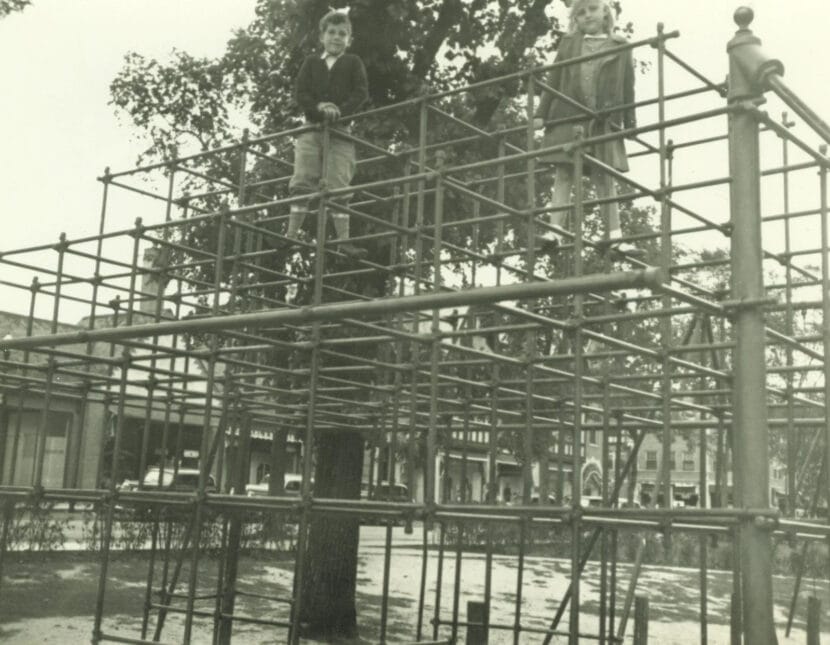
Hinton’s original jungle gym, pictured here in the 1930s at the Horace Mann School before it was moved to the Winnetka Historical Society. (Courtesy of Winnetka Historical Society)

To this day, kids sometimes still stumble across it, and Treishman has to politely tell them to stay off.

“I’ve seen adults come back here and really want to climb it because it reminds them of their childhood,” she says, adding that something about the classic bars really animates people. “The memories of this climbing structure are very deep. This is what everyone played on.”

Few things last 100 years. Children’s toys seem particularly fickle. Pet rocks, pogo sticks and scooters have all had full boom and bust cycles while the jungle gym — unflashy, workman-like, no fuss — keeps children coming back. Why is that?

It may be that the act of swinging and climbing in the jungle gym contains just enough risk, says Ellen Sandseter — a professor at the Department of Physical Education and Health at Norway’s Queen Maud University College, and an expert on risky play.

Sandseter says the jungle gym, and its sibling the monkey bars, offer a lot of challenging and also risky play, which is a good thing. She says it helps kids’ physical development — think motor skills — and their mental health, by building courage and self-confidence while reducing anxiety.

What’s more, unlike a lot of newer equipment that tells kids how it’s supposed to be used, Sandseter says the beauty of the jungle gym is in its simplicity.

“A monkey bar could be used in many different ways. And it, therefore, also affords creativity among children,” she says.

This all may help explain why the jungle gym has endured 100 years. But what about Fannin’s original question: how did the monkey bars get their name? Well, in the original 1923 patent for the jungle gym, Hinton seems to imagine children playing on it in language that has an ethereal quality of dreaming, of imagination:

“I have designed a climbing apparatus, so proportioned and constructed that it provides a kind of forest top through which a troop of children may play in a manner somewhat similar to that of a troop of monkeys through the treetops in a jungle.”
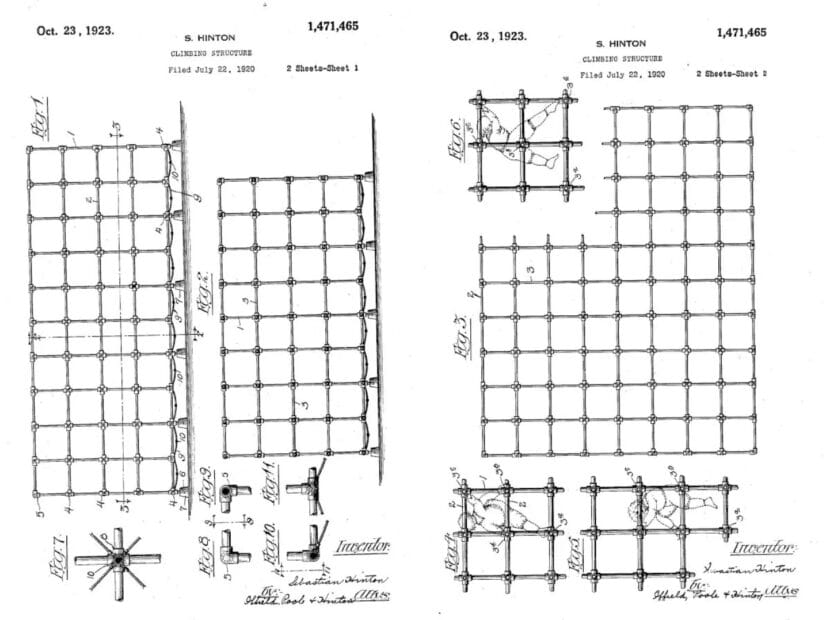
Hinton’s plans for the jungle gym, as outlined in his patent application. (United States Patent and Trademark Office, Sebastian Hinton.)

“There’s an illustration of it in the last patent he had approved. It basically is a jungle gym, and then adhered next to it is the ‘Accessory monkey runway,'” says Fannin. AKA, the monkey bars.

It’s worth remembering, Hinton was a patent lawyer, not a primatologist. And that behavior — swinging by your arms — is ape behavior, not what monkeys do. So should they be called ape bars?

“If you want to be pedantic about it,” says Fannin. “But I love the term monkey bars.”

Sadly, Sebastian Hinton never saw his invention get the U.S. Patent Office’s stamp of approval. He died in April of 1923, just six months before his patent was officially approved.

Much has changed since then: safety concerns have softened materials and rounded edges in playgrounds. But Hinton’s simple design that doesn’t dictate behavior, but facilitates it, has endured.

Perhaps it’s precisely because of this freedom that jungle gyms have afforded children the chance to dream for the last century. And maybe some of them will even dream about new dimensions.

Copyright 2023 NPR. To see more, visit https://www.npr.org.

Juneau is at the forefront of Alaska’s burgeoning pinball scene

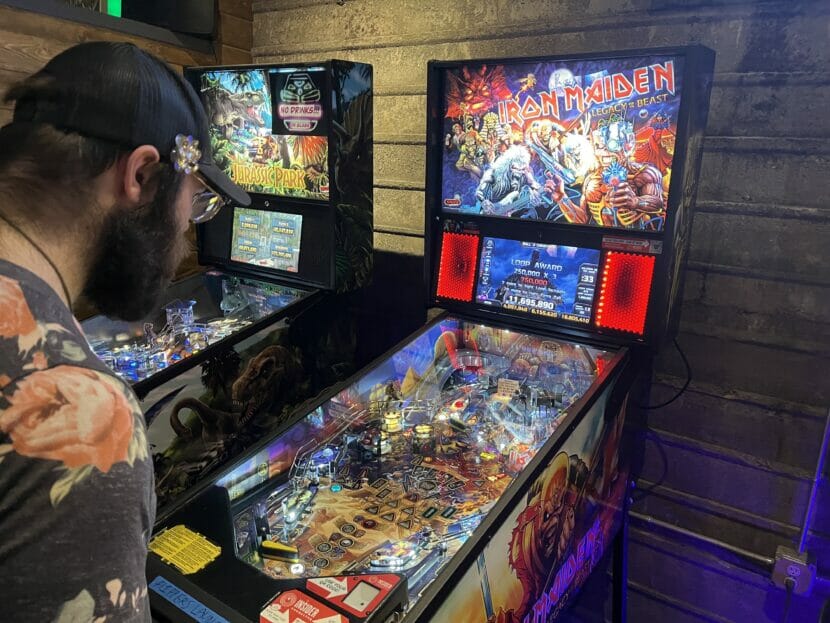
Ettin Briar competing in a pinball tournament at the Bearcade in Juneau. August 29, 2023. (Photo by Yvonne Krumrey/KTOO)

Listen to this story here:

Nine years ago, Rebecca and Henry Kephart fell in love over pinball machines.  

“One of our dates was, we went and played pinball, and he beat me. No one’s ever beaten me at pinball, so I decided I should marry him,” Rebecca Kephart said. 

The couple spoke to KTOO while standing outside Juneau’s Crystal Saloon holding boxes of pizza, before Juneau’s most recent pinball tournament.

All they really care about is beating each other, but they’ve been finishing fourth and fifth in the local tournaments. This year, for the first time, Alaska tournament results are going to the International Flipper Pinball Association, which publishes online rankings for players all over the world. 

That group is run by the Sharpe brothers, Zach and Josh. For pinball aficionados, that name might sound familiar — they’re the sons of Roger Sharpe, a GQ reporter who was instrumental in making pinball legal in Manhattan in the 1970s.

Josh Sharpe said the brothers revived the pinball association in the early 2000s, and it’s grown far more than they expected. He loves the way that the tournaments unite people, even those just trying to beat each other, like the Kepharts.

“Really, we’re both fighting this machine,” he said. “And there’s really a sense of camaraderie and support even among people, you know, playing against other people.”

Sharpe said he loves to see pinball growing in places like Alaska because he believes the people who start playing will form their own communities in the sport.

“If we can find someone to sort of like, pull into our little family, it’s usually safe that they’ll find two more people, and then those people will find two more people,” he said.

Upstairs, at the Bearcade — a recently-opened games bar above the Crystal Saloon — David Elrod enforces the rules and pretty much smokes the other players.

He started organizing pinball tournaments in Juneau after falling into the sport in California when he was going through a divorce. He said he didn’t like to spend too much time at his apartment, so he found himself going to an arcade instead. 

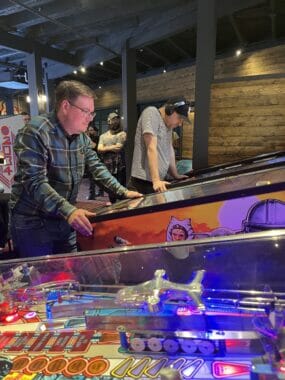
Gabriel Villenave, left, and David Elrod, right, competing in a pinball tournament at the Bearcade in Juneau. August 29, 2023. (Photo by Yvonne Krumrey/KTOO)

Elrod is the top-ranked player in Alaska, but he wants to generate some competition and share the love of the sport with others. 

“I get feedback a lot about how people —  just especially a lot of people are introverts and don’t normally come out very much and just found this community that they get to go to, which is what was always really important to me,” he said.

Since Elrod started the tournaments in April, 70 people in Anchorage and Juneau have jumped in. He said that’s more than some states with far more people.

And Juneau players are catching up to Elrod. 

“Last couple tournaments have been so friggin’ competitive,” he said. “Within the final round of the final game, it was three of us tied for first. Like, ‘This is when you lose one finally, David.’”

Ettin Briar is one of the players who’s been closing in on Elrod. They consistently come second.

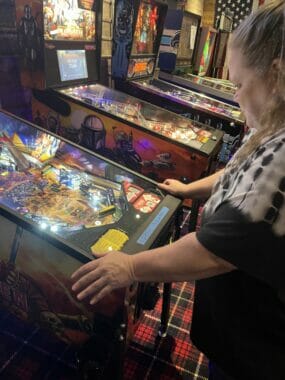
Rebecca Kephart competing in a pinball tournament at the Bearcade in Juneau. August 29, 2023. (Photo by Yvonne Krumrey/KTOO)

“I like to make him fight for it,” they said.

Briar has only been playing for about two years. They started playing at a pizza place, and then the Bearcade opened.

“They put some machines in here and I was ecstatic and now there’s a whole little community about it,” they said.

Upstairs, the tournament took a surprising turn. Rebecca Kephart played a strong final round on the hardest machine, the Hulk. She came in first, beating the three left in the tournament — by a lot. 

Henry Kephart was almost as excited as she was. But, with a strong lead going into that round, Elrod won again that night.

The top 16 players in the state will get a chance to duke it out for number one in Sitka in January. If the current rankings stand, 11 players will be from Juneau.

Alex Honnold and Tommy Caldwell summit Devil’s Thumb, with help from a local climbing legend

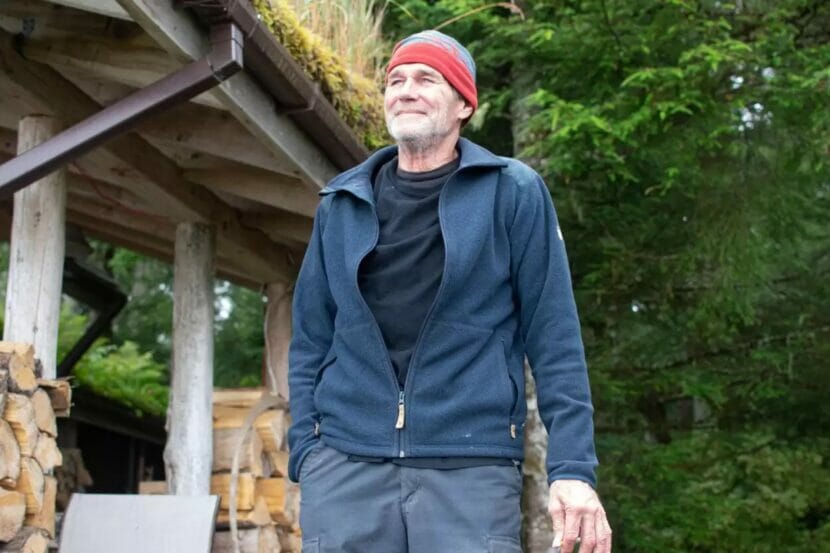
Dieter Klose stands outside his cabin on Sandy Beach Road. (Shelby Herbert/KFSK)

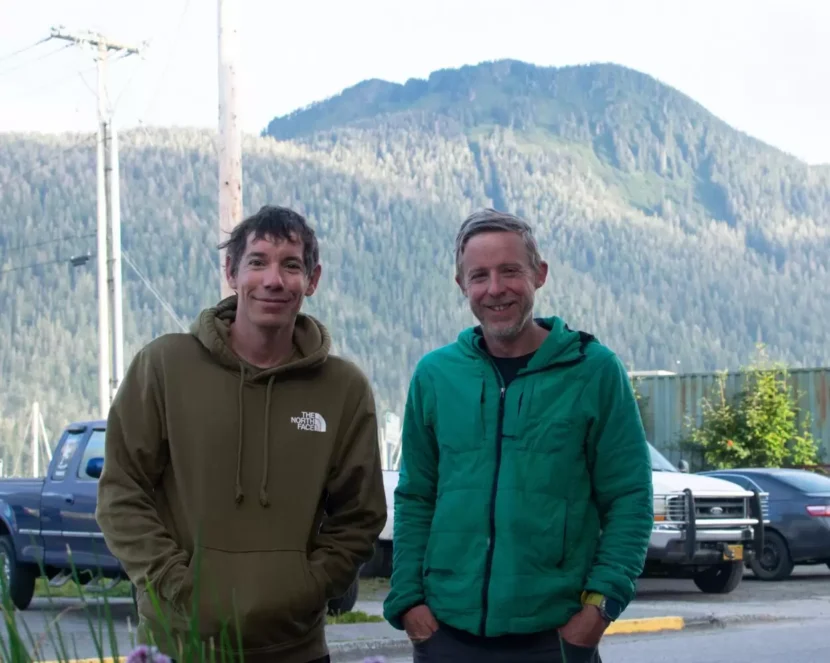
Celebrated climbers Alex Honnold and Tommy Caldwell summited Devil’s Thumb in late August. But they couldn’t pull it off without the counsel of a local climber who’s had a decades-long love affair with the mountain.

Standing outside his little cabin on the edge of the rainforest, Dieter Klose gazes out at the ocean. He built this place in the shadow of this giant rock. On this day, a wall of fog blocks his view. But Klose knows exactly what’s behind those clouds.

“It looks just like a German beer stein that’s a little wider at the bottom, so it doesn’t tip over when you’re drunk,” said Klose. “There’s only room for one person at the top, and you can just barely stand — if you have the courage.”

Klose stood there himself, twice. He can’t even count how many unsuccessful climbs it took  — his best guess is a dozen. He’s the only person to make it halfway up the unclimbed Northwest face — and come back alive. Klose has been climbing since he was a kid. He moved to Petersburg in 1982. At first, he lived behind a cemetery in a borrowed tent.

“It got torn up by a bear,” said Klose. “A friend of mine told me, ‘Hey, there’s a boat for sale for 200 bucks.’ And I thought, ‘Great! Then I can look at Devil’s Thumb.’”

Klose said it wasn’t love at first sight — or first summit. His enchantment with the mountain grew over the course of his life.

“It had everything I wanted, everything that satisfied me by climbing,” said Klose. “It’s difficult by any side, and it’s not super high altitude, which is great. We’re totally alone. And it’s a wild looking thing.”

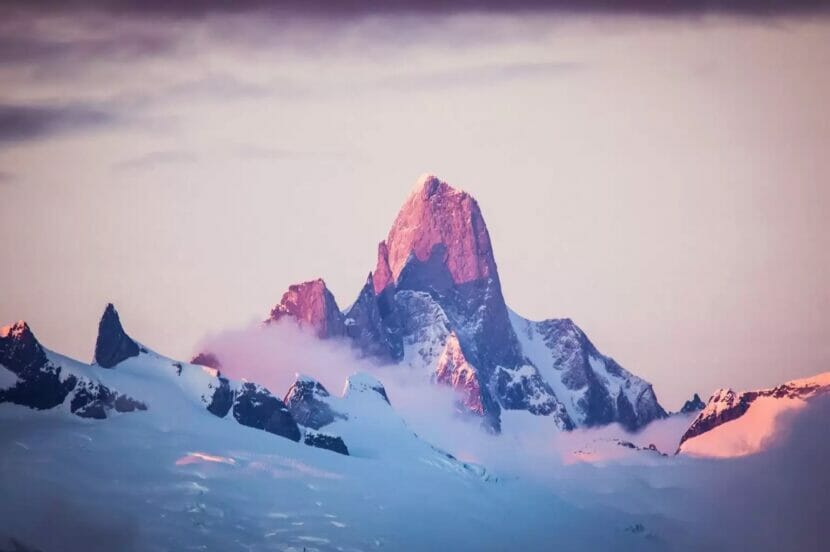
A view of Devils Thumb from Petersburg. (Photo courtesy of Carey Case)

Klose is a home builder by trade. He hurt his back at work a few years ago. The injury all but ended his climbing career — but he’s still known to climbers in the region as the godfather of the Stikine Ice Caps.

“I mean, Dieter is key to anybody who comes here to climb,” said world-class climber Tommy Caldwell.

Caldwell came up north recently to climb Devil’s Thumb and shoot a documentary about it. Dieter advised him and his climbing partner, Alex Honnold.

“There’s just nobody else that knows nearly as much about Devil’s Thumb,” said Honnold. “He’s like, the local custodian — just, like, managing the mountain.”

Klose also helped draft their route. It tags every peak up and down the whole massif; over the twin summits of the Witch’s Towers, the slender Cat’s Ears Spires — and then the looming cathedral of Devil’s Thumb itself. Caldwell said those features were as wicked as the sound of their names.

“All of the summits are like incredibly pointy,” said Caldwell. “You climb up it and you’re sitting on the summit, and there’s like thousands and thousands of feet drop on either side of you. It’s one of the more exposed-feeling summits I’ve ever seen in my life.”

Alex Honnold and Tommy Caldwell spoke with KFSK the day before they left Alaska. (Shelby Herbert/KFSK)

Hours before they left Alaska, both climbers came by to write in a book that Dieter Klose keeps about the mountain. It contains the names of everybody to ever summit in living history. Alex and Tommy sketched out a map of their route that took up two whole pages.

Back in front of his house, Klose gazed across the sound. He said the view is actually better from down here.

“You’re not necessarily enjoying yourself on difficult climbs — you’re getting tired and thirsty, hungry, all of that,” said Klose. “It’s not until you get back into the valley and look up at that mountain, and then you get some real joy out of it.”

Climbing Devil’s Thumb today would be difficult for him. But Dieter Klose still dreams about one last summit.

Yukon Quest Alaska to hold 300-mile sled dog race as rift with Canada continues

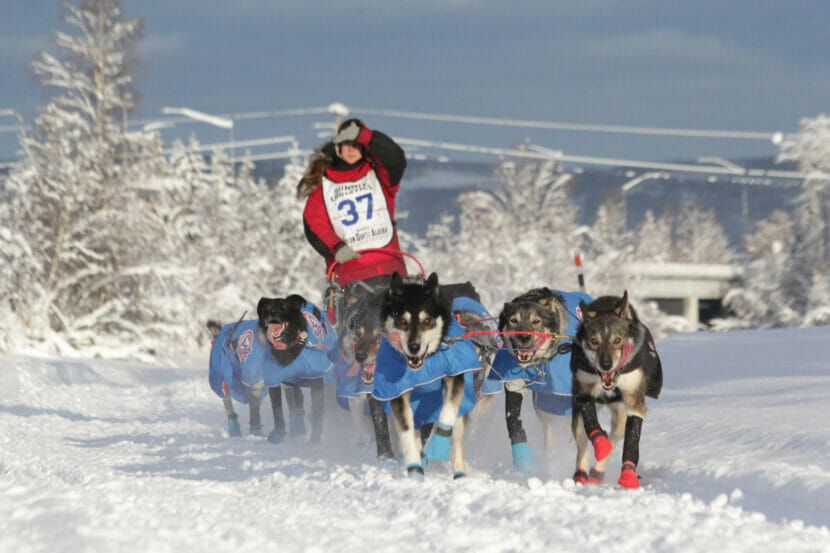
Jennifer LaBar heads off on the 300-mile 2023 Yukon Quest. (Lex Treinen/KUAC)

The Yukon Quest Alaska has revised its 2024 race plan. The organization has decided not to run a 550-mile race like it did last February and is instead falling back to a 300-miler for its premier event.

Quest Executive Director Lisa Nilson said a Fairbanks to Circle and Central race trail has been modified in response to musher feedback to include 25 miles on the Yukon River, instead of returning to Central via Birch Creek.

“The rough area around Birch Creek gets pretty cold, so we eliminated that and we wanted to make sure and get back on the Yukon River so the 300-miler basically starts in Fairbanks, heads over to Circle and then the part after that is new trail,” Nilson said. “So it goes back to Central to have the finish there, and the new trail is what touches on the Yukon River instead of Birch Creek.”

The Quest will also host 200- and 80-mile races, both starting in Fairbanks.

“The 200-mile qualifier finishes in Central and the 80 is to Two Rivers and back just like last year,” she said.

The traditional 1,000-mile Yukon Quest International Sled Dog Race between Fairbanks and Whitehorse has not been held since 2020. It was initially canceled due to pandemic restrictions, but was canceled again last year due to a dispute between Canadian and Alaska side race organizers over dog rest requirements.

Nilson said the Quest has not given up on running longer races.

“Our goal is to hopefully make up with Canada someday and communicate with them and coordinate with them, but right now our main focus is definitely —  especially with the 2024 race coming up — is just to make sure that we’re putting together an amazing race, we’re building up the sport, we’re encouraging young mushers to sign up,” said Nilson.

Nilson, who was hired last month, said she’s focused on building sponsor and community support so longer races can be held in upcoming years. Quest organizers have announced a minimum 2024 300-mile race purse of $30,000, but Nilson said she’s working to increase the amount prior to the Feb. 3 start date.

Sign-ups for the 2024 Yukon Quest races open on Saturday, Sept. 30, at the Yukon Quest Alaska race headquarters in downtown Fairbanks.

Alaska education board bans transgender girls from girls’ high school sports

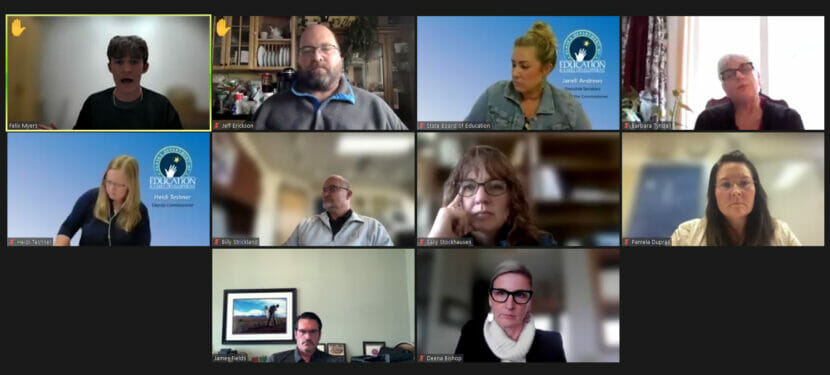
The Alaska Board of Education and Early Development unanimously voted to ban trans girls from competing in girls sports in Alaska. (Screenshot from Aug. 31, 2023)

The Alaska Board of Education voted unanimously Thursday to approve a ban on transgender girls participating in girls’ high school sports. The change will apply to all public high schools in the state competing under the Alaska School Activities Association.

Several board members spoke in favor of the regulation, citing safety concerns and questioning the fairness of girls competing against other athletes who were not assigned the female gender at birth.

“I’m not convinced that there isn’t a potential safety issue, or I am convinced there is a physiological difference for sure,” said board member Jeff Erickson. “I think there’s some unfairness. I think the federal law at present protects women’s sports.”

The regulation says that schools that participate in the Alaska School Activities Association — the governing body for high school sports — must limit participation on high school athletic teams to “females who were assigned female at birth.”

Board Chair James Fields said that an athlete who identifies as intersex or athletes who transitioned genders before puberty may be able to receive a waiver allowing them to participate on sports teams that match their gender identity after going through an appeal process.

There are currently 19 states with active bans on trans athletes competing in sports that match their gender identity. Courts in four other states are deciding the fate of similar bans.

The board did not take public comment during Thursday’s special meeting, and Student Advisor Felix Myers was the only board member who spoke in opposition to the proposed changes. Myers said he felt like the regulation was a distraction.

“This has not been an issue that’s occurred. It doesn’t seem like this is a problem that we need to fix currently,” he said.

Myers said the board should refocus its priorities to train coaches to recognize the signs of eating disorders that plague young athletes. He was the only board member to vote against the regulation, and military advisor Lt. Col. James Fowley abstained from voting, but neither of their advisory votes counted toward the final tally.

According to ASAA Executive Director Billy Strickland, Native Youth Olympics and downhill skiing are the only two sports in Alaska high school athletics that are not sanctioned by ASAA, and would not be subject to the regulation.

The board passed a resolution in support of the change in March, and put the changes up for public comment in June. At a July meeting, the board decided to postpone action on the proposed regulations to answer additional questions posed in the more than 1,400 pages of written testimony submitted by members of the public.

The Mat-Su school district had the only trans ban in effect in Alaska prior to the board’s vote.

Rain and mud make Mount Marathon trail ‘an absolute nightmare’

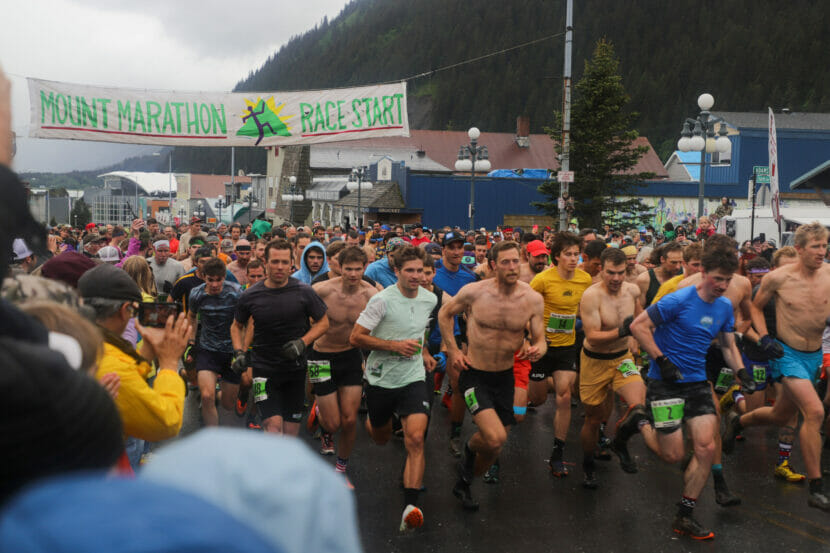
Runners take off at the starting line of the Mount Marathon men’s race in Seward on July 4, 2023. (Dev Hardikar/Alaska Public Media)

More than 800 runners tackled rain and treacherous trail on Tuesday in Seward’s grueling Mount Marathon race. David Norris, originally from Fairbanks, took first place in the men’s race with a time of 44 minutes and 51 seconds. He said it was one of the toughest races he’s ever run.

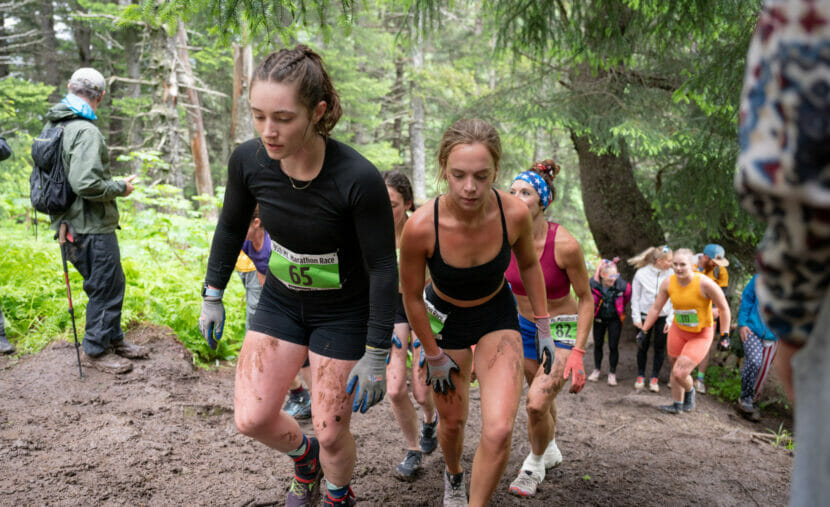
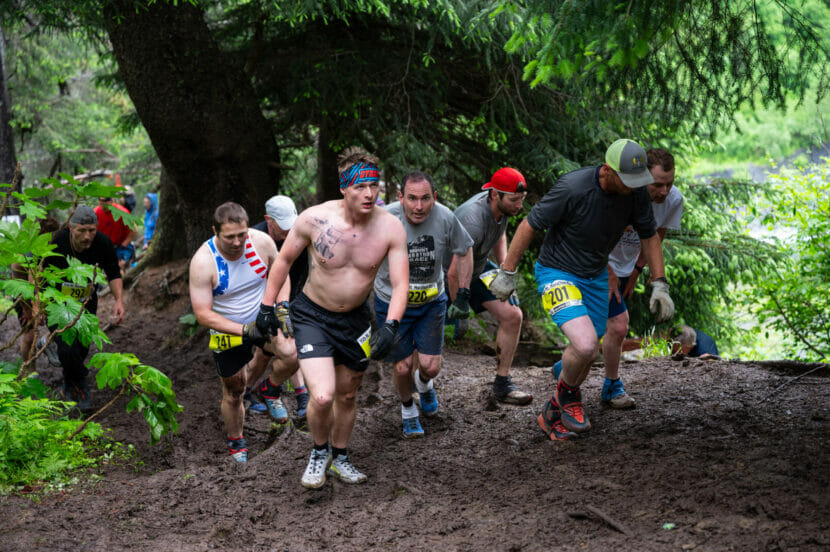
“It’s probably the gnarliest I’ve ever seen,” said Norris. “Just like, super muddy down in the woods, and then even up top where it’s usually just dry rock, that had a little mud mixed in.”

Brenna Flannery and fellow racers trudge up Mount Marathon. (Matt Faubion/Alaska Public Media)

This year marked the 95th running of the race that sends runners up and back down the towering Mount Marathon on the Fourth of July. Norris now lives in Colorado, and has run the Mount Marathon race four times. He’s also won all four times. He set the record of 41 minutes and 26 seconds in 2016.

In the women’s race, Christy Marvin of Palmer came out on top with a time of 52 minutes and 52 seconds.

“This is my 10th year, and it was my goal to make it in the top three all 10 years in a row,” she said. “And I did it today with a third win! So I’m super stoked.”

Competitors make the grueling climb to the top of the course. (Matt Faubion/Alaska Public Media)

She pulled off a close first place just 15 seconds ahead of runner-up Meg Inokuma of Palmer.

Marvin said the rain made the race especially tough this year. It slowed down all the runners, who had to be careful not to slip. The course was so muddy that competitors had to hose themselves off at the finish line.

“The conditions were an absolute nightmare and a huge mess and I was really nervous both for my boys this morning and then for myself this afternoon,” said Marvin.

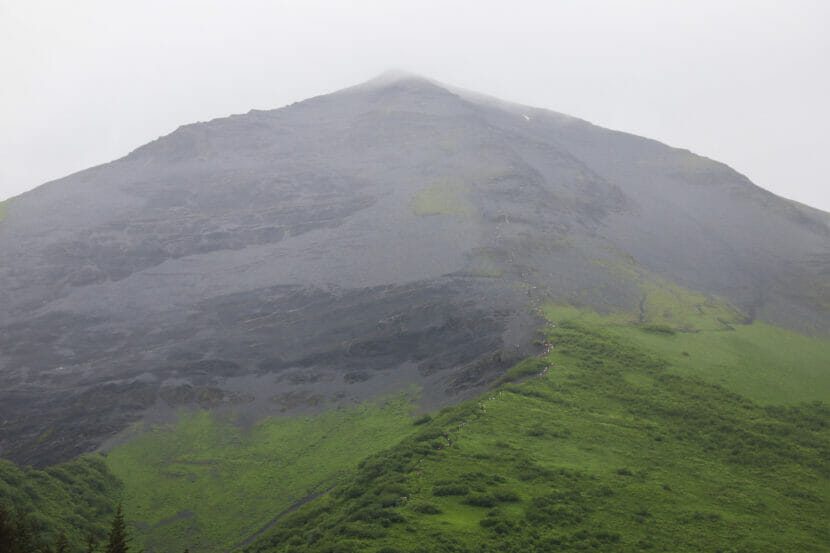
Competitors make their way up the ridgeline. (Dev Hardikar/Alaska Public Media)

Marvin wasn’t the only one in her family with a first-place win on Tuesday. Her 16-year-old son Coby won the Mount Maraton boy’s race.

Tania Boonstra of Kenai, age 15, won the girl’s race.

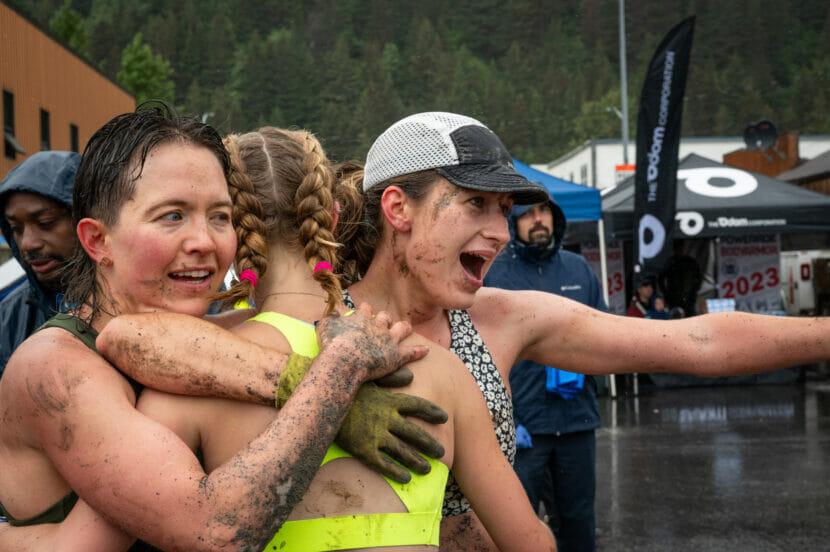
Julianne Dickerson (left) rejoices with other racers at the Mount Marathon finish line. (Matt Faubion/Alaska Public Media)
Site notifications
Update notification options
Subscribe to notifications