Archives for:

"Alaska Performance Scholarship"

Dunleavy signs bill expanding Alaska Performance Scholarship program

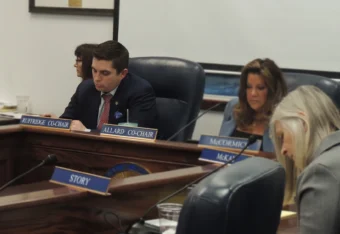
Rep. Justin Ruffridge co-chairs the House Education Committee on April 13. (Riley Board/KDLL)

Last week, Gov. Mike Dunleavy signed a bill expanding a state scholarship program. Advocates say it will help more Alaska students qualify for and use the Alaska Performance Scholarship program, which gives money to Alaska’s high performing students to use at in-state universities.

The bill expanding the program was sponsored by the House Education Committee and carried by the office of Soldotna Republican Rep. Justin Ruffridge’s office during the 33rd Alaska Legislature. Speaking to the Kenai City Council on Wednesday, Ruffridge celebrated the bill becoming law.

“For those of you with connections to our area high schools, certainly something you might want as information for students going into their senior year, especially this year,” he said.

Since the program was established in 2011, it’s paid out over $100 million to more than 11,000 students. Use of the scholarship has declined in recent years. In 2022, just 17% of Alaska high school seniors were eligible for the program. The same year, that rate was just 15% for the Kenai Peninsula Borough School District.

The bill increases scholarship award amounts, requires school districts to notify students earlier of scholarship opportunities and removes standardized testing as a prerequisite for eligibility.

The lowest level scholarship award amount would increase from $2,378 per year to $3,500 per year. Awards for the middle level would go from $3,566 to $5,250. For the highest scholarship level, the amount would increase from $4,755 to $7,000 per year.

Additionally, the bill creates a new “step-up” provision that allows students to increase their scholarship amount if their grade point average improves in college. Students can also now use career and technical education courses toward eligibility.

Kenai Peninsula residents joined Alaskans from around the state in voicing their support for the bill when it was introduced.

Virginia Morgan lives in Cooper Landing and also serves on the Kenai Peninsula Borough School District’s Board of Education. She was one of multiple people who spoke in favor of removing standardized testing as one of the scholarship’s eligibility criteria. Addressing the House Education Committee last year, she said not all Alaska students have equal access to testing. That can make it harder for them to qualify for the program.

“The testing opportunities are limited on the Kenai Peninsula and our family lives 50 miles away from the nearest testing center,” she said. “There was one test available for my daughter to take as a senior and it was in the City of Seward. Luckily, we do live on the road system and we were able to leave home around 5 a.m. to drive through a snowstorm for her to take the test.”

Megan Murphy, a counselor at Soldotna High School, shared similar thoughts with the committee.

“It’s just not fair for students that live in Nanwalek and Tebughna to have to come over and they can’t access testing sites,” she said. “And this year, we had students that had to go drive to Anchorage or go to Homer in order to access those tests. So for this reason, many of our students are choosing not to do these tests because they don’t have accessibility — by cost or the ability to get to those testing sites. Which is unfortunate, because otherwise they would qualify.”

State data show that standardized testing requirements do impact how many students receive Alaska Performance Scholarships. The program’s testing requirements were waived for two years during the COVID-19 pandemic, and the number of students eligible for the scholarship went up. That trend was also observed on the Kenai Peninsula.

On Wednesday, Kenai City Council member James Baisden said he’s hopeful the changes will encourage more Alaskans to stick around.

“My son’s been a direct benefit of that at the University of Fairbanks and it’s played out well for us keeping him in state,” he said. “I think it’ll play a big part maybe with some of these other kids doing the same thing.”

Changes to the Alaska Performance Scholarship became effective at the end of last month. That means they’ll be in place for students for the upcoming school year. More information about the Alaska Performance Scholarship can be found on the Alaska Commission on Postsecondary Education’s website at aps.alaska.gov.

Alaska lawmakers work to lower barriers to eligibility for in-state scholarships

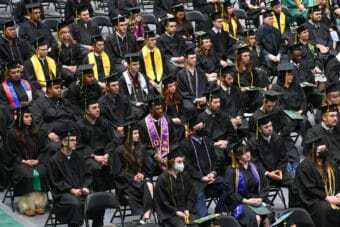
The Bartlett High School class of 2022 commencement. (Adam Nicely/Alaska Public Media)

A state-funded scholarship program to encourage students to stay in Alaska for college reported its lowest eligibility numbers last year since the program began in 2010.

The Alaska Performance Scholarship is a merit-based program that funds post-secondary education for Alaska students attending school in-state. Students who take the scholarship are more likely to stay and build a career in Alaska than those who don’t, according to a report released this month.

Lawmakers say that’s a serious concern for a state suffering from outmigration and a shrinking labor pool.
“We know we have a workforce shortage. We know we want our students to stay in state. And this is a solution to that,” said Rep. Andi Story, a Juneau Democrat.

Story has a bill moving through the legislature this session to make it easier for students to access the scholarship. This year’s the scholarship’s outcomes report found that only 17% of the class of 2022 was eligible for the scholarship — the lowest rate since the program’s inception.

In rural parts of the state, the eligibility rate is even lower — just 9% in western and northern Alaska.

“The number one barrier that students said was the requirement for the standardized test — an SAT or an ACT. And it especially appears to be affecting our rural students,” said Sana Efird, executive director of the state Commission on Postsecondary Education, which administers the scholarship.

Institutions nationwide are rethinking the value of standardized test scores in college applications, and many have dropped the requirement altogether. In Alaska, Efird said rural students often have to travel to take standardized tests, which adds extra costs, planning and time.

At the same time, nearly half of scholarship-eligible students are choosing to attend school out of state instead of in Alaska. Efird says that’s in part because of funding uncertainty in the University of Alaska system.

“Reductions and cuts to our university programs over the past few years have an effect on families and students,” she said. “There were concerns saying, ‘well, we might start a program and then it gets cut, or it may not continue.’”

Story’s bill would make several changes to the program to encourage more students to take advantage of it. It would remove the standardized testing requirement. Students would be judged on course load rigor and GPA instead.

It would also increase the amount of scholarship money, which hasn’t happened since 2011. Meanwhile, tuition at the University of Alaska Anchorage has increased by 50 percent in that time.

The bill would also let students know in their junior year whether they are on track to receive the scholarship, instead of waiting until the end of their senior year, when many have already made their college decisions.

Story said these changes and others will help raise scholarship use rates in the short term. But long term, she said students need more support to prepare them for postsecondary studies and make them aware of scholarship opportunities.

“The key thing is we have to get more families aware of that, and a lot of our districts haven’t had guidance counselors — haven’t had or are cutting back on them,” Story said.

Story’s bill is still moving through committees, along with partner legislation sponsored by Sens. Forrest Dunbar and Elvi Gray-Jackson. Story said she’s heard positive feedback from her colleagues for her bill but still has some work to do to get enough support for it to pass.

State Supreme Court affirms Dunleavy decision that drained fund for Alaska college scholarships

The University of Alaska Anchorage held commencement ceremonies on Sunday, May, 1, 2022. (Photo by Bill Roth/ADN)

The Alaska Supreme Court affirmed Tuesday a lower court decision against a handful of Alaska college students who sued the administration of Gov. Mike Dunleavy, challenging a decision that drained Alaska’s $410 million Higher Education Investment Fund.

The decision means the Alaska Performance Scholarship program and WWAMI, the state’s equivalent of medical school, do not have a dedicated funding source and must compete with other programs in the state’s annual budget process, but a separate effort by the Legislature may reinstate a dedicated account.

“Although the plaintiffs tried to make this case about supposed policy calls made by the executive branch, the Court recognized that the State was just following the Alaska Constitution,” Deputy Attorney General Cori Mills said in a statement released after the court’s ruling.

“No one disputes that the performance scholarships are an important program, which is why Governor Dunleavy included appropriations to pay for the scholarships in his budget. But that does not mean that the Higher Education Investment Fund falls outside of the reach of the constitutionally required sweep into the CBR (constitutional budget reserve),” Mills said.

The scholarship programs remain funded through at least June 30, and the budget making its way through the Legislature has money to fund the programs in the next fiscal year.

The Legislature is separately considering a bill that would remove the fund from the state treasury so that it can’t be emptied by the end-of-session legislative sweep. That measure, House Bill 322, passed the state House on Monday, and is heading to the Senate for consideration.

“We are not giving up,” Pat Pitney, president of the University of Alaska System, said in a statement Tuesday. “We have been simultaneously working to fund HEIF and the programs it supports through legislative action.”

The fund “is too important,” Pitney said. “Our state’s future is inextricably linked to the success of our people and their access to high-quality workforce training and higher education.”

Pitney said the university will dedicate its efforts to “solving this issue by supporting HB322.”

That bill would create separate accounts for higher education scholarships and for the Alaska Marine Highway System.

“Ongoing crucial state services such as the Alaska Marine Highway System should not suffer the destabilizing effects that may result from the sweep of the funds,” said Rep. Dan Ortiz, I-Ketchikan. The bill would create “needed certainty” both for the ferry system and for the higher education investment fund, he said.

The bill originally applied only to the Alaska Marine Highway System fund and was amended to cover the education fund.

“It’s about our workforce. It’s about our future engineers, our future business accountants, our teachers. Many important jobs that need to be filled,” Rep. Andi Story, D-Juneau, said on the House floor, before the House voted 25-15 to pass the bill.

Lawmakers who opposed the measure said that creating separate accounts defied the state’s constitution.

In the Superior Court decision that was affirmed by the Supreme Court, Anchorage Superior Court Judge Adolf Zeman said that Dunleavy’s administration correctly classified the higher-education fund as part of the state’s general fund in 2019. That made it subject to a clause in the Alaska Constitution that requires leftover general fund money to be automatically swept into the Constitutional Budget Reserve, a special savings account.

The Alaska Legislature regularly votes to reverse that sweep, but it failed to do so in 2021 because of opposition by Republican legislators in the state House. That failure, combined with the administration’s classification, drained the fund.

This story was originally published by the Anchorage Daily News and is republished here with permission.

University of Alaska will cover student scholarships until lawmakers reach deal

University of Alaska Southeast (Photo by Heather Bryant/KTOO
Students at the University of Alaska Southeast campus in Juneau in 2013. (Photo by Heather Bryant/KTOO)

Legislators voted earlier this week to avoid a partial government shutdown, but they couldn’t agree on how to fund college scholarships to support more than  5,400 Alaska students. So those funds are not currently in the state budget. 

But the University of Alaska announced Thursday that it will honor the scholarships for current and incoming students. 

In a statement, Interim President Pat Pitney said she was confident the legislature would resolve the funding of these scholarships during the special session in August.

The Alaska Performance Scholarship and the Alaska Education Grant programs provide students across the state with vital funds for their studies. Most of them are students at the University of Alaska. 

The University of Alaska Southeast had about 150 students who received scholarships last year. The university sent out a message to the students letting them know that it’s carefully monitoring the situation, says Lori Klein, Vice Chancellor for Enrollment Management Student Affairs.

“While waiting, of course, is very difficult and challenging. We want students to stick with their plans for the fall, and to come to us and to stay in state and to plan on having those funds,” Klein said.

She also says the program funds directly impact the state’s future.

“These funds impact our future state leaders,” she said. “They impact their future state residents, our business owners, our professionals. You know, many of our students will stay in state after they get their degrees and they will contribute back to their home communities.”

The legislature reconvenes for a special session in August. Klein says she hopes by then legislators can bring certainty to students for the upcoming school year.

Editor’s note: This article has been updated to include information from a statement by University of Alaska Interim President Pat Pitney. The headline has been updated to include that the university system will honor the scholarships.

Former Alaska Gov. Sean Parnell selected to lead University of Alaska Anchorage

Former Alaska Gov. Sean Parnell waits to cast his Electoral College vote for Donald Trump during a ceremony on Monday, December 19, 2016 in Juneau, Alaska.
Former Alaska Gov. Sean Parnell waits to cast his Electoral College vote for Donald Trump during a ceremony on Monday, December 19, 2016 in Juneau, Alaska. (Photo by Rashah McChesney/Alaska’s Energy Desk)

Former Republican Gov. Sean Parnell will be the new leader of the University of Alaska Anchorage, the state’s largest university.

Interim University of Alaska President Pat Pitney announced Wednesday that she had picked Parnell as the next UAA chancellor.

Parnell beat out Pearl Brower, the former president of Iḷisaġvik College, along with Anchorage School District Superintendent Deena Bishop and five other finalists for the job.

In a letter to the UAA community, Pitney said she selected Parnell because of “his passion for our mission, his deep commitment to Alaska, and his desire for all Alaskans to have access to higher education.”

Pitney also said Parnell had support from the search committee, as well as the UAA community, including students.

“I believe Sean to be uniquely positioned to lead UAA in providing the programs that support Anchorage and Alaska’s workforce needs and economic growth, including innovative research to drive the state forward,” she said.

Parnell will take the lead of a university that has recently grappled with deep state budget cutsaccreditation issues and the pandemic. The entire UA system is approaching its final year of a three-year, $70 million state budget cut that began in 2019 — imposed under Republican Gov. Mike Dunleavy. The slashed funding has led to hundreds of layoffs across the university system, and the elimination of some academic programs.

Parnell will start his new job as UAA chancellor June 12.

He served as Alaska’s governor for five years beginning in 2009, when he moved from lieutenant governor to the state’s top elected position after the resignation of Sarah Palin. He was elected in 2010, then lost his re-election bid in 2014 to independent Bill Walker.

As governor, one of Parnell’s signature pieces of legislation led to the creation of the Alaska Performance Scholarship, a fund for high-achieving Alaska students, which Pitney also cited in the letter.

Parnell is currently an attorney in Anchorage.

He’s taking over the chancellor position from Cathy Sandeen, who left UAA in early January to become president of California State University, East Bay.

UAA has campuses in Anchorage, Soldotna, Kodiak, Palmer, Valdez and Homer.

Fewer Alaska students qualifying for or using state scholarship fund, review finds

East High graduate Albert Timo after receiving his diploma on Thursday, May 21, 2020 in Anchorage. (Hannah Lies/Alaska Public Media)

A state-funded scholarship designed to boost academic performance and college access in Alaska isn’t paying out as many scholarships as anticipated, according to a new review.

The biggest barriers appear to be SAT/ACT test requirements and political and funding instability around the University of Alaska system.

The report analyzed use of the Alaska Performance Scholarship, which pays scholarship money to Alaskan students based on GPA and standardized test scores, for the Alaska Commission on Postsecondary Education. Money for the scholarship comes from the state’s Higher Education Investment Fund, which was initially created by the Legislature with $400 million.

Legislators expected the scholarship to give out more money over time when it was created in 2010. But after a few years of initial growth, its use has steadily declined, said Rebecca Braun, part of the research team that conducted the review of the APS. In 2019, she said, it paid out $9.4 million.

“If you look back at the legislative history, and when it passed, that’s less than half of what was anticipated as the annual payout,” she said.

Millions of dollars are not being used by Alaska students each year. In fact, the fund has never given out the $20.6 million in annual awards that it anticipated.

According to the report, only 644 Alaska high school graduates used the scholarship in 2019, far fewer than the 2,305 students it was anticipated to serve each year.

The scholarship was designed to encourage students to achieve higher academically as well as encourage students to stay in Alaska for their post-secondary education. Alaska has struggled with both objectives.

According to state data, 66% of Alaska’s 9th graders tested below or far below proficient in English language arts and 73% tested below or far below proficient in Math on the PEAKS assessment in 2019. And, the percentage of Alaska high school graduates enrolling in college has been on the decline since at least 2013 according to the ACPE. Just 44% of Alaska’s high school graduating class of 2019 enrolled full-time in college, well below the national average of 61%.

The biggest barrier for Alaska students to qualify for the scholarship is SAT/ACT scores, Braun said. And the review found racial disparities in which students were eligible for the scholarship were also largely driven by the testing requirement. Less than 10% of Alaska Native students were eligible for the scholarship in 2019 compared to an average of 23% of all students statewide.

“A lot of Alaska students, particularly in rural Alaska and in groups such as those who are first generation to go to college, have low awareness of the test they may have barriers to access not just paying the fees but in some cases finding a place that administers it,” Braun said.

There was one outlier in the data: the graduating class of 2020. Eligibility for the scholarship for Alaska Native students increased by 159%, and increased by 60% for all students. This was the same year most colleges, and the scholarship program, waived SAT/ACT requirements due to the pandemic, further implicating standardized tests as a barrier to the scholarship money.

Even though the scholarship can offer up to $4,755 to recipients per year, the review found that when students do qualify for the scholarship, some aren’t using it, in part because it comes in too late compared to other college’s financial aid offers. But also, some survey responses indicated that staying in Alaska is becoming less attractive to college-going students.

In 2019, thousands of students who received the APS were notified months before fall classes started that the money might not be available due to a legislative budget issue, although the funding was ultimately restored. Before that, lawmakers proposed cutting the scholarship fund entirely in 2017.

More recently, the state’s major college option, the University of Alaska system, has been navigating through the final year of implementing a $70 million state funding cut, which resulted in cuts academic programs, proposed campus mergers and the proposed elimination of some sports teams.

The scholarship can only be used at in-state institutions, and it isn’t large enough to keep students who have competing offers from other colleges in Alaska, Braun said.

“The state is going to have to do something different to achieve that objective of making the University of Alaska more attractive and keeping these students in state. But meantime, we’re losing the opportunity to help some of these rural students, first generation and underrepresented groups get to college. They are much more likely to use this scholarship if it’s offered to them.”

The review’s recommendations include getting rid of the standardized test requirements and simplifying eligibility. Because the scholarship program is written into law, Braun said any changes to the program would require legislative action.

Site notifications
Update notification options
Subscribe to notifications