Archives for:

"Baby Raven Reads"

Baby Raven Reads fosters next generation of Tlingit speakers

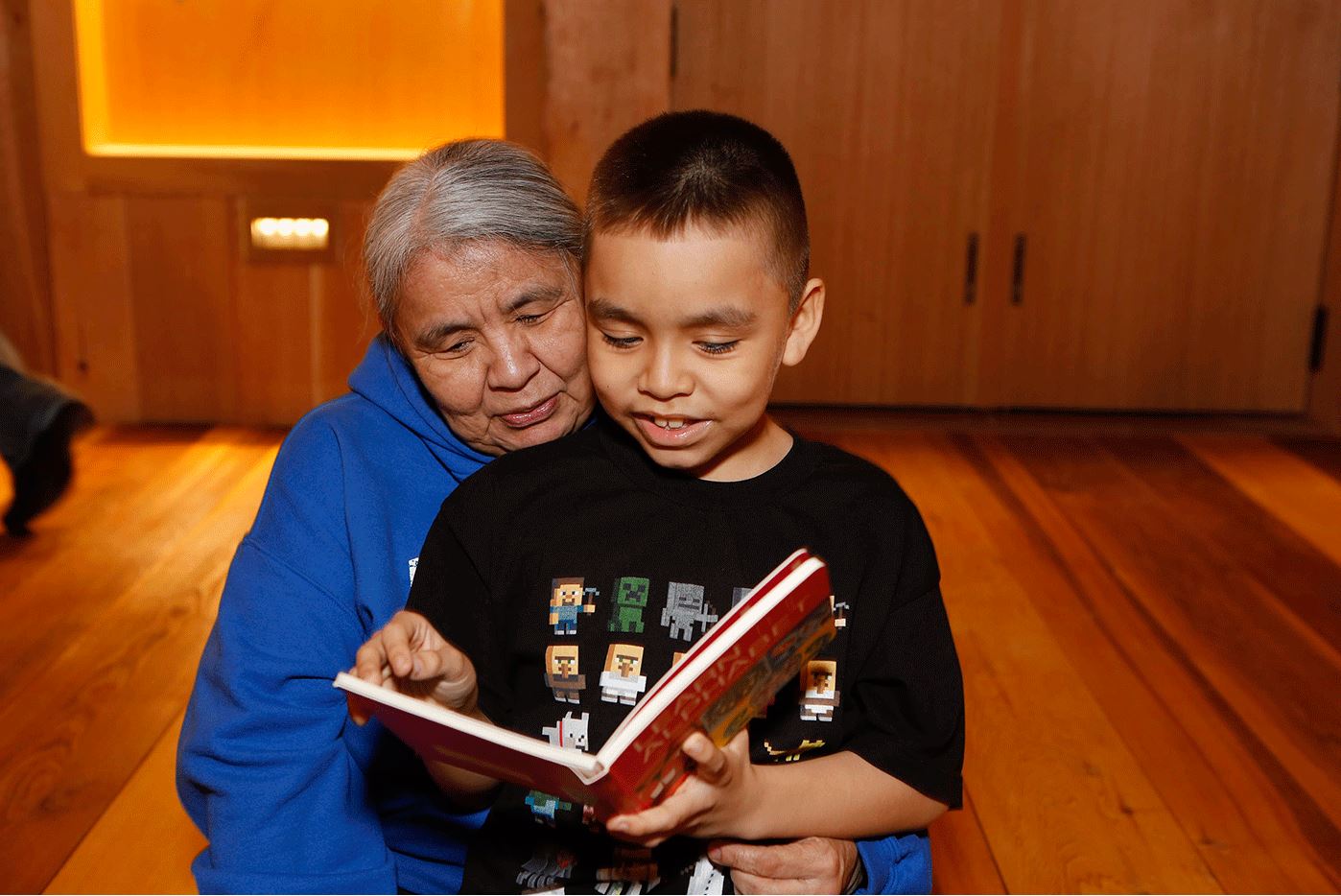
Betty Ann Samato reads a book with her grandson Bryson Stepetin at a Baby Raven Reads family night. (Photo by Brian Wallace/Courtesy Sealaska Heritage Institute)


Families and young children mill around tables in the lobby of the Walter Soboleff Building. There’s a station for coloring, one for science. Margaret Katzeek and her 2-year-old niece Elayna are at the snack table.
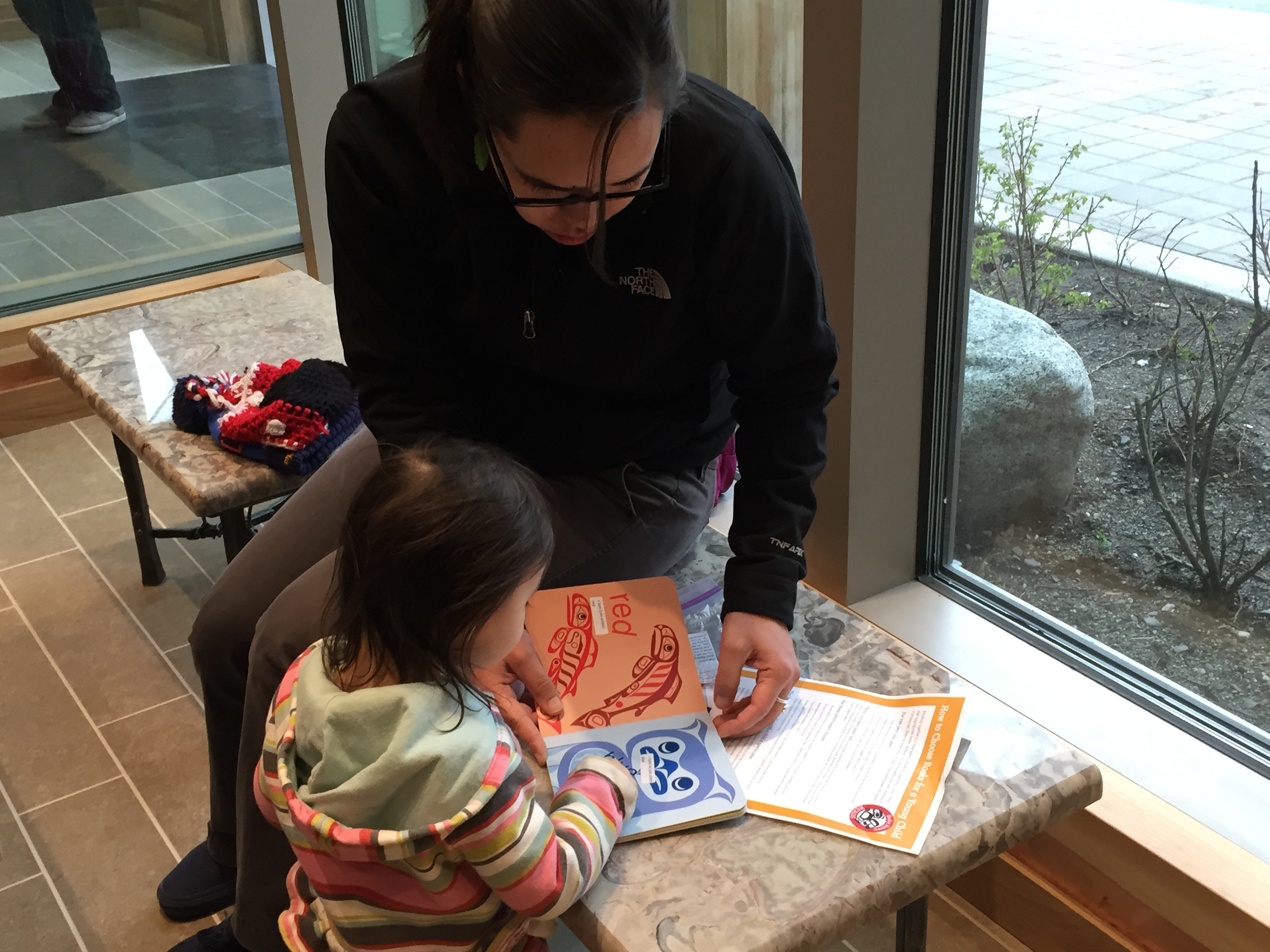
Margaret Katzeek brought her niece Elayna Katzeek to the Baby Raven Reads family night. (Photo by Lisa Phu/KTOO)

“Do you want some water?” Katzeek asks Elayna. “Do you remember what it’s called? Heen. Let’s say heen.”

This is their second Baby Raven Reads family night. The free early childhood program run by Sealaska Heritage Institute builds on the strengths of Alaska Native culture in teaching early literacy. Katzeek says they’re a fun way to learn the Tlingit language, for her niece and herself.

“They say the best way to learn something and get to know something is trying to teach it,” she says, “so I definitely work on the words that I do know, I work with her on it lot.”

But Katzeek says Elayna picks up songs better and, lucky for her, there are several that evening with language learner and teacher Mary Folletti.

Inside the clan house, about 30 children, infants to 5-year-olds, start off sitting on small rugs or on the laps of family members. Moments later, many of them are on their feet, singing, laughing and dancing along. About 40 adults sitting on the periphery watch their children, smiling. Some join in the singing.
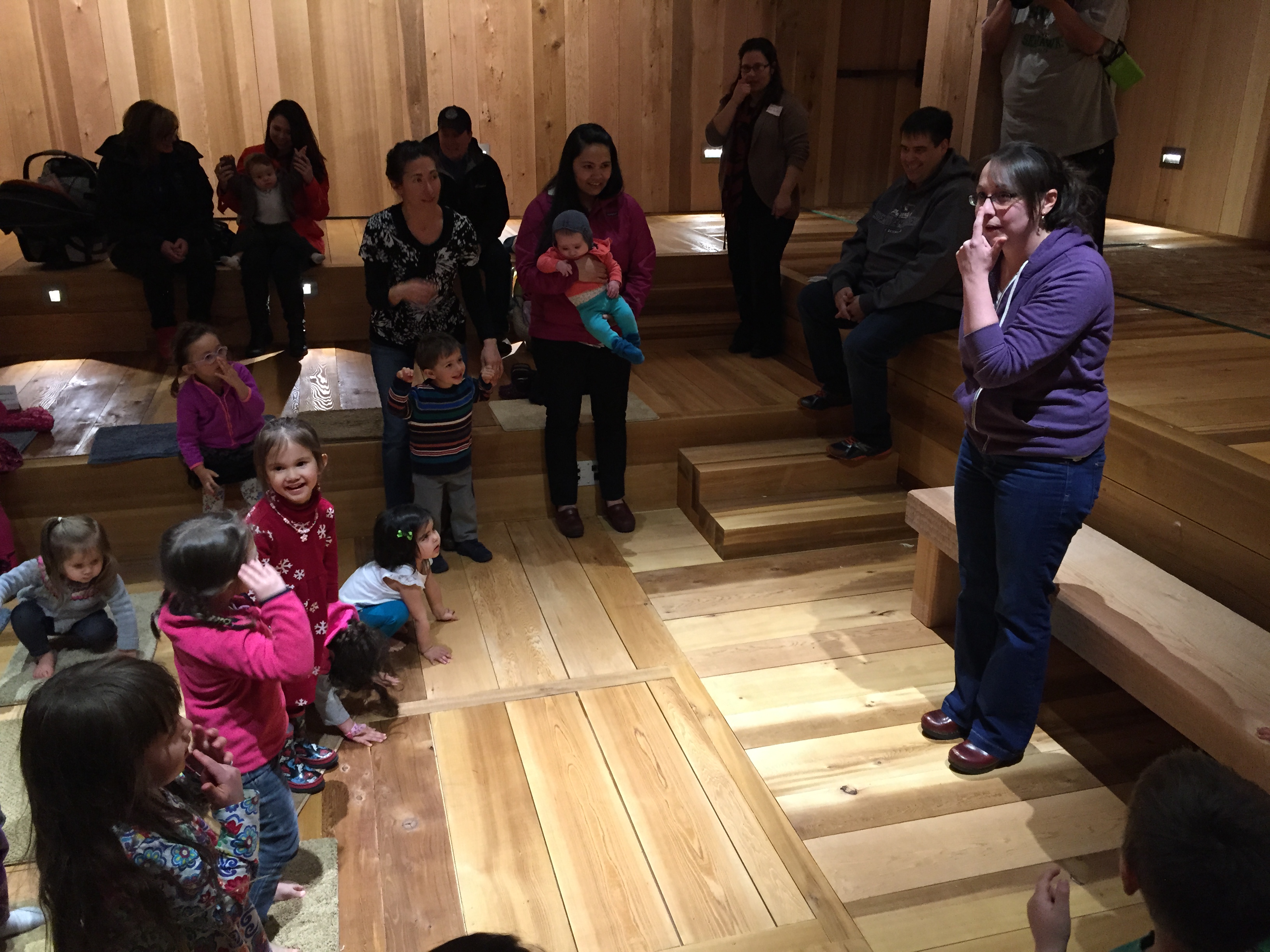
Inside the clan house at the Walter Soboleff Building, Mary Folletti sings familiar sounding songs with Tlingit lyrics. (Photo by Lisa Phu/KTOO)

Folletti leads the group in Tlingit songs to the tunes of “If You’re Happy and You Know It” and “The Hokey Pokey.” She helped translate these songs several years ago.

“Those songs are great because the kids are already familiar with them and they are the same idea. We do things different, like, ‘Dance like a Tlingit,’ but it is like, ‘Turn yourself around,’ so it’s got a lot of the same ideas,” she says.

Folletti says exposing children to the sounds of the Tlingit language is important for development.

“I know people who learn the Tlingit language when they were older and because they had never tried to make those sounds before, they’d never heard those sounds before, they physically could not make the sounds, so I think it’s important for them to hear it,” Folletti says.
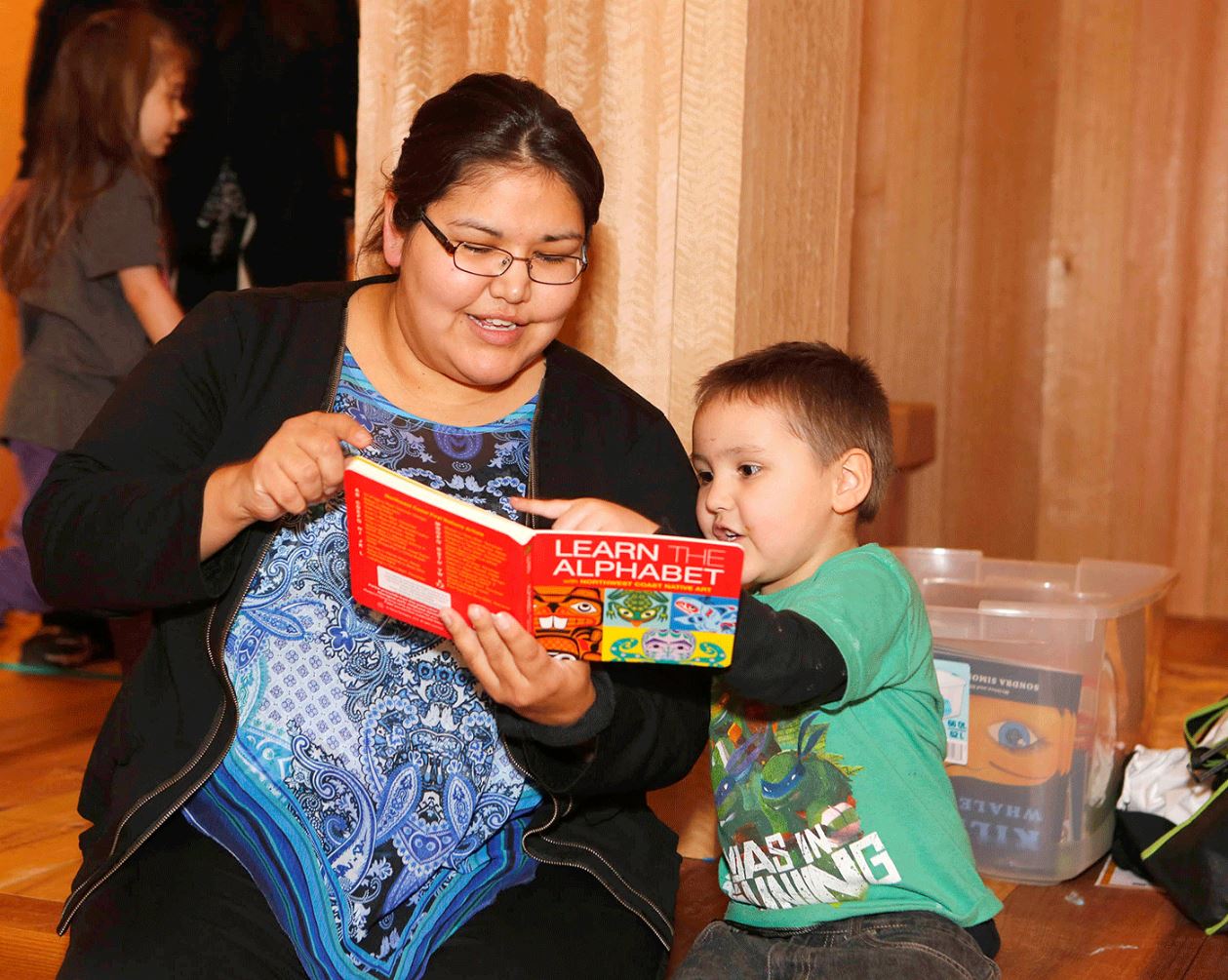
(Photo by Brian Wallace/Courtesy Sealaska Heritage Institute)

Early education specialist Karen Larson is working with Sealaska Heritage Institute. She says the Baby Raven Reads program emulates other successful early learning practices. It gives out a free children’s book at each session, like the Dolly Parton Imagination Library. It brings families together, like events organized by the Association for the Education of Young Children. And it’s all done in ways relevant to Alaska Native families.

“People are really craving cultural experiences for their children and language exposure. And then people bring their own culture to it and it grows from there,” Larson says.
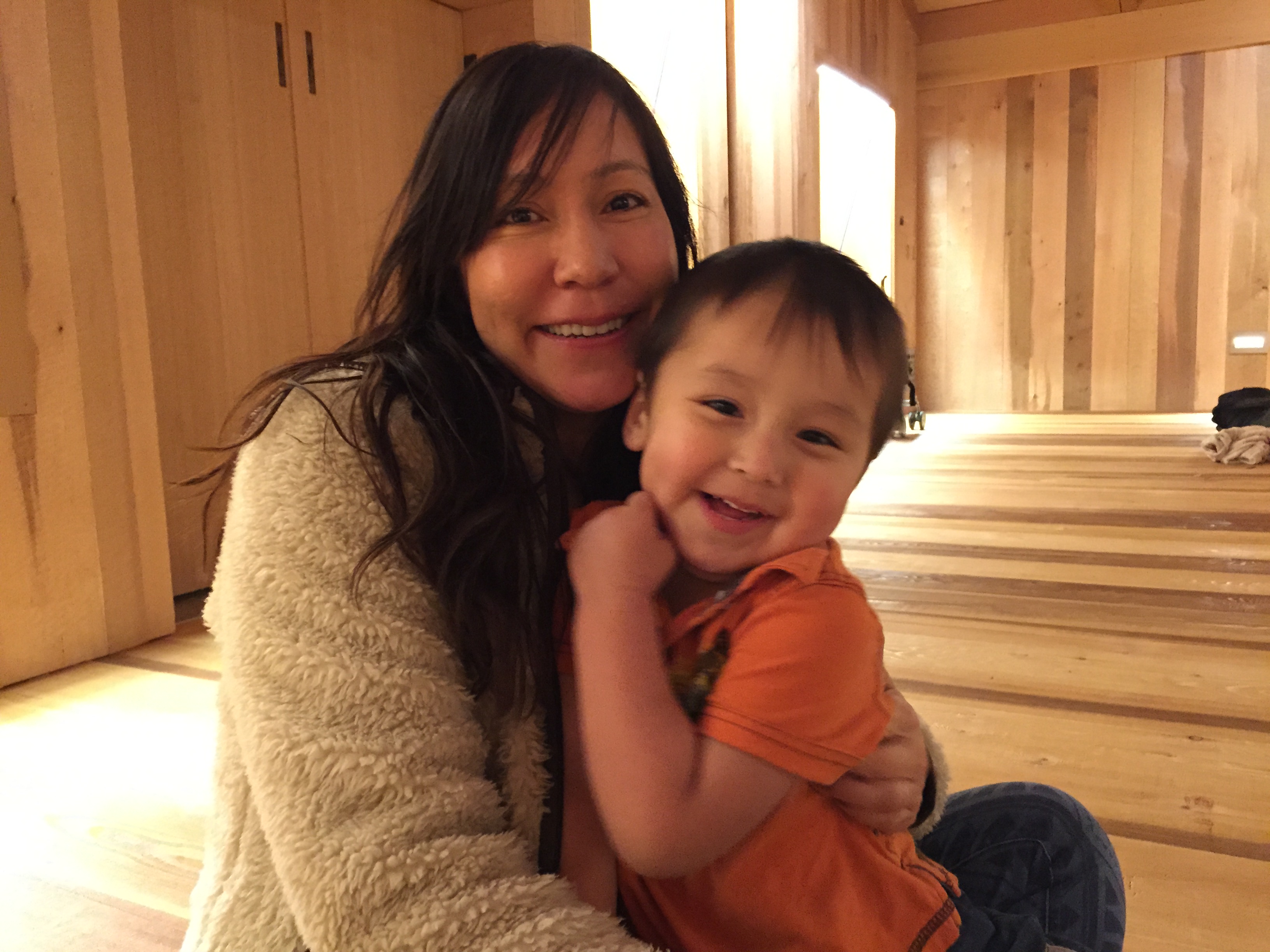
Pamela Craig and her son, Kee Night Gun Cole. (Photo by Lisa Phu/KTOO)

Parent Pamela Craig is one of those people. She’s with her 2-year-old son.

“This is exactly the kind of thing that I think he needs, to be able to meet up with his Native peers from an early age and be able to work with them and have people to talk to, especially learning language,” Craig says.

The Baby Raven Reads events are good for her as well.

“Just looking around, I have family here, my relatives and other people I’ve met through the years going to different Native events, and so it’s a good opportunity for me,” Craig says.

That’s part of the early childhood program – creating community.

Jackie Kookesh is the education director for Sealaska Heritage Institute. She hopes people like Mary Folletti will be an inspiration to parents and relatives.

“To sing along with Mary and their children and try to pronounce the Tlingit words that are in the song, that takes a lot of courage,” Kookesh says. “And so if that’s an outcome we come away with, I say that’s phenomenal, creating those safe places for the language to be in the air and to be heard and for everybody to do it together.”

Kookesh hopes the program will make more parents comfortable singing “Twinkle, Twinkle, Little Star” in Tlingit with their children. 
Sealaska Heritage Institute is hosting another Baby Raven Reads family night for Alaska Native families this Saturday, May 23. For more information, contact Jackie Kookesh at 586-9229.

Sacred architecture: Walter Soboleff Building opens its doors

The Sealaska Heritage Institute unveiled its new structure in downtown Juneau today. It’s called the Walter Soboleff Building after the late Tlingit scholar, elder and religious leader. Inside stands a full-sized replica of a traditional red cedar clan house.

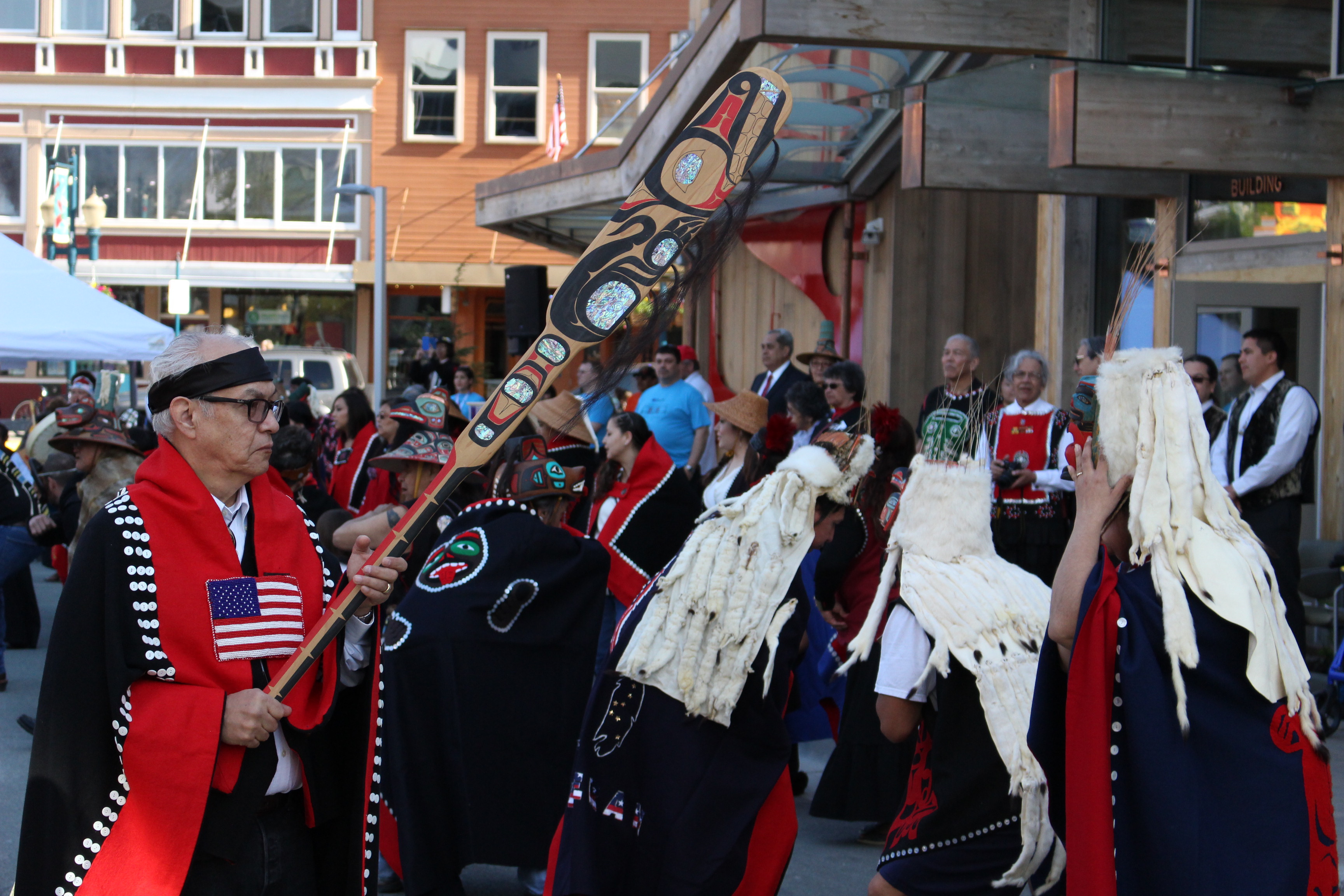
At the opening ceremony, the Aangun Yatx’i dance in their regalia in front of the Walter Soboleff building.

The Aangun Yatx’i dance in their regalia in front of the Walter Soboleff building.  (photo by Elizabeth Jenkins/KTOO)
The Aangun Yatx’i dance in front of the Walter Soboleff building. (photo by Elizabeth Jenkins/KTOO)

Davina Cole is the arts assistant here. She clutches her four-month-old baby girl tightly to her chest.

“We’re Yanyeidí from the T’aaku Kwáan area. We’re little wolves. She’s my baby pup,” she says.

Cole says she’s looking forward to what the Soboleff Building will offer her daughter. They’ve already gone to a Baby Raven Reads class before the grand opening. It teaches pre-literacy through Native stories.

“So even right now she’s benefiting from the center because it’s going to be really good for her to be surrounded by that and even have a place to go and learn that,” she says.

The building is a museum for Tlingit, Haida, and Tsimshian artifacts, a space for cultural ceremonies and it houses a gift shop. The building is part of an initiative to turn Juneau into the Northwest Native arts capital. But designing a space that could serve all those functions and reflect the past was difficult.

“When we got the responses, the designs were all very traditional,” Rosita Worl says.

Worl is the president of Sealaska Heritage Institute and a Tlingit from the Eagle moiety. She says the Native artist committee wanted a structure that was more “traditionally inspired.”

“They don’t like the word ‘contemporary,'” she says.

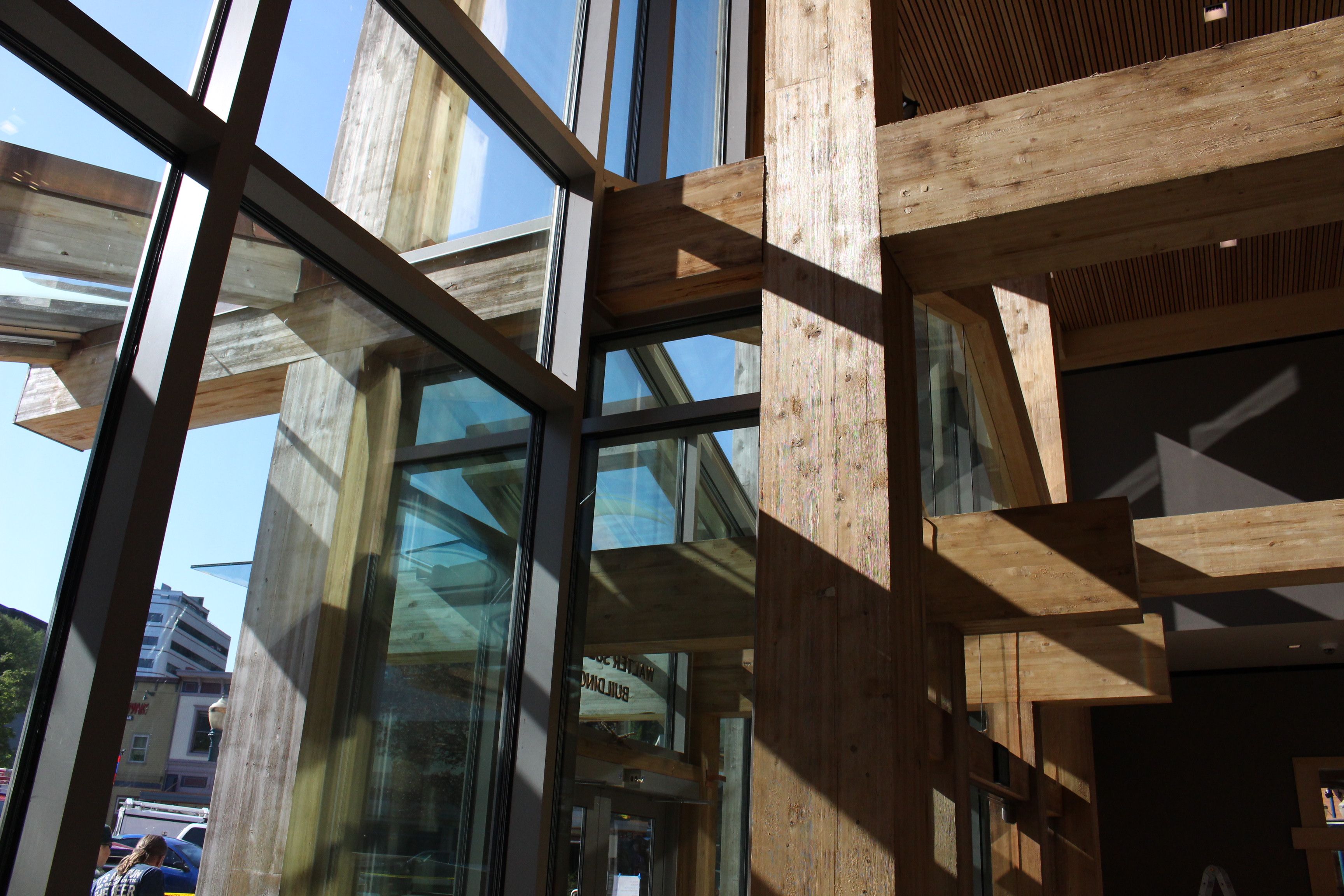
Yellow cedar beams in the entryway of the Walter Sobeloff Building. (photo by Elizabeth Jenkins/KTOO)

SHI sifted through submissions and picked architect Paul Voelckers’. The design was influenced by the form of ceremonial clan houses with chunky beams of yellow cedar. It has an open feel and a wall of glass at the entrance.

“I will tell you that we made the right decision in selecting Paul. It might not have even been the lowest bid. But we all said we got to go with him,” she says.

Voelckers is the president of MRV Architects. The firm’s founder Linn Forrest Sr. specialized in totem pole and clan house reconstruction.

“The firm has sort of tried to maintain that legacy of involvement in the cultural design issues from Southeast ever since,” Voelckers says.

Most recently, MRV worked on a clan house in Kasaan. For the Walter Soboleff Building, Voelckers looked at old photos of clan villages. Some were covered in moss from age.

“But it would have the angles of the house. You know, the big massive beams on the front. And sometimes the old house post inside. That became the essential element that was left in these villages. And so what we tried to do in the new design was capture some of that heavy framework,” he says.

The basement level floor houses the research lab and mechanical room. The whole building is heated using wood pellets.

“It simply flows down like grain or something,” he says.

The building was designed to meet the U.S. Green Building Council’s gold standard for energy efficiency. The wood pellets come mostly from the Sealaska Corp. land on Prince of Wales Island. Rosita Worl says that’s part of keeping the core cultural values in the design.

“Haa Aani: our relationship to the land,” she says.

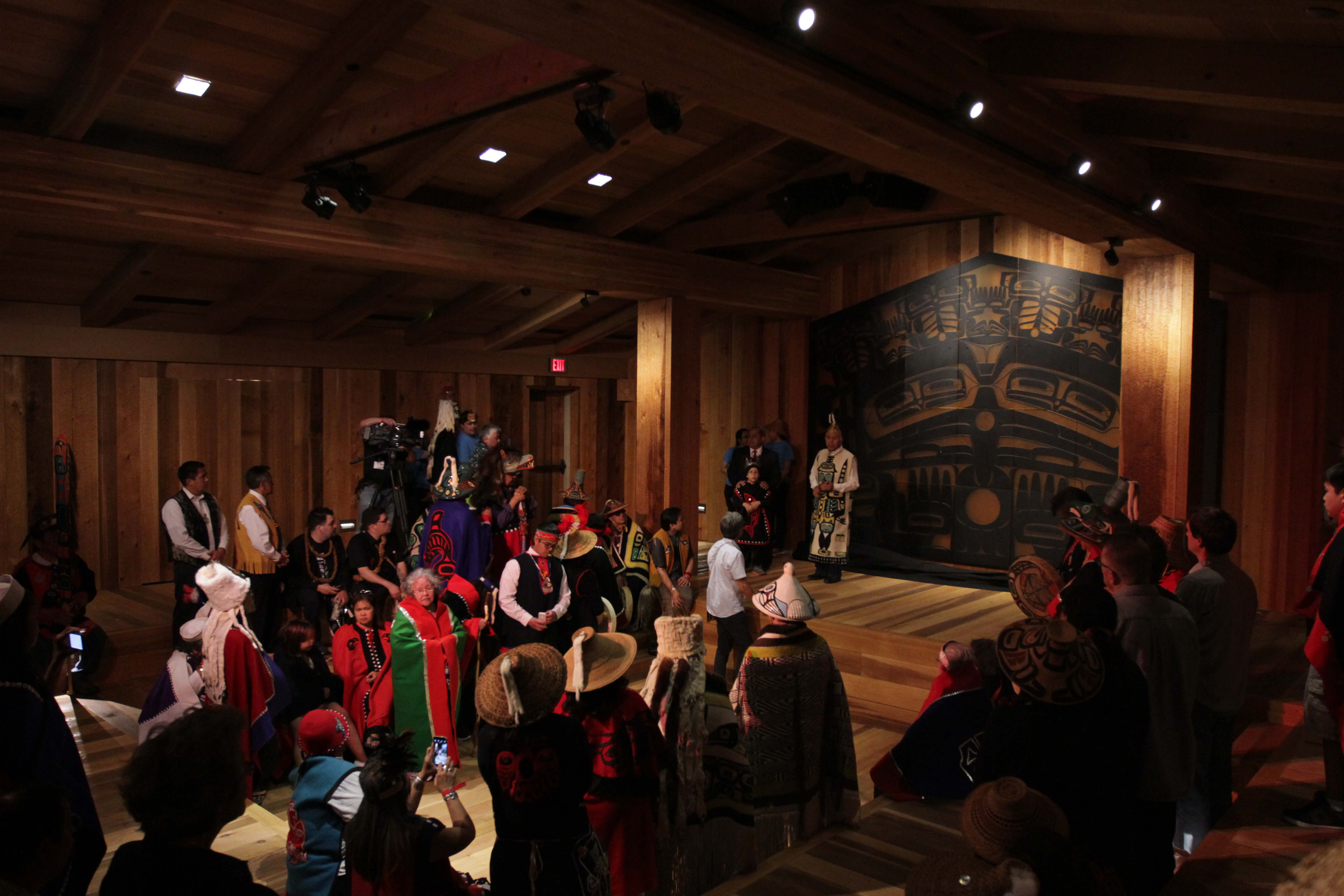
On the main floor is a full-sized replica of a clan house. It can seat 300 people and fits with tradition: pitched roof, windowless and built with adzed red cedar. The floor is tiered with sunken-in seating. Worl says she knew it would a special place.

The inside of the clan house features a traditional small door to thwart invaders. (Photo by David Purdy/KTOO)

“But what we hadn’t counted on, what I hadn’t thought about was this almost sacred feeling that you get when you go into that clan house.”

Worl says she has a strong connection to her ancestors.

“And it was almost like they were saying to us, ‘Rosita, you know you’re talking about being progressive, you want to move into the 21st century.’ It almost became like their space and they said, ‘This is where we are.’”

At the the Walter Soboleff’s closing ceremony, the clan house was given the name Shuká Hít.

Site notifications
Update notification options
Subscribe to notifications