Archives for:

"Baby Raven Reads"

Ketchikan Charter School students use theater to tell Indigenous stories

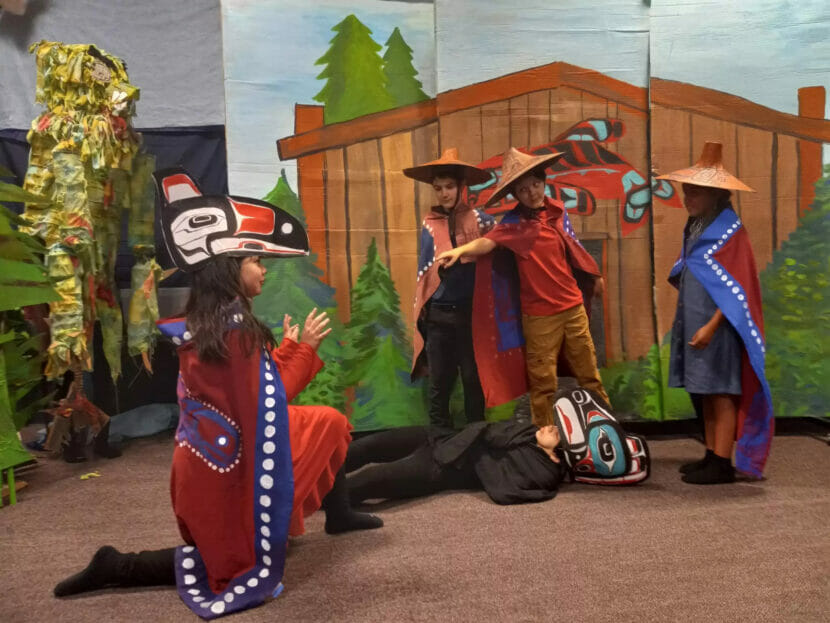
From left to right, Madison Ryan, Chance Side, Isaak Simerly, Mallory Willard Flanery and Olivia Heisler Hinahon act out a scene in “How Devil’s Club Came to Be.” (KRBD photo/Raegan Miller)

Two Indigenous stories came to life on stage at Ketchikan Charter School. Students turned “Killer Whale Eyes” and “How Devil’s Club Came to Be” into short plays featuring handmade props and formline the students learned from an artist-in-residence.

Paddling a cardboard canoe, the student actors are exploring the ocean. They’re looking for their classmate, the one who turned into a killer whale. Pods of hand painted cardboard orcas bob and weave in an ocean of royal blue cloth shaken by the students.

In another play, a student fights a monster who is stealing their tribe’s shaman. The heroine visits the Thunderbird people. She defeats the giant.

Then the metaphorical curtain came down, and they were all kids again, acting out traditional Indigenous stories as plays. The stories, written in those forms by Sondra Segundo and Miranda Rose Kaagweil Worl, are part of Sealaska Heritage Institute’s Baby Raven Reads program.

Halli Kenoyer is an art teacher at Charter School. Her class designed the props, and drama students in Erin Henderson’s class wrote the scripts. She applauds the students’ work.

“I mean, look at their formline,” Kenoyer commented.

Student Amelia Loeffler helped make a lot of the props — she proudly states she learned how to use an Exacto knife. Loeffler says her favorite of the two plays is “How Devil’s Club Came to Be.” That story follows Raven’s niece as she battles a giant who had been taking the village shaman. She discovers devil’s club and its medicinal properties along the way.
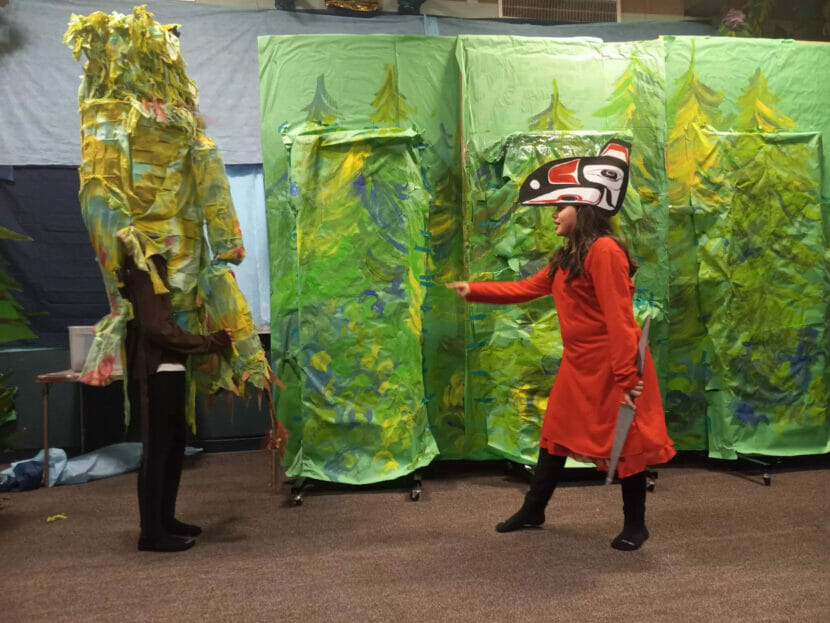
Sophia Weston and Madison Ryan act out a scene in “How Devil’s Club Came to Be.” (Raegan Miller/KRBD).

“It’s sort of fun to see how different cultures are,” she said.

Riley Presnell also helped bring the scenes to life.

“I think I really like painting,” he said. “I really like painting the canoe. I really liked painting the blanket.”

Kai Clevenger, a Lingit student, is the daughter of Kevin Clevenger, the school’s artist-in-residence. She helped create the formline that appears on the props. The seventh-grader says it’s important to her to see her culture taught and celebrated in school.

“I like how my culture is communicating with other, like, stuff now,” Clevenger explained. “And l like how my culture is like out there now.”

Student Ryan Boling also worked backstage. He says the fact that they’re traditional stories is what makes it special.

“I feel like Native stories need to get out there more than they are,” Boling said.

Bringing the stories to the stage was a community effort, Kenoyer says, with help  from Ketchikan’s tribe staff. That included Irene Dundas, Ketchikan Indian Community’s cultural resources coordinator.

Fourth- and fifth-graders were able to pitch in, too. Kenoyer says the school’s artist-in-residence had taught the younger kids about formline design, which came in handy.

“And when we ran out of time to work on our props, fifth grade and fourth grade did our designs on the paddles, they worked on the button blankets,” she said. “They worked on the designs for all of the hats. And it was all on account of working with Kevin Clevenger that they knew how to do this. They were really excited to participate.”

That was one of the most satisfying parts of the production process, Kenoyer says.

“It was really cool to see that just that ripple effect of a really great program come into play in our little theater project,” she added.

The students performed their plays for classmates and community members, including the staff of Ketchikan’s local theater. They received a rowdy chorus of applause.
In ‘Berry Song,’ Lingít illustrator Michaela Sheít.een Goade shares her own story

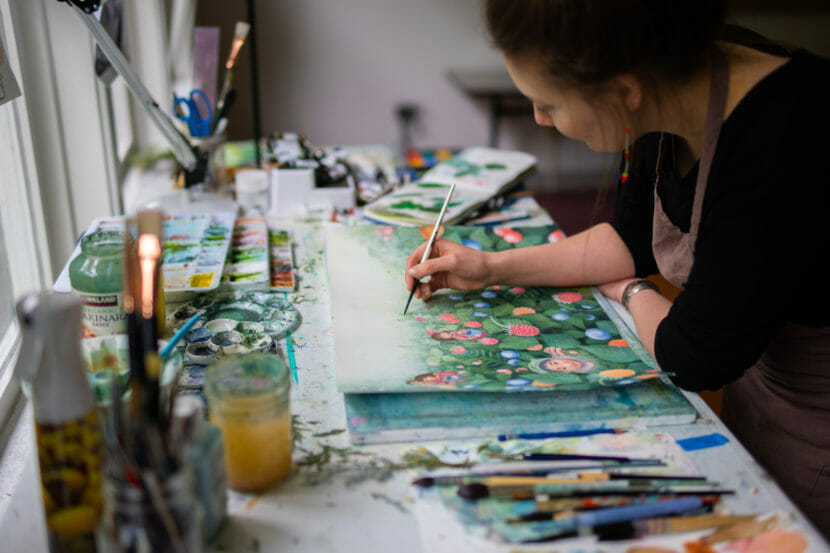
Michaela Goade working on an illustration for her new book, Berry Song (Photo by Bethany Goodrich).

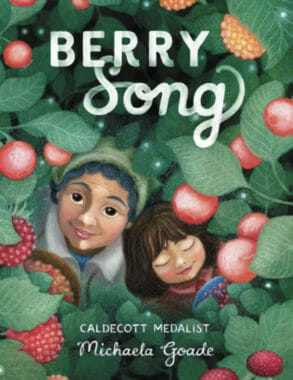
Lingít illustrator Michaela Sheít.een Goade released her first self-authored picture book this week. “Berry Song” was an opportunity to tell her own story and create images inspired by her homelands.

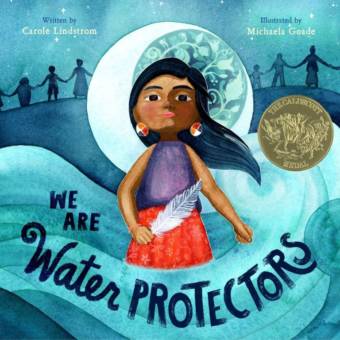
Goade began her career as a picture book illustrator at Sealaska Heritage Institute as part of the Baby Raven Reads program. She has since worked with authors from many different Indigenous nations. The books she illustrated were picked up by major publishers, and in 2021 she was awarded the Caldecott Medal for her illustrations in “We Are Water Protectors,” by Carole Lindstrom.

“And so everything just sort of expanded,” Goade said. “I was able to learn about all of these different cultures and places around the country and into Canada.”

With “Berry Song,” Goade brings her focus back to Alaska. The story and the imagery are inspired by her childhood here in Lingít Aaní, where she was born and raised. It is also the first book that Goade has both written and illustrated herself.


She says it took her some time and experience with the format before she felt ready to tell one of her stories in a picture book.

“Because it’s its own unique art form,” she said. “It has things like the page turn and pacing and narrative storytelling and all of these different elements that I wasn’t familiar with.”

Cover of “Berry Song,” written and illustrated by Caldecott Medalist Michaela Goade

And after helping other authors bring their stories to life with her pictures, she found comfort in illustrating the familiar scenes of Southeast Alaska.

“Getting to work on “Berry Song,” going into the experience of writing the story and then illustrating it, it just felt like coming home. Like I could take all of that experience and return to where I started illustrating and where I grew up.”

Goade hopes “Berry Song” will add to greater inclusivity and representation of Indigenous people in the publishing world. She also wants to help readers understand more about the lifestyle, cultures and land in the Tongass National Forest.

“It’s such a special, unique and incredibly important ecosystem and part of the world,” she said. “Trying to share some of that with a wider audience has been very inspiring.”

The full interview with Goade is available here.

Finding activism through art: A Q&A with Tlingit illustrator Michaela Goade

Sitka illustrator Michaela Goade, who is Tlingit, made headlines twice this winter. Once for her Google Doodle of Tlingit leader Elizabeth Peratrovich, and once for illustrating the children’s book ‘We are Water Protectors,’ for which she won the Caldecott Medal, one of the highest honors in children’s literature. (Photo by Sydney Akagi)

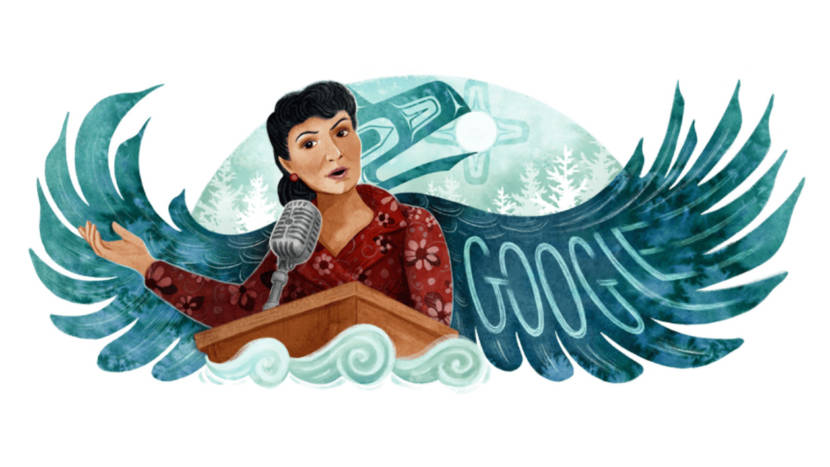
Sitka illustrator Michaela Goade received national attention in December for her Google Doodle of Alaska Native leader Elizabeth Peratrovich, whose legacy is honored annually on Feb. 16. Goade made headlines again last month as the first Indigenous person to win the Caldecott Medal, one of the highest honors in children’s literature. Following news of her award, KCAW’s Erin McKinstry interviewed Goade about her work illustrating “We are Water Protectors” and what inspires her as a Tlingit artist.

KCAW: Your illustrations are just so bright and colorful and captivating. It’s hard to find the right words to describe them, but I just wondered, where do you get inspiration for your art from?

MG: From growing up here, really. I get a lot of ideas when I’m out on walks or just out on the water. I take a lot of photos. I make a lot of notes to myself on my phone. Just things that I see around me. Other than that, you know, culture, culture is a huge inspiration. And I started on this picture book journey back working with Sealaska Heritage Institute in 2016 or 2017. And they were getting started on their Baby Raven Reads program. Before those projects, I had never really picked up watercolors much or never illustrated. And picture books are their own unique art form. So we were all figuring it out together. And when I didn’t know what I was doing, essentially, the fact that these stories were rooted in culture and in place and were something I felt on a really deep level, that really helped me through that process. And I think that’s just naturally carried over. And now I’m working with Indigenous authors from different parts of Canada and the U.S., and just having the similar core themes across the board.

KCAW: What made you want to work on “We are Water Protectors” specifically, this book that you won the Caldecott for?

“We are Water Protectors” urges activism to protect water and other natural resources. Author Carole Lindstrom was inspired by Indigenous led movements like the 2016 demonstrations against the Dakota Access Pipeline. (Cover illustration courtesy of Michaela Goade)

MG: Well I think upon first reading Carole’s story, I knew that I wanted to work on it. Just the way she wrote and what she was writing about. I’m sure we can all relate here, just growing up in Southeast Alaska, being Tlingit, like people of the tides. Water is a way of life here, and it is is our life here in so many different ways. So that core theme really resonated. And I remember, like Carole, feeling helpless in 2016 during the gathering, the Stand at Standing Rock, and I remember feeling helpless. And at the time I was a bit younger, and still working up in Anchorage. So it was just, how can I help. I’m not a super vocal person. I shy away often times from those more extroverted things, so it was awesome to have an author write the story. And then activism through art is something that I’ve really learned through this book.

KCAW: Sure, what are some things that you hope that parents and their kids take away after reading this book?

MG: You know, I hope that people take away the message that we are all connected to each other and to the land. And that this fight for protecting our waters and our lands and mother earth shouldn’t just be on the shoulders of Indigenous people as it historically has been. And so just first and foremost to encourage people to look at their own relationship with the land and water and how might they take some more steps in their life to become better land stewards and then raise awareness of these really important Indigenous-led movements that are happening. And then also, to help Indigenous children feel seen and validated and adults. And to know that their voices and their stories are worthy of everyone lifting them up. And just to feel valued in that way. Because that is very important. Representation is so important. And for non-Native people as well. To see these books find success and find wide audiences, so that’s really, really affirming and really rewarding.

KCAW: So sort of the big national headline is that you’re the first Native American to win the award. Do you identify as Native American? Do you identify as Indigenous? Alaska Native? Native?

MG: I appreciate the question because I don’t get that question very often. I just get labeled. I identify as Tlingit and I also identify often as mixed Tlingit. Because it’s important to identify that I’m also white. So it can be a little strange to see the first ‘non-white.’ That’s just a tricky label, you know. I like to amplify as much as I can and lift up communities as much as I can. So I’m really honored by the recognition and the award. And the knowledge that I’m helping open doors for more people.

And I think it’s important to look at that and digest it and acknowledge and reflect on being the first in the award’s 83-year history. I think I remember reading, I didn’t know this, out of the 83 years, only 21 years has the award gone to a woman. And then I’m the only BIPOC (Black, Indigenous, Person of Color) female to get that award. It’s just interesting to look at that and reflect on that while also just being excited for the future and just know that there have been a lot of big strides in the publishing industry in the last few years and to acknowledge that. And I am really grateful to be sort of entering this industry now. Because from what I’ve been told, it was even a lot different 5-10 years ago. So it’s really great timing too, and I think that is worthy of note. I feel very grateful for that.

Google Doodle of Alaska Native civil rights icon Elizabeth Peratrovich by Michaela Goade (Source: Google)

KCAW: I wonder if you’ve gotten any feedback from Indigenous parents or children on the book that you would like to share that’s been particularly heartening to you?

MG: I can’t think of anything big. Oftentimes, it’s just these personal messages you receive from parents or families. Like when the Google doodle came out that I worked on that had Elizabeth Peratrovich. Just seeing and receiving little comments like I am so proud to be Native today, or I am so proud to be Tlingit today or my Tlingit or my Native children were so excited to show this to me. Those sorts of personal little messages feel more real or I guess significant than maybe the big recognitions. So just receiving little things like that over the last few days, that has been really great.

New Baby Raven Reads books include story written by Juneau elementary students

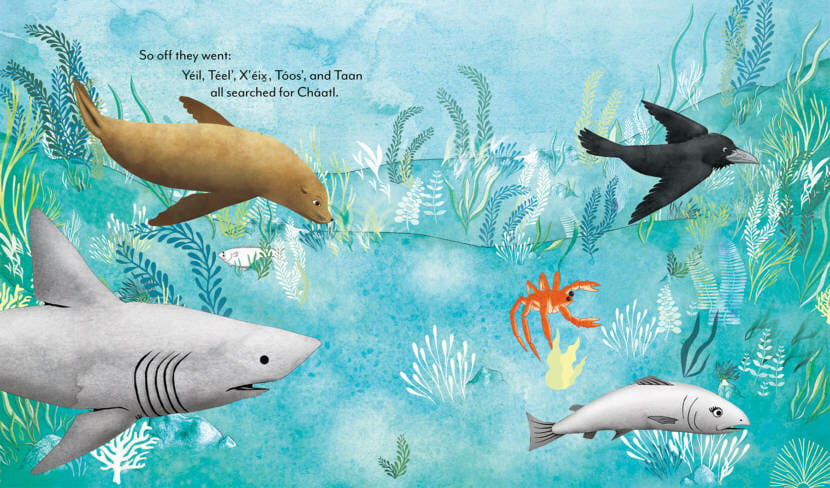
In “Raven and The Hidden Halibut,” Raven (Yéil) enlists a group of animal friends to help find Halibut (Cháatl). (Image courtesy Sealaska Heritage Institute)

Sealaska Heritage Institute has published four new books to bolster its efforts of teaching Indigenous language and culture to kids. One is an original story written by kids from Harborview Elementary School in Juneau.

In “Raven and The Hidden Halibut,” two animals that are complete opposites want to play with each other.

“Halibut really wants to play with the Raven and has to talk him into it, and they end up playing hide-and-seek. And Halibut, as it turns out, is a very good hider,” said Katrina Hotch, who worked with the students who wrote the original story.

In the story, Raven enlists a group of ocean creatures to help look for Halibut.

“Raven, or Yéil, works with Téel’, dog salmon, Náakw, octopus, X’éix, king crab, Tóos’, salmon shark and Taan, sea lion,” said Hotch.

Hotch says it’s a testament to the strength of the school district’s Tlingit culture, language and literacy program that the students wrote the story.

Now the book is available through Sealaska Heritage Institute’s Baby Raven Reads program, along with three other books published entirely in Indigenous languages. Two of them are in Lingít, and one is in Sm’algya̱x.

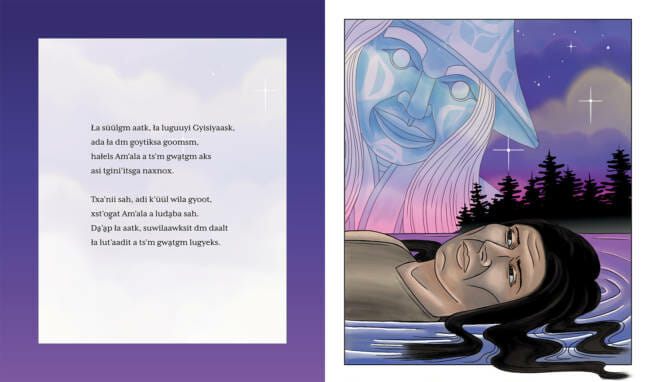
Am’ala (Sm’algya̱x) is one of the newly translated books recently published by SHI. In this traditional Tsimshian story, a young man who is teased by his brothers for being lazy and dirty trains secretly with a spirit and gains superhuman strength. He takes on warriors, animals, and even a mountain before facing his greatest challenge – the world itself. (Image courtesy Sealaska Heritage Institute)

Tess Olympia is the program’s manager. She says it all started in 2014 as a pilot project in Juneau.

“And it was very successful,” Olympia said. “After that, it was able to expand to nine communities in Southeast Alaska through partnership with Tlingit & Haida Head Start programs.”

Olympia says three of the books are the first to be published by Sealaska entirely in the region’s native languages.

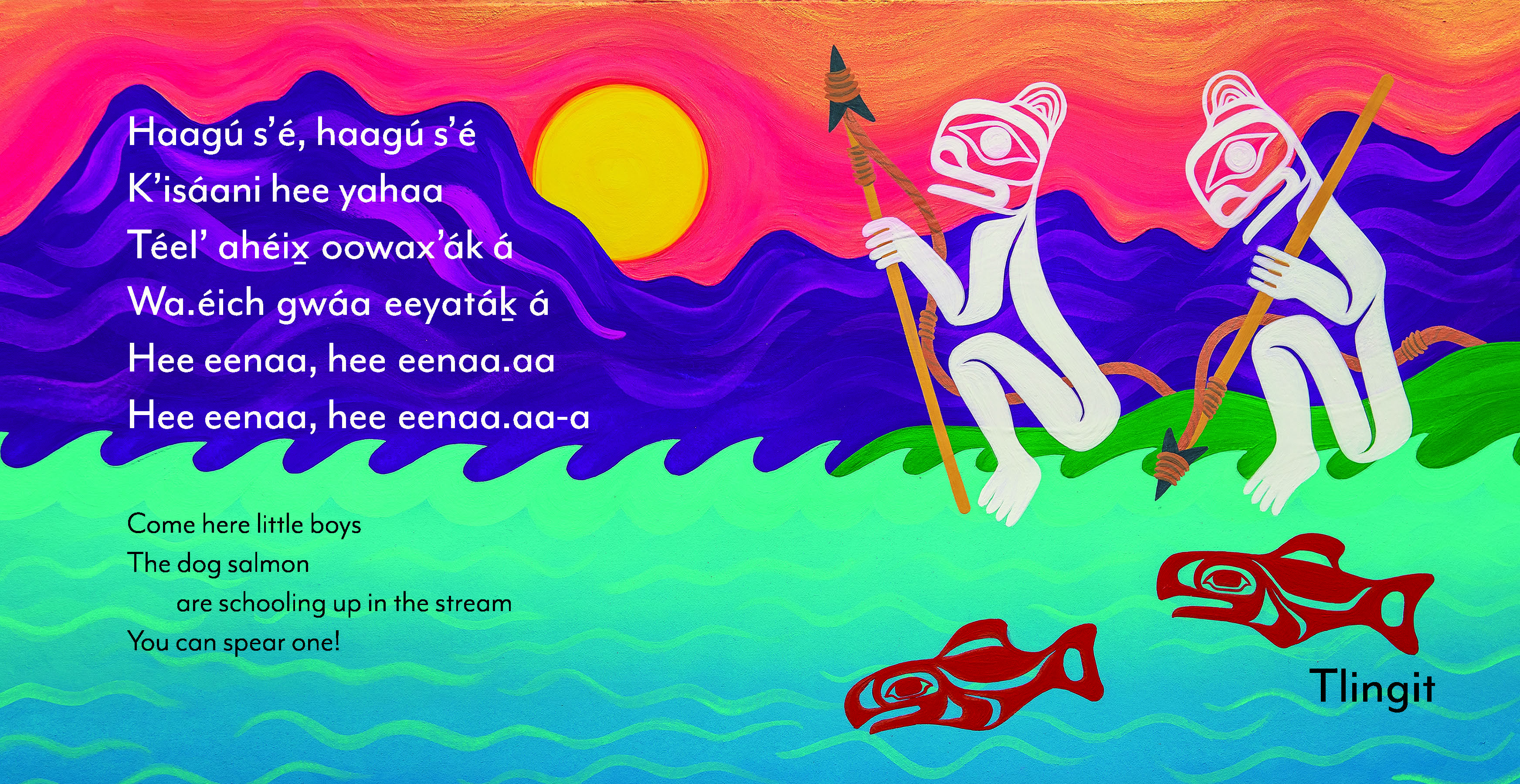
Nax̱too.aat! (Let’s Go!) teaches about Tlingit, Haida and Tsimshian subsistence harvesting activities. (Image courtesy Sealaska Heritage Institute)

“We have a lot of language learners that have been asking for this. So we’re excited to be able to be at the point with our publications, that we could make that happen,” she said.

Olympia also says the program is currently serving more than 350 children throughout Southeast Alaska. In December, the institute mailed out 1400 books to families. And more than two thirds of those families report reading daily.

Olympia says she’s gotten feedback from families all over the region who are touched to have these stories in their home.

“When they didn’t grow up with stories, like books, to represent their own selves and their own culture and their homes and so, it’s finally this opportunity to have to have that happen. And for children to see themselves in the stories, it’s very validating,” she said.

As for whether Raven was able to find Halibut, readers can find out for themselves. The new books are available to buy from the Sealaska Heritage Store.

Sealaska Heritage to release new trilingual collection of lullabies as children’s book and CD

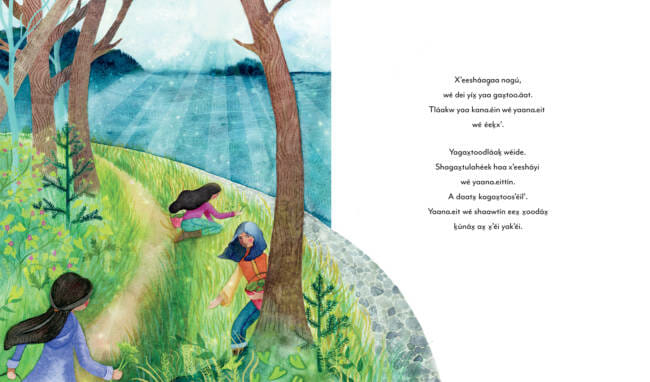
This is a page from Sealaska Heritage Institute's new trilingual book of lullabies called "Cradle Songs of Southeast Alaska," to be released Dec. 6, 2019. This lullaby is attributed to Ḵaal.átk’ Charlie Joseph and adapted by Ed Littlefield, and the illustration is by Crystal Kaakeeyáa Worl.
This is a page from Sealaska Heritage Institute’s new trilingual book of lullabies called “Cradle Songs of Southeast Alaska,” to be released Dec. 6, 2019. This lullaby is attributed to Ḵaal.átk’ Charlie Joseph and adapted by Ed Littlefield, and the illustration is by Crystal Kaakeeyáa Worl. (Courtesy of Sealaska Heritage Institute)

Sealaska Heritage Institute announced Tuesday that it’s releasing three new children’s books, including its first trilingual one.

“Cradle Songs of Southeast Alaska” features lullabies in the languages of three Southeast Alaska Indigenous groups:

  • the Lingít language of the Tlingit,
  • the Xaad Kíl language of the Haida, and
  • the Sm’algyax language of the Tsimshian.

There are three songs in each language, each accompanied with English translations. They’re sung or performed in spoken word in a companion CD.

“Like parents throughout the world, the Tlingit, Haida and Tsimshian sang lullabies to their infants,” SHI President Rosita Worl said in a press release. “These lullabies and the graphic designs introduce children to their culture, land and rich environment in which we live.”

Worl also said that sharing songs in this way is unusual.

“Most songs in Southeast Alaska Native cultures are restricted from general public use because of clan or family membership,” Worl said. “We are able to offer these beautiful songs because they are in the public domain or original works.”

The other two books to be released next week are Xaad Kíl and Sm’algyax versions of a previously released book about learning colors in Lingít. The new books will be distributed to families enrolled in SHI’s Baby Raven Reads program. They’ll all be available to purchase at the institute’s online store.

To date, the Baby Raven Reads program has published 25 books. The program promotes literacy, language and school readiness for preschool-aged children. It began in Juneau in 2015 and has expanded to other Southeast communities.

The new books will be released during the Dec. 6 Gallery Walk in Juneau. SHI will also host a Baby Raven Reads event open to the public that night.

Southeast Alaska Native literacy program expands

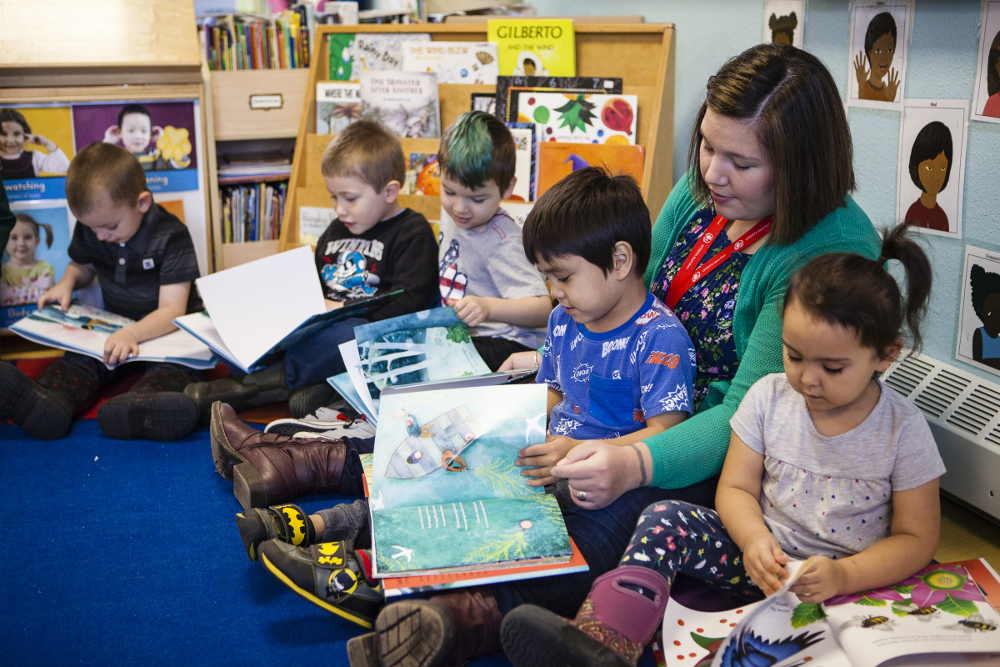
Tlingit & Haida Head Start teacher Kayla Tripp and her class look through six new Baby Raven Reads books Oct. 20, 2017, after they were delivered by Sealaska Heritage Institute staff. (Photo by Nobu Koch/courtesy Sealaska Heritage)
Tlingit and Haida Head Start teacher Kayla Tripp and her class look through six new Baby Raven Reads books Oct. 20, 2017, after they were delivered by Sealaska Heritage Institute staff. (Photo by Nobu Koch/courtesy Sealaska Heritage)

A Southeast Alaska Native cultural organization is expanding a children’s literacy program into nine other communities in the region.

The Sealaska Heritage Institute announced this week it will be partnering with the Central Council of Tlingit and Haida Tribes of Alaska’s Head Start to offer the Baby Raven Reads program in communities around Southeast.

Baby Raven Reads promotes literacy, language skills and school readiness for Alaska Native preschool-aged children.

A pilot program in operated in Juneau for three years but ended this year.

The organization’s education program manager Katrina Hotch said it initially was aiming to reach 50 families in Juneau, but ended up serving 190 families.

The program uses nearly 20 books published by Sealaska Heritage, featuring Native authors and artists.

But Hotch said training has been an important piece.

“The books were a part of the program but there were monthly family literacy nights and different trainings that happened throughout the year so helping parents to learn literacy exercises to do at home and training for early educators and different family members, I think that was a really impactful piece of it,” Hotch said.

The institute plans to offer family literacy events along with training sessions in Angoon, Craig, Hoonah, Klawock, Petersburg, Saxman, Sitka, Wrangell and Yakutat.

Some of the first events could be as soon as this January.

Hotch calls it an exciting development.

“I know we got a lot of responses you know and events would go up on Facebook and people would say when is this going to happen in my village and now we’re going to get to bring it to the outlying communities,” Hotch said. “So that is pretty exciting.”

As part of the expansion, Sealaska Heritage plans to publish another nine children’s books over the next three years. Those are given out free to Native families in the program.

Two of the most recent book offerings feature illustrations by Haida artist Janine Gibbons of Petersburg.

They’re also available to purchase on the institute’s website. Sealaska Heritage also is looking for other authors and illustrators for future publications.

The effort is funded with a grant from the U.S. Department of Education. It was among 15 programs in the country honored this year by the Library of Congress for implementing best practices for literacy promotion.

Sealaska Heritage is a private non-profit formed by Sealaska, the regional Native corporation. It aims to perpetuate and enhance Tlingit, Haida and Tsimshian cultures.

Site notifications
Update notification options
Subscribe to notifications