When the Interior Department axed a proposal last winter to build a gravel road through the Izembek National Wildlife Refuge, conservation groups cheered.
Now, eight of them are stepping up to defend the government’s decision in court.
The Sierra Club, the Audubon Society and Wilderness Watch are among those joining Interior Secretary Sally Jewell in a federal lawsuit. According to a recent filing, the groups will focus their arguments on “protecting the exceptional wilderness and wildlife values of Izembek.”
The lawsuit was originally brought forward by local governments, tribes and residents of King Cove and Belkofski.
They’ve been fighting to construct a road through the refuge for decades. When the Interior Secretary turned it down, they argue that she violated her trust responsibility to Alaska Natives — and federal law.
The court has agreed to let the State of Alaska join the lawsuit and help King Cove make its case for road access.
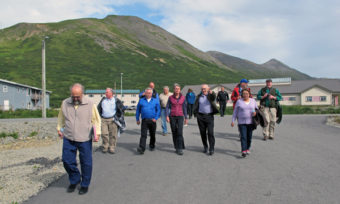
Interior Secretary Sally Jewell in King Cove. (Photo by Annie Feidt/APRN)
Tribes, local governments, and residents from the King Cove region are suing federal officials for denying them the right to build a road through a wildlife refuge.
King Cove residents have been arguing for years that the road would be the easiest, safest way to get to emergency medevac flights at the all-weather airstrip in Cold Bay.
They didn’t stop arguing when Interior Secretary Sally Jewell decided not to allow a land swap in the Izembek National Wildlife Refuge in December. That had been the best hope for getting a road built.
“We’re at the point where we can’t let this go, and we’ve got to keep moving forward,” says Della Trumble.
She’s a spokeswoman for the King Cove Corporation and the Agdaagux Tribe. They are two of the plaintiffs in a lawsuit that was filed Wednesday in United States District Court in Anchorage.
The complaint alleges that the Interior Department’s decision to reject the road violates the Constitution and several federal laws, including the National Environmental Policy Act and the Alaska National Interest Lands Conservation Act.
This isn’t the first legal action by advocates of the road. In April, the State of Alaska announced that it may sue the federal government for a right-of-way through the refuge based on historic use.
But Della Trumble says that’s a separate case.
“They are related in some ways, but they are not the same,” Trumble says. “Part of this lawsuit is basically that saying that the EIS that was submitted to the Secretary is inaccurate.”
Trumble is referring to the environmental impact statement, which was completed in 2013. The Interior Secretary used that document to make her final determination on the land swap.
Trumble argues that the EIS didn’t provide a full picture.
“The EIS technically falls heavily on the side of the US Fish and Wildlife in regard to the wilderness,” Trumble says. “It does not take into consideration the human factor and the health and safety issues that revolve around it, as directed by Congress.”
This spring, Trumble and several other King Cove officials traveled to Washington, DC. They wanted to lobby the Interior Secretary to reconsider her decision. In return, Secretary Jewell requested a report, explaining why a road is the only viable option to get from King Cove to Cold Bay during medical emergencies.
Trumble says the King Cove group turned it in almost two months ago.
“But we have not had any communication or response from [Jewell] to this point,” Trumble says.
That’s not acceptable, according to Robert Dillon. He’s a spokesman for Senator Lisa Murkowski, who has criticized the Obama administration for its handling of the road.
“They want the people of King Cove to go away and stop bothering them,” Dillon says. “And that’s the most important thing – is to keep reminding them that this issue remains alive and that the people of King Cove are not going to go away until their children and families are safe.”
A representative for the Interior Department declined to comment because of the pending litigation.
The defendants on the lawsuit include Interior Secretary Jewell, along with the assistant secretaries for Indian Affairs and Fish, Wildlife and Parks. Employees of the U.S. Fish and Wildlife Service and the Izembek refuge are also listed.
Interior Secretary Sally Jewell in King Cove. (Photo by Annie Feidt/APRN)
Over the last year, residents of King Cove have been ramping up their campaign to build what they say is a life-saving road through the Izembek wildlife refuge.
The issue has made national news. Alaska’s lawmakers have taken up the fight in the state legislature and in Congress. And now, the issue may be headed for court.
“Before the state can legally file suit against the federal government, it has to give notice to the affected agency,” Kent Sullivan, an assistant attorney general for the Alaska Department of Law, said. “That’s what the state’s done with this recent filing against the secretary of the interior and the department of homeland security.”
The notice says after the 180-day waiting period, the State of Alaska may sue to set up a right-of-way through the Izembek National Wildlife Refuge.
The federal government would still own the land, but King Cove residents would have the right to pass through it. Sullivan says the state would probably take that a step further, and argue that villagers should have the right to build a road through the refuge as well.
Della Trumble is a spokeswoman for King Cove’s tribal council and village corporation. She says residents have been crisscrossing the refuge for generations.
“It has to do with hunting, fishing, and trapping that the people have done for many, many – technically thousands – of years,” Trumble said. ”They walked basically back and through there.”
Trumble says she’s glad the state’s considering legal action – even if it takes a while to resolve. Alaska’s filed similar claims against the federal government in the past. Some of them have gone on for up to 15 years.
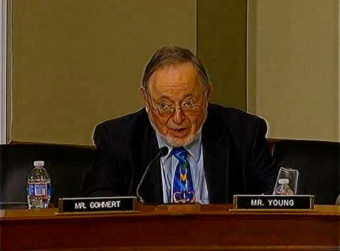
Don Young spent his five minutes questioning Jewell about the King Cove road. (Image via YouTube)
Interior Secretary Sally Jewell already rejected a plan to build a road through the Izembek National Wildlife Refuge to link King Cove to the all-weather airport at Cold Bay. These days, all three members of Alaska’s Congressional delegation are trying to get her to change her mind. Today was Congressman Don Young’s turn to press the case.
As a member of the House Natural Resources Committee, Young was allotted five minutes to question Jewell on the president’s $12 billion budget for Interior. Young asked only about King Cove. And Young wasn’t taking “no” for an answer. In fact, at times during the fiery exchange, he wasn’t taking any answers.
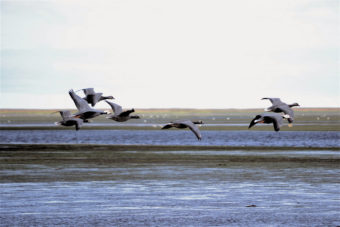
Young said the birds of the Izembek Refuge could adjust to traffic, like the birds on the George Washington Parkway, along the Potomac. Jewell told him the Izembek is a wetland of global significance.
–The birds that are in that area (Izembek) are different than the birds in the Potomac River.
–They are no different. There the same type of bird. The same species, as far as genetically goes, and you and I know that!
–No, sir, the Pacific black brant is …
–There is exactly the same attitude. They get used to it!
When bad weather prevents normal air travel in King Cove, critically ill and injured people have to wait for a Coast Guard helicopter. Such rescues generally happen four or five times a year, although there have been five just since December. They are said to cost more than $200,000 apiece. Young threatened Jewell with an unpleasant choice: Which of her divisions should Congress deduct that cost from?
–Which one of those departments do you think we take it out of?
–Congressman, I will continue …
–Which one of the departments should we take it out of?
–Congressman I do not believe money for a medical …
–You don’t think it’ll happen, do you?
–Can I finish? Would you like me to answer the question?
–No, I’m going to ask you which department. You answer.
Jewell also had to defend her King Cove decision last week at a Senate hearing, though Senators Lisa Murkowski and Mark Begich were less forceful in style.
Here’s a video of the exchange that was posted on Don Young’s YouTube channel:
A group of tribal and government officials from King Cove are back from a week of lobbying in Washington, D.C. — and they’ve come home with a new assignment.
The point of the trip was to convince Interior Secretary Sally Jewell to reconsider their request to build a road to an all-weather airport in Cold Bay. Residents of King Cove say it would provide easier access to commercial medevac flights.
Jewell had rejected the road in December because it would cross through the Izembek National Wildlife Refuge. At the time, Jewell said the refuge ecosystem needs to be protected.
Jewell didn’t budge on the road when it came up during a congressional hearing last week. But she did ask for something from the visiting King Cove group.
“We need suggestions from the people that live in the area on what alternatives would be potentially viable to them if a road does not go through,” Jewell said.
Laura Tanis of the Aleutians East Borough says the alternatives would be a hovercraft or a landing craft — and they both have weather limitations that would prevent them from operating in King Cove year-round.
Regardless, Tanis says that local officials will put together information on road alternatives and send them to the Interior Department within the next two weeks.
A Coast Guard helicopter flew to the village Monday afternoon to pick up a fisherman with an eye injury. The 58-year-old man was working aboard the P/V Golden Alaska, when he was sprayed with a high-pressure hose.
The crew took the injured man to King Cove’s clinic. Medical staff referred him for a medevac, but commercial services were grounded because of bad weather.
That meant the Coast Guard had to fly in and transfer the man to Cold Bay’s airport. From there, he made it onto a commercial medevac plane bound for Anchorage.
According to the village of King Cove, that was the fifth time the Coast Guard’s had to help medevac a patient this year.
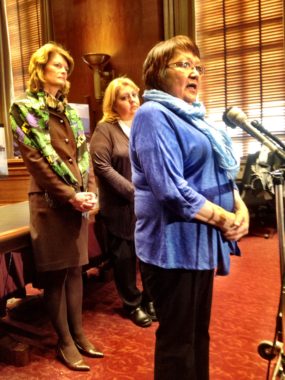
Della Trumble, of King Cove Corp., says road is “life or death” for her town.
Before Sally Jewell had said a word, Sen. Lisa Murkowski spoke for 15 minutes about the road. Murkowski reminded the Interior Secretary she has a trust responsibility to the mostly Aleut population of King Cove.
“The notion from your department that you must protect Alaska from Alaska Natives, our first people, it is … it’s insulting,” Murkowski said.
Murkowski has been hammering Jewell in the press for months over her decision in December rejecting the road, through 10 miles of the Izembek National Wildlife Refuge to Cold Bay. She advertised her fury today with an Incredible Hulk scarf draped around her shoulders, a nod to the late Sen. Ted Stevens. Murkowski says Jewell has done nothing to advance her promise to look into alternatives for King Cove. At a press conference after the hearing, Murkowski ridiculed Jewell for telling her in a private meeting that she’d made some phone calls about improving marine access for King Cove.
“Well, go talk to the corps of engineers about a breakwater,” Murkowski said, “because I’ve been fighting to get breakwaters and docks in the state of Alaska for the 12 years that I’ve been here, and we’ve got a 20-year backlog. How are you going to get a breakwater?”
Murkowski says she’ll never back off her demand for a King Cove road. She and King Cove leaders on hand for the press conference say a road is the only viable option. King Cove EMT Bonita Babcock says plenty of Americans care about the refuge but too few about her critically ill and injured patients.
“We need people to care enough about their lives, about their beating hearts and to understand that they’re worth more than some eel grass and some ducks,” she said.
Sen. Mark Begich and the King Cove delegation met privately with Jewell yesterday. He and Rep. Don Young agree with Murkowski on the need for the road. At the hearing, Begich questioned Jewell about the road for five minutes, then moved on to other issues, such as contaminated land and the backlog of contract support costs owed to Native health organizations. The Interior Department has a huge role in Alaska. It’s essentially the landlord for 60% of Alaska and oversees the BIA. Murkowski says she will have to work with Jewell on a large number of issues, but she says the road for King Cove is non-negotiable.
Outside the hearing, Jewell reiterated the reason she opposes the road. Jewell says it would run over a sensitive strip of land between two lagoons.
“It is a very, very important and unique habitat, and the determination by the fish and wildlife service is that a road would be very disruptive though that area,” she said.
If Murkowski’s repeated assertions that she’s heartless bother her, Jewell doesn’t show it. She says she respects Murkowski’s passion.
Sen. Lemar Alexander, a Tennessee Republican, said at the hearing Murkowski and Jewell are both highly respected and would be likely allies if it weren’t for this one issue. Alexander says he hopes they can work out a resolution.
Close
Update notification options
Subscribe to notifications
Subscribe
Get notifications about news related to the topics you care about. You can unsubscribe anytime.