Archives for:

"King Cove"

King Cove closer to goal of 100 percent renewable electricity

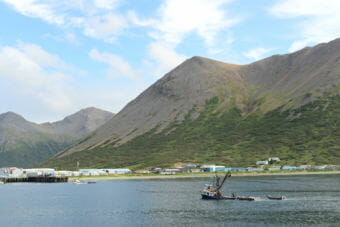
Two hydro facilities cover most of King Cove’s 4.5 megawatt power demands. (Photo by Berett Wilber/KUCB)

A small eastern Aleutian community is now getting nearly all of its electricity from renewable sources. With a second hydro facility that began producing power late this spring, the city of King Cove has dramatically reduced its dependence on diesel.

Gary Hennigh has been focused on renewable energy ever since his first city council meeting as King Cove City Administrator in 1989.

“The council said, ‘hey, you’re the new guy and we’re starting to learn something about this hydroelectric potential that we have in the Delta Creek Valley. Can you help us figure out is it something real? Is it good for the community?’” Hennigh said.

Diesel was relatively cheap back then, but Hennigh says the community got fired up when they found out hydro looked like a promising power source for King Cove. In 1994, Delta Creek came online and pretty soon the community was getting half of its power from renewable energy.

But the project was risky. Hennigh says Delta Creek cost $5.7 million. Grants covered a lot of the cost, but the city still had to borrow a couple million dollars to pay for it. He says back in the early 90s that was a big deal for a community the size of King Cove and it paid off.

“Within a couple of years of Delta Creek getting built, it was easy to look back and say, ‘wow’,” Hennigh said. “We were either pretty lucky, pretty smart or a combination of both.”

After seeing Delta Creek’s success, Hennigh says the city started looking into building a second hydro facility. Financing was a challenge. It took more than a decade to finalize the permitting and round-up nearly $7 million. In the end, the city pieced together the funds from a combination of grants, loans and money from their own budget.

Even though it was expensive, Hennigh doesn’t think residents will bear the burden of paying it off in the form of higher utility rates.

“We believe it’s quite the contrary that they’re going to end up paying less,” Hennigh said. “I would hope to be in a position in the next six to 12 months to be able to go to the city council with a rate decrease.”

Right now, one kilowatt hour costs 30 cents in King Cove. It’s one of the lowest rates in rural Alaska. Hydro power covers nearly all of the city’s 4.5 megawatt demand — which includes two boat harbors, public facilities and all homes.

Overall, Hennigh says the community is happy with their commitment to green power.

“We’ve come to know that Mother Nature can be our friend and that renewable energy, at least in King Cove, Alaska, gives us confidence about survivability in the future for all things energy related,” Hennigh said.

But is it possible for other small rural, communities to follow in King Cove’s footsteps?

For the Waterfall Creek project, King Cove got a lot less money than expected from the state. Funding for renewable energy projects has dried up; for the past two budget cycles there have been no grants from the state’s renewable energy fund.

But Cady Lister, of the Alaska Energy Authority, says King Cove made it work, partly because the city has some financial advantages.

“They are small. They are remote,” Lister said. “But they do have sort of an active cash economy in the fishing industry that kind of allows them to access other resources outside of their community that other places might not have the ability to.”

Even so, Lister believes other communities can replicate King Cove’s energy funding. She says King Cove has proved it’s possible to pay for energy projects with more than just grants.

Hennigh says this is likely the end of bolstering King Cove’s hydro facilities, but he’s pushing for 100 percent renewable electricity — like another community in Alaska.

“We have certainly talked about couldn’t we be even better and be like a mini Kodiak,” Hennigh said. “That’s the new challenge”

With strong winds, Hennigh thinks that’s what King Cove will look to next. But they plan on taking it slow with another year of measuring the wind and looking into the economic feasibility of a project.

Correction: This story has been edited to note that King Cove gets most of its electricity from renewable sources, not most of its energy, as a previous version stated.

U.S. House passes King Cove Road bill

The U.S. House on Thursday passed a bill that would allow a road between King Cove and Cold Bay. If it becomes law, it could end a decades-long quest for Alaska’s congressional delegation: An escape route for a town near the start of the Aleutian Chain.

King Cove, population 989, has been campaigning for years for a road to Cold Bay, which has a former military runway where planes can land in all weather. The problem is, 11 miles of road would go through the Izembek National Wildlife Refuge.

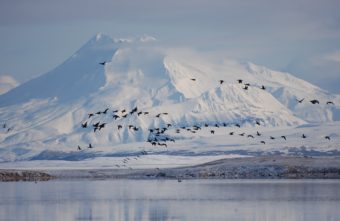
Brant geese in front of Mount Dutton and Izembek Lagoon in the Izembek National Wildlife Refuge
Brant geese fly past Mount Dutton and Izembek Lagoon in the Izembek National Wildlife Refuge on Nov. 7, 2008. (Public domain photo by Kristine Sowl/USFWS)

The vote was 248 to 179. Congressman Don Young predicts construction of the road could start soon.

“I would suggest it would be done before the year is over, as far as beginning,” Young said.

The Senate hasn’t passed the bill yet. Young hinted the Trump administration might not need new legislation to take action.

“We hope to pass it to the Senate. The two senators are working on it very hard,” Young said. “But I’ve still got one more ace in the hole. So I’m planning on getting that road finished.”

The bill authorizes a land trade between the state of Alaska and the federal government for a one-lane gravel road in the Izembek National Wildlife Refuge. Part of the road would go through a designated wilderness, the federal classification of highest protection.

Conservation groups especially dislike that the bill waives the requirements of the National Environmental Policy Act.  They say the road would damage habitat important for migratory waterfowl in a world-class refuge.

Rep. Raul Grijalva, D-Arizona, argued against the bill on the House floor, saying it would be no simple trail through the woods.

“It’s a road through a narrow chain of islands and lagoons,” Grijalva said. “It’s construction requires the development of bridges, installation of culverts, and pipes, and the dredge and fill of nearly 4 acres of wetlands.”

Young and other proponents call it a “life-saving road” that would allow people in King Cove a way to fly out in an emergency.

Sen. Lisa Murkowski sponsored a Senate version of the bill, which is still pending. The issue predates her time in Congress. Her father, former Sen. Frank Murkowski, authored a King Cove road bill, back in 1997, as did Young.

Trump’s Interior secretary takes first baby step on King Cove road

U.S. Congressman Ryan Zinke of Montana speaking at the 2016 Conservative Political Action Conference at National Harbor, Maryland, on March 3, 2016.
Then-U.S. Congressman Ryan Zinke of Montana speaking at the 2016 Conservative Political Action Conference at National Harbor, Maryland, on March 3, 2016. (Creative Commons photo by Gage Skidmore)

There was a bit of a victory Monday for supporters of a proposed road in Southwest Alaska that would connect the village of King Cove to an airport at Cold Bay via the Izembek National Wildlife Refuge.
U.S. Interior Secretary Ryan Zinke, appointed by President Donald Trump and confirmed in March, announced Monday morning that his department has issued a permit for a study on where to put the road.

The state of Alaska’s position is that a road through Izembek is necessary for medical emergencies. In bad weather King Cove’s airport is inaccessible, and residents must use boats or helicopters to get to the airport in the neighboring community of Cold Bay.

In an interview Monday, Gov. Bill Walker said last summer he heard many stories of injured, sick and elderly King Cove residents risking their lives to get medical treatment.

“(The road) is going to save lives,” Walker said. “And so, this is a good first step of many steps, but we’re glad it’s being taken.”

The state has long sought authorization from the federal government to build the 11-mile road.

Zinke’s predecessor, Sally Jewell, was Interior secretary under President Barack Obama and visited King Cove in 2013. Later that year, she decided a road would cause irreversible damage to the refuge and the wildlife that depend on it.

The area is an important feeding and resting spot for hundreds of thousands of waterfowl, including nearly the entire populations, worldwide, of several bird species.

Village resident and King Cove Corporation spokeswoman Della Trumble said, for the human residents in the area, the road is a life-or-death issue.

And, even after Monday’s announcement, Trumble said she’s not holding her breath.

“A good part of our lives has been advocating for this road for this community,” Trumble said. “I tell you, after being involved in this for so long, that, until I see the signing on the paperwork – it’s been a long battle.”

Alaska’s congressional delegation continues to push for approval of federal legislation in the U.S. House and Senate seeking the road.

Congressman Don Young pulls punches for road foe

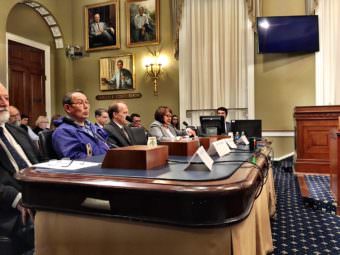
Witnesses wait to testify at a hearing in the U.S. House on the King Cove Road. (Photo by Liz Ruskin/Alaska Public Media)

At the U.S. Capitol, Alaska Rep. Don Young is known to berate Democrats and environmentalists who oppose his efforts to get a road for King Cove.

Young accuses them of being indifferent to the lives of his constituents, the Alaska Natives who reside in a remote, isolated community.
At a hearing Wednesday, the witness who spoke against the road was also an Alaska Native from a remote, isolated community. And this wasn’t just about the road.

Young glared across the dais in the hearing room, at the Democrats on the Natural Resources subcommittee on federal lands.

One of them had just spoken against the 11-mile road for King Cove, saying it would harm waterfowl habitat in the Izembek National Wildlife Refuge.

Young said the road would save lives.

“The day that this Congress would take and love a goose, that’s not going to be harmed, over a human life – shame on you!” Young said. “I’m not going to tolerate that. You want to go out and kill people, go out and kill them! But don’t do it because you’re being stupid!”

Della Trumble, speaking for her fellow residents of King Cove, told the subcommittee they need the road so they can drive to the all-weather airport at Cold Bay, so they won’t have to endure dangerous flights from their town when they need medical care.

“I for one know this know this first hand, as I witnessed my daughter’s airplane crash-land at the field in King Cove, four years ago,” Trumble said.

All aboard survived.

Trumble said she’s fought for the King Cove road for 35 years.

The details change, with new accounts of harrowing medical evacuations every year, but this is how hearings on the road have gone for decades.

Trumble has been to Washington at least 30 times to advocate for the road. Less usual was the type of witness who spoke Wednesday against the road.

“My name is Myron P. Naneng Sr. from Hooper Bay, a village in Western Alaska,” the ex-president of the Association of Village Council Presidents said.

Naneng now is the board president of Hooper Bay’s village corporation.

His region, the Yukon-Kuskokwim Delta, is a few hundred miles from Izembek, but he said the people in the Delta have traditionally depended on the waterfowl that feed in the Izembek lagoons during the spring and fall migrations.

Naneng pointed out that people in his area have been severely curtailed in the number of salmon they can take.

“If we’re not allowed to fish for salmon, what other food resources would we be allowed to harvest?”Naneng said during a break in the hearing. “That’s why migratory birds are just as important for our subsistence use.”

Myron Naneng of Hooper Bay opposes the King Cove road because it would harm waterfowl habitat.

Raising a long-standing beef, Naneng said commercial fishermen in the Eastern Aleutians, near King Cove, have not faced similar restrictions, and some of the salmon they catch are bound for the Y-K Delta.

“We’ve gone to the Board of Fisheries to get them to recognize the fact that our people on the Yukon or Kuskokwim need salmon for food,” Naneng said. “It seems like big-money advocates usually get the best of whoever are the decision-makers.”

It’s an argument King Cove has heard before.

The Aleutians East Borough has a webpage to debunk the claim that fishermen catch all the northbound salmon at False Pass.

Naneng said even if there were plenty of fish in his region, then he’d still be fighting the King Cove road, to conserve waterfowl, a cause he’s pursued in the Delta for years.

As for King Cove’s need for safe transportation, Naneng said lots of Y-K villages have it just as bad.

Naneng, with some pressing, acknowledged The Wilderness Society paid for part of his trip to speak against the road, though he said his village corporation picked up most of it.

Young did not go after Naneng as harshly as he has other road opponents.

But the subcommittee chairman, Rep. Tom McClintock, R-Calif., took a swipe at Naneng as he questioned Trumble.

“He’s not even from this community? … But he wants to deny your community the right to build this road?” McClintock said.

Young later said it’s not good to have two Alaska communities pitted against each other.

As he has in the past, Young has sponsored a bill that would authorize a land trade for the road corridor.

The state would exchange 43,000 acres of land in exchange for 206 acres within the refuge. The bill would waive any more review under the National Environmental Policy Act.

Then-Interior Secretary Sally Jewell rejected a similar exchange in 2013.

King Cove is challenging her decision in court. If the community wins, tjem road advocates hope the trade can occur without another act of Congress.

Legislature briefed on nearly 30 legal conflicts the state has with federal government

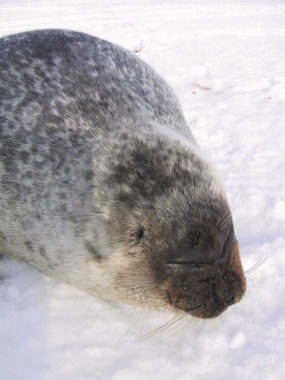
A ringed seal.
A ringed seal. (Public domain photo by Lee Cooper)

From rivers to ringed seals, Alaska is not always seeing eye-to-eye with the federal government on how its resources should be managed. Legislators recently got an update from the Department of Law on nearly 30 ongoing cases or conflicts the state has with the federal government, Alaska’s largest landowner.
Questions about how that land can be used, who controls it and how it can be developed often wind up in court.

“The theme that you’ll see in a lot of these cases is that in recent years the federal government, through regulation, has tried to expand federal jurisdiction and federal powers in this state,” said Alaska’s acting Attorney General Jahna Lindemuth.

Jahna Lindemuth
Gov. Bill Walker named Jahna Lindemuth Alaska’s next attorney general on June 28, 2016. (Photo courtesy Alaska Governor’s Office)

She and members of the Department of Law started briefing legislators last month on everything from the road to King Cove to protecting seals through the Endangered Species Act.

The state isn’t necessarily suing the federal government in these dozens of cases. In the case of Alaska moose hunter John Sturgeon who is suing the U.S. Department of the Interior, the state is not a party to lawsuit. It’s just intervening.

That case started when rangers in the Yukon-Charley Rivers National Preserve told Sturgeon that he couldn’t use his hovercraft there. It wound up in the Supreme Court last year and is now back in front of a court of appeals and has since morphed into a debate on federal overreach.

The state has also weighed in on the battle between the Environmental Protection Agency and the development of the Pebble Mine.

Some issues haven’t made it to court yet, but could. Last year, President Barack Obama banned drilling in large portions of the Chukchi and Beaufort seas. The state is trying to figure out what, if any, legal recourse it as.

But Attorney General Lindemuth said there may be change on the horizon. President Donald Trump has already rolled back at least one federal rule that Alaska was involved in challenging.

“You know, with this change in administration at the federal level we’re hopeful that we’ll be able to work through many of these issues more quickly and without litigation on some of these things. So, we have hope and we’ll see what happens,” Lindemuth said.

Lindemuth said the Department of Law is also taking that “wait and see” approach with some of the state’s other disputes with federal agencies.

Hopes for King Cove road renewed with new Interior secretary

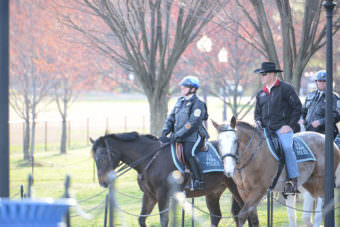
Interior Secretary Ryan Zinke rode a National Park Service horse named Tonto about a mile, posing along the National Mall for photos. The Park Service, the Mall and the horse are within Interior’s domain. (Interior Department photo)

Secretary of the Interior Ryan Zinke, a former Montana congressman, rode a horse to his first day of work in Washington, D.C., today.

The Secretary of the Interior is an important position for Alaska, where more than 60 percent of the land is owned by the federal government.

The Interior secretary is also charged with upholding trust obligations to Native tribes.

U.S. Sen. Lisa Murkowski, R-Alaska, said she hopes she’ll finally get approval for a road to connect King Cove to the all-weather airport in Cold Bay with the new secretary.

Zinke seems sympathetic to the need for what she called a “life-saving road,” Murkowski said.

“He has had the opportunity to be briefed on it many times,” Murkowski said. “He has also met with some of the residents from King Cove. He has indicated his understanding of the situation.”

Zinke, though, would face fierce opposition from conservation groups who say the King Cove road would damage the Izembek National Wildlife Refuge and important bird habitat.

Soon after his swearing in, Zinke signed an order to reverse a last-minute Obama administration ban on lead ammo and fishing tackle in national wildlife refuges.

That made U.S. Rep. Don Young, R-Alaska, happy.

The lead ban “had little to do with science and conservation” and was instead “one last parting gift to our nation’s most extreme environmental elite,” Young said.

Steel shot and all-copper bullets cost more than those with lead.

Some sportsmen also say the non-lead ammunition shoots differently.

Those who want to ban lead ammo argue the toxic metal contaminates waterways, wildlife and people who eat game meat.

Site notifications
Update notification options
Subscribe to notifications