Archives for:

"King Cove"

‘One mussel could kill someone’: officials warn of extremely high shellfish toxin levels in Unalaska

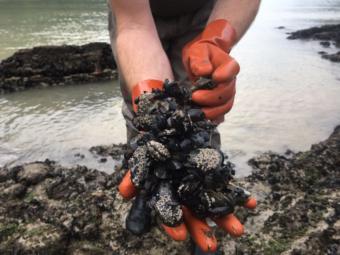
Blue mussels at Nahku Bay. (Claire Stremple/KHNS)

Alaska state and local health officials are warning of dangerously high levels of toxins in shellfish, after a person died of paralytic shellfish poisoning from mussels and snails in the Aleutian Island community of Unalaska.

“Right now, the levels are high enough that just one mussel could kill someone,” said Sarah Spelsberg, a physician assistant at Iliuliuk Family and Health Services, Unalaska’s clinic.

The state health department announced the death in a prepared statement Wednesday.  The person had underlying health conditions that contributed to the death, but the state medical examiner’s office confirmed that the primary cause was exposure to the toxins from seafood, the statement said.

This is the first known paralytic shellfish poisoning fatality in Alaska since 2010, although serious illnesses are reported more frequently, the state said. Dating back to 1993, the state has recorded four previous PSP deaths: in 1994, 1997 and two in 2010. There have also been more than 100 non-fatal cases of shellfish poisoning.

The person who died ate the mussels and snails collected from an Unalaska beach July 4. The shellfish were cooked, and the person developed symptoms some four hours after eating.

Blue mussel samples collected from the beach the same day were found to have extremely high toxin levels — more than 100 times higher than the safe limit, the state said. The snail samples also had elevated toxin levels, but not as high as the mussels.

The patient’s initial symptoms included tingling fingers, numbness, a floating sensation and vomiting, the state said. Several hours later, the patient reported numbness in their mouth, weakness in their hands and pain in their neck and back.

The patient was transferred to Unalaska’s clinic, and later was flown to an Anchorage hospital, where they died.

Two other people ate smaller amounts of the same shellfish but never developed symptoms, according to state health officials.

“When it comes to PSP, you have to medevac this person — that’s their only chance,” said Spelsberg, the physician assistant. “The problem with this is there’s no antidote, so the only thing we can do is be ready to breathe for you if you can’t breathe for yourself. And we can be ready to try to help your heart beat if you can’t keep your own heart beating. But there’s no antidote to this and sometimes there’s nothing we can do. You could land in the ICU at the best hospital in the world and they wouldn’t be able to save you.”

Officials have been monitoring local beaches for PSP since 2009, said Melissa Good, a marine advisory agent with Alaska Sea Grant in Unalaska.

She said there have been a few summers where toxin levels have exceeded the regulatory limit, which the U.S. Food and Drug Administration sets at 80 micrograms per 100 grams of tissue.

A recent report of some of the highest-ever recorded levels of PSP toxins in butter clams taken from the Alaska Peninsula community of King Cove last month prompted officials to test in Unalaska, too, Good said. Test results from Unalaska showed 11,200 micrograms of toxins per 100 grams, she added.

High levels of algal toxins that can cause PSP have also been found recently in shellfish from other Alaska communities.

Those include Craig, Hydaburg, Ketchikan, Kasaan, Juneau and Metlakatla in Southeast Alaska, as well as Kodiak and Chignik Lagoon along the Gulf of Alaska, the state said.

In recent years, communities across the state have reported spikes in toxin levels, possibly related to rising ocean temperatures, which create a better environment for the algae that produce the toxins – alexandrium catenella in Alaska — to grow year-round, as opposed to only in warmer months, according to some researchers.

Shellfish toxicity can vary by beach, harvest, and mussel bed, and Spelsberg said it’s important for people to understand that the toxins cannot be eliminated.

“It’s really important that people understand that you can’t freeze it out. You can’t cook it out. It’s a preformed toxin. And once you’ve ingested it, all we can do is try to keep you alive until you can flush the toxin out,” Spelsberg said.

If someone decides to harvest bivalves — that includes mussels, clams, cockles, scallops and rock jingle — in the region, officials highly recommended that they do not immediately consume their harvest. Instead, freeze it and send in a sample to the Alaska Department of Environmental Conservation’s lab, said Good.

Prior to sending in samples, contact Matthew Forester, bio-analysis section manager with the DEC’s Environmental Health Lab by phone at 375.8204, or by email at Matthew.Forester@Alaska.gov.

The state’s warnings apply only to non-commercially harvested shellfish, since commercial operations are required to regularly test for toxins.

Murkowski’s Trump ‘struggle’: Her goals for Alaska vs. her values

Sen. Lisa Murkowski, R-Alaska, answers questions in a studio at KTOO on August 13, 2019, in Juneau, Alaska. (Photo by Rashah McChesney/KTOO)

Murkowski said she didn’t set out to make a scene last Thursday, but she ran into a group of reporters in the Capitol and one of them asked her about what former Defense Secretary Jim Mattis said.

Mattis had just published an op-ed that was highly critical of the president.

“I think probably a good politician would have deflected the question,” Murkowski said Wednesday. “But I felt it was necessary to be direct. The country is is is hurting. And I felt that if I was going to say that words matter, I needed to make sure that mine were clear, too.”

At the time, Murkowski told reporters: “I thought General Mattis’s words were true and honest and necessary and overdue.”

For Trump supporters, Murkowski betrayed the cause. And her critics on the left say she was anything but clear. On Facebook and other social media, they pointed out that Mattis described Trump as a threat to the Constitution. If she agreed with that, the critics asked, how could she still be struggling?

Murkowski is a moderate in a polarized world. She is always trying to bridge gaps. Since the start of his presidency, and even before, Trump has widened the gaps.
“I believe that he feels that it is more effective to divide than to attempt to unite. And I don’t think that that’s healthy for our country,” she said.

But, she said, Trump shares her agenda on energy and resource development questions in Alaska.

“I’ve got to look at policies, again, that have been good for for our state,” she said. “And then balance that against the the leadership and the leadership style of this president.”

Trump, as he reminded Murkowski by tweet last week, signed a bill opening the Arctic National Wildlife Refuge to oil drilling. His Interior Department has tried build a road for King Cove. He just signed a memo to get new icebreakers on the water by 2029. Goals that she and the rest of the congressional delegation have pursued for decades have advanced at break-neck speed.

“But I do struggle, because I am a person for whom values really matter,” Murkowski said.

She said she’s not concerned about Trump’s threat to campaign against her when she’s up for re-election in 2022.

Sen. Dan Sullivan will be on the ballot this year. He rarely breaks with Trump. Sullivan is a Marine and was a big fan of Mattis, a retired Marine Corps general. But after Mattis issued his critique, Sullivan said the “blame game” isn’t helpful.

Murkowski said she knows her decision to criticize the president is hard on Sullivan and other Republican senators.

“I think I’ve probably made life harder for everybody for whom they get asked the question: ‘Well, what do you think about Lisa’s comments?’” Murkowski said. “It then puts them in the position – Do they defend me? Do they defend the president?”

Murkowski said they shouldn’t have to answer for her words, but she felt compelled to speak her mind.

Ferry Tustumena crew member tests positive for COVID-19, passengers quarantined

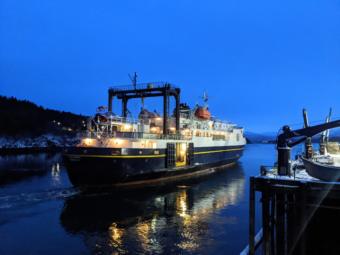
The M/V Tustumena pulls away from Kodiak on Jan. 11, 2020, beginning a ferry service gap of more than three months. (Photo by Kavitha George/KMXT)

The first ferry of the season to Unalaska, brought a case of COVID-19 to the community. The ferry Tustumena sailings have been canceled after a crew member tested positive for the virus on Saturday.

The ship will now be sailing back to Homer from Unalaska on Sunday. It will not make any stops.

That’s according to state Department of Transportation officials that said a crew member developed mild symptoms including a runny nose, cough, and body aches, but they did not have a fever during the voyage along the Aleutian Chain.

The employee is in isolation on the ferry and did not disembark the vessel, but did have contact with passengers and crew before arriving in Unalaska.

“This is not considered a community case. This is a travel-related case,” said Unalaska City Manager Erin Reinders. “It was an individual who was an employee of the Alaska Marine Highway System. I don’t know a lot of the details behind it, but what we do know is that this individual was symptomatic, did not leave the room that they were in, was tested here locally, and that test came back positive.”

The Department of Health and Social Services has begun contact tracing and will contact people who may have had interactions with the crew member.

A statement from the Department of Transportation says there are 35 crew members on the Tustumena. It says 16 close contacts — all crew members — have been identified and are quarantined on board the ship. It also says all crew stayed on board while docked in Unalaska and that no passengers have been identified as close contacts.

Dutch Harbor Ports Director Peggy McLaughlin said 21 passengers got off the ferry in Unalaska. She said all passengers were directed to follow the city’s protocol to self quarantine for 14-days upon arrival.

The ferry was on its first trip after returning to service on June 2.  It left Homer and visited the communities of Seldovia, Kodiak, Chignik, Sand Point, King Cove, Cold Bay, False Pass, Akutan. DOT did not say which of those communities received passengers.

Neither the city nor state has said how many passengers had boarded the Tustumena in Unalaska on Saturday before being informed that the sailing had been canceled. DOT says the infected crew member did not have contact with any of these passengers.

McLaughlin said those passengers should take precautions.

“The recommendation for the passengers that were trying to leave on Unalaska/Dutch Harbor today, was to get off the ferry, go home, shower, and self-quarantine,” said McLaughlin. “The state is working on various options for them to continue to get from point A to point B.”

Melanee Tiura, chief executive of Iliuliuk Family Health Services in Unalaska, said the health clinic’s staff have been informed of the situation.

“We are all concerned with the possible risks present in this scenario,” said Tiura. “If there is good news so far, it is that the most recent information from the state indicates that there was limited direct exposure to the passengers, both those who disembarked today and those who had briefly boarded.”

The city has a mandatory 14-day quarantine for anybody traveling to the island, whether by air or sea, with the exception of AMHS “day travelers” during their stopover in Unalaska.

State officials said the symptomatic crew member was tested at 5 p.m. Saturday. The positive result was returned an hour later. Unalaska’s local medical provider said it wasn’t part of that decision chain that allowed passengers to board with a potential coronavirus case on board.

“We, at the clinic, would like to make sure the community knows that we were not involved in any decisions that led to community members boarding the ferry with a symptomatic individual on board,” said Tiura. “We are here to care for patients and to help to keep Unalaska safe.”

Unalaska has had three cases of COVID-19, all among seafood workers.

Officials said there is no known community spread in Unalaska at this time. The city will not be raising its assessment of the community’s risk level, which is currently at “medium.” Under the city’s COVID-19 emergency response plan, the city will not move to “high” risk unless there is confirmed community spread or widespread exposure of COVID-19 on the island.

Mayor Vince Tutiakoff Sr. said the city’s unified command — which is a COVID-19 response team made up of healthcare officials, seafood industry, school district representatives, social service agencies, and the Qawalangin Tribe — has developed comprehensive plans.

“I want the community to know that we keep all of their health as number one priority, and today shows that [our plan] works,” said Tutiakoff. “The team got together, worked out a plan, and got it working within a half hour of when the question arose as to whether the employee was infected or not. So [the plan] works and the community has to have confidence in what we’re trying to do.”

Reinders said it is up to every Unalaskan to practice social distancing measures and limit community spread as the state continues to open up. She said those measures include washing hands, maintaining a six-foot distance from others, wearing a face covering over both the nose and mouth, and keeping social circles small.

The Tustumena departed Unalaska on Saturday night with crew and six passengers that had originally boarded in Homer. During transit, only essential crew will operate the ship, and the remaining people  on board will self-quarantine, DOT says.

Everyone will be tested for COVID-19 once the ship arrives in Homer. The Tustumena’s future sailings are suspended until further notice.

A new fish processor is buoying King Cove’s fishermen. But now the town’s finances are sinking.

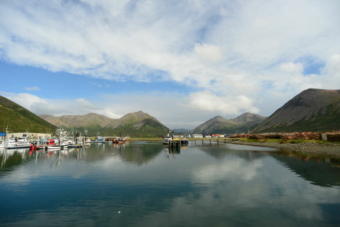
King Cove. (Photo courtesy Aleutians East Borough)

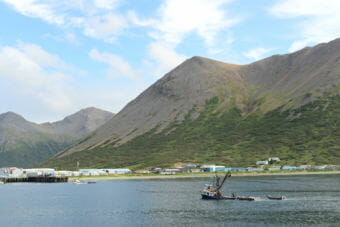
For the fishermen of King Cove, the 900-person town near the tip of the Alaska Peninsula, the construction of a new fish processing plant in a nearby village came as welcome news.

King Cove has long been a company town. For decades, its fishermen were frustrated by Peter Pan Seafoods, Inc., the private company that runs King Cove’s own massive processing plant. Especially vexing were the limits: While another processor in the region was buying far more salmon, Peter Pan would only buy 35,000 pounds from each boat, each day, said A.J. Newman, a King Cove city council member who skippers the 58-foot Lady Lee Dawn.

“It’s hard to watch your friends catch double what you caught,” said Newman. “Peter Pan had too many boats, and they couldn’t handle all the fish. And we just didn’t feel like they were hearing us — for years, we told them our concerns and they just didn’t really listen.”

Newman now sells his fish to the new plant, operated by Silver Bay Seafoods LLC., in the tiny village of False Pass, 45 miles west. And he’s not the only fisherman who broke up with Peter Pan — more than half of King Cove’s seine fleet switched to delivering their salmon to False Pass last summer.

The competition among processing companies is making things “way better” for King Cove’s fishermen, Newman said. But it’s also causing new problems.

The migration of the town’s fishermen to the Silver Bay plant in False Pass has left King Cove with a massive budget hole. And a possible realignment of Alaska’s seafood industry is threatening the future of the Peter Pan plant and viability of King Cove itself.

Silver Bay Seafoods’ chief executive, Cora Cambell, declined to comment. But King Cove officials say they hold no grudge against the company for opening up the competing plant in False Pass, and they note that it’s taken steps to soften the impact, like opening a new marine parts store in King Cove.

But the financial blow has been undeniable, and a solution remains elusive.

In a typical year, King Cove’s fish tax revenues are some $1.5 million, or a little more than half of its $2.8 million in general fund revenue. With last year’s opening of False Pass’ competing plant, King Cove officials estimate that they’ve lost of some $650,000 in revenue, or nearly 25 percent of their yearly total.
Graphic by Hannah Lies/Alaska Public Media

Even worse, potentially, is this month’s news that Peter Pan Seafoods is being put up for sale by its Japanese owner, the seafood conglomerate Maruha Nichiro Corp. After the construction of the new False Pass plant and reconstruction of a fire-damaged plant not far away in Port Moller, experts say there’s now far more processing capacity than necessary along the Alaska Peninsula — making a shakeup likely that could end with players or plants shutting down.

“Everybody is wondering: why such an arms race in a place where you really don’t have enough resource?” said John Fiorillo, executive editor of the trade publication IntraFish Media. He added: “Somebody’s going to be a casualty.”

Peter Pan’s chief executive, Barry Collier, didn’t respond to requests for comment, and the company hasn’t said anything publicly about the King Cove plant’s future. It’s not clear exactly what will happen to the plant or who might buy it.

In the meantime, King Cove’s city council is trying to sort out which services they’re going to have to cut. That could include hours at the town’s teen and rec centers, along with a program that helps seniors pay for their utilities.

“To pick on kids, and to pick on seniors, that’s a lot of emotions,” said Gary Hennigh, King Cove’s city administrator. “This is really what the mayor and the council are struggling with — that we know the value and the pride and the reasons that we have done these things, but the times are changing and we can’t afford them.”

The city council is trying to be careful not to cause a panic, Hennigh said. But the history of the isolated fishing towns of the Aleutians and the Alaska Peninsula is also at the back of people’s minds. A resolution passed by King Cove’s city council last month noted the “disappearance” of other communities, when their fish processing activities and plants shut down.

“The city must, and will do, everything within our ability to not let history repeat itself in this regard, and to sustain our quality of life and socioeconomic and cultural identity and well-being,” the resolution said.

King Cove isn’t the only village in the region that’s suffering amid a downturn in the region’s fishing industry: Another plant in the nearby town of Sand Point closed for the winter amid a crash in cod stocks linked to global warming.

“We’ve got to start educating our fellow citizens that things are happening that we really don’t have control over,” Hennigh said. “With a little bit more time and hopefully a little bit more good news, maybe we’ll end up being okay. But we’re certainly not close to that now.”

There have been a few pieces of good news amid the bad news about Peter Pan, like Silver Bay Seafoods’ new marine parts store and a $100,000 grant to King Cove from the local borough, Hennigh said.

But until the village finds out what’s happening to Peter Pan’s processing plant, Hennigh says, King Cove will have to be very careful about how it spends its money.

Environmental groups file new lawsuit to block new Izembek land swap deal

A view of King Cove. (Photo by Berett Wilber/KUCB)

The Wilderness Society and eight other environmental groups have filed a new lawsuit to block a road in the Izembek National Wildlife Refuge.

For nearby King Cove, it’s the latest in a long series of legal and political hurdles dating back decades.

“We’re not surprised,” said Della Trumble of the King Cove Corporation.

She is a longtime proponent of the proposed road, roughly 12 miles through the refuge, to connect King Cove to Cold Bay and its all-weather airport. She says it’s a matter of life and death in medical emergencies. But environmental groups have always stood in the way.

Della Trumble of King Cove Corporation, advocating at the U.S. Capitol in 2014 for a road in the Izembek National Wildlife Refuge. (Photo by Liz Ruskin/Alaska Public Media)

The lawsuit “just continues the basic concept that they don’t care about the lives of the people out here,” Trumble said. “The birds have more priority.”

The lawsuit challenges a land swap agreement U.S. Interior Secretary David Bernhardt and the King Cove Corporation signed last month to create a road corridor that would be owned by the village corporation.

The conservation groups claim the swap violates environmental laws and the Alaska National Interest Lands Conservation Act.

It’s similar to their last lawsuit, which the groups won in March. A judge agreed the Interior Department hadn’t justified its switch from an anti-road position during the Obama administration to its current pro-road stance. This time, along with the new swap agreement, Bernhardt wrote 20 pages of justification.

The lawsuit claims the justification is still inadequate.

The Center for Biological Diversity is one of the plaintiffs. Its public lands program director, Randi Spivak, said she doesn’t prioritize birds over humans, but she said the people of King Cove have other transportation options.

“What is also important is that this refuge is internationally important for birds all over the world, and wildlife,” she said.

A road, Spivak said, wouldn’t solve all of King Cove’s transport problems.

“Look, they’re way out there in the Aleutians. Very remote area with severe weather conditions,” said Spivak, who has visited the Alaska Peninsula community. “That road would not provide guaranteed safety 365 days of the year, either.”

King Cove leaders say the road would be passable nearly all the time and is the only practical option.

The suit was filed by Trustees for Alaska, a law firm that represents environmental groups. Other plaintiffs include Friends of Alaska National Wildlife Refuges, Alaska Wilderness League, Defenders of Wildlife, National Audubon Society, the National Wildlife Refuge Association, Sierra Club and Wilderness Watch.

It’s back: US Interior Dept. signs new land swap deal for King Cove road

(Map by Shiri Segal/Alaska Public Media)

The U.S. Interior Department has already signed a new land swap agreement for a King Cove road, days after it gave up its appeal of a court ruling that its prior agreement violated federal law.

Deputy Secretary of the Interior David Bernhardt.
U.S. Interior Secretary David Bernhardt. (Creative Commons photo by Bureau of Reclamation)

Alaska Public Media has obtained a copy of the new agreement, signed earlier this month by Interior Secretary David Bernhardt and the CEO of King Cove Corporation.

As with previous agreements, this one calls for the department to give land in the Izembek National Wildlife Refuge to the Native corporation in exchange for land of equal value. The intent is to allow the corporation to complete the final 12 miles of road to Cold Bay.

Much of the new agreement is identical to the old one. This time, though, the swap is not limited to 500 acres, and the agreement doesn’t say the road is limited to non-commercial use — though it does specify it would be unpaved.

Bernhardt also signed a 20-page document setting out his reasons for approving the land swap. U.S. District Court Judge Sharon Gleason blocked the 2018 agreement, saying former Interior Secretary Ryan Zinke hadn’t explained his policy, thus violating the Administrative Procedures Act.

Environmental groups have been fighting the road proposal in court for years, and they’ve pledged to continue.

Site notifications
Update notification options
Subscribe to notifications