Archives for:

"King Cove"

Don Young files new bill for a road to Cold Bay

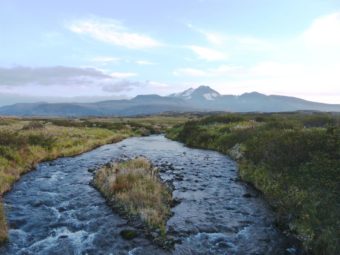
Frosty Creek, Izembek National Wildlife Refuge.
Frosty Creek, Izembek National Wildlife Refuge. (Public Domain photo by Kristine Sowl/ Alaska Region U.S. Fish and Wildlife Service.)

When Alaska Congressman Don Young was sworn in for his 23rd term in the House of Representatives Tuesday, he quickly introduced 38 pieces of legislation. Among them is a bill to build the King Cove road.

For decades, the village of King Cove on the Alaska Peninsula has sought to build an 11-mile road to an all-weather airstrip in Cold Bay. It would cut through the Izembek National Wildlife Refuge, ecologically sensitive habitat protected by the Fish & Wildlife Service. The Obama Administration denied a land swap proposed in 2013. With a new administration and the backing of Alaska’s Congressional Delegation, King Cove has renewed hope they’ll get their road.

After talking to President-elect’s Trump new Interior Secretary pick, Montana Representative Ryan Zinke, Young said that he thinks the road can be approved administratively. But, in case it is not, he also has introduced a bill.

Della Trumble, a spokesperson for the King Cove Corporation, lists key reasons proponents of have fought so long for the road.

“First and foremost is safe access in times of emergencies,” she says. “And in this case, it’s normally medical emergencies. And other than that, it’s on a day-to-day basis safe access between the communities of King Cove and Cold Bay.”

When weather is extreme, planes can’t get in or out of King Cove. In the past year, 17 people were medically evacuated, three by the U.S. Coast Guard.

Opponents of the land swap and road construction say it would damage sensitive wildlife habitat. They say that a road through the congressionally delegated Izembek National Wildlife Refuge could harm species such as Pacific brant, emperor geese, Steller’s eiders, tundra swans, and sea lions.

What King Cove’s lobbying strategy with a new Interior Secretary will be, Trumble won’t yet say. She does say, though, that the village is optimistic and that decades into this fight, they don’t plan to give up anytime soon.

Murkowski puts riders in spending bill; Dems decry ‘poison pills’

Sen. Lisa Murkowski talks with reporters during a press availability following her annual address to the legislature, Feb. 19 2014. (Photo by Skip Gray/Gavel Alaska)

U.S. Sen. Lisa Murkowski had a chance to flex some legislative muscle Tuesday. As chair of an Appropriations subcommittee, Murkowski writes the legislation that sends money to the Department of the Interior, the EPA and the Forest Service and tells them how to spend it. Her subcommittee passed that bill today. Murkowski also added several of her favorite environmental policy changes, which Senate Democrats are calling “poison pills.”

Murkowski says she’ll never stop trying to get a road for King Cove, to link the community to an all-weather airport. The senator says her bill authorizes a land trade to allow for a road through a portion of the Izembek National Wildlife Refuge.
“I recognize the need to protect the environment, but recognize it should not come at the expense of jeopardizing the lives of those I represent,” she said when her subcommittee met this morning.

The land trade is an example of a rider – a policy change a lawmaker slips into another bill, sometimes completely unrelated. Another of Murkowski’s Alaska riders would stop the feds from imposing stricter predator-hunting rules in the state’s national wildlife refuges.

Her $32-billion bill has several big national riders, like one that would block an EPA rule defining which waters are subject to the Clean Water Act. Another halts a stream buffer protection rule that mine advocates say would kill coal mining in Alaska and around the country.

Murkowski says her bill pinches EPA’s regulatory budget, in areas where she says the agency has overstepped its bounds.

“Several program areas that have issued controversial rules that are currently blocked in court are reduced,” she said, reading from a prepared statement, “because I believe it is more important to provide resources to programs that yield tangible results in improving the environment instead of funding more lawyers and bureaucrats to draft rules of questionable legality and dubious environmental benefit.”

The top Democrat on her subcommittee, Sen. Tom Udall of New Mexico, says he likes that the bill increases money for drinking water infrastructure and the Indian Health Service. Still, Udall says he can’t support it.

“We’re not prepared to gut environmental rules as the price of getting spending bills passed,” he said.

Among the riders Udall counts as a poison pill are changes to environmental rules in the Tongass National Forest, in Southeast Alaska. Exactly what the bill says on that is unknown. Murkowski did not make the document public, but she and Udall issued summaries. The bill itself is scheduled for release on Thursday when it goes before the full Senate Appropriations committee. Udall says that’s when he’ll try to remove the parts he doesn’t like.

King Cove road advocates take plea to Washington, D.C.

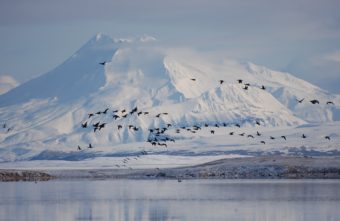
Brant geese in front of Mount Dutton and Izembek Lagoon in the Izembek National Wildlife Refuge
Brant geese in front of Mount Dutton and Izembek Lagoon in the Izembek National Wildlife Refuge, Nov. 7, 2008. (Public domain photo by Kristine Sowl/USFWS)

Lt. Gov. Byron Mallott joined residents of King Cove in Washington, D.C. Thursday morning to make another plea for a road between King Cove and the all-weather airport in Cold Bay.

Mallott likened the struggle to other public land-use controversies, in which, he said the federal government puts another concern ahead of local Alaskan needs.

“Our lives are minimized, marginalized and in many ways consciously, consciously, determined to be unimportant, to the point where we become faceless,” he said.

Mallott spoke at a hearing called by Sen. Lisa Murkowski. Alaska’s congressional delegation has tried for decades to get the government to agree to a road. They say residents need a way out in a medical emergency.

But 11 miles of the road would have to be built in the Izembek National Wildlife Refuge. Interior Secretary Sally Jewell ruled out a road in 2013, citing in part the area’s importance to waterfowl and other species. Jewell said she’s trying to find an alternative.

Aleutians East Borough Mayor Stanley Mack says other alternatives make no sense, given King Cove’s often harsh weather and the realities of boat travel.

“Strapping an injured patient in a gurney and hoisting them up to the dock on a boat, which can be as much as 25 feet, is always a scary situation,” Mack said. “This is basically what we have to do. Or putting elders in a crab pot and using a crane to hoist them to the top of the dock is frightening.”

Sen. Murkowski said she’s not giving up. She didn’t say what her next move will be, but she noted that Jewell won’t be Interior secretary much longer.

Speaking to reporters after the hearing, Alaska Congressman Don Young said the secretary is valuing geese over people. Young threatened to bring in the heavy equipment and build the road himself.

Judge: National Environmental Policy Act probably doomed King Cove road

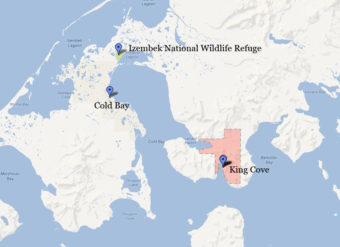
King Cove road, Izembek National Wildlife Refuge, Cold Bay map

A federal judge in Anchorage has ruled against a group from King Cove seeking an emergency road to Cold Bay.

Judge H. Russell Holland says Interior Secretary Sally Jewell’s 2013 decision to reject an 11-mile road through the Izembek National Wildlife Refuge is in keeping with the National Environmental Policy Act, known as NEPA. The judge says that, given the sensitive nature of the lands in the proposed road corridor, the need to follow NEPA probably doomed the project. “Perhaps Congress will now think better of its decision to encumber the King Cove road project with a NEPA requirement,” he wrote.

Sen. Lisa Murkowski says she was disappointed in the decision, but she’s already working on a Congressional solution. She has inserted a rider in a spending bill that would allow a land exchange and take the road decision away from the Interior secretary.

King Cove residents want a road to reach Cold Bay’s long, paved runway, to allow medical evacuations in rough conditions.  King Cove Mayor Henry Mack spoke of the need in a call to APRN’s Talk of Alaska this week.

“We would love to get our sick grandmas and grandpas and young children who need (it) to get out safely, instead of waiting in a clinic in miserable nights in bad weather,” he said. “Why, we could drive over there.”

The city joined with local tribes and the Aleutians East Borough to bring the legal challenge. They say they’re evaluating their next legal move.

Environmental groups argue that a road would diminish important waterfowl habitat. They say most of the world’s population of Pacific black brant and emperor geese rest and feed in the Izembek Refuge during migrations. Tim Woody, spokesman for the Alaska branch of The Wilderness Society, says their position does NOT amount to placing bird needs above human needs.

“Everyone is respectful of King Cove’s concerns and their need for emergency transportation,” Woody said, “but we need to start looking for a solution that meets their needs while keeping the wilderness of the refuge intact.”

Woody says other transportation methods – like helicopter service or a ferry — might serve the community better. Road proponents say those alternatives aren’t realistic.

Murkowski bill would impel Izembek Road, undo EPA efforts

A bill by U.S. Sen. Lisa Murkowski cleared an Appropriations subcommittee today, but controversy is brewing over sections that would undo two of the Obama administration’s highest profile environmental efforts. The bill would also compel a land exchange to build an 11-mile road in the Izembek National Wildlife Refuge, to connect King Cove and Cold Bay.

If the state of Alaska agrees to the land exchange, the bill would require the federal government to trade some 200 acres in the refuge so the road can be built, according to Murkowski’s staff. Murkowski has long argued the road is necessary for medical evacuations, and she says this bill aims to pin down the feds.

“We’re not going to let the Interior Department say they’re not interested,” she said in a phone call to reporters. “We’ve already gone down that road once before.”

Nationally, the bill would block new rules defining “Waters of the U.S.” in the Clean Water Act. Republicans complain the so-called WOTUS rule is EPA overreach. The bill would also gut new Obama administration limits on greenhouse-gas emissions from power plants.

Murkowski, as chairman of an appropriations subcommittee, is responsible for writing the bill that funds Interior, the EPA and other resource agencies. She says the bill fully funds contract support costs for Native-run hospitals. It also changes the way fighting wildfires is funded, so agencies won’t have to divert money from other programs to pay for major fires.

The top Democrat on the subcommittee, Tom Udall of New Mexico, says he has deep objections to the policy changes.

“This bill takes dead aim at core environmental laws that have for decades protected the health of our communities, our families and our environment. And for decades were bipartisan,” he said.

Udall says he’ll try to strip those sections out on Thursday, when the bill goes to the full committee.

Aleutian marine sanctuary proposal stalls out

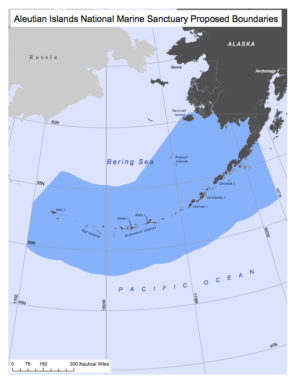
The proposed sanctuary would cover more than 730,000 square miles of federal waters. (Courtesy of Rick Steiner)

The federal government has turned down a request to create a vast marine reserve around the Aleutian Islands.

On Friday, the National Oceanic and Atmospheric Administration announced that the Aleutians won’t advance in the process to become a national marine sanctuary — mostly due to a lack of local support.

Adak, King Cove, Akutan, and the Aleutians East Borough all came out against the nomination. Environmentalists and research groups had been seeking permanent limits on oil and gas leasing and commercial fishing in federal waters around the Chain.

At more than 730,000 square miles, it would have been the largest marine sanctuary in the country.

In a letter, a NOAA representative suggested that a smaller swath of the Bering Sea could be eligible — areas that ”encompass the specific resources you believe to be of the highest value.” But the agency would still need to see proof that other interest groups are on board.

There are 13 national marine sanctuaries around the United States — each with its own local management panel. Those groups can advise NOAA on new regulations for commercial inside the reserve.

Site notifications
Update notification options
Subscribe to notifications