Archives for:

"WWAMI"

Alaska lawmakers weigh becoming only state to not fund medical education

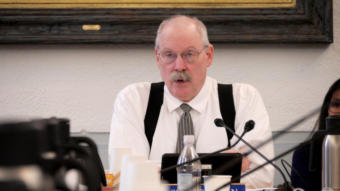
Sen. Bert Stedman, R-Sitka, co-chairs a Legislative Budget and Audit Committee meeting in Juneau on Jan 14, 2019.
Sen. Bert Stedman, R-Sitka, co-chairs a Legislative Budget and Audit Committee meeting in Juneau in January. On Monday, Stedman asked WWAMI medical school program administrator Dr. Suzanne Allen if the program has sought funding from private sources. (Photo by Skip Gray/360 North)

As part of Gov. Mike Dunleavy’s budget cuts, Alaska would be the only state that doesn’t fund medical education. On Monday, lawmakers weighing the proposal heard from an administrator for the program that’s now in place about the benefits and costs to the state.

WWAMI is the name for the University of Washington-operated medical school program that serves students from Alaska and four other states: Washington, Wyoming, Montana and Idaho. Alaska students spend their first three semesters at University of Alaska Anchorage. Then they get clinical training around the five states.

Dr. Suzanne Allen oversees the program. She said serving the needs of Alaska and the other states is a program goal.

“When we look at the needs across the state — primary care and in rural areas — WWAMI has created our curriculum to really address those specific issues, to try to train the workforce that is needed for the state,” she said.

Allen said the money the state spends for the program is well spent. She said the state spends slightly less than $40,000 per year for each of the 80 Alaskans who get their M.D.s through WWAMI. Another $10,000 or so for each comes from the University of Alaska.

“I believe the WWAMI program is a very cost-effective program to help provide physicians for the state of Alaska,” she said. “So, if you look at the cost per student, if you look at what the cost is per Alaskan, it’s significantly less than what it is for other states. And we have a higher return rate here in the state of Alaska than if you look at other public medical schools.”

But it’s that return rate that Dunleavy’s administration has cited as a problem. Sixty-one percent of Alaskans who go to WWAMI return to Alaska. This is higher than the national average of 39 percent of public medical students who stay in the state where they attend school. But it’s lower than what state leaders would like to see.

Sitka Republican Sen. Bert Stedman told Allen during the Senate Finance Committee meeting on Monday that changes to Alaska’s WWAMI funding are likely.

“We’re facing budgetary constraints,” Stedman said. “So has there been any discussion within the WWAMI group to try to come up with some other mechanism or help from another entity — if it’s hospitals or what have you, some other group — to help with some of these costs, so we can continue the WWAMI program amongst our other demands on our treasury?”

Allen replied: “We have not currently had any other conversations with other groups about potential funding opportunities.”

Hazel Brogdon, a recent WWAMI graduate from Chugiak, plans to practice as a psychiatrist in Alaska once she completes a residency in Washington. She said receiving part of her training inside Alaska will help her prepare to practice here.

“I am from Alaska, and I enjoyed being able to do most of my training at home, and learn from people that I’m ultimately going to work with in the future,” she said. “And it’s a small group, and there’s a lot of camaraderie between everyone who trained up there, so overall it was a really positive experience.”

She opposes eliminating WWAMI funding.

“I think that could be detrimental to the state as a whole,” Brogdon said. “I know there is already a shortage of providers, and just having this grassroots program being taken away could, you know, potentially limit the amount of folks planning on returning back to Alaska.”

The House Finance subcommittee on education and early development didn’t adopt Dunleavy’s proposal. It decided to continue with $3.1 million in state funding for WWAMI.

The full House Finance Committee begins considering the budget this week.


Watch the latest legislative coverage from Gavel Alaska:

‘Devastating’ and ‘significant’: Educators react to Dunleavy’s budget proposal

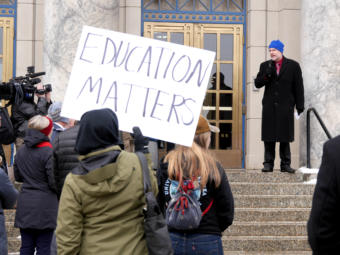
UAF neurobiology and anatomy.Professor Abel Bult-Ito speaks at a rally in front of the Capitol in Juneau on Feb. 13, 2019. About 80 people participated in the rally organized by the University of Alaska to advocate for support of state funding. It was held on the same day Gov. Michael Dunleavy released the latest version of his proposed state budget.
University of Alaska Fairbanks neurobiology and anatomy professor Abel Bult-Ito speaks at a rally in front of the Capitol in Juneau on Feb. 13, 2019. About 80 people participated in the rally organized by the University of Alaska to advocate for support of state funding. It was held on the same day Gov. Michael Dunleavy released the latest version of his proposed state budget. (Photo by Skip Gray/360 North)

One of the areas most affected by Gov. Michael Dunleavy’s budget proposal is education. About 23 percent of K-12 funding would be cut. The governor also proposed a 44-percent cut to the University of Alaska system.

During his unveiling of the budget proposal, Dunleavy said education is one of the largest cost-drivers in the state, and that efficiencies needed to be made.

“It’s going to compel school districts to evaluate how they spend their money,” Dunleavy said. “As you know, spending is a local control issue. It’s not controlled by the state. The funding is.”

In a press conference held shortly after the budget was released, University of Alaska President Jim Johnsen stated that in the past few years, the university has already made significant cuts to adjust to smaller budgets.

University of Alaska President Jim Johnsen delivers the State of the University Address at a Juneau Chamber of Commerce luncheon in Juneau on Feb. 16, 2017.
University of Alaska President Jim Johnsen delivers the State of the University address at a Greater Juneau Chamber of Commerce luncheon in Juneau on Feb. 16, 2017. (Photo by Skip Gray/360 North)

“We’ve laid off over 1,200 faculty and staff. We’ve cut over 50 academic and degree certificate programs. We have been forced to raise tuition, and we have watched our enrollment decline,” Johnsen said.

He called the cuts proposed by the governor “devastating.” He said the university has never had to deal with cuts of this magnitude. One of the programs that the budget proposal would cut is the WWAMI medical school program.

Johnsen said if the budget proposal goes through, he’s confident that other programs would also have to be cut and campuses would need to shut down.

“I respect the governor’s boldness and his vision for a sustainable and growing Alaska,” Johnsen said. “This budget, however, at least how it impacts Alaska’s university system, guts one of our state’s most powerful tools for realizing that vision.”

In Anchorage, University of Alaska Anchorage Chancellor Cathy Sandeen said in a tweet on Wednesday she would meet with students on Friday to discuss the cuts, and then she’s going to Fairbanks to meet with the other two chancellors in the UA system about how to move forward.

Public schools across the state would see a total loss of about $300 million under the governor’s proposed budget. Anchorage School District Superintendent Deena Bishop said that in the state’s largest school district, about one-in-six Anchorage residents will be affected by these cuts.

“Forty-eight thousand students, 6,000 employees, and that’s not even including parents that come in and out of our doors,” Bishop said. “So we’re a significant piece of what we know as our society here in Anchorage.”

Under the proposal, the district would see a decrease of about $110 million. Bishop said that would take the district back to budget levels from more than a decade ago.

That doesn’t include inflation and rising costs.

“Over 10 years, the increase in salaries went up about 30 percent, but the increase in health insurance went up 160 percent,” Bishop said.

Bishop said in that time period, the district also introduced more STEM programs as well as career technical classes. She said these classes, while beneficial to students going into Alaska’s workforce, are also more expensive, serve smaller class sizes and likely would be the first programs to be cut.

Bishop added that while the cuts would be felt hard in Anchorage, rural districts would have an even rougher time getting quality educators to teach there.

“Even with resources, it’s been hard to attract people to our entire state given the setup of different systems, whether it’s retirement, distance, things like that,” Bishop said. “It’s different in rural Alaska.”

During his campaign and as governor, Dunleavy prioritized public safety and job creation. Bishop argues having a strong education system is vital to those goals, and education cuts run opposite to the governor’s priorities.

Site notifications
Update notification options
Subscribe to notifications